


This time I'm going to write an article about a place that evokes, with the necessary differences, of course, the same feelings as Madonna's famous song, "La Isla Bonita." It is, in fact, precisely a small "beautiful island," located 93 km south of Sicily and about 290 km from the African coast.
I imagine the sea breeze, not tropical but Mediterranean, the sun high in the sky, the beautiful faces of the locals with eyes that are reminiscent of both the nearby Sahara Desert and the Nordic plains of Europe.
And I imagine that, at siesta time, life stops only to resurface in the lively festivities featuring folk songs in a language that mixes Italian and Arabic words and is, in fact, the only Semitic language written with Latin characters.
This "beautiful island" of reality is not called San Pedro, like the one in the song, but Malta, and it has more to do with Saint Paul than with Saint Peter.
Souvenirs of Tunisia
I've crossed the Mediterranean several times, but I've never been to Malta. And the only Maltese people I've met in person are some classmates who studied Arabic with me in [unclear - possibly "unclear" or "unclear"]. Tunisia . What struck me about those boys at the time was their perfect Italian, their fluent English, and their facility with Arabic; or, more specifically, with the Tunisian "dialect." They were ideal ambassadors for their country, which, in just over 316 km², spread across only three small islands—Malta, Gozo, and Comino—has accumulated an incredible wealth of history.
A nerve center in the heart of the Mediterranean
The archipelago's crucial location has made it a natural crossroads, both for exchanges and conflicts between Europe, Africa, and Asia. Indeed, Malta is European, Catholic, and similar to southern Italy in its traditions, cuisine, and the character of its inhabitants, but it has its own Semitic language (similar to Tunisian Arabic) and has been a British territory for over a century.
A story as old as time, also in language
The origins of Maltese history are shrouded in mystery. A people about whom little is known built megalithic temples there (most notably Ġgantija, Ħaġar Qim, Mnajdra, and Tarxien) between the 4th and 3rd millennia BC (before Stonehenge and the Egyptian pyramids). The ruins of these colossal structures have been declared a UNESCO World Heritage Site.
From 1000 BC onwards, Malta was a Phoenician colony. Its name, according to tradition, comes from the great Semitic navigators: “Malìt” or “Malat” (in Phoenician and in Hebrew or ancient: «safe haven»). The Greeks, for their part, called it “Melite” (from which the Latin “Melita” derives), due to its famous honey. After the Phoenicians, it was the turn of the Carthaginians, the Romans, the Byzantines, and Muslim rule. In 870 AD, the island became part of the Arab Emirate of Sicily, whose language (a variety of Maghrebi Arabic) also spread to Malta and, paradoxically, only survived there, giving rise to modern Maltese. The Norman Conquest (1090) and the expulsion of the Muslims in the 13th century led to the complete Latinization of Sicily, but in Malta the population, although it converted en masse to Christianity, preserved the ancient Semitic language, which over time, thanks to geographical isolation, acquired peculiar characteristics and was later enriched with Sicilian, Italian, and English vocabulary. The result is modern Maltese, a language with Semitic grammar and syntax, but with a decidedly European lexicon and which, uniquely for a Semitic language of Arabic origin, is written with Latin characters.
Bread, for example, is called ħobż, as in Arabic (khubz); the sun, xemx, as in shams; the book, “ktieb”, as in “kitab”. And, what is even more curious, God, for Maltese Catholics, is “Alla”.
For an Italian who has studied Arabic, Maltese has a very curious sound, half Arabic and half Sicilian, with loanwords from English. Today it is also the only official Semitic language of the European Union and, along with English, an official language of the State.
A piece of Italy or England?
Neither one nor the other. If anything, we could say that Malta has preserved and integrated into its identity fragments and legacies of the rulers that have succeeded one another over time, with the ability to create a unique identity.
In fact, for centuries Italian was the language of culture, law, and the Church on the island, and it remained an official language alongside English until 1934, when it was replaced by Maltese. The British, in fact, wanted to suppress any form of Italian irredentism by fostering among the islanders the awareness that they were different from their neighbors.
Many Maltese people still understand and speak Italian perfectly, often thanks to television programs and, of course, geographical and cultural proximity.
Malta became part of the British Empire in 1814 and separated from it with independence in 1964, becoming a republic in 1974: an island that is a small world where the spirit of southern Italy, especially Sicilian, blends with Maghrebi and British influences. Houses of yellowish stone, villages perched like those in southern Italy; sea, light, and an almost African landscape; driving on the left, English as the language, and red telephone boxes like in Great Britain.
The Catholic Christian faith: national identity
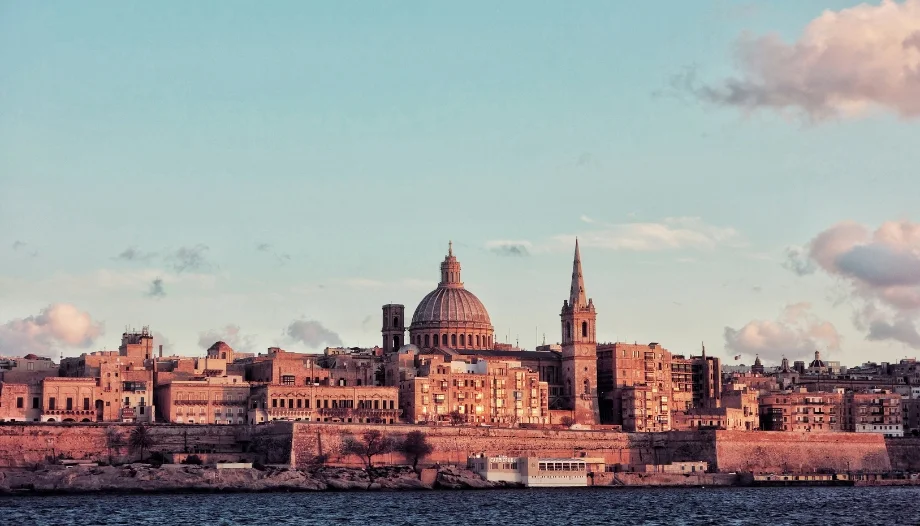
Malta is one of the most intensely Catholic countries in Europe. Churches, numerous and scattered throughout the archipelago, are a distinctive feature of its towns and cities; they are often so imposing, with their domes, bell towers, and Baroque facades, that they seem almost excessive for the relatively small settlements in which they are built.
Countless processions, brass bands, and patron saint festivals showcase a faith that forms a fundamental part of the national identity here, deeply rooted in the island's history, dating back to the most famous castaway to arrive in Malta: the Apostle Paul, around 60 AD (as we read in the Acts of the Apostles). Let us not forget, of course, the Knights of Malta (or Knights of St. John), who, in the 16th century, transformed this archipelago into a Christian stronghold, as well as one of the political, military, and hospital centers of the Mediterranean, particularly its capital, Valletta. This small city was built after the Great Siege of 1565, and the splendor of its walls, churches, palaces, and hospitals is already evident in photographs as almost disproportionate to its population (around 5,000), making it one of the smallest and least populated capital cities in Europe.
The main urban center of the Republic, for its part, is San Pawl il-Baħar (Saint Paul's Bay, the place where the apostle was shipwrecked), which has about 40,000 inhabitants.
A political life in turmoil
As in Great Britain, political life in Malta is also dominated by two major parties, Labour and the Nationalist Party, and by a very high voter turnout. Since 2004, the country has been a member of the European Union, and although it is not widely known internationally, it is characterized by a lively political debate that, in recent times, has become particularly intense given its location at the center of migration routes and flows.
In this context, on October 16, 2017, journalist Daphne Caruana Galizia, known for her investigations into corruption and offshore companies linked to those in power, was assassinated by a car bomb almost at her doorstep. This brutal murder shocked Europe: thousands of people took to the streets in protest, and Prime Minister Joseph Muscat resigned in January 2020. In fact, the investigations uncovered alleged links between businessman Yorgen Fenech (accused of being the mastermind behind the assassination) and key figures in Muscat's Labour government.
A public inquiry concluded in 2021 that the State should assume responsibility for the climate of impunity and five people were convicted as the perpetrators of the attack, but the alleged instigator, Fenech, was acquitted by a jury in September 2026, which triggered a new institutional crisis.
The current Labour Prime Minister, Robert Abela, is under intense political and popular pressure, while the young leader of the Maltese Nationalist Party, Alex Borg, has pointed the finger at the Government and the ruling party and called for the urgent passage of a package of anti-mafia laws.
To understand how such a small island got to where it is today, we must go back to two key events: the castaway named Paolo and the Knights of St. John. We will do so in the next article.






 Español
  English
  Italiano
  Français
  Deutsch
  Polski
  简体中文
简体中文