


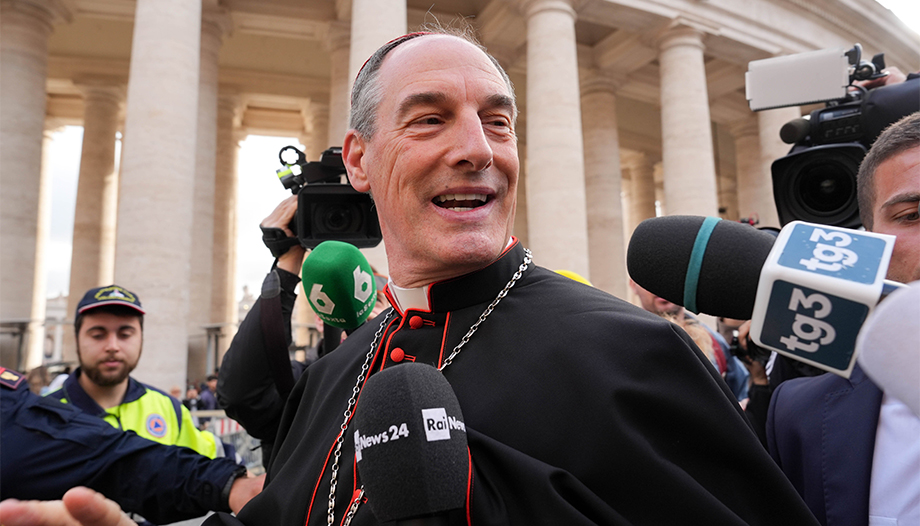
In this interview, Franciscan Cardinal François Bustillo, Bishop of Ajaccio (Corsica), analyzes how contemporary Western society is deeply fractured and proposes healing it through a profound relational project. To achieve this, the author advocates dismantling the “tribunal” of suspicion and mob justice on social media, countering this digital frenzy with the silence and reflective distance of the monastic tradition, which allows for calm and measured judgment.
Bustillo calls for a shift in perspective that replaces individualism with the common good —seeing others as allies rather than threats— and calls for the exercise of political and ecclesial authority grounded in humility and active listening, transforming differences into a collective asset that enables us to rebuild the damaged social fabric together.
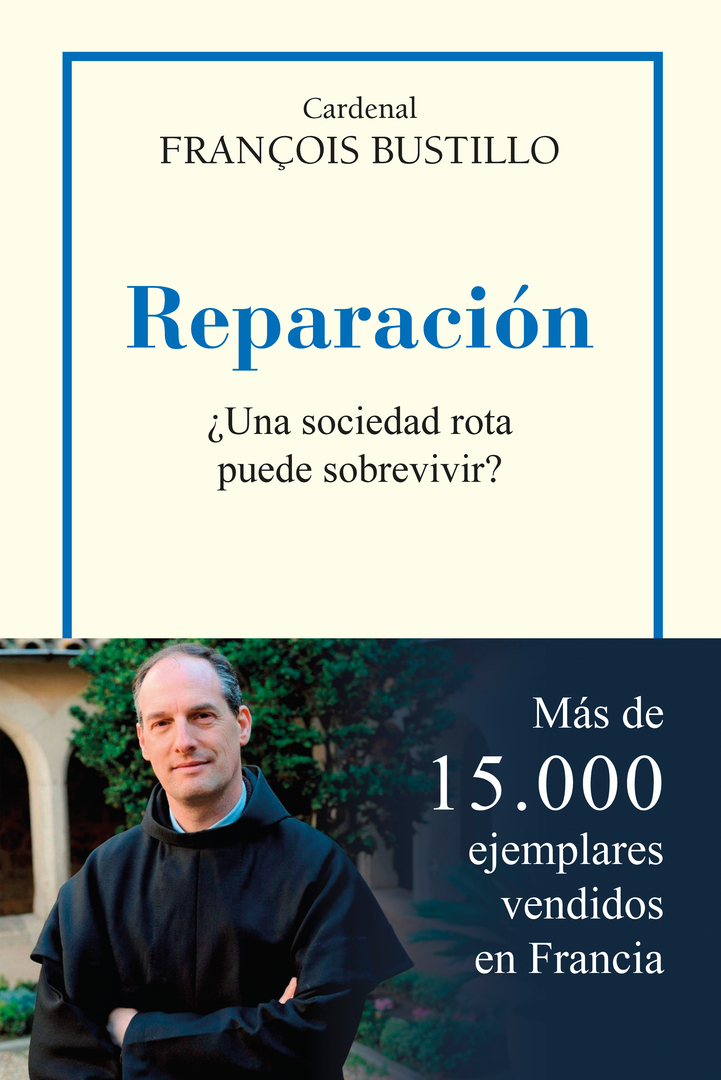
You just posted Healing. Can a Broken Society Survive?, on how to heal a fractured society. What is the book's main argument?
—Quite simply, I would say that I agree with what Max Weber said at the beginning of the 20th century: that we live in “a disenchanted world.” I cannot limit myself to noting that the world is in a bad way, that society is in a bad way, or to making a list of everything that isn’t working in society. My goal—because I am a believer and a child of the Resurrection—is to explain how our society can improve. And perhaps, in this regard, we need to acknowledge that, in our Western society, we have set aside the values and principles of the Gospel.
That is why, in the book, I propose—in a simple yet direct way—a return to principles that are no longer lived out today, but which give strength and stability to our society: love, forgiveness, not judging, not condemning, and giving. For me, these principles of the Gospel are not mere poetry; they are the foundation of a better society—a society that is evangelized and, because it is evangelized, civilized.
In the first part of the book, he points out that we are demonizing politicians and ordinary people on social media.
—We live in a society where, quite casually, through social media and the power of the media, we stir up controversy: “He said this, he didn’t say that, I agree, I disagree…” I believe that, at this point, our society deserves and needs some reflection.
The media system—and, above all, social media—conveys a very basic message rooted in very primitive principles. The mindset is more that of judges than of philosophers. People judge and condemn without having the facts or the arguments, instead of acting like philosophers who, when faced with issues, seek solutions through reflection rather than emotion.
It's true—we're human, not robots. I agree that there needs to be emotion, but there's a lack of reflection. We need to take the time to delve deeper into certain issues and not react impulsively—and, all too often, unfairly.
In this regard, which scenes from the Gospel should we keep most firmly in mind in order to understand the Christian perspective on these issues?
—If I quote certain passages from the Gospel, it is because, after all, Jesus told us two thousand years ago to be careful with our judgments. When we look, for example, at the woman caught in adultery, the scribes and Pharisees are already armed; they have already condemned her. Jesus disarms our ability to judge and condemn without knowing the whole story. He asks us, “Who among you is without sin?” It seems we live in a society where there are the pure and the perfect on one side, and everyone else on the other. That dualism is dangerous for our society, because not everything is black and white—neither in society nor in our own lives.
We also see other passages from the Gospel, such as the one about John the Baptist and Herodias’s daughter: “I want the head of John the Baptist on a platter.” Today, many call for the heads of others, and that, too, is dangerous. On the one hand, it’s all too easy to “call for someone’s head” simply because we don’t like them or because they disagree with us. On the other hand, while there may be no stoning with stones today, we stone people with books, with tweets, with words. Often, through our writing, we end up tarnishing people’s dignity. In a harsh and violent society, we must rediscover the values of the Gospel to restore a peaceful social life.
«We need to take some time to delve deeper into certain issues and not react impulsively—and, often, unfairly.»
Cardinal François-Xavier BustilloBishop of Ajaccio
To those who work professionally in the world of social media—the digital missionaries—what message would you give them?
—Social media, in and of itself, is wonderful. But we shouldn't idolize it, nor should we demonize it. It is a means to an end: to convey a message.
We can convey a positive or negative message. I've noticed that in France, there's a lot of evangelization through social media. Today, many of the young people in France who convert and begin to live out the Gospel do so through social media.
We need to take into account how easily younger generations use social media, so we have to spread the gospel there as well. There are some risks—it can be misused—but perhaps we need to change our mindset there too and use social media not only to speak words of condemnation—because we’re harsh—but also words of blessing.
At the end of Masses, at the end of celebrations, there is a blessing. And, etymologically speaking, to bless It means “speaking well.” I think this is an exceptional challenge for our society: to find words that aren’t naive, but that say good things about others. We’re very quick to say bad things, but when it comes to saying good things, we’re very shy and not very free.
Some people may consider certain messages from the Church regarding peace or immigration to be naive. What are your thoughts on this?
—I talked about this a while back in an interview in France, perhaps a little too strongly. We live in a society that promotes oversimplification through the system of likes on Facebook. We’re pitted against one another and we never stop labeling each other: I’m right-wing, left-wing, modern, old-fashioned, whatever… It’s always labels.
We run the risk of falling into a tribal system, in which we protect our own and attack those who are not like us. The Catholic Church has a universal message. That is what makes the Catholic Church unique and powerful.
We are not part of an elitist club of the pure and perfect, where we protect our own and criticize others. The universal aspect breaks down barriers. I believe that, in our Western society, we have forgotten a form of Catholicism.
Perhaps, on a more mundane and non-Catholic level, people judge and condemn one another, pitting themselves against each other. We Catholics must rise above that—not because we are better, but because we have a powerful ideal. If we do not follow that ideal, we very easily fall into ideology, because we all have ideas: we want what is good, a noble ideal, but we can fall into ideology. Ideology has no heart. That is where we must be careful. The Church has a unique message for moving beyond labels. Jesus speaks with an apostolic heart.
We Christians are not clones. Who could have brought together Matthew, a tax collector, and Simon the Zealot, a nationalist? No one—only Jesus. Jesus and the Church have a duty to bring together people who may not share the same ideas or the same vision. Just because we’re different doesn’t mean we’re enemies. Today, unfortunately and all too easily, what is simply a distinction or a difference can turn into division. We must be careful.
How can we avoid falling into this division when it comes to controversial issues or those that may have been misinterpreted—for example, some issues related to pastoral care for homosexual persons?
—There are issues that are sensitive and difficult because, on the one hand, the Church’s ideal is crystal clear: marriage is between a man and a woman. With regard to the doctrine on homosexuality, we have Amoris laetitia.
Now, we are facing a reality—for example, in France—with catechumens, especially young people who are coming to the Church; many arrive with an emotional history that has not been shaped or guided by the Church. I believe—without naivety or idealism—that we are going to experience a period—which seems normal to me—in which those who approach the Church do so with their own history; in many cases, they are the lost sheep. I see this in France: people in their 20s or 40s who come from a completely different world—who haven’t received a religious education, don’t know Jesus Christ, aren’t familiar with the Gospel, and have never been taught the catechism. Everything that used to be «normal» and natural for us—thanks to our upbringing and catechism instruction—they lack.
So, how can we welcome people without being puritanical, on the one hand, and without trivializing the ideal of the Gospel, on the other? How can we accompany these people? For example, in the case of divorced people or those who are unmarried but living together and suddenly ask to be baptized. What do we do? Do we check their “passport” to see if they’re pure and perfect, and turn everyone away? Do we say that everything’s fine, that it doesn’t matter? I believe that the Church’s wisdom lies in her pastoral approach as well. ad personam.
In other words, we must take into account what each person is going through and understand canon law and moral principles. We must then ask ourselves: What is canon law? What are moral principles? What is the right course of action for this person? And that is where we find ourselves in a delicate phase that requires careful adjustment. We are now laying a new foundation—one we don’t have in France—so that from childhood onward we receive an education and know what is right, what is wrong, the principles, and so on.
«We run the risk of falling into a tribal system, in which we protect our own and attack those who are not like us. The Catholic Church has a universal message.»
Cardinal François-Xavier BustilloBishop of Ajaccio
In his book, he discusses education. However, there are some Catholic schools where little attention is paid to doctrinal, moral, and sacramental formation, but rather to social formation.
—I think that’s part of what makes the Catholic Church great—that there are both progressive and conservative tendencies within it. That saves us from a form of sectarianism.
There will always be a segment of Catholic society that says, “We need to be more like this,” “We need to be clearer on doctrine and morality.” And others will say, “Well, we need to be more open.” What we must avoid is what we have painfully witnessed in France: a sector breaking away from the Church and ordaining four bishops without a papal mandate.
On May 8, 2025, when Leo XIV was elected and stepped out onto the balcony of St. Peter’s Basilica, he spoke of unity and peace. How do we work within the Church to promote unity and peace? How do we work to prevent any form of harshness from dividing us?
The fact that there are different trends within the Church is not a problem for me. What’s important is that it not be treated as dogma, as it was in France in the 1970s, 1980s, and 1990s, when some who called themselves modern and open-minded interpreted this to mean that everyone could do whatever they wanted—that a stole was all that was needed to celebrate Mass. Since 2010, we’ve seen another group swing to the opposite extreme.
How can we avoid these divisions? Sometimes, I tell those who are more rigid to be careful, lest in 40 years they end up having the opposite reaction, with priests celebrating Mass just as they did in the 1970s.
How, drawing on the intelligence, wisdom, and experience of history, do we avoid these extremes? How do we prevent a schism in the Church in France, as happened last July? I believe the Church in France today has struck a fairly healthy balance.
In his book, he talks a lot about the change that we—believers and non-believers alike—must make in order to adopt a more socially conscious perspective. Does this conversion take place in the confessional?
—Confession is all the rage in France right now. We have a coach for food, for sports, for public opinion… For everything. In France, people are rediscovering confession as that space of intimacy where you grow as a person.
When it comes to Confession, many have focused solely on the moral aspect and not on the spiritual one: on what your relationship with God is like, how you grow inwardly, how you become a better person… That is what seems most interesting about Confession. We need to discover this sacrament as a space where we grow spiritually and strive to behave in a way that is consistent with our faith.
Book






 Español
  English
  Italiano