



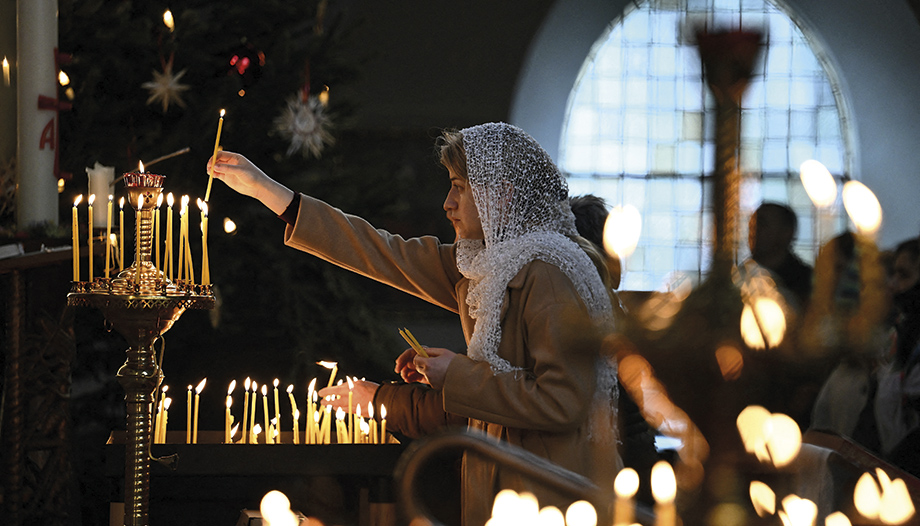
 Liturgical music in the Maronite Church"Let us pray for communion," Pope asks Eastern Churches
Within the Catholic Church, the rites transcend the mere execution of rubrics; they are understood as the delicate architecture of actions, prayers, gestures and disciplines that embody the faith and actualize the Sacramental Mystery. Under this meaning, tradition recognizes liturgical treasures such as the Ambrosian or Mozarabic Rite. However, in ecclesial terminology and its magisterial documents, the term «rite» often acquires a deeper juridical and anthropological dimension, referring to the Churches. sui iuris.
These communities, particularly those in the East, have their own liturgy, ecclesiastical discipline and spiritual patrimony that distinguish them from one another and from the Latin West. However, as the decree rightly emphasizes Orientalium Ecclesiarum, all «are entrusted equally to the pastoral government of the Roman Pontiff».». This diversity is not a fracture, but a richness: among these Churches and rites there reigns a communion which, far from wounding unity, manifests it in all its fullness. Unity in otherness is, in fact, the visible hallmark of catholicity.
From the Upper Room in Jerusalem to the Parousia, the Churches of God guard the apostolic faith by celebrating the same Paschal Mystery. As the Catechism of the Catholic Church well summarizes (n. 1203): «The Mystery is one, but the forms of its celebration are diverse.». This plurality is the fruit of the evangelizing mission itself; liturgical traditions germinated in specific geographical and cultural contexts, typifying the «deposit of faith» through symbolisms, community organizations and particular theological sensibilities.
Today, globalization and migratory flows have brought about a mutual rediscovery. The Catholic faithful of different traditions have begun to appreciate this spiritual map that has accompanied the journey of God's people since apostolic times. Recently, in the context of the Jubilee of Hope, Pope Leo XIV reminded the representatives of the Eastern Churches of its intrinsic value: «They are Churches to be loved: they are custodians of unique spiritual and sapiential traditions. They are priceless treasures that have much to tell us about synodality and Christian life.».
The origin of the various rites in the Catholic Church is the fruit of the crystallization of the preaching of the apostles in the great metropolises of the ancient world and the work of saints who, centuries later, codified these traditions.
The five sources of tradition
To understand the origin of the various rites of the Church, one must look to the original apostolic sees. Each developed its own way of celebrating the mysteries, adapted to the language and culture of its region.
First of all, the Alexandrian Rite was born in Egypt under the figure of St. Mark the Evangelist. From his preaching in Alexandria emanate the Coptic Church and the Churches of Ethiopia and Eritrea. This tradition reached the Horn of Africa through St. Frumentius († 383), the first bishop of Aksum, who structured the faith in the region under Alexandrian authority.
The Antiochene or Western Syriac Rite has its origin in Antioch, the see founded by St. Peter before his departure for Rome. From here drink the Syriac Church and the Maronite Church, which owes its spiritual identity to St. Maron († 410), a hermit monk whose charism shaped this community.
This is also the origin of the Syro-Malankar Church in India, which, although it uses the Rite of Antioch, was founded by St. Thomas the Apostle, and its present Catholic structure is due to the impulse of Mar Ivanios († 1953).
To the east, in Mesopotamia, the Chaldean or Eastern Syrian Rite was consolidated. Its roots are in the work of St. Thomas and his disciples St. Addai and St. Mari. It is the liturgy of the Christians who lived outside the Roman Empire, maintaining Aramaic as the sacred language.
The Constantinopolitan (Byzantine) Rite is the most widespread and has its origin in the preaching of St. Andrew. Its expansion throughout the Slavic world is due to Saints Cyril († 869) and Methodius († 885), who adapted this liturgy to the vernacular. In other contexts, such as Italo-Albanian, the figure of St. Nilus the Younger († 1004) stands out.
Finally, the Armenian Rite is attributed to the apostles St. Jude Thaddeus and St. Bartholomew, but it was St. Gregory the Illuminator († c. 331) who, in the fourth century, gave it its definitive form by making Armenia the first Christian nation in history.
Apostles who did not originate rites?
When reviewing this genealogy, a doubt arises: What happened to James, Matthew, Philip or Simon the Zealot? Did they not originate anything? The answer is that their work was the foundation of the aforementioned rites, but their names were not linked to a specific liturgical rite for historical and geographical reasons.
James the Greater is the clearest example. He evangelized Hispania, but his early martyrdom in Jerusalem (he was the first apostle to die, in 44 AD) prevented him from establishing a lasting administrative structure. His legacy merged into the Latin tradition of the West. St. Matthew, for his part, preached in Ethiopia, but that community ended up under the organizational influence of the See of Alexandria, adopting the rite of St. Mark.
In the ancient world, local churches in small towns tended to adopt the liturgy of the nearest large metropolis to ensure unity. Thus, the work of St. Philip in Turkey or that of St. Simon the Zealot in Persia was absorbed by the political importance of sees such as Constantinople or Antioch.
The success of these apostles was their historical humility: their missions were the invisible bricks that allowed the great liturgical families to become the beacons we know today. It is not that they did not found rites, it is that their rites became the basis of the unity of the Church.
The 23 Churches that “came back home”.”
The Catholic Church is a communion of 24 autonomous Churches (sui iuris): the Latin is the largest, but there are 23 other Eastern Churches. The history of the latter is a tale of painful separations and hopeful returns.
Although the popular imagination places the division of Christianity in the Great Schism of 1054, the fracture began much earlier. The robe of Christ began to tear in the 5th century, after the Councils of Ephesus (431) and Chalcedon (451), due to disagreements over the nature of Jesus. There, the Churches we know today as “Pre-Chalcedonian” (Copts, Armenians, Syriacs) split. Centuries later, political and cultural tensions between Rome and Constantinople culminated in the mutual excommunication of 1054.
Over time, groups within these separated communities felt the need to re-establish communion with the Bishop of Rome. They did so not to “become Latin” but to become “Catholic” while maintaining their own laws, liturgy and, in many cases, married clergy.
Over the centuries, various Christian communities in the East have re-established their communion with Rome, giving rise to the 23 Eastern Catholic Churches that exist today. This process was neither uniform nor simultaneous, but took place at different historical moments and in contexts marked by theological disputes, political tensions and searches for ecclesial identity.
Alexandrian and Armenian Rite
In the Alexandrian and Armenian traditions, often linked to a memory of resistance and martyrdom, some of the most significant returns occurred after long periods of separation. The Coptic Catholic Church, for example, formalized its union with Rome in 1741, after remaining separated since 451.
Similarly, the Ethiopian and Eritrean Churches - heirs of the ancient mission of St. Frumentius - were progressively structured in communion with the Holy See between the 19th and 21st centuries. For its part, the Armenian Church, also separated after the Chalcedonian controversies, saw its Catholic patriarchate recognized in 1742.
Antiochian and Chaldean Rite
The heart of Syria and Mesopotamia is another major focus of these encounters. The Maronite Church occupies a unique place here, since it never considered itself formally separated from Rome, although it explicitly reaffirmed its full communion in 1182, in the context of the Crusades.
The Chaldean Church, on the other hand, was born from the rapprochement of a large sector of the Church of the East, separated since 431, which in 1553 sought communion with the Pope and established its center in the region of Mesopotamia, in present-day Iraq. Further east, in India, the Syro-Malabar and Syro-Malankar Churches went through complex historical and identity processes before re-establishing their link with Rome in 1599 and 1930, respectively.
The heritage of Constantinople
Finally, the Byzantine sphere - heir to Constantinople - saw a considerable number of unions after the great schism of 1054. In many cases, these rapprochements were formalized through regional agreements. This was the case with the Ukrainian and Byelorussian Churches, whose union was sealed in 1595 with the agreement of Brest, and which today constitute the largest Eastern Catholic group.
The Ruthenian and Slovak Churches were also incorporated into Rome through the Union of Uzhhorod in 1646. In 1724, the Patriarchate of Antioch underwent a division from which the Melkite Church emerged, one of whose branches opted to resume communion with Rome. Something similar happened in the Romanian sphere, where the union was formalized in 1697 in Alba Iulia. In contrast to these processes, the Italo-Albanian Church represents a singular continuity, since its communities never separated from Rome after the schism of 1054.
The persecution of the 20th century
The Eastern Catholic Churches in the 20th century experienced one of the most dramatic periods of their history, marked by the systematic persecution by the communist regimes in Eastern Europe. These Churches, which maintained communion with Rome but preserved their own Eastern liturgical and disciplinary traditions, were seen as a political and cultural threat by the Soviet states and their satellites.
After World War II, the advance of communism in countries such as Ukraine, Romania and regions of the former Russian Empire unleashed a policy of religious repression that particularly affected the Eastern Catholic Churches. Unlike the Orthodox Churches, which in many cases were tolerated under strict state control, the Churches united to Rome were perceived as instruments of foreign influence. As a consequence, they were officially banned.
In Ukraine, the Ukrainian Greek Catholic Church was outlawed in 1946. Its structures were dissolved and its assets transferred to the Russian Orthodox Church. Similar situations occurred in Romania in 1948, where the Romanian Greek Catholic Church was suppressed and its faithful forced to join the state-controlled Romanian Orthodox Church.






 Español
  English
  Italiano
  Français
  Deutsch
  Polski