


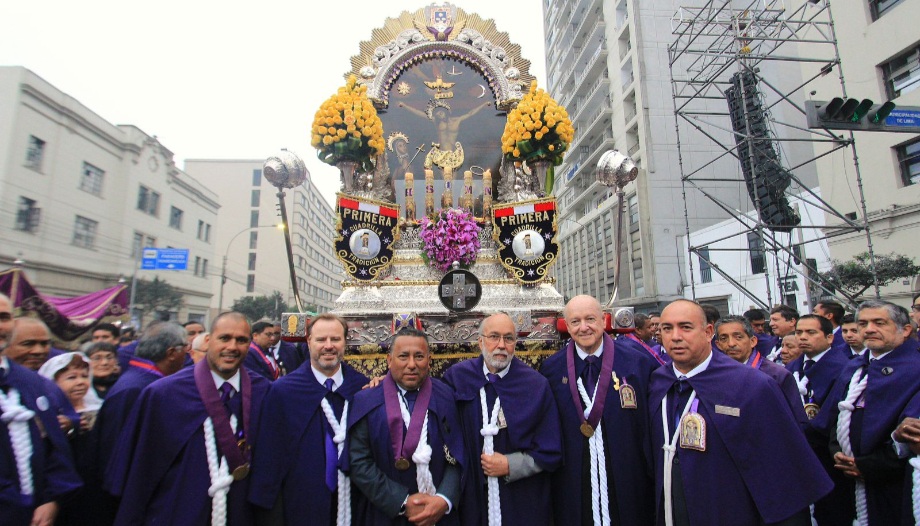
That childlike ability to shape and create with his hands was the first step on a path that led him to become an architect, but fate had a much more sacred structure in store for him. José Antonio Vallarino Vinatea is now the guardian of one of Peru’s most powerful traditions: the custodian of the sacred Andas of the Lord of Miracles.
We spoke with the man who, working closely with the Carmelite Sisters of the Nazarenes, takes on the monumental task each year of organizing the procession that brings the capital to a standstill.
How does an architect end up organizing Peru’s most important procession?
–My relationship with the Monastery of the Discalced Carmelite Nazarenes, guardians of the image and devotion to the Lord of Miracles, dates back to 1976, when the Mother Prioress at the time, Sister María Soledad of Our Lady of Guadalupe, contacted the construction company where I worked, requesting support to carry out a project at the convent on Tacna Avenue in Lima. Since her request did not include any plans, I was tasked with assisting her and seeing to the preparation of the necessary plans.
The project turned out to be much larger than it initially seemed, and the mothers entrusted me with both the project and, later, the construction work, which led me to develop a relationship that went beyond a purely professional one.
Years later, in 1990, after having carried out numerous projects at the Convent, the nuns asked me if I would accept the position of “Patrón de Andas”—the title given to the person responsible for maintaining and caring for the Andas that are carried in the October procession— as well as representing them on occasions when authorities or institutions pay tribute by presenting medals, insignia, or decorations to the Lord of Miracles. I have had the privilege of receiving these items to place on the Andas for the past 37 years.
Who are the people behind *The Lord of Miracles*?
–When the mothers entrusted me with the process of assembling and then storing the Andas, the system was somewhat disorganized and involved many people, each with a very specific task. Little by little, we changed the way we assembled the Andas (these are stored disassembled to facilitate cleaning and maintenance), improving the fastening methods for the parts and replacing those that were in poor condition. In addition, we have gradually reduced the team of assemblers, and today there are six of us: the head of Andas, two deputy heads, two assistants, and a former deputy head, all of whom help with cleaning and assembly, as well as accompanying the processions.
What is the process of assembling the Andas like?
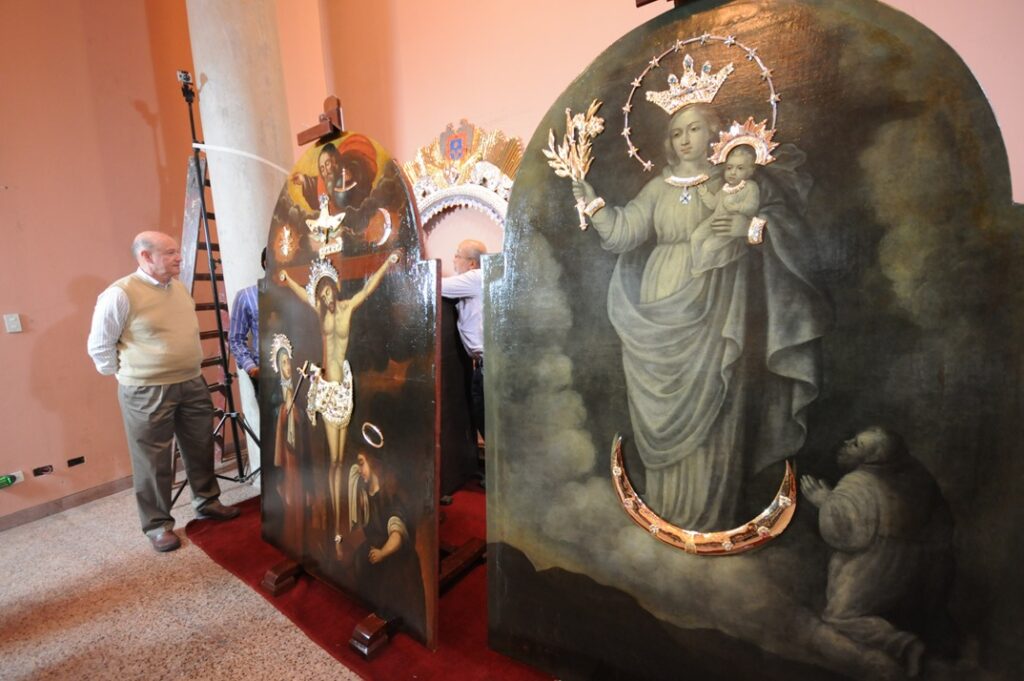
–The work of assembling the Andas begins three weeks before the first Saturday in October—the day of the Lord’s first procession—with the cleaning of the silver and gold-plated pieces, each of which has been stored in its own velvet case and properly wrapped for protection. The cleaning is done with non-abrasive products and takes us a full day. The next day, we proceed to place all the pieces that have been removed from the central table, following the sequence scrupulously—otherwise, the Andas cannot be assembled correctly—based on the numbering marked on each piece. The Friday before the Lord’s procession is the most important part of the assembly, because that is when the panels are placed in their frames and lifted into position. For this, the mothers have previously placed the jewels that adorn the Lord.
They're also setting up a stage…
–The altar for the outdoor Masses held on procession days at 6:30 a.m. is set up the night before with the help of the Knights of the Lord, a group of more than 70 people who support the Monastery in October by providing security, guidance, and selfless assistance with numerous tasks under the responsibility of the Patron of the Andas. The platform components, which can accommodate up to 80 people including celebrants, are stored by the mothers in a nearby warehouse. Given its versatility, it can be assembled in about an hour, which is essential since its placement partially blocks traffic on Tacna Avenue.
Have you loaded the Andas?
–Yes. During the Lord’s first procession from the Monastery’s Andas Hall, the first group of bearers consists of friends and supporters of the Monastery, assisted by the Knights of the Lord and some leaders of the Brotherhood. This is probably the most exciting moment: when the music plays, the devotees applaud, the choir sisters raise their voices, and the procession begins. I’ve had the opportunity to carry the statue several times as part of this group of bearers, though now I have the privilege of leading it.
What does it take to be a porter?
–The bearers belong to the Brotherhood of the Lord of Miracles of Nazarenes and are organized into 20 teams, each of which is divided into five groups of bearers based on their height. Each group typically has 34 bearers. To become a bearer, an applicant must be sponsored by a group and may join depending on the number of openings available each year. Of the approximately 4,000 bearers currently active, about 200 new members join each year. Before becoming full members of the Brotherhood, the brothers undergo a training process while they are candidates.
Which year's procession made the biggest impression on you?
–The ones I remember most are the ones we made to the districts far from the city center, on the so-called “mobile Nazarene,” in 1996, 1997, and 1998—a platform that was modified to transport the Andas. It was impressive when we set out on the first journey on the mobile platform to see that instead of bidding farewell to the Lord, people began to accompany him at the vehicle’s speed—that is, at a very brisk pace— and along the entire route to Villa el Salvador, there were always people lined up along the avenues, waiting for the Lord to pass by for hours on end, just to catch a glimpse of him for a few moments.
The visit to Las Palmas was also memorable, when Pope Francis came. It was also very special to see the faith of the people during the years when there was no procession due to COVID-19, and how they came to the Shrine to pray for the health of their loved ones.
How do you follow the procession?
–The Patron of the Andas, as the representative of the mothers during the processions, must be on the lookout for any unforeseen circumstances and must accompany them throughout the entire route. To do this, we take turns, since it is very difficult to be present for the entire route, which on the 18th and 19th lasts nearly 48 hours nonstop. We work 8-hour shifts with the assistant patrons, but we are all always present during the guard duty, which is when the Lord arrives at the Sanctuary, usually between 3 and 4 in the morning.
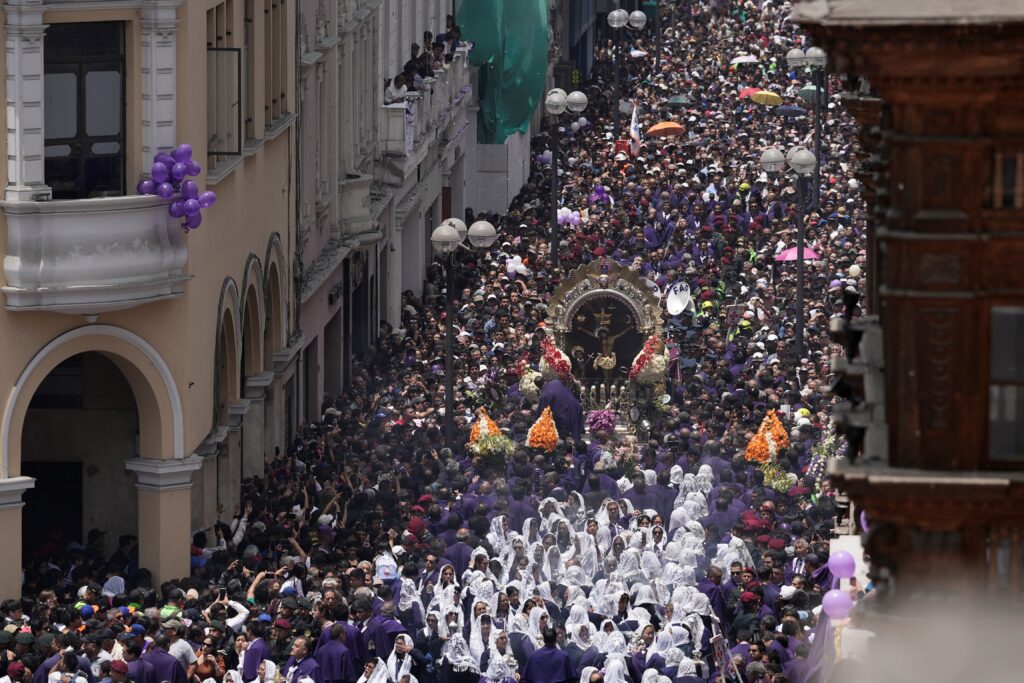
The procession is accompanied by thousands of faithful who want to get as close as possible, unlike what happens in other places where devotees simply watch the Andas or Pasos go by; and although there is a safety rope, there are moments when space is minimal, and it is a great satisfaction to be able to help ensure that everything goes smoothly. In all the years I have accompanied the Lord, I always feel the same emotion on the day of the procession and the moment it ends on November 1st.
What impresses you the most?
–Without a doubt, the piety and devotion of the faithful. Seeing their faces filled with emotion, their tears, and that search for a direct connection with Jesus Christ on the cross. For many devotees, the image of the Lord on his platform represents a sort of direct path, a door that allows you to be closer to Jesus, to talk with him, to ask him for things, and above all, to thank him.
Popular piety has this aspect that I find wonderful: it allows people to address Jesus as a friend, even using very familiar forms of address, as if he were part of their family. Undoubtedly, the Catholic formation of many leaves much to be desired, but this direct dialogue can only lead to good things, such as service to others, promises to be better, efforts to be faithful, and gratitude toward Our Lord.
Another very interesting aspect is the diverse social backgrounds of the Lord’s followers. While in its early days it was a faith practiced mainly by people of color and humble means, this has gradually changed over the years, drawing in more and more devotees from all backgrounds and social classes, as it is not uncommon to see people from higher economic levels alongside those who live hand-to-mouth. This is what is so wonderful about the Lord: that He calls us all
Do young people go to the procession?
–Yes, of course. Many young people are applying to join the Brotherhood, and while most of the faithful are older, they bring their children along, instilling in them a devotion to the Lord of Miracles. You see people of all ages, especially during the processions.
How do the Discalced Carmelites manage to support themselves?
–The nuns at the monastery used to receive income from a fee paid by the brothers for carrying the Andas. This was called the “carrying license.” Now this is income for the Brotherhood, so the nuns have gradually developed their own projects that allow them to cover not only their daily activities but also their share of the October activities, such as caring for the Andas, the security and maintenance of the Sanctuary, payment for services, etc., as well as all the staff working at the Shrine, which numbers more than 100 people in October.
The Sisters also run a free soup kitchen that serves lunch daily to 600 elderly people and children, as well as a medical clinic that provides daily consultations. Revenue comes from rent on commercial spaces, the sale of religious items in the sanctuary’s atrium, and the production of candles, communion wafers, and devotional images.
Do you know if they have any callings?
–I don’t know exactly how many nuns there are at the monastery today, but I know there are at least three novices. However, in these times, young women find it difficult to embrace the contemplative life, and vocations are certainly few and far between—even more so in a monastery that, although cloistered, bears the responsibility of Peru’s most important shrine and organizes one of the world’s largest processions, requiring very special vocations.
What happens when the Pope comes?
–During Pope Francis’s last visit, he gave a talk to women religious of the contemplative life at the Shrine. It was a very complex undertaking, because women religious came from all over Peru and from many different orders. The talk was for 500 nuns, whom we had to welcome at the Monastery, accommodate, ensure their safety, and then invite to lunch. The logistics were incredible, further complicated by the Pope’s security detail—which included the Swiss Guard, security provided by the Archdiocese, and state security.
We had to coordinate a lot of details, but in the end everything went very well, and when it was over, I was lucky enough to greet him as he passed by, when he approached the spot where we were standing—at Cardinal Cipriani’s suggestion—to greet Teófilo Cubillas, who was with us, taking advantage of the fact that he was a soccer fan. Then we took the Lord in a vehicle to Las Palmas for the general Mass, and even though we didn’t tell anyone, not even when we would be taking him—which was after midnight—there were many people waiting for the Lord to pass by, dressed in robes and pajamas. I could share many anecdotes from the Pope’s visit, but it would take too long to mention them all. Hopefully Pope Leo XIV will visit us soon, as he has promised.
Is the procession held in other parts of Peru and around the world as well?
–The Nazarenas brotherhood has ties to many brotherhoods around the world, but as far as I know, there is no organization that brings them all together. Recently, a group of people has called itself Hermandades del Mundo, but in general, each one has its own rules, although they are always asking for advice on organization and on the Andas. Most of them try to resemble the Nazarenas’ Andas, and it’s very interesting to see how, when we make a visible change, many brotherhoods adopt that change as well. Like when we changed the way we arrange the flower cones.
I don't think the exact number of brotherhoods is known, since wherever there is a group of Peruvians, a brotherhood dedicated to the Lord of Miracles immediately springs up. There are many in the United States, in various Latin American countries, in Europe, and even in Sweden and Japan, where Catholics are in the minority.
In Peru, there are dozens of brotherhoods scattered throughout the country, even in places where there is a local devotion to another Christ, such as in Ica, Tarma, or Cuzco.
Although the devotion to Our Lord of Miracles began in a neighborhood on the outskirts of Lima, today it is a Peruvian devotion with a global reach. There are processions of Our Lord of Miracles that reach St. Patrick’s Cathedral on Fifth Avenue in New York, Notre Dame de Paris, and even St. Peter’s Basilica in Rome.
The procession and the Andas
The procession of the Lord of Miracles The procession in Lima is one of the largest in the world. It winds through the streets of downtown Lima in October, which is known as “Purple Month” because of the purple robes worn by the devout faithful who participate in the procession and by the bearers of the Andas.
The Andas consist, first and foremost, of a sort of mahogany wooden platform reinforced with metal, upon which the statue stands; the platform is traversed lengthwise by four long crossbeams made of Oregon pine, which are used for transport. The crossbars, 3.46 m long, are covered on top with silver plates and on the bottom with a light padding of purple velvet, which is their characteristic color in processions. The ends of the legs are made of bronze.
On the table stands a small wooden pedestal covered with carved silver sheets, which serves as a base for the image. At each of the four corners of the platform, a solid silver angel, 1 meter tall and weighing 50 kilograms, with outstretched wings, holds in its hands a silver lily with steel prongs, where the cones of flowers are placed.
Both the front and back of the float feature silver flower boxes for the floral arrangements received along the route, as well as silver candelabra for the candles—five in front of each image—which remain lit throughout the procession. The canvas depicting the Lord of Miracles is positioned on the central axis of the platform.
The canvas, on the back of which is the painting of Our Lady of the Cloud, is framed by a double frame of Solomonic columns topped with capitals shaped like cherubs, supported by an arch decorated with scrollwork and angelic faces.
The arch’s base aligns with the arms of the cross. The columns, arch, and ornamentation are made of pure silver and are surrounded by silver-plated rays gold made of 21-karat gold and topped with 33 points. At the very top, above the rays, is the coat of arms of the City of Kings. The Andas of the Lord of Miracles measures a total of 4.40 meters in height and 1.64 meters on each side, and originally weighed about 1,700 kg, of which 450 kg was pure silver; with the accessories, it weighs about 1,950 kg.
Peruvian priest





 Español
  English
  Italiano