



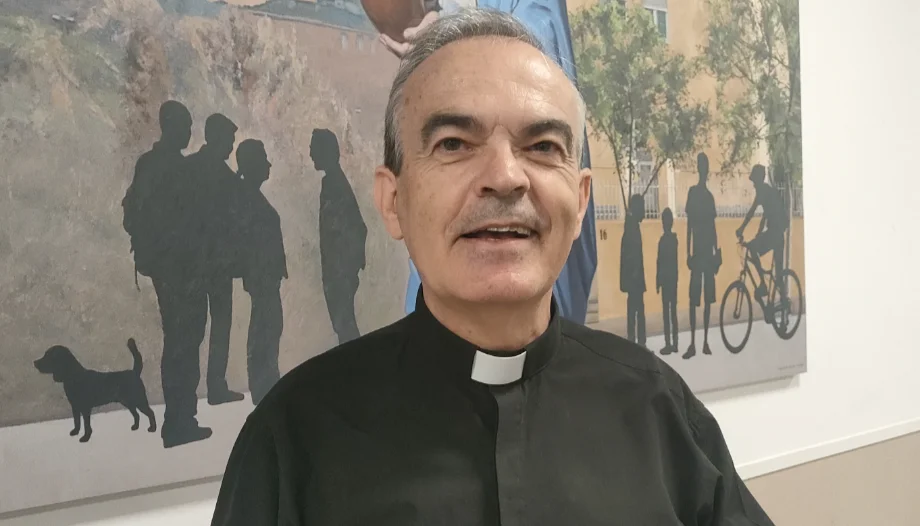
“I want people to discover that a Christian is not a ‘pringao’. It is to be happy. With this idea, Jaime Sanz (Palencia, 1962) has just published in Palabra ”No busques ser feliz, ¡consíguelo!“. Monsignor Jesús Sanz, in the prologue, assures that ”the secret of the happiest happiness is the one explained in that Sermon on the Mount“. The Beatitudes, as a way to be happy... also in the human aspect.
Jaime Sanz, with the same surname as his bishop, although not related, now works in the parish of the Sagrada Familia in Oviedo and as a hospital chaplain. A Doctor of Law, he has previously been a university chaplain at the University of Navarra in Madrid, at the Brafa Sports School and in educational centers. He has published more than half a dozen books on marriage, vocation and listening.
Now he is releasing “Don't look for happiness, get it! The title sounds a bit like a self-help book, a smoke peddler's book...
-Yes, it sounds, it sounds, but that's why it has a subtitle: “The Way of the Beatitudes”.
The idea is to explain to people that to be a Christian is to be happy, that is, it is not to stop being a Christian, but it is really to seek to be happy.
Because sometimes there is the idea that to be a Christian is to sign up just in case there is something, or to say “look, this is what there is, so resignation”. Well, no, to be a Christian is to be happy to the fullest and to enjoy happiness. This is the key. If one does not understand this, one does not understand the Christian message of the beatitudes.
What is heaven? Well, life on earth taken to its maximum expression. It does not mean that there is no cross and contradiction, which there will be, but it means that in the cross one meets the Lord and finds the reason for the pain. In the contradiction one often finds that one is like Our Lady at the foot of the cross, accompanying the Lord, with tremendous pain, but with a serenity that is not sad, but joy, as Our Lady would be.
But where is the saying of St. Teresa of Jesus that life is a bad night in a bad inn?
-She says it referring, precisely, to the earth. I mean, heaven is so much more. Not because this is a disaster. It's true that the world is very complicated, we're in a war, we're with very needy people, people are disoriented. It's a bad night in a bad inn, but it's still a marvel. So, if this is a bad night, what will heaven be? We live with our feet on the ground, but our head in the sky.
You have been with university students, now in a parish and in a hospital. Do you have direct experiences of people who experienced happiness precisely because of their faith?
-You have the experience of the saints, the experience of Jesus Christ. There is a chapter in the book that says that Jesus Christ was the happiest man in the world. Why? Because he fulfilled the mission that the Father had entrusted to him. That mission is to bring about the Redemption. And it was not easy. He dies on the cross, he is condemned with an unjust trial, and in addition, he is inflicted a penalty, such as scourging, which is death. A bestial injustice. For the Lord dies absolutely happy.
Everything has been fulfilled, he says at the end. I think it is very important that we understand this, because if we do not, we do not understand the Christian life. In other words, the Christian life is happiness.
Some non-believers accuse Catholics of being bitter because they are always thinking about the cross. And it seems to them that the message of Jesus and his life are centuries-old history. What to say to young people who think that?
-That is the idea of the book. To make people see, first, that happiness is not in having everything, or in giving oneself all kinds of pleasures, or in the selfishness of getting everything and living happily for oneself and for others, but that one has the experience that when one has been happiest, it is when one has surrendered oneself. Happiness is in surrender.
Happiness cannot be accumulated. Here, above the parish [San Manuel González, in Madrid, where the interview takes place.We have solar panels, which are used for self-consumption. When there is electricity left over from the sun that has been generated, it is sent to the grid. It cannot be accumulated. Well, this is the same thing. You cannot accumulate happiness and keep it for yourself. You have to give it away. To the extent that you give more, to that extent you make others happy and there is more happiness around you.
The beatitudes are a kind of guide to happiness.
Even at the human level?
-Yes, they touch on almost every subject. They touch on poverty, hunger and thirst for justice, mercy, persecution, cleanness of heart, pain... All the tremendous situations that man goes through are included in the beatitudes. But they are oxymorons, because they are a contradiction.
Because they say things like “blessed are the poor...” and this is not understood. The beatitudes are not a theoretical discourse, but a discourse of what the Lord has lived and what we learn from Him. Jesus Christ does not preach a theoretical gospel, but preaches the gospel that He has lived and that those who have been with Him have shared. The beatitudes are, in a certain way, the outline of the Lord's life.
If you follow them, that's when you're really happy.
Of all the beatitudes, which is the most difficult to live?
-Perhaps that of meekness, of the meek of heart. Because it depends a lot on character. And meekness is acquired with time and experience.
It is difficult to be meek when one is stepped on. Meekness is in accepting others as they are, in loving people, in knowing how to understand others. I think it is one of the most difficult virtues, which requires more time.
In general, older people tend to be more meek. I had a case in the hospital of a doctor, who was a well-known cardiologist. He had a broken heart and was in very bad shape. He spent months in the hospital. When you went to see him, he would tell you about all the Santiago Posteguillo novels he had read, he made you spend a nice time with him. Impressive. Why? Because he was devoted even in such a difficult situation. For example, he asked not to be given painkillers and not to be given morphine at the end, because he wanted to offer the pain to the Lord.
He was an example in the hospital. All the nurses, the doctors on the floor, the priests who went to see him, we were really excited.
Aren't we in danger of making these beatitudes seem a bit utopian? That is to say, an ideal, but unattainable.
-You run that danger if you don't live them.
If you truly strive to be poor, to be poor in spirit, to detach yourself from things, to embrace the values that are really worthwhile. Or if you try to be merciful, always knowing how to forgive and forget, and forgive immediately, well, then it is nothing theoretical, it is a practical reality.
Jesús Sanz, my bishop of Oviedo, in the prologue, says that the beatitudes are like a balcony to which we look out to see what we have to live of the life of Christ, and then apply it to ourselves. In other words, it is to contrast the life of Christ with our life, as the Catechism says.
In the book you talk a lot about happiness. What is the greatest enemy of happiness?
-Selfishness, no doubt.
What does this book contribute? Because there are a million books on the beatitudes.
What it provides is, first of all, a modern, up-to-date vision of the beatitudes in informative language.
I try to spread the highest things in a simple way to the people of today. I am in contact with many people, I am in the spotlight, because I am with university students, in the hospital with those who suffer, in a parish poorer than Vallecas, in Oviedo, in the neighborhood of Ventanilles, which is the poorest of the poor.
On my way here, a lady called me. She said she wants to talk to me because she has three children, she has been kicked out of her apartment, she has no housing, she has nowhere to sleep, she doesn't know what to do. I have given her some provisional solutions, and we will talk next week. That is the real beatitude, that is what one has to learn to live.
It is to realize that it is possible to live this way, that it is possible to lead a Christian life today, as things are, and in the environment in which one moves. It is not necessary to go to South Sudan, but in your environment you can live the beatitudes to the full. But without being half-hearted. To remain half-hearted is a bet for unhappiness. It is a want and I can't. It is like saying that you could have bought the lottery ticket that won the jackpot, but you didn't buy it because you were a rat.



 Español
  English
  Italiano