


Worship music has spread through Catholic circles over the past few decades, helped along by the charismatic renewal movement. However, in smaller countries, worship bands are rare, rarer are worship bands that are active for a long time.
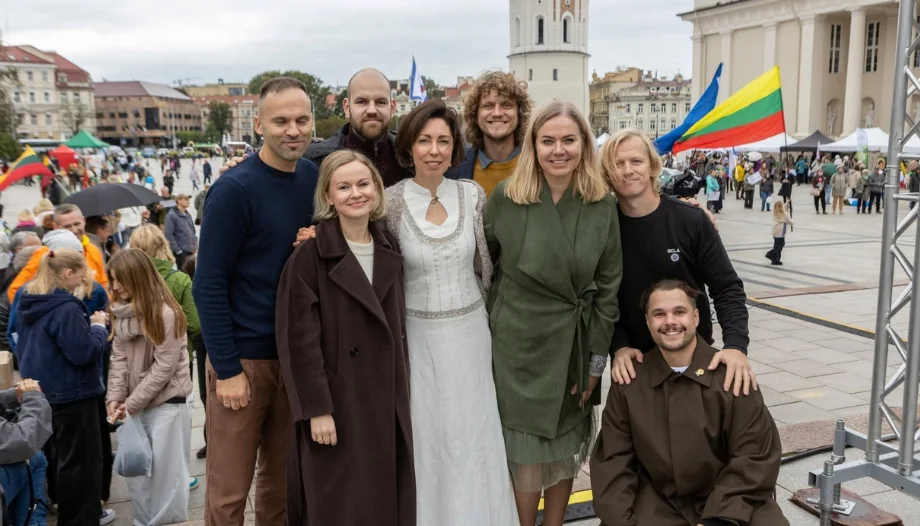
For Lithuanian Catholics, ICHTHUS remains a good example of that. Formed in 2007, the band has released three albums and earned a place in the country’s Catholic life, most recently performing at the Vilnius March for Life.
In a largely Catholic nation of fewer than three million people, where Christian music has little room on the mainstream stage, that longevity is remarkable. The group’s name comes from the Greek word for fish, an early Christian acronym for “Jesus Christ, Son of God, Savior.”
Omnes spoke with its members about what has kept them together, and what it takes to worship music in a place where it is the exception.
A Small Miracle
Electric guitarist Romanas Sabakonis calls ICHTHUS “a small miracle.” As the band approaches its 20th anniversary, few members have changed, but the group is still together. “It’s quite awesome to be here still together,” he notes. “Our kids have also grown up, and we have a bit even more time now, so hopefully we do something meaningful soon as well.”
Asked what makes a worship performance meaningful, he says it has less to do with applause than with faith. “At first it’s our relationship with God,” he notes. “If our music touches at least one person during a concert, that’s already an achievement for us.”
ICHTHUS began when its members were “very young and passionate about church and music.” The group met in Vilnius, in Bernardine Church which is run by the Franciscans. The friars had encouraged them to start a worship band. The group has since released three albums, all of them consist of contemporary praise and worship music.
Most members of ICHTHUS are not professional musicians, Sabakonis says, though the lineup now includes some skilled professionals. For Christian musicians with full-time secular jobs, the hardest task is often mental. “I would like to play like a professional, to concentrate more on my music and focus on God,” he says.
The band’s longevity is also a family story. His children watched him perform from the start of the band, so it never seemed strange to them. His oldest, now 18, has begun singing for God herself, and this summer the two shared the stage for the first time, she on bass and he on electric guitar. “I was proud of her,” Sabakonis says.
He speaks of the band’s endurance with gratitude. “There’s a lot of good that we can still do,” he says. “I think it’s a blessing to be able to do it.”
Raising the Standard
Paulius Minkevičius, a vocalist and guitarist for ICHTHUS, told Omnes that for a long time, the group waited for invitations to perform. The band served local churches and released worship songs on CD and YouTube. Only two years ago did the group move its catalog to streaming platforms, a first move toward getting its music out proactively.
The 2026 World Apostolic Congress in Vilnius sharpened that shift. Inspired by the event, the band began offering to play for more parishes and cultural centers and started organizing ticketed concerts. The challenge was presenting ICHTHUS to secular audiences with little familiarity with worship music. Minkevičius said the aim was to raise the standard of presentation, not to soften the message. “We are a worship band, and we present ourselves as such.”
For Minkevičius, professional production and religious authenticity do not compete. Sound, lighting, LED screens, visual direction and styling make the experience welcoming newcomers. “By looking good and making a professional event we strengthen the message of Salvation through our Lord, not weakening it. Good things should be presented in quality.”
Audiences have changed too. Christian youth festivals once gathered believers almost automatically, he says, but younger people now need more deliberate engagement. “I think management and marketing are key together with good content in order to make successful Christian events nowadays,” he says.
His advice to aspiring worship musicians is practical. A band needs shared conviction, musical competence, rehearsal space, funding to make records and lasting organization. He also expresses gratitude to the Franciscans, who helped ICHTHUS in its early days by providing a room equipped for music production.
He is equally clear about economics. “In our band everyone has a regular job,” he says. Performing worship music remains an addition to one’s life, not a full-time livelihood. “There is a long way to go until you can provide for your family only from worshiping.”
Rooted in Faith
Milda Žukienė has spent two decades as the vocalist of ICHTHUS, and she is clear about what has kept her going. Faith, for her, is not something she puts on for the stage. “I’ve been a believer since childhood; my faith runs very deep within me, like roots,” she says. When life becomes difficult or painful, she goes back to them. “Both my mind and my heart know and feel that there is no other foundation, only the truth revealed by God.”
Prayer and song keep her connected to that foundation. They are daily practices before they are public ones, which is why music has never become a routine gig for her. People often thank her after performances, but she extends the gratitude back to them. “Worship helps and is necessary first and foremost for me personally,” she says. Through it, she explains, faith and hope are reborn, and she finds great joy in playing with fellow musicians.
Her earlier rock band, GYVAI, lasted eleven years, “and that was already a long time.” Žukienė recalls that it was turned away from mainstream stages not for weak musicianship but “solely because of Christian lyrics.”
As an explicitly Christian band, ICHTHUS is, she accepts, not a proper fit for purely entertainment or popular music events. Worldwide, she observes, contemporary pop and worship do not “mix.” Worship songs live in particular places and settings and on Christian radio.
Rather than resent that divide, Zukiene sees a mission in it. “We, as people of faith, must create our own high-quality music,” she says, and offer an alternative “to pop music, the cult of the body, and the culture of death.”





 Español
 English
 Italiano
 Français
 Deutsch
 Polski