


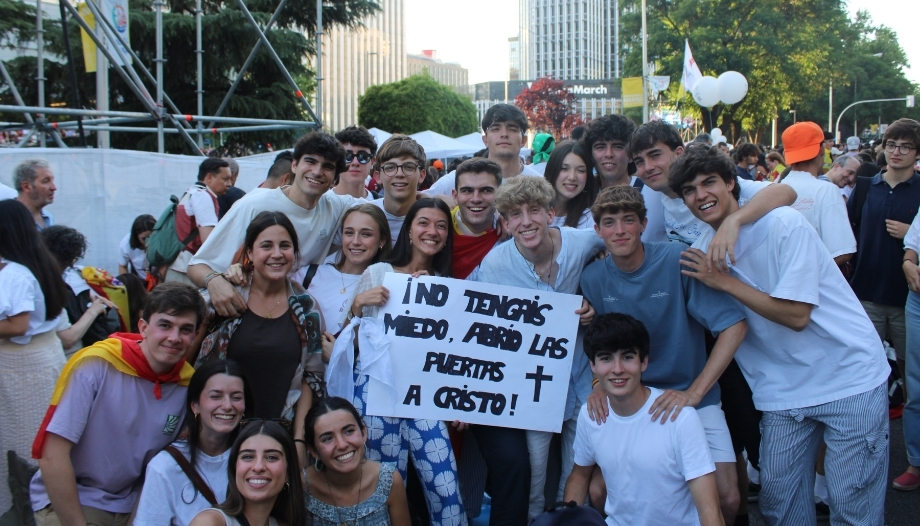
“Today there are many young people who are searching for God, others who would like to believe, and still others who don’t want to talk about God, but often we don’t know how to help them. How can we—who are also searching—accompany them as they discover the beauty of faith?” This was the question posed to the Pope by Manu, a 25-year-old man, at the youth vigil on June 6.
The Pope replied loud and clear: “¡We are not alone!”. That night, León XIV reminded Manu and all the young people that we have God and a wonderful community by our side. He also pointed out that it is through our experience and testimony that we must teach the beauty of faith to those who do not know the Lord.
Setting aside theories and moralizing, the Pope emphasized to young people the power of witness. Manu was deeply moved by his words, and in an interview with Omnes, he shares his experience with us.
Restless Youth
Manu was able to see with his own eyes and attest to the Pope’s statement that “we are not alone.” He says that, like many others, he was struck by the 600,000 people who knelt and observed a moment of silence during the vigil before the “one and only king.”.
The vigil made it clear that young people are taking action in search of answers: «I see a great deal of unease, both among young Catholics and among those who don’t believe. We’re all wondering about our future, our calling, and the meaning of life. And that’s precisely why so many people end up turning to the Church.»
For him, Christianity offers a different answer to the prevailing logic: «We live in a society where it seems that everything revolves around work or success. The Church reminds you that your vocation is much deeper. In my case, for example, my vocation is not my profession, but raising a family. Work is a means, not an end.»
How can we explain the «renunciations» involved in being a Christian?
During the conversation, a common question arises: how to explain concepts such as chastity or the demands of the Gospel to those who are distant from the faith.
His answer is surprisingly simple. «We often try to persuade people through reason. We explain why we make certain sacrifices, and people even understand our logic, but they don’t buy it.».
But for Manu, it must be the other way around: «First you have to experience God’s love. Only then does everything else make sense. If you start with the rules, it seems as though Christianity is nothing but prohibitions. But when you discover God’s love, those same things cease to feel like sacrifices and become a natural consequence.».
To be able to ask the Pope a question
Manu explains how the experience of standing before the Pope was a clear sign of God’s love for him: «When they told me I was going to ask the question, I was going through a pretty rough time. My self-esteem was very low, and I thought I didn’t deserve to be there.».
«For me, it was a reminder that, even though I might beat myself up because I’m a sinner and feel like I do things very badly, the Lord shows me how much He loves me. Even when I think I’m at my lowest point, He always lifts me up to the highest step because that’s how He sees me.”.
»That's what I'll take away from this: to try to see myself through God's eyes and to look at others that way as well—both our friends and those we find hard to love—because if He always lifts us up, even in our worst moments, we, too, should try to lift others up in the same way.".
A simple conversion
Although he has always been Catholic, Manu admits that for many years his faith was simply something he had inherited: «I always went to Mass because my parents raised me that way, but I didn’t really know God personally.».
The way he lived his faith changed when he became involved in his parish (Our Lady of Good Success) in 2022: «It wasn’t a dramatic conversion, but it was a very profound maturation. I stopped living my faith out of habit and discovered that God wanted to be a part of my life.».
Since then, he has been coordinating youth groups, participating in diocesan training, and next year he will also begin teaching catechism.
The momentum of the vigil continues
Weeks after the papal visit, he acknowledges that the initial enthusiasm has not faded: «It’s a moment I keep coming back to. When I feel like I’m about to break down, I remember the vigil, I remember everything I experienced, and I regain my strength.».
He also hopes that it has sparked questions in those who watched from afar as crowds of young people gathered around the Pope: «I think many people will wonder what motivates so many young people. What makes hundreds of thousands of people want to be there, experiencing it all with such joy, such silence, and such peace. I hope that question will be a starting point.».
Because, as he learned during those days, evangelization does not begin with grand speeches, but with the witness of a life transformed by God’s love.





 Español
  English
  Italiano