



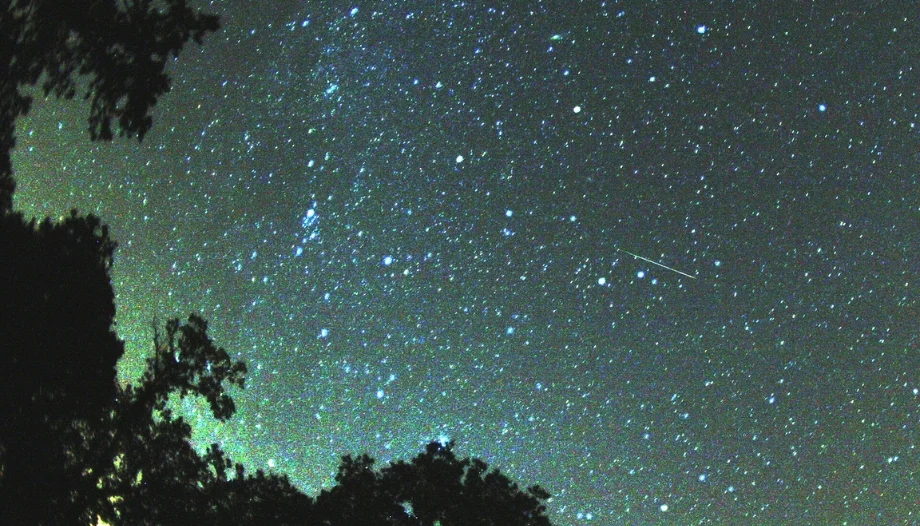
Every August, one of the year’s most famous astronomical spectacles takes place. It is the Perseids, a meteor shower that peaks around August 10–13 and which, in Spain and other countries with a Christian tradition, is known as «the tears of Saint Lawrence.» The coincidence with the saint’s feast day, which the Church celebrates on August 10, gave rise to a tradition that for centuries has linked the memory of a martyr with the stars that seem to fall from the sky.
The Perseids are dust particles and other debris left behind by Comet Swift-Tuttle that the Earth passes through each year as it orbits the sun. When these particles enter the atmosphere at high speed, they heat up, burn up, and produce the flashes of light that we see from Earth as shooting stars. Their radiant—that is, the point in the sky from which they appear to originate—is located in the constellation Perseus. This is the source of their astronomical name: the Perseids.
But science does not explain the popular name «Tears of Saint Lawrence.» To understand it, we must look back at the story of a young deacon of the Church of Rome, whose memory became associated with that August night.
A Deacon in the Service of the Poor
Saint Lawrence was a deacon in Rome and one of the men closest to Pope Sixtus II. As archdeacon, his responsibilities included administering the Church’s assets and caring for those most in need. He devoted himself to caring for the sick and to looking after orphans, widows, and marginalized people. Lawrence became a much-loved figure in Rome, and even after his death, he was immediately the object of popular veneration.
According to tradition, during the persecution under Emperor Valerian in the year 258, Pope Sixtus II was arrested and executed along with several of his deacons. Lawrence was arrested shortly thereafter. The prefect of Rome then demanded that he hand over the Church’s property.
The deacon asked for a few days to gather them. But, according to tradition, he used that time to distribute among the poor the goods entrusted to his care. When he returned before the authorities, he did not bring with him riches or material treasures. He was accompanied by a crowd of needy people whom the Church was helping. Pointing to them, Lawrence is said to have uttered one of the most famous phrases associated with him: «These are the treasures of the Church.».
Lorenzo was sentenced to be burned to death on an iron grate, suffering a slow and agonizing death. It is said that in the midst of his martyrdom he exclaimed, «Turn me over—I’m already done on this side.» According to legend, his tears are the «stars» that will fall from the sky in the coming nights.
Why «Tears of Saint Lawrence»?
According to an ancient Christian tradition, the shooting stars that appear in the sky around the feast of Saint Lawrence are said to be his tears, shed from the heavens in remembrance of his martyrdom. Another tradition speaks of small particles, or «lapillis,» coming from the flames of the gridiron on which he was burned.
Thus, the image of a saint’s tears appearing to fall upon the earth transformed a celestial phenomenon into an expression of the Christian memory of Lawrence.
Saint Lawrence is also one of the best-known martyrs of the Church of Rome. His veneration has been documented since the 4th century, and his name has become closely associated with the city of Rome and Christian tradition.
What Really Falls from the Sky
The Perseids, then, are neither falling stars nor tears turned into light. They are meteors produced by particles entering Earth's atmosphere at very high speeds.
Every year, around August 12, Earth passes through the region of space containing the debris left behind by the aforementioned comet Swift-Tuttle. This comet, composed of dust and ice, follows an orbit around the Sun that takes about 133 years to complete. Its last close approach to the Sun occurred in 1992, and the next one is expected in 2126.
When the tiny particles in that swarm enter the atmosphere, friction with atmospheric gases causes them to heat up and burn up. The flash we see from Earth’s surface is what we call a meteor. So, even though we commonly refer to them as «shooting stars,» we aren’t actually seeing stars—we’re observing the luminous trail produced by tiny fragments of cometary material.







 Español
  English
  Italiano