


In Peru, popular piety is widespread throughout the country. There are hundreds of devotions, each with its own festivals and processions. One could say that every town has its own patron saint, and the feast day is celebrated in grand style. When we look at the Church in Peru today, we see numerous dioceses, prelatures, and apostolic vicariates spread throughout the country. In every place, popular piety is quite strong. Pope Francis once said that Peru was a “land of saints.” In every city and every town, there is some form of devotion, and the feast day is celebrated in grand style.
In Lima, the procession of the Señor de los Milagros draws millions of people in October; in Puno, the festival of the Virgin of Candelaria; in Cuzco, the Corpus Christi procession; in Arequipa, the Virgin of Chapi; in Ayacucho, Holy Week; in Piura, the Lord of the Captive; in Chiclayo, the Divino Niño de Eten; in Ica, the Señor de Luren; and so on—in many other provinces throughout the country, there is a patron saint or a deeply rooted devotion.
In addition, in the various ecclesiastical districts, catechism is taught, the faithful are prepared to receive the sacraments, and they are helped to become good Christians.
Separation of Church and State and Mutual Cooperation
In contrast, state authorities seek to emphasize the secular nature of their institutions, which, logically, do not correspond to a theocratic government. They have not gone so far as to ban crucifixes or remove any Christian symbols from state agencies. In these institutions, we can find images or paintings of the Virgin Mary or a Peruvian saint. Now, photographs of Pope Leo XIV have also become more common, simply because he is Peruvian.
Legally speaking, there is a clear and healthy separation between the Church and the State, but there is also an agreement under which the Peruvian State recognizes and values the Catholic Church. Article 1 of the agreement reads as follows: “The Catholic Church in Peru enjoys full independence and autonomy. Furthermore, in recognition of the important role it has played in the historical, cultural, and moral development of the country, the Church receives from the State the necessary support to better carry out its service to the national community.”.
Relations with all branches of government have always been very good and cordial. Whenever there is an important celebration, the authorities never fail to offer their support. Everything is very well organized; celebrations and processions can take place, along with the corresponding Masses, which are included in the calendars. Religious life is evident throughout the country.
A concern and ecclesiastical permission
Father Ángel Ortega, now in his later years and with a wealth of experience, was part of the first class of priests ordained in Yauyos and moved to the Diocese of Lima a few years ago.
In his new assignment, he noticed that government agencies did not have a chaplain. Concerned about this, he approached the bishop of Lima to ask for permission to minister to the judges of the judiciary—which was, at that time, the group he had the closest access to. The bishop granted him permission, and when he arrived at the Palace of Justice, the judges were delighted and told him that for years they had hoped to have a chapel, because many people who were suffering from serious problems— due to the cases being heard in court, and a chapel could help them receive the comfort from God or the Virgin Mary that they urgently needed.
The Origins of the Judicial Chapel
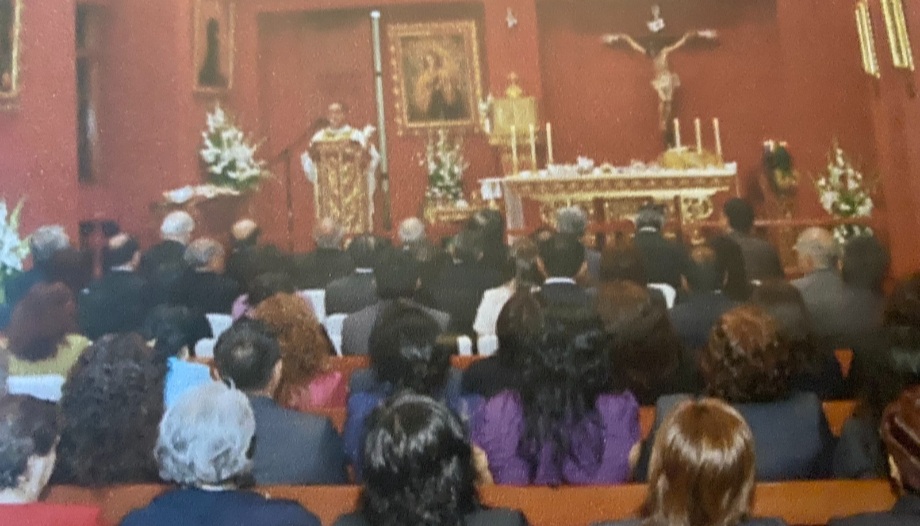
Father Ángel began taking steps to set up the chapel. First, he found the ideal location, next to the entrance hallway where many people passed by and could see that there was a chapel where they could go in and pray. He immediately asked a priest who was also an architect for help; the priest designed the altarpiece and helped him find everything needed to create a dignified and elegant space, complete with a tabernacle, so that the Lord would always be present. Officials from that branch of government collaborated on the project. Finally, the chapel was installed, to everyone’s delight.
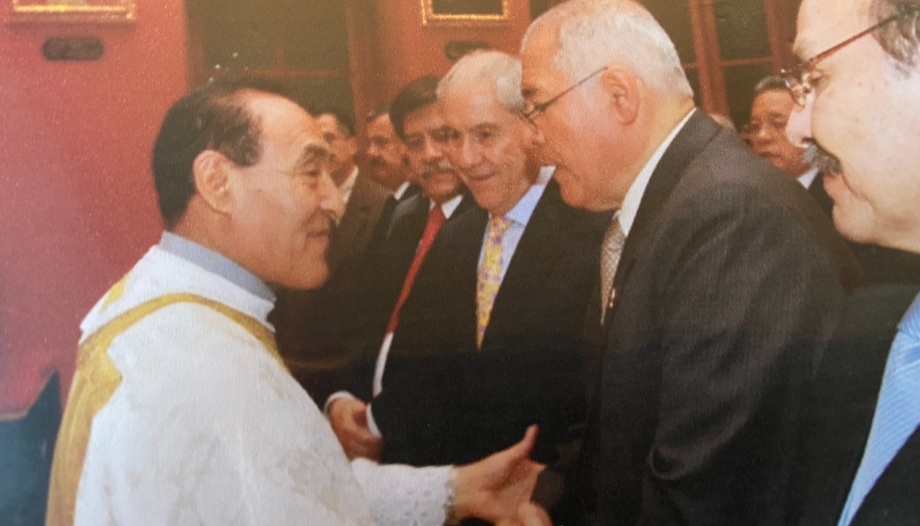
The Cardinal of Lima and the Chief Justice of the Supreme Court attended the dedication ceremony. Cardinal Juan Luis Cipriani consecrated the chapel. The officials had previously signed a document of recognition and authorization.
Expansion of the initiative to the provinces
Now there is daily Mass in the chapel, and many people come in throughout the day to pray. Father Ángel’s schedule includes weddings, funerals, and visits to the sick. The chapel at the Palace of Justice in Lima is now an important place that has greatly contributed to the spiritual life of the people and of many judicial officials.
Father Ángel is a man of action and initiative; he knows how to find the resources needed for the projects he undertakes. He decided to extend this initiative to the courthouses in Peru’s provinces. With that vision in mind, he began traveling. And now, with the help and support of the authorities, he has succeeded in building several chapels in those government institutions.
Father Ángel knows that in Peru, when a priest sets out to launch a project for the glory of God and the good of souls, that project succeeds. That is why Father Ángel did not hold back; he approached the Public Prosecutor’s Office and the Congress of the Republic, and there, too, he was able to build chapels, which are now fully operational. Father Ángel Ortega has earned prestige and fame among judges and members of Congress, and he is now known as the angel of judges and government officials.
Peruvian priest





 Español
  English
  Italiano
  Français
  Deutsch
  Polski
  简体中文
简体中文