



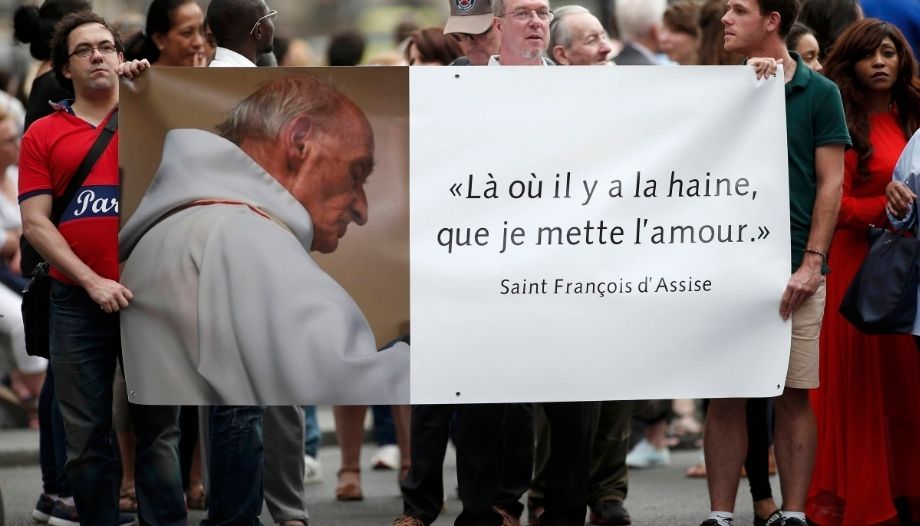
Two women, Roseline Hamel and Nassera Kermiche, were the focus of the first major gathering of the Meeting for Friendship Among Peoples—commonly known as the Rimini Meeting (Italy)—a few days ago. This year marked the 47th edition of the event.
The organizers, Communion and Liberation—and specifically Bernhard Scholz, president of the Encuentro—put on stage This story of forgiveness and reconciliation—of “two sorrows that are impossible to bear alone”—comes just on the eve of Pope Leo XIV’s visit on Saturday, August 22.
It was the suffering of Roseline Hamel, the sister of Father Jacques Hamel, and that of the mother of the young jihadist, Nassera Kermiche, who—for security reasons—was not recognizable, was wearing sunglasses, and was sitting at an angle to the camera.
"’Soeurs de douleur’ (Sisters in Sorrow)
This is a summary of the hours leading up to Father Hamel’s murder on that day in 2016—10 years ago—including how both women and their families experienced those events, how they met and became friends, and how they reconciled.
Now they are “Soeurs de douleur’ (Sisters in Pain), as is the title of the book published by Ares-LEV, in which they have told their story. We’ll focus on excerpts from what they shared at the Rimini Meeting, which you can watch in the video at the end, at a reference from the Vatican news agency, and some articles published, for example, in *Il Messaggero*.
The facts
On the morning of July 27, 2016, Father Hamel was celebrating Holy Mass at his parish in Saint-Étienne-du-Rouvray, in northern France.
When the Mass ended, right after the blessing, two young jihadists murdered him. When the police arrived, the two killers were trying to flee and were shot dead.
Shortly afterward, the news of her brother's death reached his sister, Rosaline. The news that one of Nassera Kermiche's sons, Adel, was involved in the murder reached his mother that afternoon, along with the news of his death. It was a terrible day for them.
"These women endured indescribable suffering," said Bernhard Scholz, "and we want to start today," he added. The sidebars consist of questions from Scholz himself, quotes from the two women, and text from Omnes.
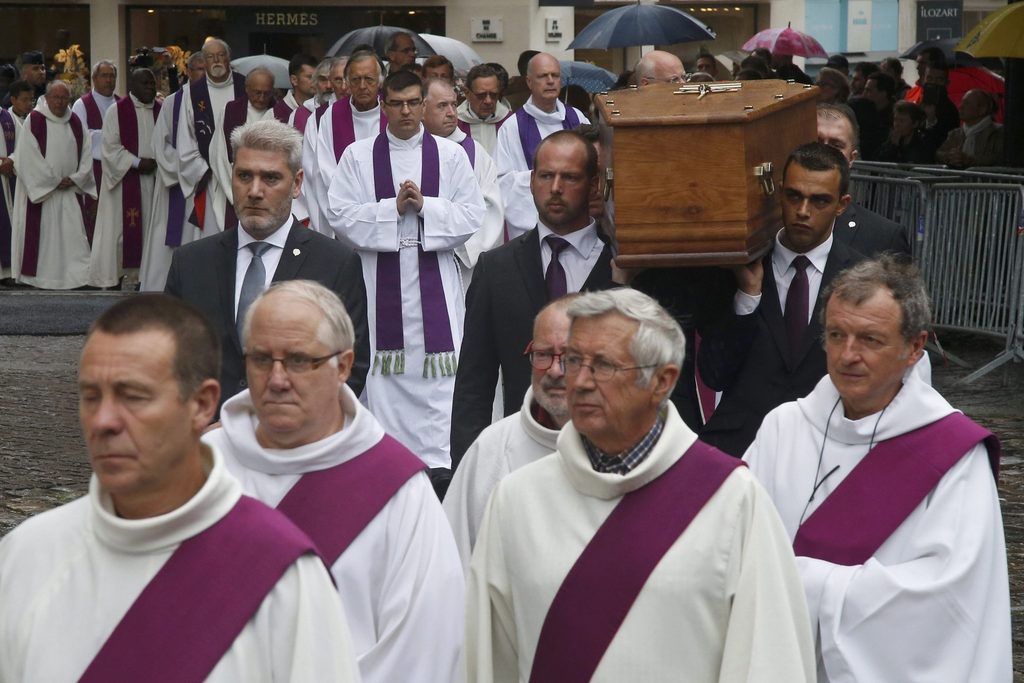
Roseline, what happened that day? How did you experience it? And above all, how did it affect you?
– Roseline: That day was truly unexpected. We had arrived in northern France, in the town where my brother—my dear brother Jacques Hamel—lived, to help him during his last week on the job, and then we were planning to go on vacation together.
We arrived on July 25, which was Saint Anne’s Day. That night, we asked my brother—I was there with my grandchildren, too—we asked him, “How is it possible for such extremely violent acts to occur? How can one human being do something so terrible to another human being?”
At the beginning of dinner, he told us, “I have something important to tell you. I’m happy to have you here at my table.” And that struck us as strange coming from my brother, because by nature he was someone who didn’t know how to show his joy.
It's the morning of July 26, and the phone rings
– We saw that my brother got up very early because he had to celebrate morning Mass. He forgot that we were sleeping. He was so used to living alone and having no one at home that he made quite a bit of noise getting up, eating breakfast, and so on. And at one point, he opened the door—you could hear it creak—and we could smell the aroma of coffee filling the whole house. He had laid everything out for us—bread, jam, and butter—and we were all there together when the phone rang.
I usually didn't answer the phone when I was at my brother's house because I thought, "What if someone asks me about the Mass times and I don't know them?" So, I didn't usually answer the phone.
But one of my grandchildren said to me, “Grandma, why aren’t you answering?” He kept insisting that I had to answer because he was watching cartoons and the phone was keeping him from hearing them.
So I answered, and the person on the other end asked me, “Is this the rectory of Saint-Étienne? Can you confirm whether the priest is at the church? There’s been an attack, and they’ve taken hostages.”.
“I thought it was impossible for anyone to harm a priest celebrating Mass in a church.”
– And I replied, “Well, if this is a joke, whoever you are, it’s really not funny at all.” And I added, “My brother will be back from church in about 15 minutes, so please call back later.”.
I hung up the phone, went back to the kitchen, and talked to my grandchildren, telling them what I’d been told on the phone, and I said, “This news can’t be true. I don’t think it’s true, but I’m going to go to church to check it out.”.
And my daughter says, “Mom, I don’t think you’ll be able to get to church because there’s a huge crowd on the street—it’s packed with people, there are soldiers, the street is blocked off, and even the stores are closing.”.
And the soldier, frowning, told me, "Go to the funeral home"—a funeral home that was nearby—and there they made us wait for hours.
I thought it was impossible for anyone to harm a priest in a church—a priest who was celebrating Mass, the Passion of Christ, and sharing this rite with others, including elderly people who had come to Mass. After waiting for two hours, they told us, “You may leave.”.
An employee at a funeral home told me that my brother, Father Jacques, had died
– But they also told us to wait near a window in the courtyard. And that’s when I started to get really nervous, and my daughter tried to calm me down again, saying, “Mom, we’ve been waiting this long. Let’s wait another 5 minutes. Be patient.” And I waited.
And there, in the funeral home’s courtyard, we see two firefighters arrive—the ones who normally help people during disasters—and they stand there in silence, along with a third person wearing a white lab coat covered in blood.
I’m starting to get really nervous, losing my composure, and I turn to these people. And I snap at them, “Move it—go find my brother.” Then a funeral home employee comes up to me and says, “It’s all over. There have been two victims—one injured person who’s in the hospital, and the other is your brother, who has died.”.
I was stunned; it came as a shock, as if a bullet had gone right through me, as if a bomb had exploded inside me. I started screaming my brother’s name in desperation because I couldn’t believe news of that magnitude. And my oldest daughter, who had been by my side the whole time, said to me, “Mom, please, I’m begging you, stop screaming. Uncle isn’t coming back, no matter how much you scream.”.
And the nurse said to my daughter, “Let your mother scream.” If she needs to scream—even for hours—let her scream. I screamed so violently that it caused a problem with my diaphragm, and a few months later I had a lung problem because of those loud screams. I even had to have surgery because of this, but thank God I’ve recovered now.
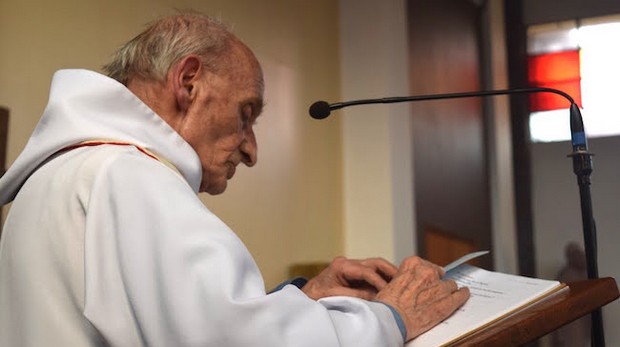
An indescribable pain—for you, too. How did you, Nassera, experience that day??
– Nassera: For me, that day started very early, at 7:30, because I woke up at that time, and I remember seeing my son (Adel) that morning—perhaps God granted me the chance to see him one last time—and I asked him why he was awake so early. And he said, “Well, I just woke up.” I told him to go back to bed. Then I went back to my room.
I remember turning on the TV and there was nothing interesting on, so I went back to sleep. A little while later, I remember the phone ringing; it was the police chief, asking me if my son Adel was home. I’d seen him just a few moments, just a few seconds earlier. So I assumed he was still there, because I didn’t think he’d been asleep that long, and I said, “Yes, yes, he’s here. Downstairs at home.”.
And the police chief said to me, “Go check if he’s there.” And I saw that my son Adel had gone out, so I said, “Well, yes, he has indeed gone out. I don’t know—I don’t know where he went.”.
The attack
– I asked the police chief why he had called me, and he said, “Because there’s been an attack at the church in Saint-Étienne-du-Rouvray.« And I was surprised because I hadn’t expected to hear about an attack at that church. So I asked him, ”But why are you calling me?“ »Why do you think Adel is involved in this attack?“ And he said, ”I don’t have any more information, but I’ll keep you informed.’”.
I started to worry, turned on the TV, began watching the news, and saw that they were indeed reporting on a terrorist attack, but they weren't giving many details.
I remember asking my daughter to go over to the church to see what was going on—maybe she'd run into her brother there.
A few minutes later, she called me and said, “Mom, look, there are so many people here, the police are here, I can’t see anything—everything’s blocked off.”
She went home, and in the meantime, I called the police chief again and asked him if there was any—if he had any more news—and he told me, “No, we don’t have any more information at this time.” He had to be back home before 12:30 because he was under certain restrictions.
My son hasn't come home, and a reporter is coming to our house
– But that’s not happening; my son isn’t coming back. Around 11:30, a reporter comes to our house and rings the doorbell. “I heard the name Kermiche outside the church.” That’s when we really started to worry. Meanwhile, my daughter Sabrina, my daughter Anisa, and my son Sofian are by my side, but he’s still missing. It’s 12:30 p.m. Adel still hasn’t come back.
We turned on the TV, and they were talking about people who had died and people who had been injured, but we didn't know exactly what had happened inside the church.
I called the police chief again. He probably already knew what had happened but simply didn’t have the courage to tell me over the phone, and he said, “Gather at home.” Meanwhile, the special units arrived—many police officers from various different police departments—and began searching the house. At that moment, we realized that Adel was involved, but we never would have thought he had died.”.
We didn't expect my son to have died. A long period of suffering began…
At the police station, the news
– The questioning lasted 4 hours, and after 4 hours they asked us to follow the police to the police station. Once there, I said, “Well, it seems my son is involved in the attack in Saint-Étienne-du-Rouvray, but I don’t know much else.” And they said, “Yes, he’s involved, and he’s passed away.” And that’s how I found out about my son’s death. At that moment, I knew for certain that he was gone, that he had died. That news hit us as if the sky had come crashing down on our heads. We weren’t expecting it.
And so began a long period of suffering for both of them, filled with many agonizing, unanswered questions—and social isolation as well, because, of course, people began to look at the family in a certain way.
Roseline, how did the initiative to find Nassera come about?
- Roseline: Right away, I had this idea, this desire. When we returned home, my children and grandchildren, who had been there with us, went back to their own homes and began to come to terms with this pain—the pain of that hellish day. Once I was home, I began to wonder how I would be able to survive all of this, how I would be able to find new meaning in my life.
“I began to talk and converse with God”
– I then began to talk and converse with God. For months I continued to talk with the Lord, trying to find an answer. I lacked patience. I was very restless because I couldn’t find an answer—an answer in Him—so I sought an answer in the Gospel.
I was looking for a word, a parable—something that could be with me, that would answer my questions, that would comfort me.
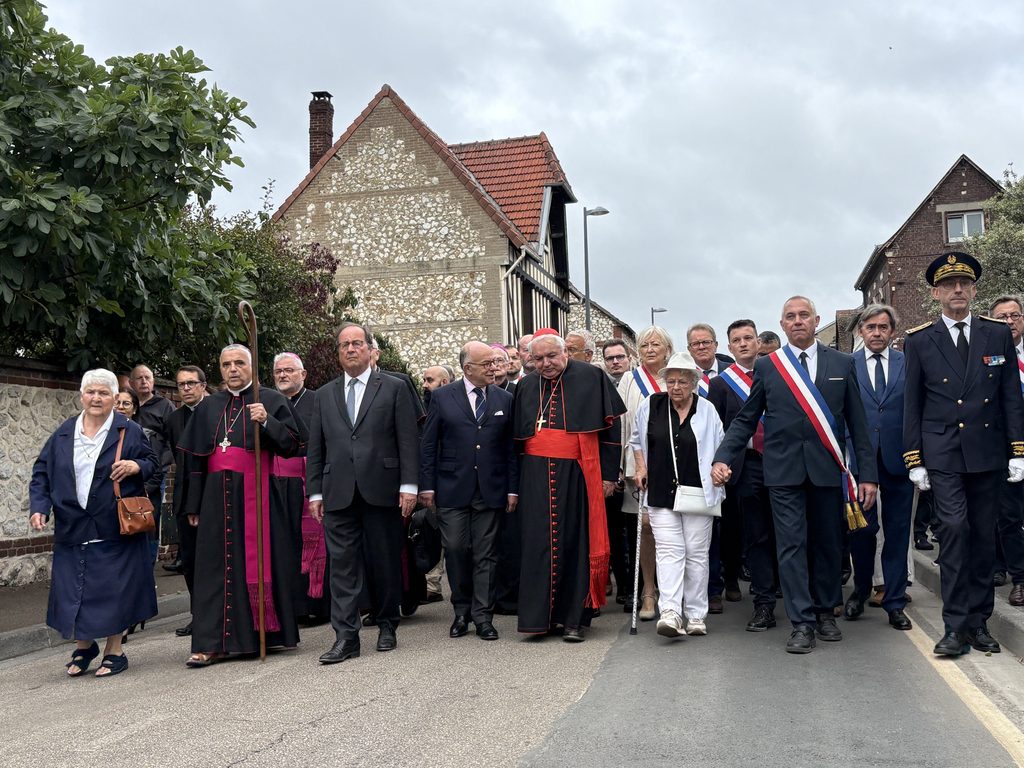
“God is answering me. In your suffering, I carried you on my shoulders.”
– And finally, after a few weeks, I came across a line from a similar story—the story of a man who was carrying a heavy burden, a great pain, and who had a friend (…), And this man who was suffering, carrying such a heavy burden, said to his friend, “But you—where were you while I was suffering so much?” And he asked, “Well, I was right beside you,” his friend replied. And he said, “Why are you lying?” And the friend said, “No, I’m not lying. Your suffering—this great burden you’re carrying—was so heavy that I was carrying you on my shoulders.”
“And here I found an answer to my question. Later, during Sunday Mass near my home, I heard the same parable in the homily—a homily that addressed this very topic. And so I said to myself, “Well, God is answering me.””.
“Show me the way forward. And I prayed to the Virgin Mary.”
– So I allowed myself to say to Him, “Show me the way forward, a path in life that makes sense.” And so I carried on like that for a year. I spent a year reflecting, and after a year I was desperate, on the verge of letting myself die.
And yet I pulled myself together and said: “For the sake of my children, who suffered with me that day, I have to find the strength to keep going.” So I went to pray before the Pietà in my church.
And right away I thought of the Virgin Mary—she who had endured the suffering of her own son without being able to intervene, just as I—as we—could not.
And I said and asked her, “Virgin Mary, give me the strength to keep going, to walk, to follow in my brother’s footsteps, just as you followed in the footsteps of your Son, seeking justice, truth, and peace.”.
“But God, who could suffer more than I do?”
– One morning I was very tired; I didn’t know what to do anymore. I was sitting there with my cup of coffee, saying, ”But God, who could be suffering more than I am? Who could be suffering more than I am?”.
And over the next few mornings, I woke up with an obsession on my mind. I kept thinking about this woman I didn’t know—this mother, this mom with children—and I said to myself, “My God, if I were this mother with a son who had committed such a horrible act, how much pain would I feel?”
“I imagined the suffering of the mother of the son who committed such a horrible act. I can’t leave her alone.”
– And then I imagined the suffering of this woman, this mother I didn’t know, and the guilt she might be feeling. And it was only natural, given the looks of contempt people can give you, right? You can even lose your job, the trust of your coworkers, your friends—everyone. And I said, “No, I can’t leave her alone because she’s suffering more than I am. I have to find a way; I have to figure out how and find out where she lives.”.
The bishop: Follow that path, and I will walk with you.
- So I spoke with the bishop (of Rouen) to find out if it was a crazy idea. And he told me, “No, follow this path, and when you’ve found her, let me know because I’ll come with you.”.
And so I started looking for her; I began trying to get in touch with her.
For a few months, we started talking on the phone. Every 15 days, with a bit of shyness at first, but as the weeks went by, our conversations became more and more meaningful.
“Ma'am, ¿”Would she agree to meet with me? And she said, 'I've been waiting for you for a long time.'"
– Roseline continued: “And finally I asked her, ‘Ma’am, on the day I come to see you in Saint-Étienne, would you be willing to meet with me?’ And she said, ‘I’ve been waiting for you for a long time.’ She’d been waiting for me for a long time.”.
–Nassera speaks up: A lot more happened after that. I went back to work, even if it was just like a robot. “I have to hold on, I have to hold on for my children, my other children, my family. I can’t break down, because if I break down, the whole family breaks down with me.”.
Finally, one day (Roseline) suggested I come to Saint-Étienne, and I told her, “Yes, I’ve been waiting for you for a long time.”, That's where we met, and that's where we got to know each other.
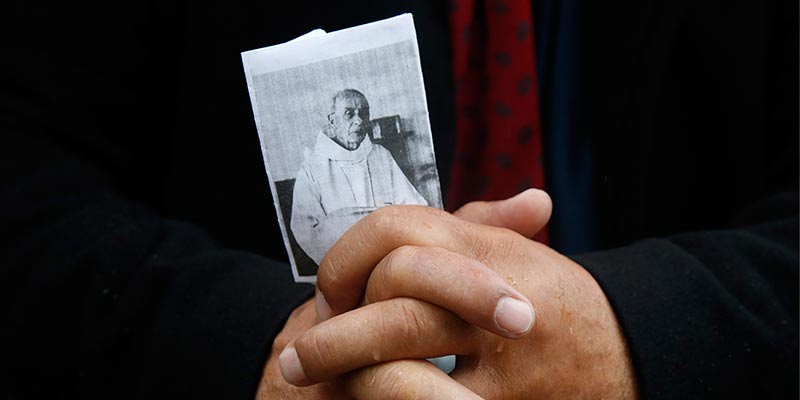
Letter from Roseline
At the Rimini Meeting, Roseline Hamel recalled that eight years earlier she had left a letter—a letter of forgiveness—at the grave of Nassera’s son.
Among other things, it says: “Adel, the soul of my brother Jacques is leading me to you. This is a testament to his forgiveness. The faith of believers is hope, and forgiveness is the path to peace.”.
“I had hidden it away a little so it would be for him (Adel),” said Roseline, "and she (Nassera) told me, 'It would have been a shame for it to rot away there in the grave, because you wrote such beautiful words for my son that I took the message home so I could keep rereading it.'".
"It had been eight years since I wrote that letter," Roseline continues. "And how is it possible that, despite the pain I was feeling, I found the strength to write those words?"
"It can't be any other way," said the sister of the Father Hamel. It was my brother who gave me these words; he was the one who inspired them. They are part of the first fruit of his martyrdom.
In the Archdiocese of Rouen, the process for the beatification of Fr. Jacques Hamel has been opened. The diocese invites the faithful to share their testimonies voluntarily. They may write The Cause for the Canonization of Father Jacques Hamel, Archdiocese of Rouen, 2 rue des Bonnetiers, 76000 Rouen – beatificationperehamel@gmail.com






 Español
  English
  Italiano
  Français
  Deutsch
  Polski