


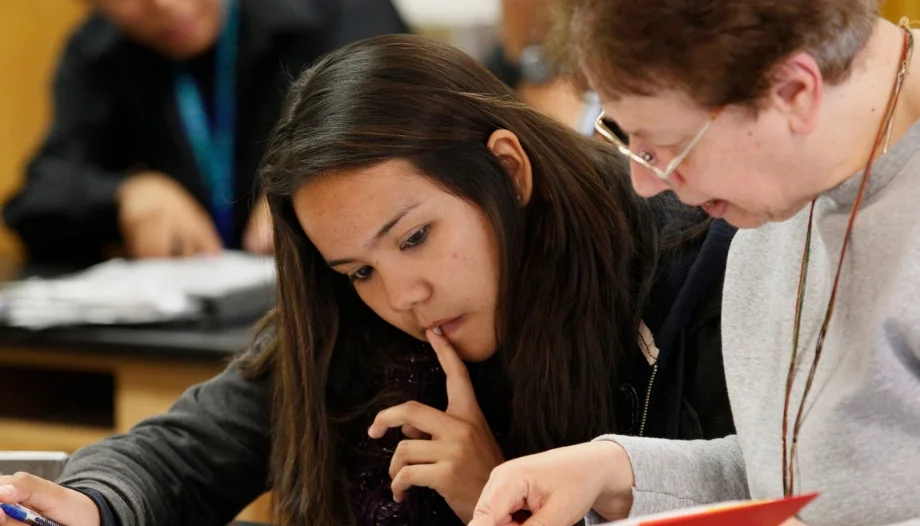
 Catholic educators describe the use of AI and agree: there is a lack of preparation
A new school year begins, and some scenes play out once again. Getting school supplies ready, back-to-school meetings, reuniting with classmates, resuming after-school activities… There are so many feelings, lessons learned, and habits absorbed that, year after year, this social and academic reality has such a lasting impact on our children’s lives. But is that impact real? Haven’t times changed? Aren’t we talking about an obsolete system?
Education and society from a century, half a century, or a decade ago—or even less—bear no resemblance to those of today. Change has always been inevitable, but today, the pace is dizzying. Everything is changing at an unprecedented speed. What was valid yesterday is no longer valid today. What remains constant? What certainly does not change is the social, emotional, and academic impact that school—and everything that happens there—has on our lives. It is one of the factors that most influences our future; therefore, if we want to safeguard the future of our families and our society, let’s prioritize the education of the new generations during their childhood and take into account the changes we are experiencing.
The Pope will visit UNESCO
Leo XIV, the pope who was greeted with ovations during his visit to Spain, is well aware of the pivotal role of education and schools. Proof of this is his upcoming visit to UNESCO (the United Nations Educational, Scientific, and Cultural Organization). As part of his apostolic trip to France, the French Church, the French government, and UNESCO itself have invited the Roman pontiff to visit this international organization.
The meeting with Khaled El-Enany, the organization’s director general (with whom he already met last June), will take place on September 25 at the headquarters in Paris to discuss the current challenges facing artificial intelligence, information integrity, education, and artistic creation in the digital age. The program also includes panel discussions and an address by the Pontiff.
What does Leo XIV say about this?
But the head of the Catholic Church has already set forth his thoughts on these issues in his latest encyclical, Magnifica Humanitas. And it's right on the mark, because it addresses issues that concern families, schools, and society in general.
For starters, he is concerned about what Pope Francis called in Laudato Si, the “technocratic paradigm.» A logic whose algorithm is based on efficiency, control, and corporate profit, which develops business models that monetize attention and time—where we, as men and women, are the business. In this model, the youngest and those with the least education and training are the most vulnerable and fragile; therefore, they are the most likely to fall prey to addiction and enslavement. Faced with this reality, Leo XIV proposes an alliance between politics, educational institutions, and families. Examples of this include the pioneering legislative proposals in France and Spain to limit social media use among minors under the age of sixteen, so that the burden does not fall solely on families.
The Pope is clear that the school is parents’ greatest ally in the education of their children. Parents have the primary and inalienable right to choose the type of education and formation their children receive, in accordance with their own moral, cultural, and religious convictions.
With regard to schooling, he also speaks of “urgent challenges,” such as overcoming obstacles to access basic education and higher education.
Educating Students to Think in the Age of AI
Another such challenge is the school’s ability to adapt to the breakneck pace of change in our society, which almost inevitably requires staying up to date. In the face of AI and other realities, the Pope proposes a holistic education that encompasses all dimensions of the person, ongoing teacher training, and a positive dialogue with technology, making responsible, critical, and creative use of it.
Faced with the constant flow of information provided by technology, we are invited to engage in inquiry, reflection, and discernment. This helps us avoid falling into fragmented, non-holistic knowledge. It also encourages genuine critical and creative thinking. As the Pope notes, many educators are increasingly speaking of dehumanization, because students “know many things” but struggle to find meaning in their lives.
Reclaiming What Technology Cannot Provide
In short, “schools are not meant to keep up with the pace of the digital world, but rather to offer what the digital world alone cannot provide: shared time for learning and trusting relationships.”
That is why families, the educational community, and society as a whole should focus their reflection on these questions: How can I ensure that my children or students truly learn? How can I foster deep friendships? How can I promote respect and closeness among everyone?
The answers to these and other questions are very broad, but they must be addressed. That is why those responsible for education—first and foremost, parents; next, teachers and educators; and, as stewards of the common good, politicians—are called upon to reflect deeply on these issues and to propose and pursue ways forward. And what better way to begin this process than by reading Leo XIV’s encyclical slowly and drawing insights from it, while paying close attention to his speech at UNESCO in late September. In this way, we will begin to prepare ourselves to help children.






 Español
  English
  Italiano