


 Why get married? Christian marriage in the 21st century"We need to rediscover the beauty of marriage."Carlota and Santi, a marriage focused on doing God's will
In the previous article we discussed celibacy as a way of giving one's life. Now we address the other great way of living the gift of creating a family and giving life: marriage.
Let's begin by considering a very current way of thinking. It's common to hear that getting married “is just a piece of paper,” “a formality,” or “a mere social event,” and that what's truly important is loving each other. So, a couple might think: we love each other, we're faithful, we want to share our lives. What does a wedding really add?
And yet, getting married is rarely experienced as simply signing a piece of paper. Saying “I do” is daunting. Even two people who have loved each other for years can feel a certain apprehension at the idea. Why, if “nothing changes”? Perhaps because we sense that loving someone and linking one's life to theirs are not exactly the same thing. And it is precisely there that Christian marriage begins to be understood.
Love already existed. The bond, however, did not.
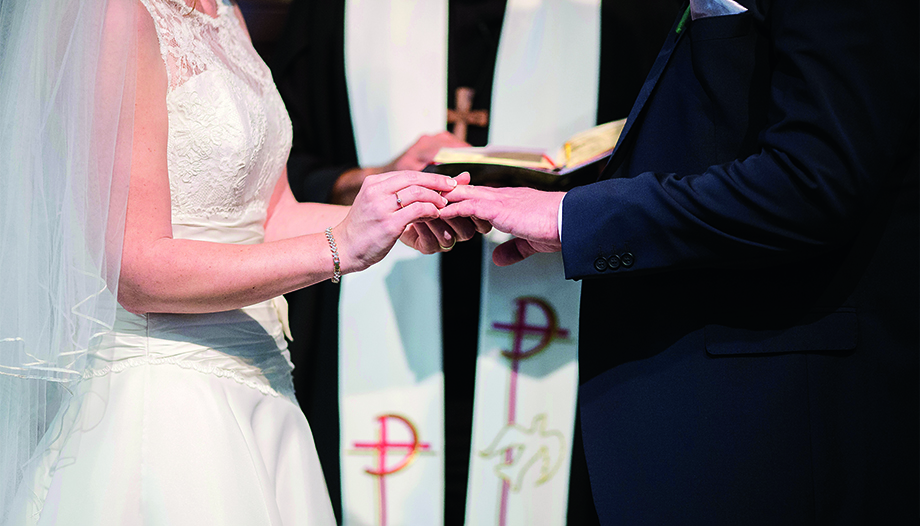
Let us imagine two lovers arriving at the altar deeply in love. The Church does not deny this love to explain the greatness of marriage. Of course, they loved each other before. But before uttering their vows, they were not yet husband and wife. Then they say: “I take you to be my husband and wife.” “I promise to be faithful to you.” “All the days of my life.” Saint John Paul II explains that these words are both the announcement and the cause of a new reality. The Catechism expresses it in an even more impressive way: the consent by which spouses give and receive each other.“It is sealed by God himself” (Catechism no. 1639). That is why Christ can say: “What God has joined together, let no one separate.”(Mt 19:6).
They have freely chosen to bind themselves together. But the bond that is formed is no longer simply a private agreement between them. God himself seals it. The sacrament does something, it causes something.
When God takes the “yes” seriously”
The human body was created with the capacity to express the gift of the person. For this reason, Saint John Paul II attaches such importance to marital consent.
When a man says, “I take you,” he isn’t just expressing what he feels in that moment; he’s surrendering his freedom. His “I do” also encompasses tomorrow. That’s why one of the most powerful phrases about marriage is perhaps the one we hear most often: “All the days of my life.”.
Getting married is, in a sense, signing your future before you've even read it. That's why marriage can't be reduced to saying “we love each other.” It says something more akin to love itself: “I give myself to you.”.
And the big question makes sense
If two people love each other, they might also ask themselves: why wait until marriage to have sex? The Theology of the Body answers: because the body also speaks.
The conjugal union expresses bodily a reciprocal and total surrender by which the spouses become “one flesh”(Gen 2:24). And this union possesses, at the same time, an openness to the gift of new life. That is why the body should not say something that people have not yet said with their lives.”.
This is why we speak of an order of events or stages: first, the spouses give and receive each other through consent. The bond is born. God seals their covenant. And what they have professed is destined to find its bodily expression in the consummation of marriage.
In this sense, the Church speaks of a ratified marriage (validly celebrated between a baptized man and woman) and a consummated marriage: when the spouses perform the conjugal act in a human manner, an act capable in itself of generating new life and through which they become “one flesh.” It is up to this point that one speaks of “absolute indissolubility”; the bond is complete,“until death”(cf. CIC canon 1141). Thus, the Church considers sex as something very great, since it consummates that mutual self-giving expressed in words during the celebration of marriage.
A “yes I do” that the body keeps renewing
Saint John Paul II says that the words spoken by the newlyweds are, in a way, “programmed” to be developed throughout their lives through the language of the body.
The body continues to tell the truth of that “I do.” However, it is not automatic; it requires a loving effort and a genuine commitment, for Saint John Paul II rightly warns of the possibility of falsifying the language of the body: it can speak the truth through love, fidelity, and marital honesty, and it can speak the opposite when it denies these realities. But it is precisely at that moment that we must turn most to those who sealed the bond: the Father, the Son, and the Holy Spirit. No marriage is ever truly alone, for the sacrament has included God in their life as spouses.
A link within a link
But the biggest question is still missing. What does God do with that bond? The Catechism says:“The covenant of spouses is integrated into God's covenant with men”(Catechism no. 1639). Therein lies the heart of the sacrament.".
Saint Paul had expressed it while contemplating Christ:“Christ loved the Church and gave himself up for her” (Eph 5:25). And after recalling that man and woman will be “one flesh,” he adds:“This is a great mystery; I say this concerning Christ and the Church”(Eph 5:32).
The love of the spouses thus enters into a greater Love. Their bond is inserted into the covenant of Christ with his Church. For this reason, Christian marriage can make something of God visible: his fidelity, his self-giving, his enduring love. And, for this reason, they do not receive merely a mission that is impossible to fulfill. They receive all the grace that will suffice for them. The Holy Spirit is called “the seal of the spouses' alliance”The source of their love and strength to renew their fidelity (cf. Catechism n. 1624). On their wedding day they say to each other: “You can count on me.” And God seems to respond in kind.
So why get married in a church?
In marriage, the love between the couple evolves from a story they both wish to continue into a covenant. A bond is born that God himself seals.
Their bodies express the truth of that commitment. And the covenant they have formed is sacramentally incorporated into the covenant of Christ with his Church.
The sacrament transforms that love into a bond, that bond into a sign, and that sign into a place of grace. Perhaps that's why marriage is such a powerful force.
Because, deep down, we sense that saying “I love you” and saying “I give myself to you” have never meant exactly the same thing. And there's still the most daring phrase of all: “Every day of my life.”.



 Español
 English
 Italiano
 Français
 Deutsch
 Polski