


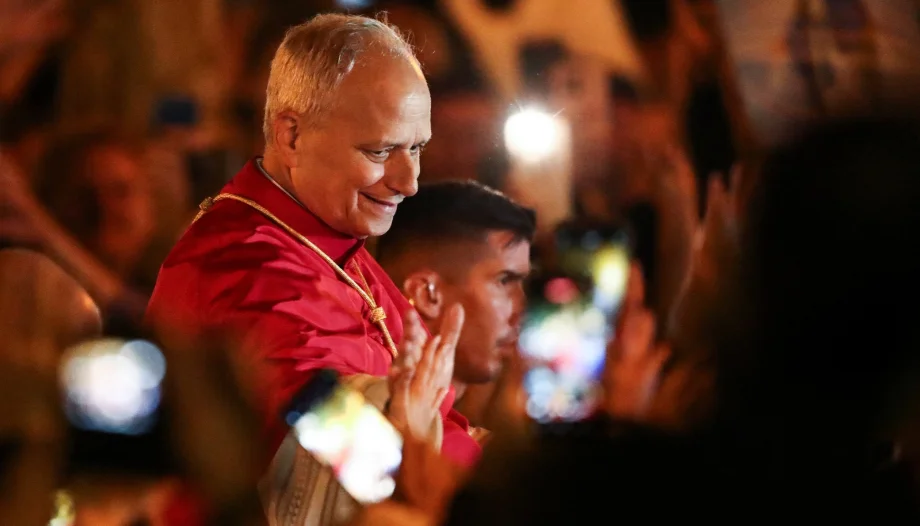
On November 7, Pope Leo XIII celebrated Mass in Paysandú, a city of about one hundred thousand inhabitants in northern Uruguay. In his homily, he used three words as images: bridge, palm groves, and mate.
It's incredible how everyone from school children to the oldest adults immediately remembers those three words. I saw it at the school where I'm chaplain when I asked third-grade students: the Pope has achieved what every preacher aims for, that his words are engraved in the hearts of the faithful.
It was one of those examples of how the pastor knows what to say to his flock. He doesn't speak in general; he speaks to those who are listening at that moment, and he uses images that are familiar to them.
I don't know how the Pope arrived at those words while preparing that homily. I suppose he sought help from those who live on this earth. In any case, it was he who decided to use them to enrich his message, to imitate the greatest communicator in all of history: Jesus.
Jesus, the great communicator
It is known to everyone, even those who do not have faith, that in his preaching Jesus used parables, those imaginary stories that carry a message, a message sometimes obvious and at other times a message that he himself had to explain to his disciples because they did not understand it.
I imagine, and this has no bibliographic support, that Jesus, in his long periods of prayer—Jesus the man, having human intelligence and memory—was elaborating these stories in order to transmit the message that his Father wanted to convey to humanity.
At this point, I encourage you to quickly recall five or six parables. I'm sure any reader can do it, even a child who has just begun catechism. And I'm sure that even someone who only knows the Gospel because they have studied it as part of their general knowledge will remember them.
Let's return to the three words he used in the homily, where I was able to be present, where I was able to concelebrate, where I was able to spend more than two hours hearing the confessions of the faithful who felt a desire to reconcile with God, moved by their participation in that Mass. My first confession was even captured by some photographer who doesn't know he's supposed to remain anonymous, but who snapped a picture as soon as I sat down, and it was published in the Sunday edition of the newspaper. Luckily, no names appear.
Bridge, palm groves and mate
Bridge: The city of Paysandú is located on the banks of the Uruguay River, which separates us from Argentina. This international bridge, with its elegant profile, has united us for over fifty years. The bridge represents union and openness, says the Pope; but he also emphasized the importance of the pillars that must be firmly planted, like a house built on rock, so that the current doesn't sweep it away. This foundation is necessary for our Christian life: a “solid doctrinal formation.” This has led me to consider how to improve my own formation so that I can transmit it to the faithful: more study, more reflection, greater depth.
Palm groves: on both the Uruguayan and Argentinian sides there are large palm groves. I don't know if their origin has any explanation, but what is clear is that these palm trees have formed a community of palm trees. The Pope spoke to us about this essential characteristic of the Church: we live in community and we form community; in this way we live our union with Christ, like him who formed the small community of the Twelve Apostles.
Mate: it's a drink that these lands have made universal. Some say that if you see someone walking the streets of the world with a thermos under their arm and a gourd with a straw in their hand, don't doubt it: “it's a Uruguayan.” Among the concepts the Pope emphasized with this word were silence and companionship. I remember as a child watching a group of farmhands at dawn around the fire, passing the mate gourd from hand to hand in profound silence, thus beginning their day. That silence is a gateway to encountering God, a moment of reflection, of companionship. Here the Pope said that mate also arrived in Rome; I was told that some young Uruguayans and Argentinians sent him a mate gourd with a letter.
Preaching with close-up images
Whenever we have to preach, we struggle to pinpoint exactly what we want to say to the faithful, what will be useful to them from the scripture readings for that day. Now, following Leo's example, the first thing I will try to find are those words, those parables, that will help them remember the message God wants to give them in that celebration.
Before concluding, I must add that Pope Leo XIII, during his stay in Uruguay, used several imagery: in his address to the country's authorities, he referenced the bas-relief on the pedestal of the Artigas statue depicting the exodus of the Uruguayan people. At the Catholic University, he structured his discourse around the five senses: sight, touch, taste, hearing, and smell. In Casavalle, one of the impoverished neighborhoods where the Church works on numerous initiatives, he drew upon the parable of the Good Samaritan. In the legendary centennial stadium, where the World Cup began and where the first match will be held in 2030, he spoke to thousands of young people about Bethlehem, the house of bread, where Jesus was born and who continues to journey through the world today through the presence of the successor of Peter.
A Pope who also evangelizes through his gestures
The Pope teaches us through his way of preaching, through his images, but also through his gestures, his gaze, his gentle smile, his wonder, his tears, his serenity, and his embraces.
In one of the most powerful testimonies, a woman with the Virgin of Guadalupe tattooed on her face approached the Pope after the ceremony and asked for a hug. The Pope responded by giving her one. She later commented in an interview that this was the first hug she had ever received from a father she had never met.
A few days ago, I met a woman on the street who was looking for a priest. Seeing my vestments, she approached me and told me what was happening—a very difficult situation. She was seeking a blessing for herself and her family. She told me sincerely, as we were standing on the street, that she wasn't particularly close to the Popes, but that seeing Leo XIII had made her cry, and that's why she had come to a church. Her daughter had encouraged her to pray the rosary, and she was going to buy one. She left overjoyed when I gave her mine and a blessing.
León has come to confirm us in our evangelizing mission, he has done so with his vivid words, with his gestures, and also by moving those who see him through the images broadcast by the media. Let us give thanks to God.




 Español
 English
 Italiano
 Français
 Deutsch
 Polski