



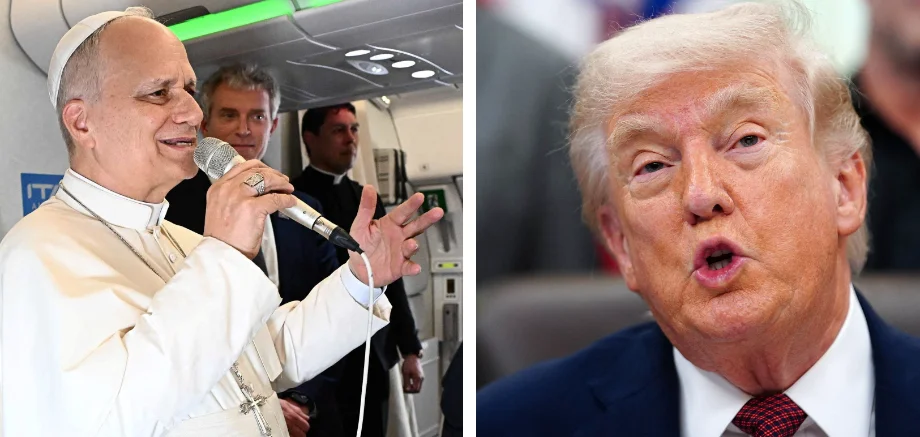
The current clash between the papal office and the Trump administration reveals a fundamental confusion about the nature of religious authority, the obligations of Christian witness along with the historical relationship between Rome and the United States. Pope Leo XIV has committed no transgression in speaking about peace, war, human dignity and the growing use of political figures to weaponize religion to further their political goals.
The fact that Trump’s administration and American conservative commentators treat the Pope’s ordinal statements as direct political provocations suggests their lack of understanding with regards to both theology and the role of the Pope. If the Vicar of Christ is not allowed to speak about peace, whose job is it then?
Understanding the context
To grasp why the criticism of Pope Leo XIV is misguided, one must first understand what exactly the context is. On March 29th, Palm Sunday, the Pope invoked Isaiah 1:15, speaking of "hands full of blood" as a scriptural reference calling for peace, a broad theological appeal, not a targeted political attack. When he addressed the "abuse of the Gospel", he was defending the faith against those who would weaponize it for political ends, without naming specific critics.
On April 5th, Easter Sunday, Trump in a profanity filled tweet, threatened Iran to open the straits of Hormuz. Political observers were quick to point out the duality of the President posting such a message on one of Christianity’s most holiest of days, while the Pope spoke about peace and on how the world was growing “indifferent to the deaths of thousands of people". After this, attacks against the Pope increased, with most claiming that the Pontiff was picking a fight with Trump.
On April 11, during a peace vigil, the Pope spoke of a "delusion of omnipotence" as describing a general mindset fueling global instability. No specific world leader or country named. He criticized "diplomacy based on force" as a general observation about international relations, not aimed at any administration.
The Pope's response
When the Pope got questioned for his Palm Sunday and vigil addresses, he himself clarified the situation on April 13th by saying “The things I say are not meant as attacks on anyone”. Despite this, attacks against him only increased. On the same day, Trump posted an AI photo of himself as a Jesus like figure, healing a sick man, a move which drew widespread criticism from Catholics.
On April 14, 2026, the Pope celebrated Mass at the Basilica of St. Augustine in Annaba, Algeria. This was a deeply personal pilgrimage in the footsteps of the Church Father whose works remain embedded in Western philosophy for nearly 1,600 years.
During that Mass, the Pope stressed what should be uncontroversial: the Church's role in bringing hope to the despairing, dignity to the poor and reconciliation where there is conflict. These are the traditional concerns of the papal office and are not political statements but theological assertions about the nature of Christian witness.
Many of us can name political leaders from the past and present, Muslim, Christian, Hindu or even Buddhist, who have weaponized religious beliefs to further their political agendas. There is no religious monopoly on politicians being hypocrites. In none of these statements did Pope Leo XIV name any political party, leader or specific administration. If any politician felt his remarks targeted them specifically, then that was their guilty conscience speaking to them.
A long papal tradition of speaking to the powerful
Papal statements on questions of war and peace are not new, nor is it primarily driven by partisan politics. American presidents have faced papal critique on military matters for decades. What is new is the intensity and personal nature of the current administration's response towards the Pope Leo XIV.
Historically, Pope Paul VI made his objection to the Vietnam War heard directly. On December 23, 1967, he met with President Lyndon B. Johnson to voice his concerns about American involvement. The Pope returned to the theme twice more in March 1969 and again in September 1970, making clear his consistent opposition to the conflict. He was exercising his moral responsibility to speak to the exercise of power by major nations.
Pope John Paul II continued this tradition. He spoke directly against George H.W. Bush's Persian Gulf War in 1991. Later, he rebuked George W. Bush's involvement in the Iraq War with particular clarity. When they met at the Vatican in 2004, John Paul II referenced the Abu Ghraib torture case, holding the President accountable not for political disagreement but for violations of human dignity and international law.
In each instance, these Popes understood their office as requiring them to speak prophetically when the exercise of state power conflicted with Christian teaching. They did not view silence as neutrality since they understood that in matters of war and peace, the Pope has a particular obligation to witness to the Gospel.
What distinguishes the previous tensions from the current Republican attacks is importance. Previous presidents, however much they disagreed with papal positions, did not question the pope's authority to speak on moral issues or dismiss his statements as illegitimate political interference. They recognized the legitimacy of his office, even in the event of disagreement.
By contrast, recent rhetoric from Donald Trump has at times sought to undermine that authority, including remarks suggesting the Pope is “weak on crime.” Such criticisms blur the line between political disagreement and personal disparagement, producing a tone that is likely to puzzle future historians.
Anti-Catholic distrust in the U.S.
To fully understand the Trump administration's attack on Pope Leo XIV, one must recognize that it taps into a long American tradition of suspicion toward papal authority and hostility toward Catholics themselves. The current moment represents not a new conflict but a resurgence of old prejudices.
Many of the American Founding Fathers viewed Catholicism through the lens of European religious conflicts and regarded Rome with caution, fearing potential foreign influence. While such concerns were not unique to the United States, they took on distinct forms in the early republic and continue to echo in political discourse today.
For over a century, "Pope Day" was celebrated in American towns on November 5th. In these celebrations, effigies of the Pope were burned in the streets. This was not metaphorical criticism. It was visceral, organized hostility to Catholicism itself. The practice continued until George Washington, recognizing that anti-Catholic sentiment threatened his alliance with French and Canadian Catholic allies during the Revolutionary War, denounced it. Even the founder of the nation had to intervene to protect Catholics from organized persecution.
In the 1850s, the Know-Nothing Party made Catholic immigrants a political target, reflecting deep anxieties about loyalty and religious identity. These political movements understood that attacking the Pope and attacking Catholics were part of the same project, to exclude Catholics from full participation in American civic life based on their religious allegiance.
In the 1900s, Irish, Italian and Latin American Catholic immigrants were openly insulted and faced discrimination. To the point when John F Kennedy was running for president, a common attack in the media by opponents was that he was simply a puppet for the Pope in Rome.
This history matters because it reveals what is at stake in the Trump administration's attacks on Pope Leo XIV. By attacking papal authority and papal pronouncements on moral matters, the administration is not engaging in principled criticism of policy. It is activating a long American tradition of anti-Catholic suspicion. It is suggesting, implicitly, that Catholics and perhaps especially an American Pope cannot be trusted to exercise independent judgment.
Vice President Vance's particular concern about the Pope's authority is especially revealing in this context. He is a newly converted Catholic, yet he is attacking the Pope's right to pronounce on theological matters and suggesting that papal statements on moral questions are inappropriate political interventions. His position essentially amounts to this: as a Catholic, I must prove my loyalty to America by rejecting papal authority.
This reflects a modern echo of longstanding anti-Catholic discrimination. It is the expectation that American Catholics must prove their loyalty and patriotism by subordinating their religious identity to prevailing political authority.
The doctrine behind the Pope's words
Speaker of the United States House of Representatives, Mike Johnson offered a different rationale for criticizing the Pope: "A religious leader can say anything they want, but obviously if you wade into political waters, you should expect some political response." Yet the Pope waded into no political waters. He spoke in theological and moral terms about war and peace.
Catholic doctrine on war, rooted in St. Augustine and St. Thomas Aquinas, is far more restrictive than casual invocations of "just war theory" suggest. The Catechism of the Catholic Church holds that war is a tragic last resort, strictly regulated by morality. It requires a grave cause, lawful authority, right intention and the exhaustion of all peaceful alternatives. Proportionality is essential and the destruction caused must not outweigh the evil being eliminated while the probability of success must exist. All the while non-combatants must never be directly targeted.
The Church’s position is not one of pacifism, it is about the moral seriousness about the use of force. In no way was Pope Leo XIV breaking centuries of tradition, nor was he ignoring matters of self-defense, nor was he dismissing or being ignorant towards the history of the papal states or Europe. Logically, it makes no sense for the Pope, who is an Augustine, to remain so ignorant on the just war theory, when it was something that St Augustine himself formulated upon. Such criticisms levied against the Pope are ignorant and show a lack of theological nuance.
Most recently, Vice President Vance invoked just war theory as justification for criticizing the Pope, claiming that God was on the side of Americans who "liberated France from the Nazis". But the Second World War represents precisely the kind of conflict that meets a classical just war criteria: response to grave aggression, legitimate authority, reasonable chance of success and proportionality.
The same cannot be said of many contemporary military actions. The Pope's point is that modern disciples of Christ must be careful about embracing war. Nowhere has the Pope Leo XIV denied the possibility of justified military action in the nature of self-defense. Just war theory asserts that such action requires the kind of rigorous moral justification that Vance and others have not provided.
Vance's attempt to lecture the Pope on just war theory is itself revealing. He does not understand, or perhaps intentionally distorts, the meaning of the doctrine. Just war theory, as formulated by Augustine, is not a permission slip for military action. It is a framework for determining when military action might be morally justified. It places the burden of proof on those who wish to wage war, not on those who advocate for peace.
Separation of powers
If the Pope should not speak on matters that touch political life, then by the same logic, politicians should not speak on theological and moral matters. The separation of church and state must run both directions. Yet the Trump administration constantly invokes religious language, claims evangelical Christian authority, and asserts that certain military policies flow from religious conviction and justification.
The Pope's statements have been models of restraint and theological precision. He has not named Trump, Vance, or any American official. He has stated basic Christian principles about peace and human dignity. That these principles challenge the current administration's military posture is a problem for the administration, not for the Pope.
The Pope does not live rent-free in the minds of the Trump administration because he has attacked them. He does so because his mere existence, his refusal to endorse military aggression and his insistence that Christian faith demands attention to peace, represents a form of authority they cannot control or dismiss as questions over the war in Iran rises.
Why attack the Pope?
Some observers have pointed out that attacking papal authority presents some benefits for the Trump administration as the US heads into the 2026 midterm elections. With roughly 70 million American Catholics representing a significant political bloc, the strategy aims to convince them that the Pope's moral authority is suspect, that his calls for peace are merely political opinions. The message to American Catholics is stark: choose between Rome and America, between the Pope and Trump.
Second, the attacks mobilize evangelical and non-denominational Protestant voters who have long harbored suspicion of Catholic institutional authority. By positioning himself as a defender of American independence against papal overreach, Trump reinforces his coalition with those who view Catholicism as theologically suspect or potentially disloyal.
Third, and most cynically, attacking the Pope deflects from the administration's own failures and unpopularity. When the Pope speaks about peace, the administration transforms the conversation from "should we pursue military escalation?" to "should we allow the Pope to meddle in American affairs?" It is simply misdirection on the political level.
Conclusion
Pope Leo XIV is the first American Pope in modern history. This fact may explain some of the administration's particular animus toward him. Trump and his supporters may view papal criticism as a form of betrayal, an American who should understand American interests siding instead with universal Christian principles.
But this is precisely what the papal office demands. The Pope speaks not as an American political leader but as the vicar of Christ, bound by doctrines formulated over centuries and obligated to witness to truths that transcend national interest.
The Trump administration is out of its league in this conflict. It cannot win by attacking the Pope's authority, because that authority does not derive from American politics. It will not persuade Catholics that the Pope has erred in speaking about peace, because the entire tradition of Catholic moral theology stands behind him. Its only recourse is continued attacks on the Pope's person and judgment, which only demonstrates the bankruptcy of its position.
Most presidents have understood historically that picking a sustained fight with the Bishop of Rome is a terrible idea. This administration has been chosen differently. Yet in doing so, it has revealed something important: the same suspicions of papal authority and Catholic allegiance that encouraged anti Catholics mobs to burn papal effigies in the streets of 19th-century America remain active in contemporary American politics. They have simply found new expressions.
The Pope will not be silenced by these attacks. Asked about criticism from US President Donald Trump of him over the US-Israel war with Iran, Pope Leo XIV answered that he was "not afraid of the Trump administration." In other words, he will continue to speak as his office requires him to speak. History will record which party demonstrated theological acumen and which simply did not.
Journalist and essayist born in the United Arab Emirates and based in Lithuania. He is a contributor to Omnes, EWTN News and CNA Deutsch.





 Español
  English
  Italiano
  Français
  Deutsch
  Polski