



 Spanish priest in China: "Christianity in China is silent, but has deep roots".The particular geopolitics of the Holy See
The legacy of Diego de Pantoja, considered a pioneer of cultural exchange between China and Spain, has been revived with the creation of an Institute that bears his name and seeks to revitalize relations between the two countries.
Born in 1571 in Valdemoro (Madrid), Father Diego de Pantoja traveled to China in 1600, where he collaborated closely with the Jesuit Matteo Ricci. Together they undertook a trip to Peking in 1601 with the aim of approaching the court of Emperor Wanli. Thanks to a series of gifts - among them clocks and a harpsichord - they managed to capture the imperial attention and gain access to the Forbidden City, where Pantoja taught music and mechanics to the court eunuchs.
During his 21 years in China, Pantoja played a key role as a cultural bridge between East and West. His famous Carta annua, sent in 1602 to the Jesuit provincial Luis de Guzmán, offered Europe one of the first detailed descriptions of Chinese geography, history and political organization. The text reached wide circulation and was translated into several languages.
An Institute with an international vocation
Centuries later, the spirit of that cultural exchange inspires a new initiative promoted by the Aragonese priest and resident in Shanghai, Esteban Aranaz. The project, called the “Diego de Pantoja Institute”, seeks to strengthen cultural ties between China, Spain and the world of Latin America through the promotion of Christian humanism in multiple dimensions, art, history, philosophy and international relations.
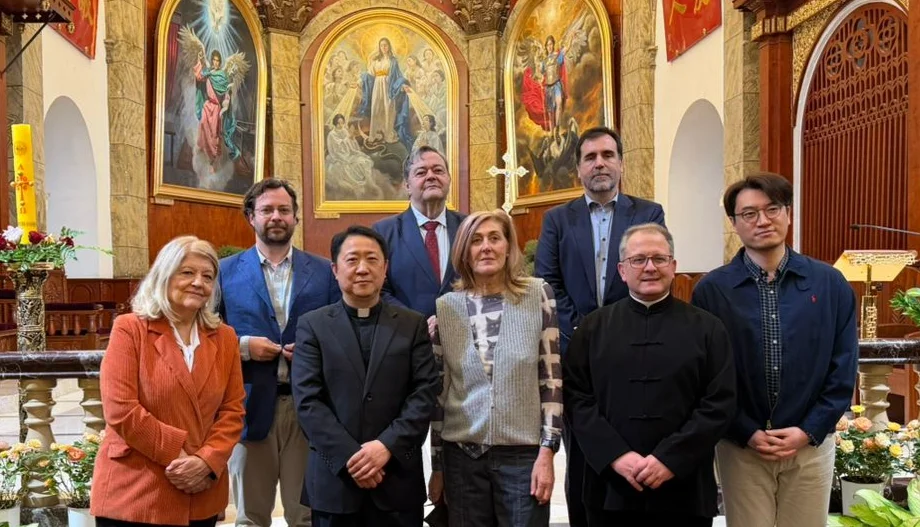
Within the framework of this project, last April, the Spanish Ambassador to China, Marta Betanzos, visited the historic South Cathedral in Beijing together with the promoters of the Institute and other members of the embassy. There they were received by the parish priest Joseph Zhang and members of the local community.
This temple was for years the cathedral of Pekin and has a deep historical connection: both Matteo Ricci and Diego de Pantoja lived on the grounds. In the present church, which dates from 1908, three large paintings on the main altar - dedicated to the Immaculate Conception, St. Michael and St. Gabriel - are the work of the Malaga painter Raúl Berzosa.
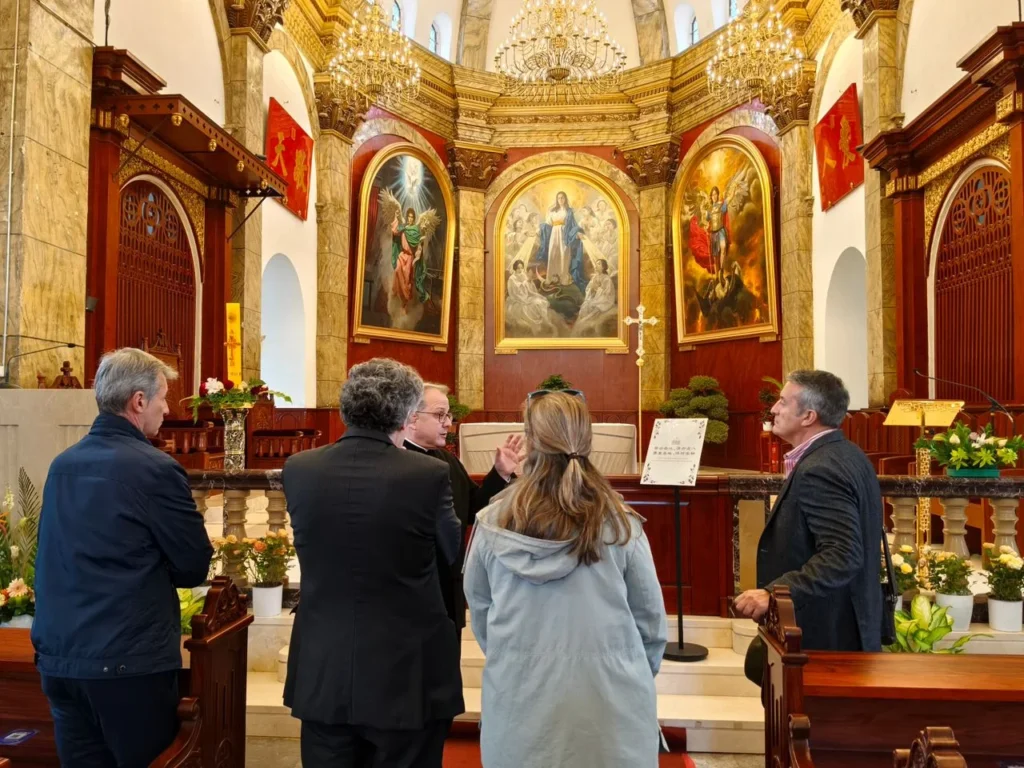
The visit also included a tour of the new stained glass windows, including those dedicated to St. Ignatius of Loyola and St. Francis Xavier, as well as the “Diego de Pantoja Conference Room”, presided over by a portrait of the Jesuit missionary.
In this space, the attendees learned about the recently created “Fondo Bibliográfico Pantoja”, composed of works in Chinese and Spanish on the relations between the two countries and the Latin American world. The day concluded with the screening of a documentary on the life and legacy of Pantoja, in an atmosphere marked by cordiality and cultural exchange.
With this initiative, the “Diego de Pantoja Institute” aims to recover and project into the future the spirit of dialogue and understanding that marked the life of one of the first great mediators between China and Spain.






 Español
  English
  Italiano
  Français
  Deutsch
  Polski