




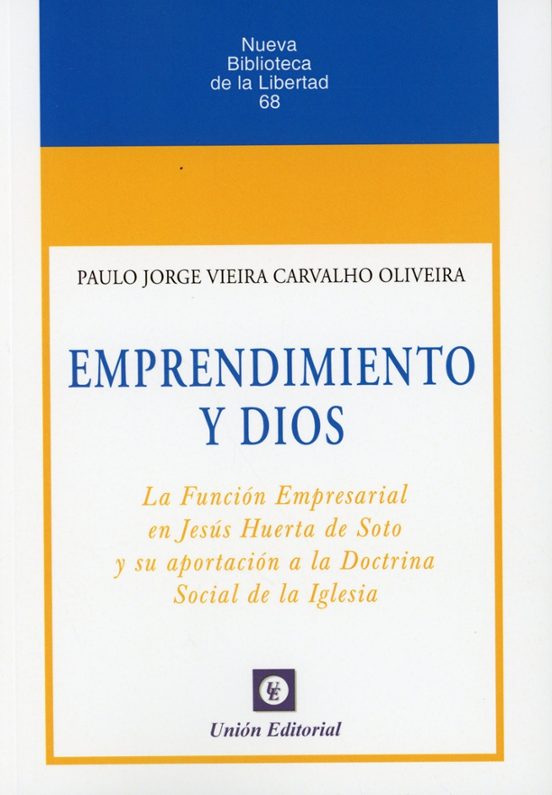
In the following lines we will summarize the doctoral thesis in Moral Theology of Justice and Social Doctrine of the Church, written by Professor Paulo Jorge Vieira Carvalho Oliveira, an intelligent and prepared Portuguese businessman and economist who was ordained a priest and who has produced this magnificent work.
Likewise, the thesis itself is a summary of the contributions of a professor of Economics at the Universidad Rey Juan Carlos to the Social Doctrine of the Church from the angle of the so-called Austrian School, of which he is an important defender and disseminator. Logically, the volume includes all the recent papal magisterium.
Method and sources
I hope not to disappoint either Paulo Jorge or my great friend Jesús Huerta de Soto, and that this summary of the summary of the summary of the summary does not become the depauperation of such a rich doctrine and such a wise and enriching spirit, in accordance with the old principle that “copying impoverishes”.
Certainly, the Austrian School, based, like the School of Salamanca, on the dignity of the human person and on the Christian humanism propitiated from Francisco de Vitoria, Domingo de Soto and Melchor Cano to the present day, will add, through the contribution of Friedrich Hayek, a systematic and exhaustive critique of the socialism of the forties and today; that is, the control of the State over the institution of the free market and prices (p. 41).
The business function
The fundamental contribution of Huerta de Soto will be focused by Professor Vieira on “the entrepreneurial function in Huerta de Soto”, for which he will explain the main characteristics of the entrepreneur in the life of the market.
Logically, the characteristics of today's businessman have a different profile than the one thought by Francisco de Vitoria, since the market life of that time is not the same as today. In any case, Huerta de Soto sees the merchant as the entrepreneur, as a man who has taken upon his shoulders the mission of serving the nation, while at the same time serving the family and his own community. The common good is much more, therefore, than the sum of particular goods (p. 49).
Ethics and virtues
Certainly, Francisco de Vitoria has a great influence on Huerta de Soto, since he grants freedom the key characteristic, as well as that of thinking about the whole society in which he is working and the repercussion of the works on society as a whole (p. 50). In this sense, he will unite justice with charity as two essential virtues for social life, together with prudence.
For Huerta de Soto, being entrepreneurial means being “homo sapiens” and “entrepreneurial man” (p. 51). Certainly, new technologies have contributed to a new vision of dignified and responsible human action.
It is interesting to note the practicality that Huerta de Soto imposes on the philosophy and ethics of a company, since “business ethics must be entrepreneurial. It is not about determining the ideal behavior or finding the perfect person, but the decision to be good here and now in certain circumstances” (89).
Market, prices and competition
And he adds: “ethics is the search for the reason for existence; it is not a theoretical search, that would be Anthropology or Metaphysics. Ethics is the search for the raison d'être of life in life. Ethics aims at every moment to orient towards the ultimate end” (p. 90). Evidently, business ethics has much to do with the art of the possible, since it moves between two extremes: moral relativism, on the one hand, and, on the other, the rigidity of forms: “this has always been done this way” (p. 93).
Therefore, for Huerta de Soto, the key element of business ethics is the free and collegial decision: “its actions are not measured only by questions of efficiency, since these are preceded by considerations of ethics and justice” (p. 96).
We would now like to dwell on the theory of the just price. For Francisco de Vitoria it would be the common feeling of Christian merchants. Moreover, he adds, the State should let the law of supply and demand work. Huerta de Soto would affirm that it is fixed “through a social process, in a system based on the division of knowledge and labor and applying the law of marginal utility” (p. 108).
With respect to healthy competition and failed monopolies, the entrepreneur must handle himself with the utmost prudence and maintain his interest in serving his own family and the society in which he lives. He will then point out: “consumers are the great beneficiaries of this adjustment of the market to their needs, which improves their quality of life” (p. 112).
Current issues and conclusion
With respect to credit expansion and the readjustments that had to be made after the 2008 crisis, given the abundance of credit and the necessary control mechanisms and the problems of certain toxic funds and products, our doctor will bring in Huerta de Soto's opinion about maintaining the maximum level of freedom of action for both bankers and businessmen (p. 129).
Further on, our doctor will refer us to Huerta de Soto's opinion on international relations and immigration. Logically, these considerations are of the utmost interest, since both in the 16th century and nowadays they are having repercussions on the number of unemployed, homeless and familyless people, which has repercussions on social fragility and discarding, problems of addictions and violence, crime, etc. (p. 141).
Evidently, neither Huerta de Soto nor Francisco de Vitoria had any other opinion than the dignity of the human person and the right of nations to regulate traffic and immigration.
The last chapter will gather the extensive documentation of the Church's magisterium on Social Doctrine and will underline the convergence with Huerta de Soto's ideas.
Entrepreneurship and God. The entrepreneurial function in Jesús Huerta de Soto and his contribution to the Social Doctrine of the Church.






 Español
  English
  Italiano
  Français
  Deutsch
  Polski