


 Neither racism nor chaos: the lesson of Salamanca on migrationThe School of Salamanca and the French RevolutionFrancisco de Vitoria and peace
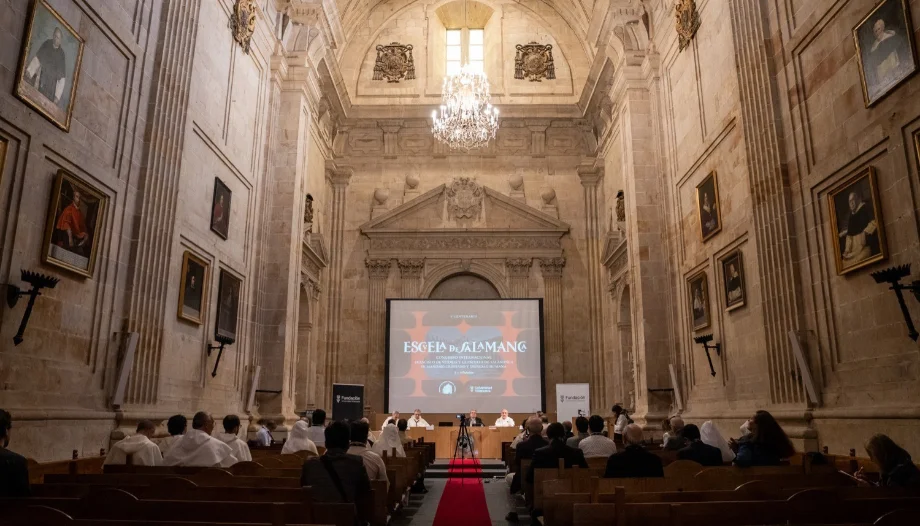
The International Congress “Francisco de Vitoria and the School of Salamanca: Christian humanism and human dignity”Organized by the Dominicans and the Villanueva University of Madrid on the occasion of the Fifth Centenary of the School of Salamanca, brought together from October 1 to 4, 2026, leading specialists in the New Chapter of the historic convent of San Esteban, where Francisco de Vitoria, Domingo de Soto and other illustrious members of the Order of Preachers lived and are buried.
The inaugural lecture was delivered by Luis Argüello, Archbishop of Valladolid and President of the Spanish Episcopal Conference. Drawing on Leo XIV's address to the Cortes Generales (Spanish Parliament), Argüello explored some of the key questions of the School of Salamanca: the concept of the person, human dignity, the common good, freedom, conscience, and the relationship between reason and faith. During his address, he encouraged the defense of human dignity and the common good, as the Masters of Salamanca had done in their time. Quoting the Pope's speech to the Spanish Parliament, he affirmed that “The defense of human life is not a partisan issue, nor a confessional interest, it is a goal of civilization.”.
For four days, specialists in theology, philosophy, law and history addressed the validity of a tradition born five centuries ago around figures such as Francisco de Vitoria, Domingo de Soto and Melchor Cano.
A tradition that continues to challenge the present
The Master of the Order of Preachers, Friar Gerard Francisco Timoner III, explained the meaning of the commemoration in a video message from Rome: “Commemorating the fifth centenary of Vitoria’s teaching in Salamanca is not simply remembering what he taught, but renewing the task to which his thought calls us, discerning with intellectual honesty and moral courage what justice demands of us in the circumstances of our own time.”.
Timoner linked the current presence of the Dominicans in the United Nations with the mission initiated by Francisco de Vitoria. “Vitoria did not shy away from the great issues of his time, but rather addressed the dignity of the person, the rights of peoples, justice and the limits of power as a theologian and preacher,”, He recalled. After the congress, all the Dominicans received a letter from the Master of the Order dedicated to “the enduring relevance of Francisco de Vitoria.”.
For his part, the provincial prior of the Province of Hispania, Friar Javier Carballo Fernández, recalled that the congress sessions took place where those teachers “They lived, they prayed, they studied, they argued” and developed their intellectual and evangelizing activities. A proximity that invites us to maintain a relationship “deeper intellectual and spiritual” With that tradition, we will continue working “for the dignification of humanity.”. Their representatives, “They are not mere figures from the past, but interlocutors from whom to ask again about the meaning of humanity, truth, justice and the common good.”.
The rector of Villanueva University, Ester Mocholí, also rejected a merely historical commemoration. “This Congress is not for looking back with nostalgia, but for offering Christian humanism as a living, fresh and urgent alternative to the anthropological crises of our time,”, He stated that among these challenges he specifically cited globalization, artificial intelligence, and digital transformation, in which it is a priority to place technology and progress at the service of the individual.
Theology, philosophy and law to return to Vitoria
The congress featured presentations by Friar Serge-Thomas Bonino, who enlightened us on Thomism and humanism in Francisco de Vitoria; José Manuel Aparicio Malo, who spoke about current globalization in light of Vitoria; Mercedes Rubio, who championed John of St. Thomas Aquinas as a key figure in the path that modernity could have chosen versus that of Descartes; Ignacio Sols, who highlighted Domingo de Soto as the discoverer of the law of universal gravitation; Friar Sixto J. Castro, who engagingly addressed the encounter between Thomism and Vitoria; Friar José Rafael Reyes González, with Sacred Scripture in Domingo de Soto; Miguel Navarro, on the Church Fathers in Vitoria; and Friar Ricardo de Luis Carballada, who spoke of faith and reason in Vitoria, recalling Benedict XVI's words in Regensburg: “To act against reason is to act against the divine essence.”.
Also participating were Adelaida Sagarra, who delved into the law of nations and human dignity in America; Juan Manuel Burgos, on Fray Alonso de la Veracruz and the Royal and Pontifical University of Mexico; Javier Crevillén, who gave us some insights into Vitoria's political philosophy; David Torrijos, on Vitoria's conception of human dignity in the Second School of Salamanca; Idoya Zorroza, on the sources of Tradition in Vitoria's concept of human dignity; Santiago Leyra-Curiá, on Francisco de Vitoria's courage in speaking clearly about his limits to the Emperor and the Pope; Leopoldo Prieto, on human sociability and Christian Aristotelian humanism; and Ignacio Carbajosa, on the Complutensian Polyglot Bible and Cardinal Cisneros's reform, which might have prevented the Protestant Reformation had it been extended earlier throughout Christendom. and José Carlos Martín de la Hoz, on truth, history and law at the School of Salamanca.
The Congress was closed by Friar Pablo C. Sicouly, Vicar of the Master of the Order, with a presentation on "The School of Salamanca in the Tradition and Intellectual Mission of the Order of Preachers." He was accompanied by Friar Manuel Ángel Martínez Juan, President of the Faculty of San Esteban. A solemn closing Mass was celebrated on Sunday, October 4, accompanied by the Choir of the Pontifical University of Salamanca.
From Salamanca to today's big questions
The congress commemorated the 500th anniversary of Francisco de Vitoria's beginning his teaching career in Salamanca, the starting point of the School that would eventually take the name of the beautiful Castilian city. From San Esteban, Vitoria and other Dominican masters developed a theological reflection capable of engaging with the political, social, and economic changes of their time, and especially with the questions raised by the encounter between Europe and America. From those debates emerged contributions on human dignity, the rights of peoples, international law, the limits of political power, and the morality of economic activity.
Five centuries later, the gathering revisited that tradition to explore its relevance to contemporary issues such as globalization, digital transformation, science, freedom, conscience, and new anthropological challenges. The sessions addressed the enduring relevance of the School of Salamanca from theological, philosophical, historical, and legal perspectives, aiming to revive its methodology for tackling the major questions of our time through study, interdisciplinary dialogue, and reflection on the dignity of every person. This is the moment for a new School of Salamanca to usher in a new era, one that we are now beginning.




 Español
 English
 Italiano
 Français
 Deutsch
 Polski