


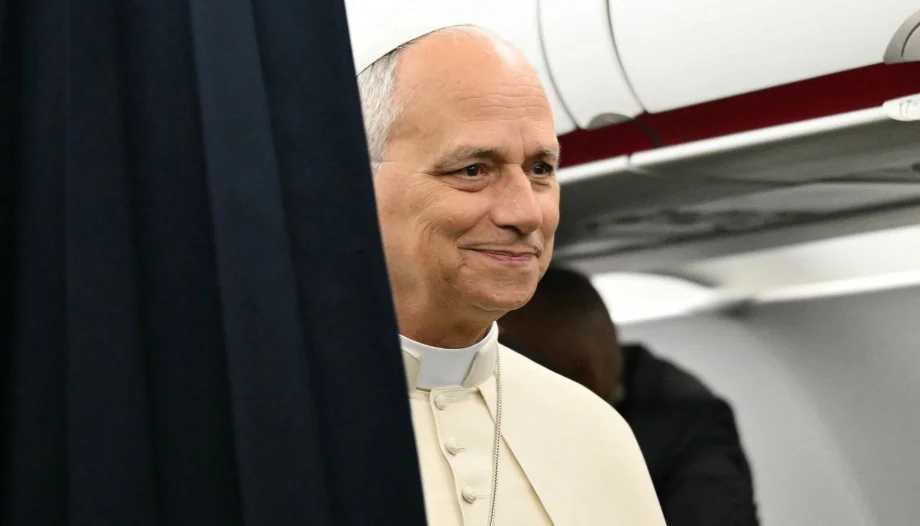
His first activity in Metz was a meeting with representatives of different religions at the Robert Schuman Congress Center. Religions, he said, are called to build peace and to be guardians of life. Following the example of Robert Schuman, who transformed Europe's old divisions into bridges, the Pope advocated for dialogue that does not dilute one's own identity: "Dialogue does not diminish our identity, but rather expresses it with simplicity and truth, opening itself to the differences of others.".
He also condemned the use of God's name to justify violence: «Invoking God's name to legitimize violence or oppression is a profanation of that name. Nothing that disfigures human dignity can be claimed as a genuine divine inspiration.» The Pope also affirmed that the greatness of a civilization is measured by how it protects the human person, especially the most vulnerable: «The greatness of a civilization is not measured by its material successes, but by the way in which it embraces, protects, and elevates the human person. Religions are guardians of life.».
Europe, between its Christian roots and peace
Later, Leo XIV attended a meeting entitled "At the Roots of Europe, for Peace and Unity." In his address, the pontiff proposed returning to Europe's roots to build peace and unity. Following Robert Schuman, he indicated that Europe is a cultural reality born from the encounter with the other and marked by Christianity: "Europe must be understood as a cultural and historical reality before it is a geographical one." And he emphasized the place of faith in its identity: "One cannot speak of Europe without mentioning Christianity.".
Leo XIV lamented the return of war to the European continent, a new «useless massacre,» in the words of Benedict XV. In response, he called for patient dialogue and boldness in negotiations, with a willingness to compromise to achieve peace: we must «show boldness in negotiations and be prepared to sacrifice some positions for the greater good of peace.» He clarified that this pursuit «must not be confused with naive irenicism.» In this regard, the Pope warned: «We must beware of the illusion of rearmament.» And he quoted his message for this year’s World Day of Peace: «It is no coincidence that the repeated calls to increase military spending and the decisions that this entails are presented by many leaders as justifications of the danger posed to others.».
Metz, land of reconciliation
In the afternoon, the Holy Father presided over Mass for Peace and Justice at St. Stephen's Cathedral, known as the Lantern of the Good Lord, with some two thousand people inside the church and thousands more watching on screens set up in the streets. In his homily, he explained that peace is a house that God gives, but that people must build it together with law, justice, charity, and forgiveness: "Peace, which is a gift from God, demands a response from people in a shared effort." He recalled that Metz, a land of wars, is also a land of reconciliation: "Metz and the Moselle River bear witness to the whole world that reconciliation is possible only when we have the courage to break the chains of resentment.".
For the Pope, the cathedral, with its stained-glass windows by Marc Chagall, is the image of what Europe is called to be: «The future of Europe does not lie in uniformity, but in the harmony of differences, where the wounds of the past become fissures that allow light to filter through.» Therefore, in his farewell, he asked the community of Metz to be, «today more than ever,» a beacon of hope for France, for Europe, and for the world.
After the mass, he went to the Metz-Nancy-Lorena airport, where he was seen off by the President of the Republic, Emmanuel Macron, before departing for Rome.
France discovers a living Church
The trip has left France and Europe with much to reflect on. The Pope placed the dignity and defense of human life, from conception to natural death, at the heart of his visit and speeches, linking it to the call for peace and unity in Europe and the world. For its part, France offered the world a surprise: in a secularized and increasingly de-Christianized country, thousands of young people and adults are discovering Christ in their lives, deciding to follow him, and requesting to join the Church through the path of Christian initiation, which culminates in baptism, confirmation, and the Eucharist. To these are added many baptized individuals who, after years of estrangement, are returning to the faith and the sacraments. A sign that, as the Pope himself said, left him "amazed" and "transcends statistical and sociological analysis."«
Perhaps the image that best encapsulates the visit was the Mass in the Place de la Concorde and on the Champs-Élysées. Nearly 800,000 people attended the ceremony. The Pope was acclaimed by French citizens from all over the country as he traveled in the Popemobile along the iconic Parisian avenue, a source of national pride for the French and the stage for major parades and national celebrations. There, the successor of Peter, Vicar of Christ, was received and cheered. Then, the Place de la Concorde, which during the Revolution was a site of execution by guillotine, was transformed, with the Mass, into a place of encounter, unity, and communion.






 Español
  English
  Italiano
  Français
  Deutsch
  Polski
  简体中文
简体中文