


The Catholic Church is an institution that has been present in society for more than two thousand years. We can consider it the longest-lived in the history of humanity, at least as far as we know. Over the centuries it has gone through epochs and profound transformations, accompanying the evolution of humanity itself.
Since its origins, it has always set as its goal the spiritual good of the people, while at the same time taking on a concrete mission: to guide one of the largest communities in existence. But what is the secret of such long-lasting governance, what does it mean to “govern” the Church today, and what will be the future of this governance in an increasingly complex and unpredictable context?
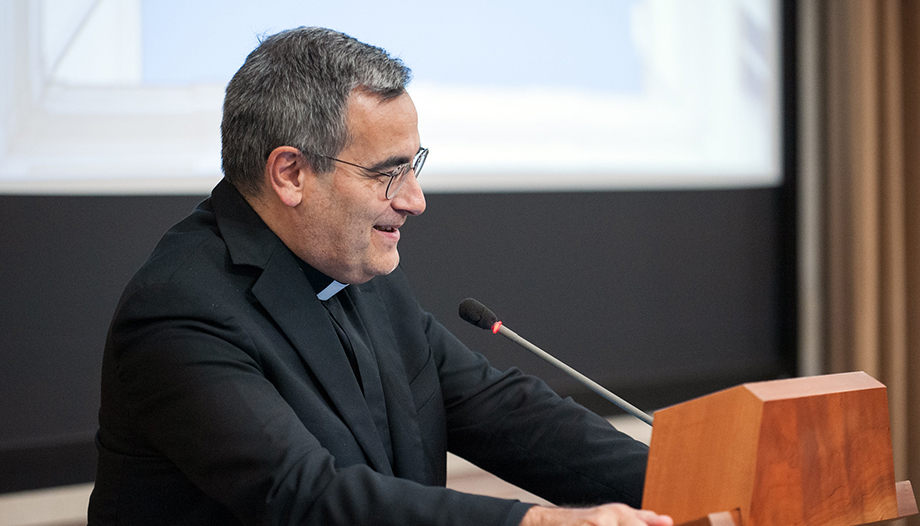
We talked about this with Father Fernando Puig, rector of the Pontifical University of the Holy Cross and Professor of Canon Law at the Faculty of Canon Law of the same university.
When we speak of “government” in the Church, do we speak of power or of service? What is the concrete difference for the faithful?
-One of the first elements to take into account in this context is that the faithful perceive the attitude of service of those who govern. Therefore, it is a matter of making this attitude not only the result of the ruler's personal virtues, but of the understanding and the “development” of the form of governing itself.
This was affirmed, for example, by the Second Vatican Council, and has been repeated for 60 years, but we are still stuck on a moralistic plane: in short, a theological and juridical understanding of government as service is needed.
How should the Church's form of governance differ from that of a State or a company?
-Let me say, first of all, how the Church's form of government should resemble that of a good government that we would define as “secular”: in professionalism, which implies training, and in the responsibility for the acts of government towards the governed.
Then we speak, with good reason, of different plans. In the first place, because the foundation of the Church's government is not democratic, and also because, in comparison with public institutions or businesses, the primary objective is the spiritual good of the people. Ultimately, for the Church it is fundamental to facilitate the action of the Holy Spirit and the exercise of the freedom of the faithful in communion. This changes many things.
Is it possible to reconcile authority and listening? Can the Church make decisions without losing contact with people?
-I am told that in some parts of the world the faithful are not listened to because pastors are convinced that they know better than the faithful themselves what they need. Moreover, we must be convinced that the faithful have the right, not to just any government, but to good government. In governing, pastors give to the faithful what belongs to them, what is their good. Listening, therefore, becomes a fundamental condition for achieving such understanding. This is valid both for pastoral government in general - which must not for that reason become an assembly - and for the procedures for the specific allocation of goods to the faithful, by means of administrative acts.
Does synodality really change something in the life of the communities or is it a theoretical idea?
-It changes if it is truly applied, in depth and on the basis of a valid theological understanding. It is interesting to note the evolution that has taken place from “synodality” as an idea to the “synodal and missionary” Church. Today we speak of the “conversion of relationships” and the relationship between the common priesthood of the faithful and the ministerial priesthood is being rediscovered as the basis of synodal commitment.
On the other hand, listening and dialogue imply a lot of preparatory study, a lot of work in favor of a culture of co-responsibility, a spirit of sacrifice and perfected instruments: not every type of meeting is suitable for every type of debate or decision. And then we need the ability to know how to rectify: governing well is difficult, it requires a lot of respect for people and a lot of distance from personal interests.
What can other organizational models, even non-religious ones, teach the Church?
Some of the formalizations of civil government have inherited forms that arose in the Church, as we saw in the colloquium held at the University of the Holy Cross on April 20-21, 2026. The very idea of government has been a philosophical and theological problem in the Christian context; not a few aporias of secular government today are due to the fact that they have their origin in the secularization of Christian debates.
That said, it seems to me that Church authority is fortunate to be able to learn a great deal from professionals who put their skills at the service of the mission. Here we find the challenge of formation for governance, which is a whole chapter to explore and is on the horizon of the research project. Purpose and models of governance in the Church, always active at Santa Cruz as part of our Research Laboratory.
How can we prevent those who exercise a position of responsibility in the Church from falling into the abuse of power?
-He is often hasty in asserting that there is an abuse of power. Governing is necessary, but difficult; rulers make mistakes. A healthy tradition of governance makes use of ordinary management tools that encourage collegiality, the gathering of information, study and work in writing, in order to avoid an excess of unilateral decisions and to share the preparatory phases with verification based on transparent criteria, etc. In addition, the possibility of review, apology and, in certain cases, appeal is crucial. Everything improves if it takes place in an atmosphere of respect for the rights of the faithful: all the faithful, laity, priests, religious, bishops. In such a context, there is little room for real abuse of power. There are errors to be corrected. Abuse of power must be rigorously identified, the culprits punished and held accountable with due reparations.
What concrete instruments do the faithful have at their disposal to feel that they are active participants and not just recipients of decisions?
-The initiative of the faithful has practically no limits: the lay faithful build up the Church without the need for mandates from the ecclesiastical structure. They are an active part of it by virtue of their Baptism. Of course, adequate formation is necessary.
The decisions of government refer to hierarchical expressions and to some fundamental goods that it is up to the pastors to moderate. Conflicts become more acute when the race for institutional and ecclesiastical spaces, which are the most instrumental dimension of the Church, begins. Pope Francis showed himself to be very inspired when, in Evangelii Gaudium, advocated for structures, styles and languages that are permanently “mission status”.”.
In a Church present in very diverse cultures, how can unity be maintained without limiting differences?
-We must actively trust in the Holy Spirit. He is the architect of communion. I say “actively” because part of governance consists in paying attention to this balance between unity and diversity. When the objective is mission - and not the defense of space - one finds, always with sacrifice, responses that leave room for the Holy Spirit.
If you had to point to one urgent change in the way the Church is governed today, what would it be?
-The Code of Canon Law says almost everything; if it were applied five times more carefully and rigorously than it is now, ecclesiastical governance would improve exponentially: “Before issuing a particular decree, the authority shall collect the necessary information and evidence and, as far as possible, hear those whose rights may be injured”.”. Listening and accountability. Responding to the faithful about how you are trying to improve things.





 Español
  English
  Italiano