


 Leo XIV: “Do not resign yourselves to the voices that repeat that the Christian family is outdated”The Pope reminds people with disabilities that their lives “are a blessing”The Pope in Buenos Aires: “The Church wishes to remain close to the Argentine nation”
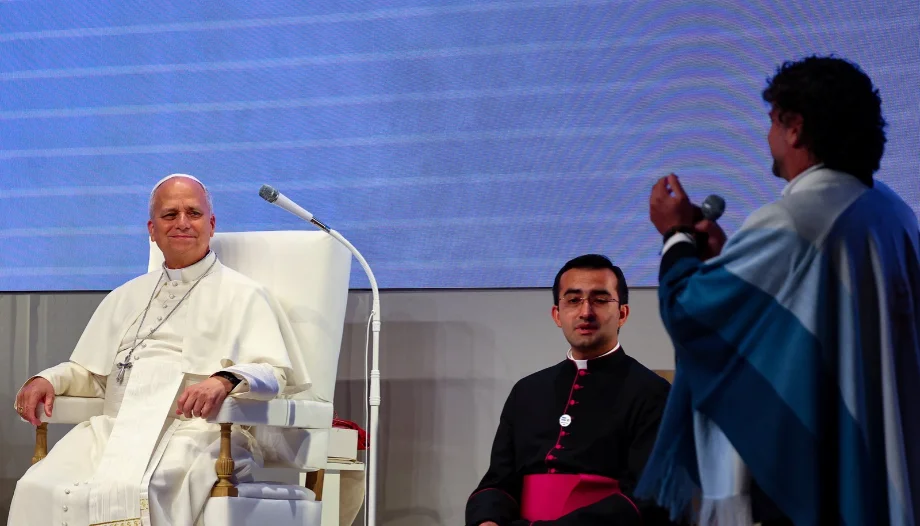
Following this morning's Mass in Palermo, Pope Leo XIV dedicated the afternoon to the world of Argentine labor at the Catholic University of Argentina (UCA). In his address, the Pope reviewed the principles of the Church's social doctrine and emphasized what he considers the most fundamental: the dignity of the human person, from which it follows that the economy “must be at the service of the person, and not the person at the service of the economy.”.
He was received by the Archbishop of Buenos Aires and Grand Chancellor of the Catholic University of Argentina (UCA), Jorge García Cuerva, and the Rector, Miguel Ángel Schiavone. In the main auditorium, the President of the Episcopal Commission for Social Pastoral Care, Dante Braida, Bishop of La Rioja, thanked him for the emphasis he placed on work in his first encyclical and did not conceal the bishops“ concern: ”The high unemployment rate and job insecurity are a reality that worries us." Braida entrusted the meeting to Saint Joseph and Blessed Wenceslao Pedernera, martyr and promoter of rural workers' cooperatives.
“We work to live with dignity”
Before the speech, five people shared their experiences. Businessman Juan Martín Allende, who lost his youngest daughter, confessed that his faith wavered during his most active period: “It never went out, but I had to choose it again.” He also spoke about the difficulties faced by those who want to do their job well in an environment where, sometimes, “kindness is mistaken for naiveté.” Dolly Magali Jojot recounted how she accompanied a neighbor from a vulnerable neighborhood in Paraná, who had an informal job and didn't dare go into a bank. Soledad Cuellar, from the Ava Guaraní community of Pichanal, in Salta, explained her work with women struggling with substance abuse and the project they launched together, Ñande, which means “ours” in their language.
Union representative Sabrina Sapone emphasized the human dimension of work: “We don’t live to work, we work to live with dignity.” Finally, Verónica San Martín, a mother of four, began collecting cardboard on the streets after losing her job and having to leave her home. Today, she is part of the Recicladores Unidos cooperative, which brings together more than 200 people: “We cardboard collectors are not trash: we are workers, we have dignity, and with our work we care for our common home.”.
Dignity, common good and solidarity
Leo XIV insisted that work “is not an instrument of conflict,” but a way of collaborating with God’s work, and he described what happens when this perspective is lost: “Where the rule of the few is the law, work becomes exploitation.” Regarding unemployment, he was clear: “To deprive a person of work is not simply to deny them an income; it is to gravely wound their dignity.”.
The Pope also addressed other principles of Catholic social teaching. In this review, he defended the right to private property, albeit “burdened by a social obligation,” and explained that, according to the principle of subsidiarity, “the State does not have to do everything,” but rather support families, communities, and social movements. Within this framework, he placed the waste pickers, farmers, and artisans who organize “from the ground up,” and reiterated the three “T’s” advocated by Pope Francis: land, housing, and work. All of this, he said, is the path to building a “social friendship” that overcomes polarization in Argentina.
The algorithm or the person?
To business leaders, he offered the venerable Enrique Shaw, a Catholic businessman who helped found the UCA (Central American University), as a role model. Leo XIV praised their willingness to risk their assets to create jobs, but cautioned them against greed: “When economic profit is absolutized as the sole criterion for success, the company becomes dehumanized.” He acknowledged the “indispensable” role of labor unions in defending the voiceless, provided they also consider the needs of precarious and informal workers.
The Pope also addressed artificial intelligence and unregulated automation, which could jeopardize many jobs: “Technology must always be subordinate to ethics; algorithms cannot replace human discernment.” Finally, he encouraged those present not to underestimate any task: “No job is too small in the eyes of God.”.
At the end of the meeting, Leo XIV presented the university with a painting of Our Lady of Good Counsel, a devotion much beloved by the Order of Saint Augustine, to which the Pope belongs. From the UCA, he traveled to the San Martín Palace to meet with leaders of other Christian denominations and religions, before praying Vespers with the Argentine bishops in the cathedral.





 Español
 English
 Italiano
 Français
 Deutsch
 Polski