


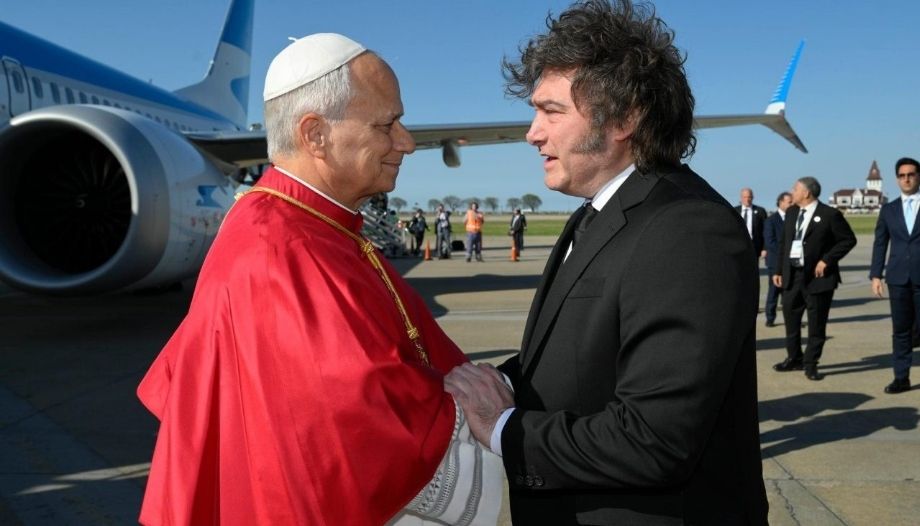
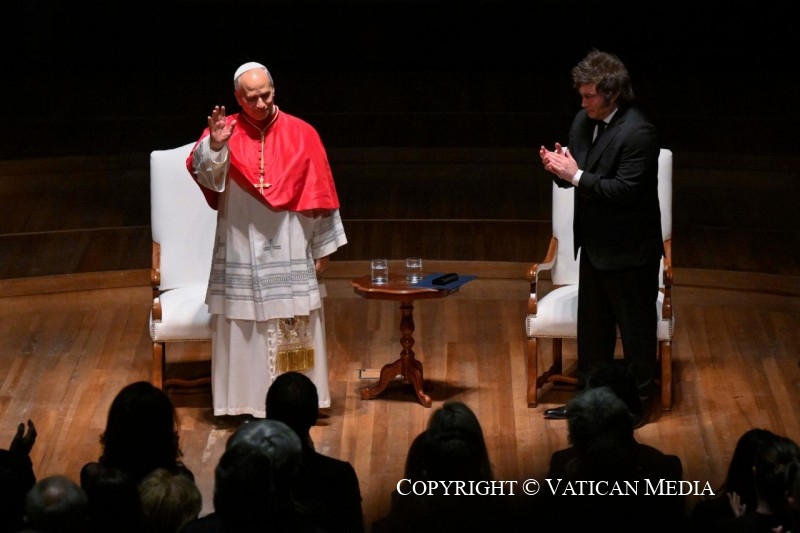
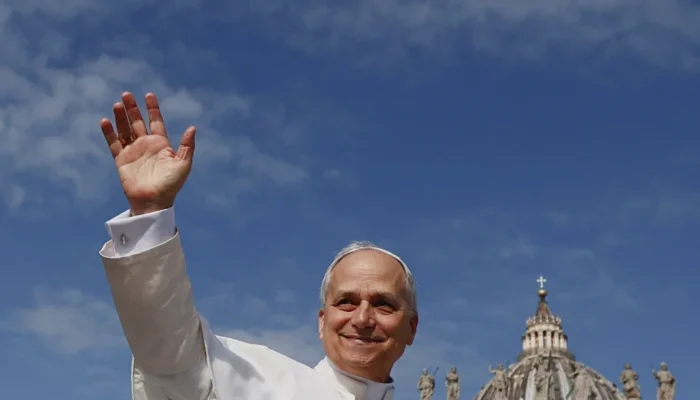
Leo XIV was greeted with a long round of applause today at the meeting with Argentine authorities and the diplomatic corps, before the Argentine president began to speak at the “Palacio Libertad, Centro Cultural Domingo Faustino Sarmiento”.
In his opening remarks, Javier Milei acknowledged being a believer and the characteristic that “we are a people of faith,” before referring to Pope Francis and praising the presence in the audience of people of all political persuasions.
The Pope had landed in the mid-afternoon at Jorge Newbery Airport in Buenos Aires, arriving from Uruguay. In a telegram addressed to President Yamandú Orsi, the Pope thanked the Uruguayan authorities and the entire nation “for the warm welcome and generous hospitality they have extended to me during this visit.”.
Applause for Leo XIV's reference to Francis
“I have come as the Successor of the Apostle Peter and, therefore, as a shepherd,” the Pope began. “I wish to meet with the Church that journeys on this earth and also to address the entire nation and all those who have received the task of serving it. The Church accompanies the life of peoples through the mission entrusted to her.”.
“My arrival in this land has a particular meaning for me. For twelve years, the universal Church listened to the voice of an Argentine Pontiff who carried with him, in his memory and in his heart, the places, the people and the faith that he received here.
Today, succeeding him in the Petrine ministry, I am in a way retracing my steps and coming to the homeland where Pope Francis began a story that would later become intertwined with that of the entire Church.”.
Lines from the Pope's speech
Pope Leo XIV expressed his condolences this Sunday, already on Argentine soil, after visiting the monument to General José de San Martín, father of Argentine independence. Speech with precise guidelines on the common good, democracy, and the family.
For example, the Holy Father has asked Argentinians to safeguard democracy, strengthen the common good – ”the economy must be at the service of the person, and not the other way around” – and maintain the willingness to engage in dialogue that has allowed them to overcome serious tensions in the history of South America.
Furthermore, he expressed that “the Church wishes to remain close to the Argentine nation,” and placed Argentina's responsibility at the service of peace in South America, with a call to preserve the will for dialogue and paths of negotiation and understanding that have allowed tensions to be overcome in the history of the region.
Democratic coexistence
Leo XIV dedicated a significant portion of his speech to democratic coexistence. “Democracy also belongs to that heritage which must be safeguarded,” he emphasized. In his view, it is strengthened through citizen participation, respect for institutions, and the freedom to express one's own convictions.
“Democracy is also strengthened in the everyday way of acting in public life: in the willingness to listen, in the care of the word, in the patient search for agreements and in the ability to recognize in someone who thinks differently a compatriot with whom one shares the same destiny,” he said.
The Pope reminded those who hold public office that “authority reaches its highest meaning when it is exercised as a service,” and he placed the common good as the guiding principle for political decisions.
“Family occupies an essential place”
The common good that authority serves must also be perceptible in the concrete conditions of daily life, the Vicar of Christ continued.
“The family, the basic cell of society, occupies an essential place here. In it, each person learns to discover that their life is linked to that of others and that they are also responsible for them. In the home we are taught to care for the weak, to forgive, to share and to stand by those who need help; and there, too, many men and women receive the first seeds of faith.”.
Argentina, blessed by God with extraordinary natural wealth
Responsibility towards humankind also extends to the care of the earth. Argentina has been blessed by God with extraordinary natural wealth, Pope Leo XIII emphasized. “Its fields, its water reserves, its energy sources, its minerals, and the diversity of its ecosystems offer ample opportunities for development.”.
A truly human ecology knows how to unite the care of creation with that of people, ensuring that the use of these resources contributes to the well-being of communities and preserves the conditions that make life and work possible in their territories (cf. Benedict XVI, Encyclical Letter Caritas in veritate, 51).
Opportunities for young people
The Pope made special mention of families living in uncertainty, those seeking employment, the elderly, and people who, despite having jobs, find it difficult to meet the needs of their households.
He also focused his attention on young people and the need to offer them opportunities to develop their life projects in Argentina. “A nation must seriously ask itself where it has failed when its young people have to leave their homeland to pursue their dreams,” he stated. He therefore called for strengthening education, vocational training, universities, and research.
“What place do those who have not yet been born occupy in our decisions?”
This horizon raises another question, as Pope Leo XIV emphasized. “What place do those who are not yet born occupy in our decisions? Before asking ourselves what kind of world we will leave them, we must recognize their dignity. Our responsibility towards future generations begins by welcoming life from its first moments and protecting it until its natural end (cf. St. John Paul II, Encyclical Letter Evangelium vitae, 101).
The same dignity demands special attention in cases of illness, dependency, and disability, the Pope added in a speech he has reiterated in Uruguay and other countries since his arrival at the See of Peter. “These times, too, it is our responsibility to care for, alleviate suffering, accompany, and make each person feel that their life always retains a value that no circumstance can diminish.”.
The legacy of the Christian faith, a mark that runs through the nation
In his address, the Holy Father invited everyone to view Argentine history as a legacy received from previous generations and passed on to future ones. He highlighted the country's welcoming nature, a nation comprised of people from diverse backgrounds, and recalled some of its cultural expressions, from José Hernández's Martín Fierro and the literature of Jorge Luis Borges to tango and the sharing of mate.
“The nation that is in your hands today will be the inheritance of others tomorrow,” he affirmed. He also placed the Christian faith within that inheritance, whose imprint, he said, “permeates the nation’s memory and remains alive in countless Argentinians who have found in the Gospel a source of meaning, hope, and fraternity.”
He reminded those who hold public office that «authority reaches its highest meaning when it is exercised as a service,» and he placed the common good as the guiding principle for political decisions.
Dialogue and cooperation in South America. In service of peace
The Holy Father extended his reflection beyond Argentina's borders, recalling the historical, human, and cultural ties that unite the peoples of the continent. “South America possesses great human and natural wealth, and its peoples share historical bonds and cultural traditions that offer ample opportunity for cooperation,” he said.
In this regard, he called for strengthening spaces for dialogue and collaboration between countries and warned about common threats such as organized crime, human trafficking networks, arms and drug trafficking, and corruption.
In his remarks on the service of peace, Leo XIV recalled moments in South American history when it was possible to find paths of negotiation and understanding to overcome serious tensions. “Argentina is called upon to preserve the will to dialogue and contribute to ensuring that it continues to bear fruit,” he stated.
Contribution of the Church to Argentine society
In the final part of his address, the Pope explained the contribution the Church wishes to offer to Argentine society. He recalled its historical presence in the Americas, accompanying its people through evangelization, education, care for the sick and the poor, support for families, and the promotion of peace and reconciliation.
“This mission is born from the love of Christ, who shed his blood for all,” he said, and continues today in parishes and communities, called to keep their doors open so that each person may find welcome and closeness.
“There are goods that a society needs and that no public policy can produce on its own,” he continued, citing trust, forgiveness, and a willingness to serve as examples. “Faith nourishes and sustains these goods.”.
Hence his most explicit statement regarding the Church's presence in the country: “For this reason, the Church wishes to remain close to the Argentine nation, to live charity by sharing its burdens and its joys, and to offer it the hope that springs from the Gospel.” And here he was referring to Pope Francis's encyclical Laudato si’.
Our Lady of Luján, guardian of his memory
My thoughts turn finally to “Our Lady of Luján, silent guardian of his memory,” Leo XIV declared.
Generation after generation, mothers and fathers, workers, young and old from every corner of the country have come before her image, bringing with them the worries and hopes of their time. “To those prayers I want to add my own today.”.
The Pope wished to do so “with the words that Pope Francis spoke thinking of you: “May the Lord make you grow as a people’ (Video Message to the Argentine People, September 30, 2016). I ask this of the Lord from my heart, through the intercession of Mary Most Holy of Luján.”.
May she continue to watch over this land, care for each of her children, and keep them always close to Jesus. May God bless Argentina and all its inhabitants,” he concluded.
Monday: Little Cottolengo by Don Orione de Claypole, Holy Mass….
On Monday the 9th, the Pope has planned a visit to the small Cottolengo Don Orione of Claypole, and afterwards, celebrate Holy Mass at the Monument to the Spanish at 11:30 am local time.
Meetings with the world of work and with leaders of Christian communities and religious traditions will be other events on Monday, concluding with the celebration of Vespers with the Argentine Episcopate and the synodal teams in the metropolitan cathedral of the Holy Trinity, and dinner with the bishops at the Archbishopric.
On Tuesday the 10th, the trip will take place in Córdoba, where he will celebrate Holy Mass. And in the evening, on the return to Buenos Aires, the Vigil with Young People will be held at the “Monument of the Spanish.”.




 Español
 English
 Italiano
 Français
 Deutsch
 Polski