



 Pope calls for “tearing down walls” to build a new societyPope donates a Golden Rose to the image of the Virgin Mary Salus Populi Romani
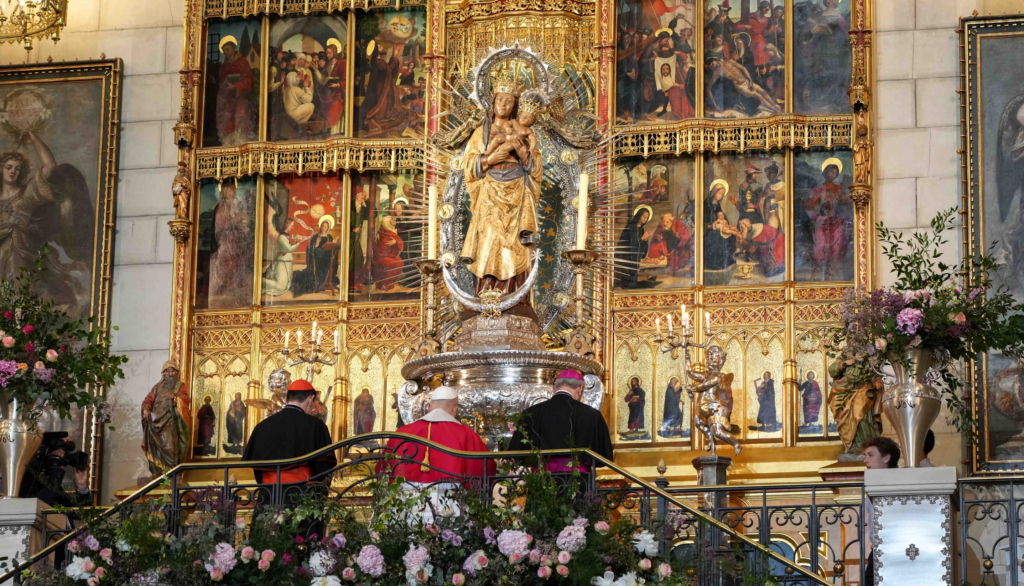
On June 8th, during his visit to Spain, Leo XIV gave a very special gift to Our Lady of Almudena, Patron Saint of Madrid, whose feast day is celebrated on November 9th. He gave her a golden rose. What is so special about this gift? An explanation of this unique present and ten other lesser-known facts about this Marian devotion.
The Golden Rose
– Supernatural Our Lady of Almudena In 2026, at her celebration, she carried two replicas of the rose given to her by Leo XIV. The workshop Sucesores de Platería Antonio Martínez crafted both roses from gold-plated silver, inspired by the one the Pope presented during his visit, which is kept protected behind bulletproof glass.
The Golden Rose is an honor bestowed by the Pope in the Catholic Church. It was established in 1049 by Pope Leo IX. It consists of a rosebush made of solid gold or gold-plated silver, complete with flowers, buds, and thorns, usually placed in an elegant silver vase or jar.
The thorns and the flower represent the Passion, death and Resurrection of the Lord, while the aroma and beauty of the rose symbolize the maternal love of the Virgin Mary and the spiritual balm she offers to the faithful.
Throughout history, it was awarded to monarchs and prominent figures of Christendom. Since the 20th century, popes have bestowed it almost exclusively upon Marian shrines, images, and devotions to the Virgin Mary as a sign of special devotion and blessing. In addition to the image of Our Lady of Almudena, three other Marian devotions in Spain hold this distinction: Our Lady of the Head in Jaén (2009); Our Lady of Montserrat in Barcelona (2023); and Our Lady of Hope Macarena in Seville (2024)..
In the Golden Rose award ceremony, Five months ago, Leo XIV, in a ceremony at the cathedral attended by Queen Sofia, called for the dismantling of walls to build a new society. He recalled that this Marian devotion “is a sign of the Christian roots that characterize you.”.
“Our Lady of Almudena tells us that to build something new, beautiful and lasting, we must be willing to destroy the walls, because to resume the journey we need spaces that allow us to glimpse the horizon,” the Pope added.
But the Virgin of Almudena has stories, legends and traditions, some less well known.
- 1. Origin of its name
It comes from Arabic al-mudayna, which means “the citadel”, alluding to the ancient walled enclosure of the town where she was hidden.
- 2. A centuries-old devotion
According to the Archdiocese of Madrid, a tradition supported by history recounts that on November 9, 1085, the front of a tower in the city wall, near the Puerta de la Vega gate, opened, revealing the image of the Virgin Mary that Christians had hidden long before to protect it during the Muslim invasion. A document from 1382 already mentions the title “Almudena” applied to an image of the Virgin Mary, venerated since ancient times by the people of Madrid.
- 3. The candles
Tradition tells that when Christians hid the image in the city wall to prevent its desecration during the Saracen invasion, they left two candles burning. When the statue was found centuries later (in 1085, after the reconquest by Alfonso VI), legend says that the candles were still burning and had miraculously consumed themselves.
- 4. A dark-skinned Virgin
The dark complexion of the carving is popularly attributed to the smoke from the candles that remained burning next to it during the centuries it was hidden in the wall.
- 5. Related to the apostles
Another ancient tradition claims that the original statue was brought to Spain by the Apostle James, sculpted by Saint Nicodemus, and polychromed by the Evangelist Saint Luke. The statue venerated today is, in fact, a 15th-century Gothic work.
- 6. The miracle of the son of Saint Isidore
Among the miracles attributed to his intercession is the rescue of the son of Saint Isidore the Farmer (Illán), who fell into a well and was miraculously saved when the water in the well rose to the surface so that he could be reached.
- 7. Coronation and patronage
Despite its centuries-long history, the canonical coronation of the image is recent, dating from the last century. The current image was crowned on November 10, 1948, and Pope Paul VI officially declared Our Lady of Almudena patron saint of the Archdiocese of Madrid on July 1, 1977.
- 8. A sweet treat: the Almudena Crown
In 1978, the Madrid Pastry Guild created a round, sweet bun filled with cream, whipped cream or truffle —similar to the Roscón de Reyes— to honor the patron saint every November 9th.
- 9. A cathedral consecrated by a Pope
The patron saint resides in the cathedral of the same name in Madrid. It is one of the few Spanish cathedrals that has been consecrated by a pope: Saint John Paul II, on June 15, 1993.
- 10. The Virgin's trousseau
This year, the Virgin will wear the mantle of Isabella II, made by the Girart sisters, the queen's official embroiderers. It was a gift from the monarch to the patron saint of Madrid on the occasion of the birth of her daughter Isabella, known as “La Chata,” at the Royal Palace of Madrid in 1851. It is made of white silk with gold embroidery. It is the same mantle she wore on June 8th, during the diocesan meeting with Leo XIV.
In addition to incorporating the copy of the Golden Rose given by the Pope, the Virgin will wear a black ribbon as a sign of mourning for the victims of the Urda train accident.
Her wardrobe is completed by the medal of honor of the city of Madrid; the sash and baton of Captain General, a distinction awarded by decree law in 1948; and the mayoral baton, of which she keeps several copies given personally by mayors of Madrid.




 Español
 English
 Italiano
 Français
 Deutsch
 Polski