


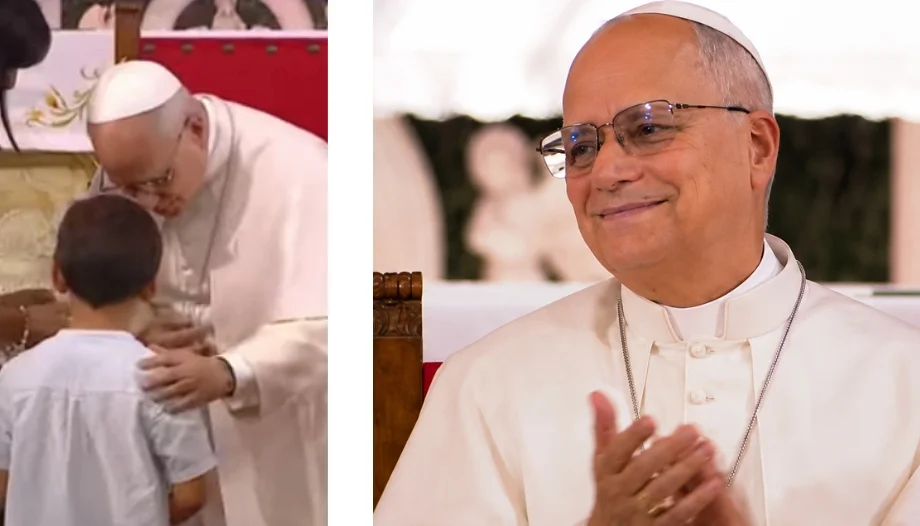
Pope Leo XIV met this Thursday with representatives of charitable and social assistance organizations of the Archdiocese of Barcelona in the church of St. Augustine, known as the “cathedral of the poor”. He visited the neighborhood of Raval, marked by poverty, immigration and social exclusion. It is one of the most multicultural areas of the city, with a strong presence of migrant communities, especially from Latin America, the Philippines and Pakistan.
The Pontiff was received by the Archbishop of Barcelona, Juan José Omella, and by the parish priest of St. Augustine, Father Faustin John Mlelva. Organizations dedicated to the care of people with addictions, entities that work with victims of trafficking in women and volunteers committed to the care of the most vulnerable gave their testimonies before the Pope, who responded emotionally, especially to the questions of Renzo, a 6-year-old boy.
Three testimonies on human peripheries
The first intervention corresponded to a representative of Caritas Diocesana de Barcelona, who recalled that during 2025 the entity accompanied more than 63,000 people in vulnerable situations. He denounced the persistence of problems such as job insecurity, difficulties in accessing housing and the loneliness of the elderly, while claiming the mission of «welcoming, defending and loving». He also expressed the helplessness felt by many workers and volunteers in not being able to reach all the people who need help.
A representative of OBINSO, an organization dedicated to accompanying people with addictions, then took the floor. He described a reality marked by loneliness, psychological suffering and loss of meaning in life. He explained that many of the people they serve come from contexts of exclusion, street or prison, and defended the importance of a constant presence based on listening and accompaniment: «it is not so much a question of resolving lives as of not turning away from them.» His intervention concluded with a question addressed to the Pope: «how to sustain hope when pain seems greater than our strength?»
The third testimony came from a nun of the Adorers, a congregation committed to assisting women victims of trafficking. The nun recounted the suffering of migrant women who left their countries fleeing violence or poverty and ended up being exploited by criminal networks. She vindicated the need to continue fighting for the dignity of these women and acknowledged «every strong and courageous woman, survivor of many shipwrecks who swim against all odds to overcome obstacles. Women capable of celebrating life by showing us that evil does not have the last word».
The meeting also included the projection of a video starring Renzo, a six-year-old boy from a poor neighborhood of Barcelona, who wanted to ask the Pontiff some questions, among others: «Do you like soccer? When you were little did you want to be Pope? Why do some people have bad things happen to them and not to others? Why are there many grandparents alone? Do we always have to forgive?». As little Renzo asked these questions, a Pope Leo could be seen full of tenderness nodding and smiling at every word uttered by the shy 6-year-old, whom he then embraced emotionally.
Pope tells an anecdote to thank for the welcome
Before answering the testimonies and questions, the Pope expressed his gratitude for the welcome he received: «Here, truly, I feel at home. Thank you for all that you represent. Perhaps you think that the reason is obvious, because it is St. Augustine, but let me tell you something.
Laughing, he added: «The first time I came to this church I did not have this archbishop sitting next to me. And he recalled an anecdote from 1984: »I was traveling by road from Rome to Leon and, upon arriving, I said: «Look, in Barcelona there is a church of St. Augustine; let's go visit it“.
However, that first visit didn't go as he had hoped. «It was closed,» he recalled. «Today it is open, and how beautiful it is to find a church with a community of Augustinians and with so many people who live the faith, praise God and find community, welcome and integration here, thanks also to this social pastoral work.».
Do you like soccer?
The Pope first responded to some of the questions raised by the child. He confessed that he likes tennis, although he also follows soccer, and used this sport as a metaphor for life «Soccer reminds us of something we must not forget: life is not a race to show off alone, but a path that we learn to walk together. Whoever does not know how to pass the ball, even if he has talent, has not yet understood the game. And whoever does not know how to live with others and for others, has not yet understood life».
Did you want to be a pope when you were a child?
About his own vocation, he explained that he never dreamed of being Pope, «neither as a young man nor as an old man,» he said with a laugh, but he did feel from an early age the desire to give his life to God. He took the opportunity to recall that each person has a unique calling and that the most important thing is to cultivate friendship with Jesus.
Why do some people have bad things happen to them and not to others?
In addressing the problem of suffering and injustice, he acknowledged that there are no simple answers, but insisted that God never abandons his children. He recalled the passion and resurrection of Christ as a sign that evil and death do not have the last word: «through the life of Jesus Christ, God shows us that, although there is suffering, he never abandons any of his children, because he has prepared for us an eternal joy where there will be no more sadness or pain. Let us have confidence, Jesus is with us, he helps us and accompanies us, and gives us strength to go through the difficult moments we may encounter in life».
Why are there so many grandparents alone, if they are so important?
The Pontiff also dedicated a few words to the situation of the elderly. He stressed that grandparents play a fundamental role in families and called for combating the loneliness that affects many of them. «Let us not allow loneliness and abandonment to become normalized in the lives of older adults. That is a very sad thing. Let's have our hearts open to all of them,» he demanded.
Must we always forgive?
Regarding forgiveness, he responded that Christians are always called to forgive, although he clarified that forgiveness does not mean justifying evil or allowing injustice to continue. For Leo XIV, forgiveness is the path that frees the heart from hatred and allows wounds to heal: «It does not mean forgetting by force, as if nothing had happened. Forgiveness means not letting hatred become the master of our hearts. And he added: »our willingness to forgive is a condition for the forgiveness we receive from God«.»
An appeal to the social action of the Church
In the second part of his address, the Pope linked the testimonies heard with the Church's social mission. He recalled that the Christian, in addition to being kind and gentle, «must be compassionate, love without interest and seek the good of others, knowing that in every brother and sister who suffers it is the Lord himself who asks and receives, who is welcomed or rejected, loved or despised.».
He recalled that every person possesses an inalienable dignity because he or she is created in the image of God and denounced a culture that too often forgets this fundamental principle. The inalienable dignity of every human being, the Pope affirmed, «does not depend on the abilities he possesses, the wealth he accumulates or the role he plays, but on the gift that precedes and exceeds him, given by God as an expression of his love that never fails» (cf. Magnifica humanitas, 50).
Before representatives of social entities, volunteers and pastoral agents, he defended that charity should not be limited to material aid, but should include closeness, accompaniment and integral promotion of the person: «they need God, his friendship, his blessing, his Word, his Sacraments and the proposal of a path of growth and maturity in faith (cf. Evangelii Gaudium, 200)».
He encouraged the organizations present to continue working with those who suffer from poverty, marginalization, addictions or exploitation. »Be credible witnesses of Christian hope,» he urged, while calling on Christian communities to approach the wounds of the most vulnerable with «discretion, delicacy and perseverance».
The visit concluded with a blessing and the personal greeting of the Pontiff to several members of the attending entities, in a church that symbolizes the social commitment of the Church in one of the neighborhoods with the greatest human challenges in Barcelona.






 Español
  English
  Italiano
  Français
  Deutsch
  Polski