



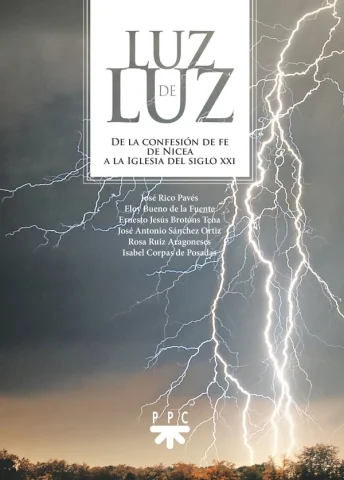
Bishop Jesús Rico Pavés of Jerez is currently the president of the Commission for Evangelization, Catechesis, and the Catechumenate of the Spanish Episcopal Conference; at the same time, he has found the time to prepare and carry out this collaborative project that we are now reviewing—one that is sure to be the subject of much discussion in the coming months, as it addresses something as central to the Church as the unforgettable figure of Jesus Christ, Son of God, true God and true man; moreover, the authors present it in a fresh and engaging way.
Certainly, we always begin milestone anniversaries—such as the recent 500th anniversary of Luther’s Wittenberg theses, the 500th anniversary of the School of Salamanca, the 500th anniversary of the birth of Philip II, and so on—with great enthusiasm, publicity, appeals to experts, etc.
The problem is that the proceedings of the conferences held on these milestone anniversaries—including panel discussions featuring experts, lectures, and so on—are either never published or appear in special issues of specialized journals that reach only small circles of people who are already well-versed in the subject.
Nicaea, 1,700 Years Later
In this magnificent volume, Professor Rico Pavés has compiled the views of six leading scholars from the Spanish theological scene in the treatise of Trinitate and of Christology who have written their chapters in perfect coordination, so that we now have a work that synthesizes historical theology and the history of theology under the ambitious title “From the Nicene Creed to the Church of the 21st Century.”.
Certainly, when the commemorative events marking the 1,700th anniversary of the Council of Nicaea in the year 325 were organized, we all had in mind the immense benefits that resulted in 1951 when conferences were held on the great Council of Chalcedon in 451. So much so that over the past 75 years we have been able to establish two major Christologies: the pre-Chalcedonian and the Chalcedonian. This distinction has been of immense help to researchers during this time.
When I saw the title of the book, which aims to commemorate the Council of Nicaea while also delving deeper into the doctrine of the “Son of God,” unity, and the Holy Trinity, I was moved by the title chosen: “Light from Light.”.
Certainly, when addressing the Council of Nicaea and studying how it is received by contemporary theologians, there is no expression more concise and apt than the one used by the council itself, which is reflected in the Nicene-Constantinopolitan Creed recited on Sundays during Masses throughout the Catholic world: “Light from Light, true God from true God, begotten, not made, of one substance with the Father, through whom all things were made.”.
The Confession of Faith in Christ
In the following lines, we will review this work coordinated by Monsignor Rico Pavés, and we encourage the reader to purchase this magnificent volume as soon as possible, read it, and draw from it their own lines of inquiry and, above all, food for meditation and reflection on the Second Person of the Holy Trinity, in the tradition of Saint Athanasius, St. Alexander of Alexandria, and above all St. Hilary of Poitiers; for the Holy Spirit certainly intervened at the Council of Nicaea, and moreover, the council featured the largest proportion of bishops in the council hall in the entire history of the Church. It seemed as if the “communion of saints” had sought to settle the matter once and for all: no Monophysites, no Docetists, no Nestorians, no Subordinationists: “God from God, Light from Light, begotten, not made.”.
As St. Paul stated in one of his letters to the early Church: “The word of God is not chained” (2 Tim 2:9), and at the same time, it was necessary to respect the harmony between faith and reason, as well as the unity of the Church under one Shepherd and in one creed.
The Arian Controversy
Certainly, this theological discussion concerning the unity of the Holy Trinity and the distinctness of the three divine persons should have been left to the experts, while the Christian people continued to believe and affirm in the “Apostles” Creed” the unity of nature and the three Persons (Catechism of the Catholic Church, no. 185).
As we recall, the Alexandrian priest Arius achieved what four centuries of terrible persecutions had failed to do: he shattered the unity of the Church. Through his teachings and catchy songs, Arius took the debate to the streets and the marketplace to spread a deceptive doctrine, but “rationalist”—that is, that “Jesus was supremely perfect, marvelous, full of every immense quality and virtue, and by the merits of his Passion and death deserved to be called God; but in reality, he was not God, for he was ontologically inferior to the Father.”.
Unfortunately, the Arians did not accept the redemption wrought by Christ, nor the sacrificial value of the Mass, nor the supernatural power of grace bestowed upon Christians. Furthermore, by asserting that Jesus was a great prophet but not God, they would be aligning themselves with Islam, which would eventually absorb the Arians who remained in the 8th century when the Muslims invaded Spain, bringing an end to the Visigothic kingdom.
The Council of Nicaea served to find a word that expressed that Jesus Christ was of the same nature as the Father. The term “homoousios” was deemed appropriate (258), and the agreement was unanimous. It was the subject of discussion and careful consideration both before and after the council. It still remained to be demonstrated, in practice, that a term not found in Sacred Scripture could work. Certainly, it has worked to this day, and furthermore, it has been shown that other terms can replace those we currently use, since the “Word of God is not bound,” but this had to be verified. For example, the term “Church as Communion” has been able to coexist with the term “Church as the People of God on the Move,” and has even surpassed it. Finally, the concept of man “as relationship” has practically become established in theological anthropology.
Jesús Rico Pavés (Ed.), *Light from Light: From the Nicene Creed to the Church of the 21st Century*, PPC, Madrid 2026, 690 pp.
Light from Light: From the Nicene Creed to the Church of the 21st Century





 Español
  English
  Italiano