


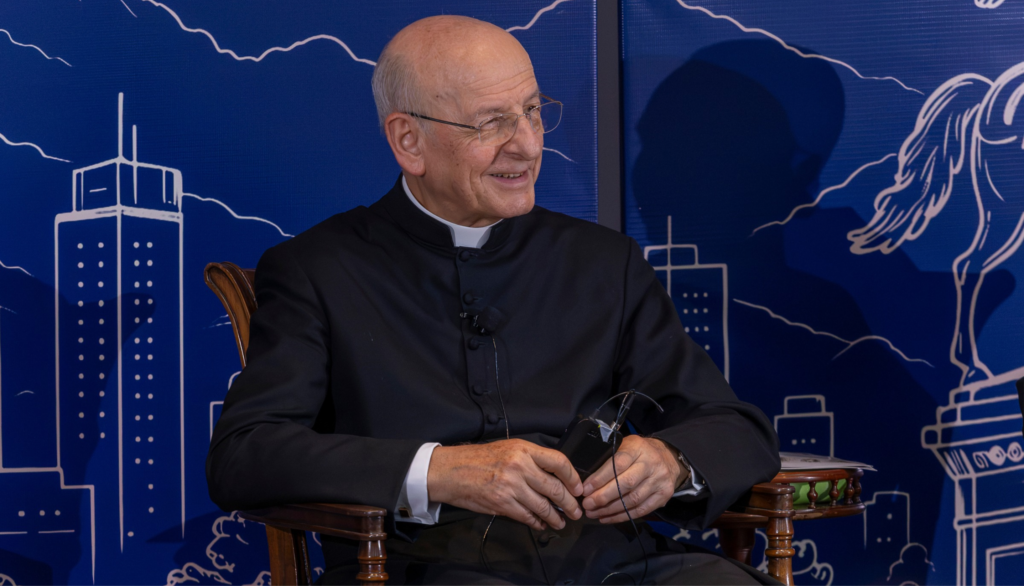
 Ocáriz outlines lines of work for Opus Dei's centennial anniversary Opus Dei begins the countdown to its centenaryOpus Dei focuses on its I Centenary: "It will not be just a party"."
Contemplation is the central theme of the pastoral letter that the prelate of Opus Dei Msgr. Fernando Ocáriz It was signed on October 16, 2026. This is a core issue in the spirit of the Work, to which it dedicates this first letter as preparation for the centenary, which will be celebrated in 2028.
The text is structured in thirteen sections, which trace the prayer of Jesus and the experience of St. Josemaría, the search for God in ordinary life, the means to grow in contemplation and its fruits in charity and apostolate.
Monsignor Ocáriz emphasizes that the vocation to Opus Dei “leads us to desire to live contemplation amidst our ordinary circumstances.” This contemplation is not understood as “a purely intellectual endeavor nor abstract speculation. Contemplation is a gaze filled with affection, a seeing born of love.”.
He recalls that St. Josemaría focused especially on Christ during the thirty years of his hidden life. “That life of Jesus, Mary, and Joseph is contemplative and, at the same time, so ordinary, without anything extraordinary,” he affirms. In this sense, he asserts that the members of Opus Dei, and those who approach its apostolates, are called “to be itinerant contemplatives, ”to live in dialogue with God amidst the roads of our cities and the turmoil of our lives; to always be with God wherever we are: in our homes, in our work, in our environments.".
The highest prayer
The prelate refers to the profound experiences of prayer that Saint Josemaría had amidst the turmoil of the world. The pastoral letter is dated October 16, the 95th anniversary of a significant moment. The founder of Opus Dei himself recounted it in an autobiographical text: “The most profound prayer I had […] while riding a tram and then wandering through the streets of Madrid, contemplating that marvelous reality: God is my Father”.
Monsignor Ocáriz points to the current trend toward activism, “devoting one’s life solely to work,” as a difficulty in living this contemplative life. Added to this are the effects of the constant presence of technology. All of this leads to talk of “a genuine crisis of recollection and attentiveness, which is such a necessary good for the interior life and for love of others.”.
In these circumstances, much of the world today is seeking to give meaning to life that goes beyond frenetic activity. “This may explain, at least in part, the interest in the ‘spiritual’ that has been observed in some countries for some decades now.” Alongside this, there are many signs of a resurgence of religious feeling, a rediscovery of the importance of God in human life, a yearning for spirituality, the prelate affirms, quoting Benedict XVI.
In short, Bishop Ocáriz echoes the idea of Saint Josemaría, who “invited all Christians to be ‘souls of prayer,’ contemplative souls in the midst of the world.” “In reality, we live in very favorable circumstances—the world is calling for it—to transmit this vision,” he affirms. Because, faced with this thirst for spirituality, “it is especially necessary to proclaim God’s invitation to be contemplatives in the midst of the world.”.
It's not something exclusive
The prelate warns that “contemplation is not reserved for a select few, nor is it a goal only for those who withdraw from the world.” The desire to see God, he affirms, “is embodied in the heart of daily activities. We encounter the Lord at our work table, in caring for our families, in social relationships, and in our rest. Love leads us to discover the gaze of Christ who contemplates us and invites us to respond with our own.”.
The letter warns against confusing contemplation with a sentimental escape from daily duties, or with taking refuge in abstract ideals. “God does not ask us to gaze at the clouds in a pointless daydream, but rather to lift our eyes to heaven precisely through what we experience, what we are dealing with; also through the unexpected events and setbacks of each day.”.
He quotes some powerful words from Saint Josemaría: “There is no other way, my children: either we learn to find the Lord in our ordinary lives, or we will never find him.” “That is why,” he continued, “I can tell you that our time needs to restore to matter and to situations that seem most commonplace their noble and original meaning, to put them at the service of the Kingdom of God, to spiritualize them, making them the means and occasion of our continual encounter with Jesus Christ.”.
“Ultimately, contemplation does not absolve us of our earthly responsibilities; on the contrary, it leads us to live them with effort and affection, because we see and love them with God, and from God.”.
In order to achieve this contemplation, the prelate suggests, on the one hand, “fidelity to daily mental prayer. We need those exclusive times of encounter alone with God.”.
And secondly, cultivate awareness of God's presence throughout the day, with “the active search for moments of silence, the strength to remain in the same activity, the perseverance in constant work, the humility to listen, contact with nature, openness to sincere friendship, among so many other paths.”.
It's not about focusing on yourself: "”The contemplative life does not close Christians off in individualistic isolation.“ ”Saint Josemaría reminds us that we cannot separate love of God from love of others,” he adds.
In this sense, the letter outlines the relationship between contemplation and dedication to others: “Our contemplation is tested in the quality of our fraternal charity. Gentleness in our relationships with others, respect for their freedom, a joyful spirit of service, and the ability to listen are concrete manifestations of a sincere life of prayer: they show that we see how God awaits us in others.”
Finally, he points out: “we could say that we do not practice contemplation: are Contemplatives. Contemplation is not something we do occasionally, alongside other things: it is a way of being and seeing life, in God and from God, that informs everything we do, everything we experience, everything we feel. Therefore, contemplation, work, fraternity, and apostolate are dimensions of a single Christian life. By contemplating God in prayer, we discover him in our work, we love him in our brothers and sisters, and we joyfully proclaim him to the whole world.”.





 Español
 English
 Italiano
 Français
 Deutsch
 Polski