



ARTISTIC COMMENTARY
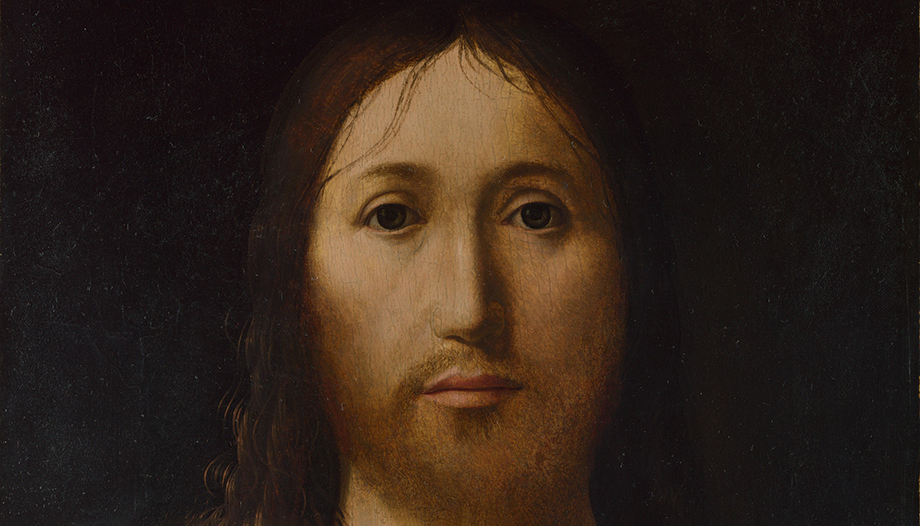
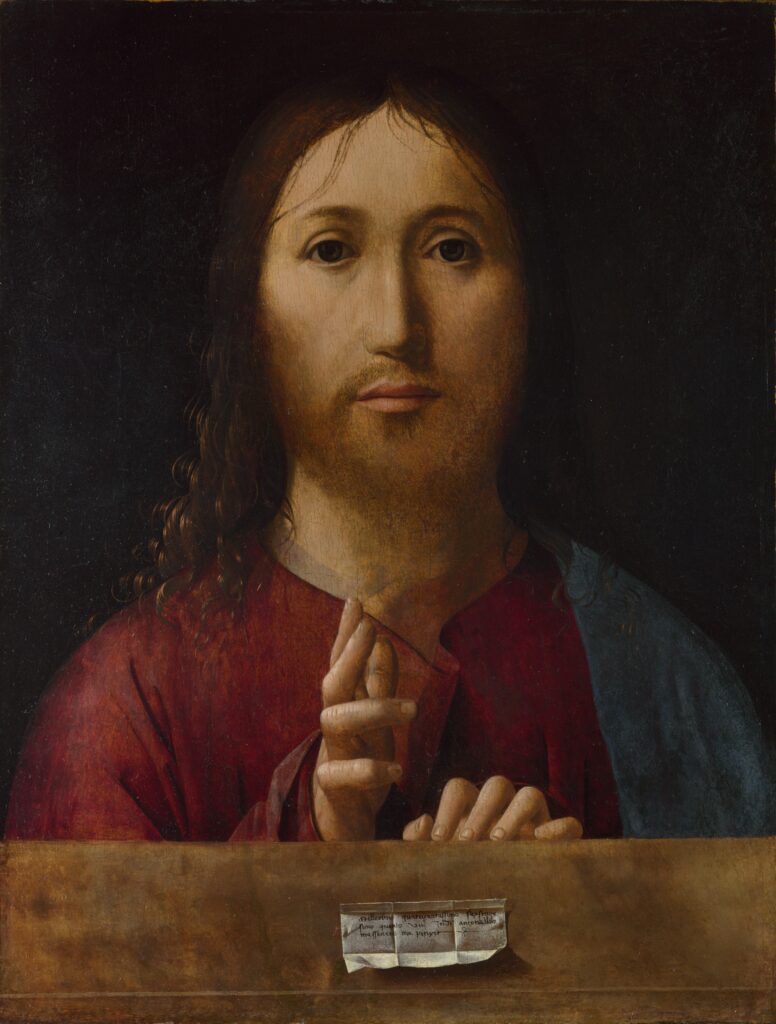
This small but captivating painting depicts a man wearing a red tunic and a blue cloak draped over his left shoulder. There are no obvious elements that immediately identify this frontal image as Christ: no inscription other than the artist’s signature, no symbols, no halo, no instruments of the Passion, and no reference to the Holy Trinity, as was customary in the past. The only clear clue is the gesture of his right hand: a blessing shown in foreshortening.
Technical Innovation and Flemish Naturalism
Christ is depicted facing the viewer, an unusual choice in portraiture of the time, when the three-quarter view—inherited from antiquity—predominated. Here, Christ looks directly at the viewer, establishing an intense connection as he blesses us. The flat black background isolates the head and shoulders, accentuating the sense of presence. The simplicity of the composition evokes the imprint of Christ’s face on Veronica’s veil. However, this is not a portrait in the conventional sense of a model posing for the painter; Antonello draws inspiration from the well-known devotional image of the Holy Face, using it as the basis for an intimate and imaginative interpretation.
The foreshortened view of the right hand, with the fingers resting on the ledge of an imaginary frame, creates the illusion that it protrudes into our space. This technique is reminiscent of the Flemish styles employed by Jan van Eyck and other 15th-century Dutch masters. Traces of Antonello’s initial design can be seen on Christ’s raised hand. He modified the position to create a greater sense of immediacy, aligning the fingers as if stacked and bringing them forward, so that the hand appears to pierce through the painted frame. This intensifies the sense of closeness and realism.
Antonello's mastery of the technique of applying oil paint in thin layers allowed him to depict textures with great precision: the silky sheen of the hair, the marbled variations of the ledge, and the sharp folds of the tag (signed paper) with his signature. These innovations, learned from the Flemish school, were revolutionary in Italy and soon influenced artists beyond his native Sicily. Such technical virtuosity encouraged painters to openly sign their works, putting an end to the previous anonymity. The tag Here, written in Latin, it says: “In the year 1465 of the eighth indiction, Antonello da Messina painted my portrait”.
A work for private devotion
The intimate scale of the work suggests that it was intended for private devotion rather than for display in a church. In the fifteenth century, the art market was undergoing changes. Although large commissions for churches—funded by monarchs, the nobility, civic institutions, or guilds—continued, there was a growing demand for small paintings, illuminated prayer books, portable diptychs, and other devotional objects commissioned by private individuals. These pieces were hung in one’s own home, in a study or private room, as a focal point for prayer and contemplation. They reflect a shift in the relationship of the faithful (at least those who had the means to commission them) with Christ, toward a more personal and intimate devotion. For its owner, such a work constituted a cherished representation of the Holy Face, inspired by the Veil of Veronica.
Antonello da Messina was the leading painter of the early Renaissance in southern Italy; he was likely trained in Naples, a city with close cultural and artistic ties to the Low Countries. His ability to combine the precision of Flemish oil painting with the clarity and order of Italian design marked a turning point in Italian art. This work entered the National Gallery’s collection in 1861, following its acquisition in Genoa, and remains an outstanding example of Antonello’s fusion of technical mastery and devotional intensity.
CATECHETICAL COMMENTARY
After the first part of the Creed, dedicated to God the Father, the Catechism leads us to the second part, which focuses on the exposition of the faith regarding God the Son. At the heart of this faith is the certainty that God sent his Son to save humanity from the consequences of sin and to bring his creative work to fulfillment through the glorification of the human person. God’s response to the sin of Adam and Eve, then, does not end with the expulsion from Paradise, as masterfully depicted by Masaccio, but rather with the sending of his own Son in a humanity like our own, as evoked by the oil painting by Antonello da Messina with the admirable synthesis of clarity and precision that we see in this work.
Through this sending, God has fulfilled the promise of salvation made to our first parents and, especially, to Abraham and his descendants. For this reason, the Son embodies a multitude of names that illustrate his identity and salvific mission; thus, all these names, in one way or another, speak of salvation and blessing. From the very beginning, the Church has proclaimed the richness contained in these names; based on Peter’s confession at Caesarea (Matthew 16:16), she has chosen three as particularly significant: Jesus, Messiah, and Son of God, to which the New Testament and Christian tradition add the name Lord. In these four names we contemplate the ineffable presence of God the Son incarnate among us; just as the painting offers no explanations or special attributes to represent the Son, so too it is unnecessary to seek further names or adjectives beyond these four names, which reveal to us the identity and mission of the Son of God.
Jesus and Christ
The accounts of Jesus’ conception reveal that the name “Jesus” was chosen by God, as the archangel Gabriel tells Mary (Luke 1:31), and refers to the One who brings God’s salvation (Matthew 1:21). Indeed, the angel explains to Saint Joseph that Jesus will save his people from their sins, based on the Hebrew etymology of this name: “salvation of God.” Therefore, hearing the name of Jesus, just as contemplating his Holy Face, evokes the entire saving work of God on behalf of humanity, which finds its culmination in Jesus the Savior.
The name of Jesus is the human embodiment of the ineffable divine name, which believers invoke knowing that it is the only one that can save (Acts 4:12). The name of Jesus, humbled in the Passion, has been glorified by the Father above every other name (Philippians 2:9), and therefore invoking it is equivalent to calling upon the omnipotent power of God: before this name of salvation, demons flee and diseases are healed; whatever is asked in the name of Jesus with true faith will be granted.
The blessing associated with this name—represented by Christ’s right hand in the painting—makes the invocation of Jesus the heart of Christian prayer, not only in liturgical forms or in the devotions that have developed throughout the history of the faith, but especially in individual prayer. These small paintings, commissioned for private devotion, serve as a reminder of the importance of frequently invoking the name of Jesus in daily life.
In the New Testament, the name “Christ” is associated with the name “Jesus,” often inseparably. This name, which comes from Greek, translates the Hebrew word “Messiah” (the anointed one), a title given to the kings of Israel who were anointed with oil as a sign of their kingship. This name was associated above all with the future king who would come in the last days to liberate the people of Israel and establish a definitive kingdom on earth. With this hope fulfilled in Jesus, the New Testament proclaims him as the Messiah sent by the Father, anointed by the Holy Spirit, to liberate all humanity and establish the Kingdom of God.
This name, which unites the Trinity, humanity, and liberation, is rarely accepted by Jesus during his public life. The danger of understanding the liberation offered in Him in human or political terms means that Jesus must purify this name of such distortions, proclaiming several times that the Christ will have to reign after humiliation and suffering. Only after the cross will He be universally recognized as Christ and the Son of God.
Son of God and Lord
In the tradition of Israel, the title “Christ-Messiah” is associated with that of “Son of God,” since that was the title given to the king of Israel, as the representative of the people whom God had adopted as His son in the Exodus. Although it is a human title, in Jesus this name takes on a special connotation, since He is the only Son of God, related to the Father in a unique and permanent way, such that the expression “my Father” is distinguished from “your Father” in the case of Jesus. This unique relationship of the Son with the Father (Matthew 11:27; Luke 10:22) is expressed in the Fourth Gospel with the term “Only-Begotten” (John 3:16), which reveals that Jesus is truly the Son because He is eternally begotten by the Father.
Jesus’ unique sonship is evident in three major scenes in the Gospels: the Baptism, the Transfiguration, and the Agony in Gethsemane. Jesus would therefore be referred to as the Son of God from the very beginning of the apostolic preaching, as we see in St. Peter (Matthew 16:17) and St. Paul (Galatians 1:15–16).
Since the Son is intimately related to the Father, He also shares with Him His lordship over all creation; therefore, “Lord” is a proper name for Jesus. Among the people of Israel, this name is reserved solely for God, as an equivalent to God’s ineffable Hebrew name (YHWH). In the New Testament, the name “Lord” is applied not only to God the Father but also to Jesus, who shares with the Father divine sovereignty over nature, sin, sickness, demons, and even death.
Everything is subject to the power of Jesus the Lord, but it is subject to a power of mercy and closeness. That is why this name also appears in the New Testament during moments of special intimacy with the Risen Jesus, such as St. Thomas’s confession (John 20:18) and St. John’s exclamation on the lake (John 21:7). Hence, recognizing Jesus as Lord is a special gift of the Holy Spirit (1 Corinthians 12:3), and longing for his final coming into the world as its Lord is a constant attitude of all who believe in Jesus Christ (Revelation 22:20).
Art historian and Doctor of Theology





 Español
  English
  Italiano