


 Sustainable monasteries, centuries of caring for creationThe only Benedictine nun in the City of Silence
I have written this article, after having dedicated another one to the Mount Athos, I have been moved by a sudden nostalgia for Greece and, in general, for the Eastern Mediterranean, precisely now that it is more difficult to travel due to the dramatic international circumstances. I think it is necessary to speak of what I call the vertices of an ideal Greek-Orthodox spiritual triangle: one extreme on Mount Athos, another in Constantinople, to which I will dedicate the next article, and another, precisely, in Meteora.
I'll start with an amusing and now unrepeatable detail: an airline ticket from Rome to Thessaloniki, a few years ago, for fifty euros round trip. An opportunity I could not pass up. I booked, left and, at the Thessaloniki airport, rented a small dark blue car with which, on a warm and sunny June afternoon, I drove along the highway to Kalambaka.
At one point, to the right, the massif of Mount Olympus appears, covered by a canopy of gray, threatening clouds, while the rest of the sky is crystal blue. Who knows, perhaps the ancient gods were jealous that I did not stop before them, and continued instead to a place where nature is equally beautiful and divine, but of a different, unobtrusive divinity: a divinity where monks, new heroes no longer mythological but real, have truly performed twelve labors to tear from the rock, or build upon it, architectural jewels to worship a God who loves not so much the intrigues, the orgies, the corruption and the whims so pleasing to the gods of the ancient world, who were but a projection of typically human vices and virtues.
In the heart of Greece
The Meteoras are located in Thessaly, the homeland of Achilles, in the center of Greece, near Kalambaka.
Once there, I settle into the hotel, leave my suitcase and decide to leave immediately to watch the sunset between the pinnacles on which stand the six monasteries, visible from the window: the rocks dominate the village from every corner. There is a wonderful light, ethereal, with the sun staining the sandstone pinnacles with ochre. The monasteries rise even higher, against the light, as if they were “meteoras”, which in Greek means “suspended in the air”.
After sunset among the rocks, I walk down to the village and enter a random little restaurant, with paper tablecloths and handwritten menu. I may have come to visit monasteries, but no one is going to take away the pleasure of eating a “moussaka” (which will turn out to be the best I have ever tasted)!
The history of Meteoras
The history of Meteora is closely linked to that of Mount Athos. In fact, in 1344, some monks, led by Athanasius Koinovitis, arrived in Thessaly and settled on a rocky platform at an altitude of 613 meters, the “Big Rock” (“Platys Lithos”), to found the first proper monastery in the area: the Great Meteora (Megalometeoro), or Monastery of the Transfiguration.
Why choose this place? Because these rocks guarantee isolation and impregnability against the invasions that followed one another in Thessaly, from the Goths to the Ottomans.
In the 16th century, Meteora was at its peak: twenty-four monasteries perched on as many peaks. Today only six remain.
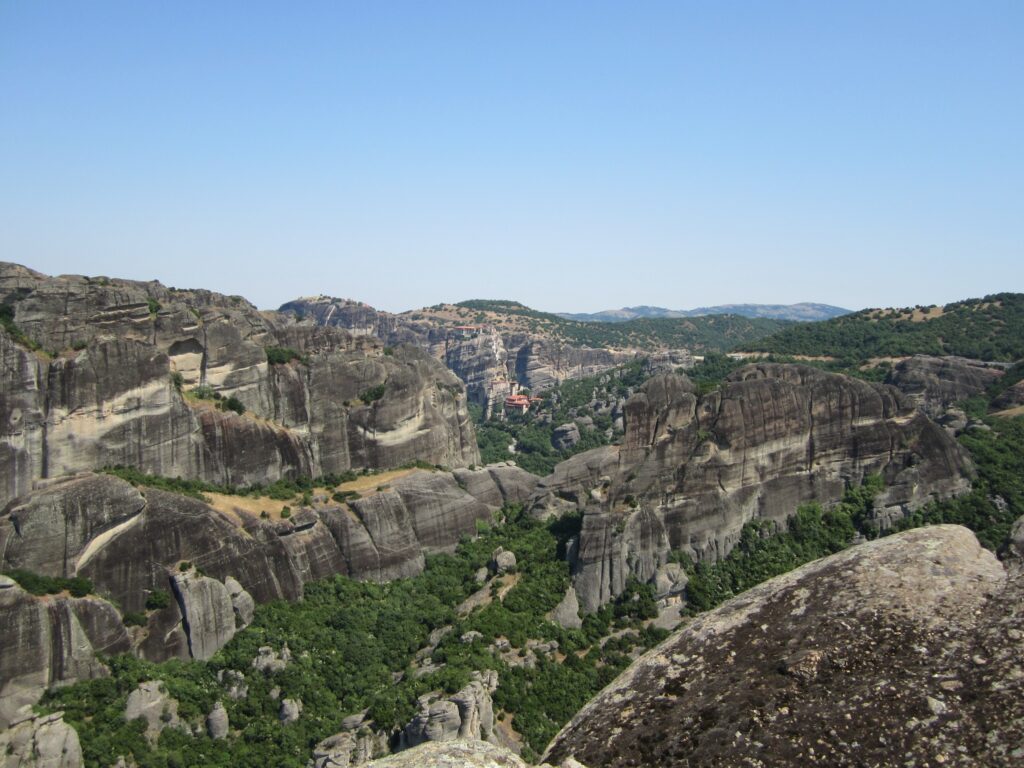
How is a “meteor” constructed?
After breakfast at the hotel, and panting in the heat of that June morning as I climb the steps carved into the rock, I arrive at the first monastery, Megalometeoro, and wonder what possessed me to climb up here and the monks to build something on these rocks, using only ropes, nets and wooden ladders!
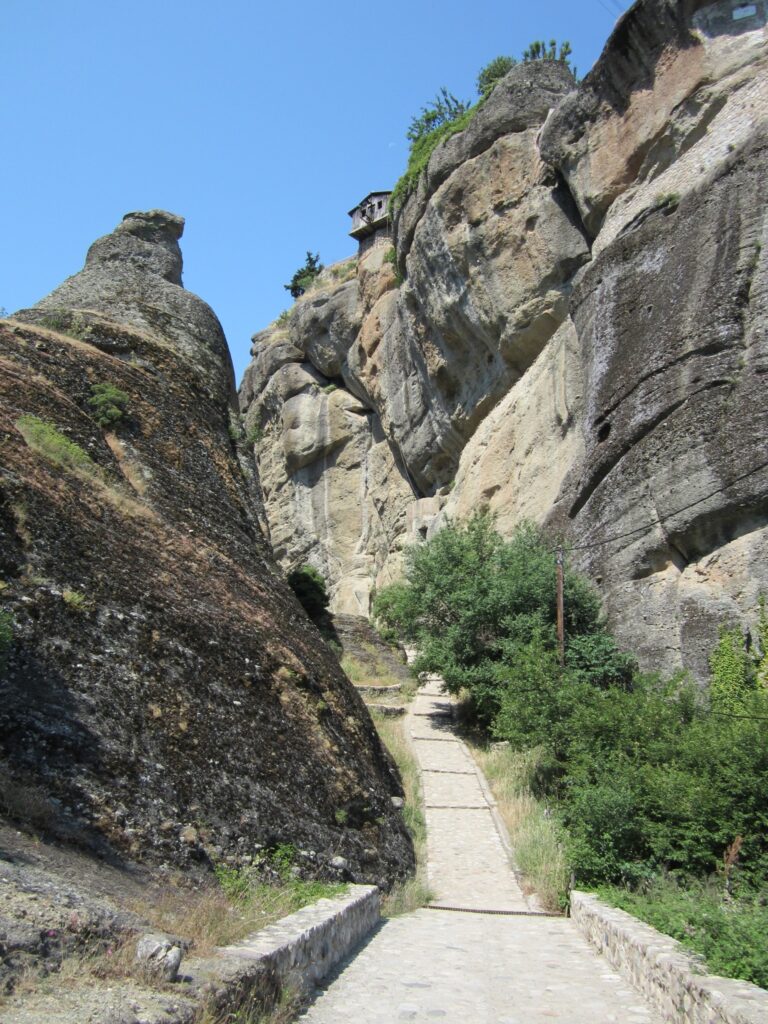
And to think that the stairs carved into the rock (140 steps for the Megalometeoro, 150 for the Monastery of the Holy Trinity) were not added until the 20th century. Before that, to access the monasteries you had to rely on someone to pull the ropes, on the strength of the knots and the solidity of the basket in which you were wrapped as you swung into the void.
Today this is no longer the case, but the maze of steps among the white sand does not exactly make the climb easier. On the other hand, it is part of the tour: every now and then, a crack in the rock gives a glimpse of the enchanting landscape and mountains, and it almost seems as if there is no imposing construction just overhead.
The six active monasteries
The six remaining monasteries continue to house active communities, with monks and nuns following the Orthodox rule of prayer, work and silence.
The oldest and largest is precisely the Great Meteoro (Megalometeoro), the mother monastery of the whole complex. Its main church, the “katholikòn”, houses some extraordinary frescoes, with scenes of the persecutions of Christians and martyrs who turn their stern, golden eyes towards the visitor.
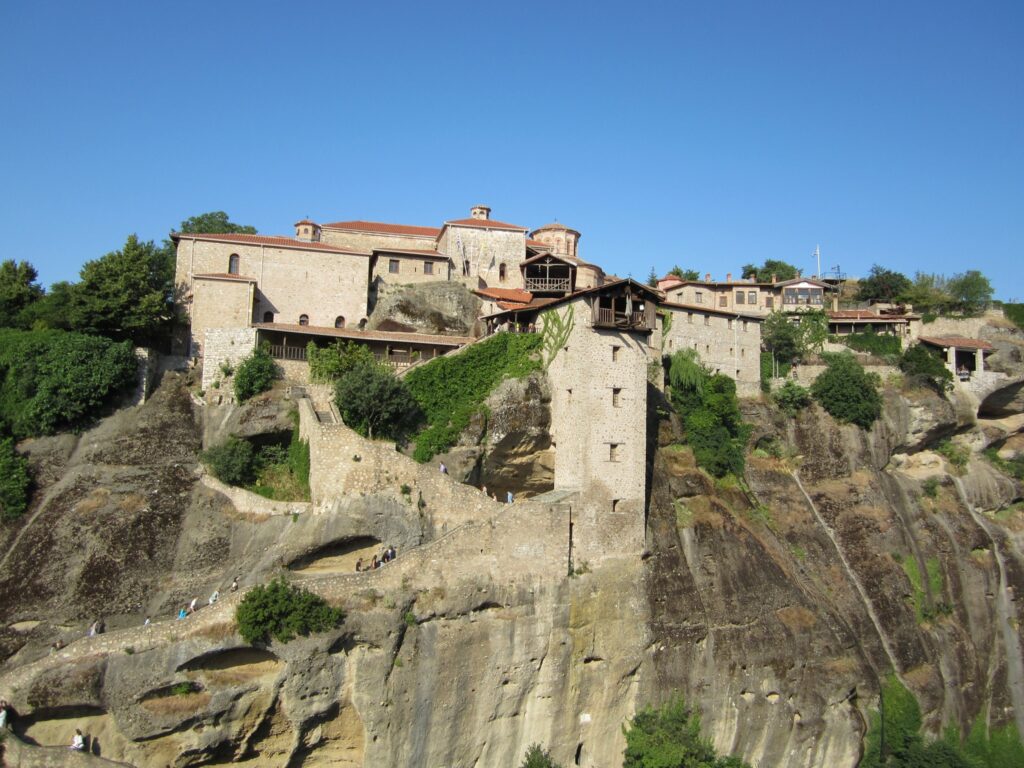
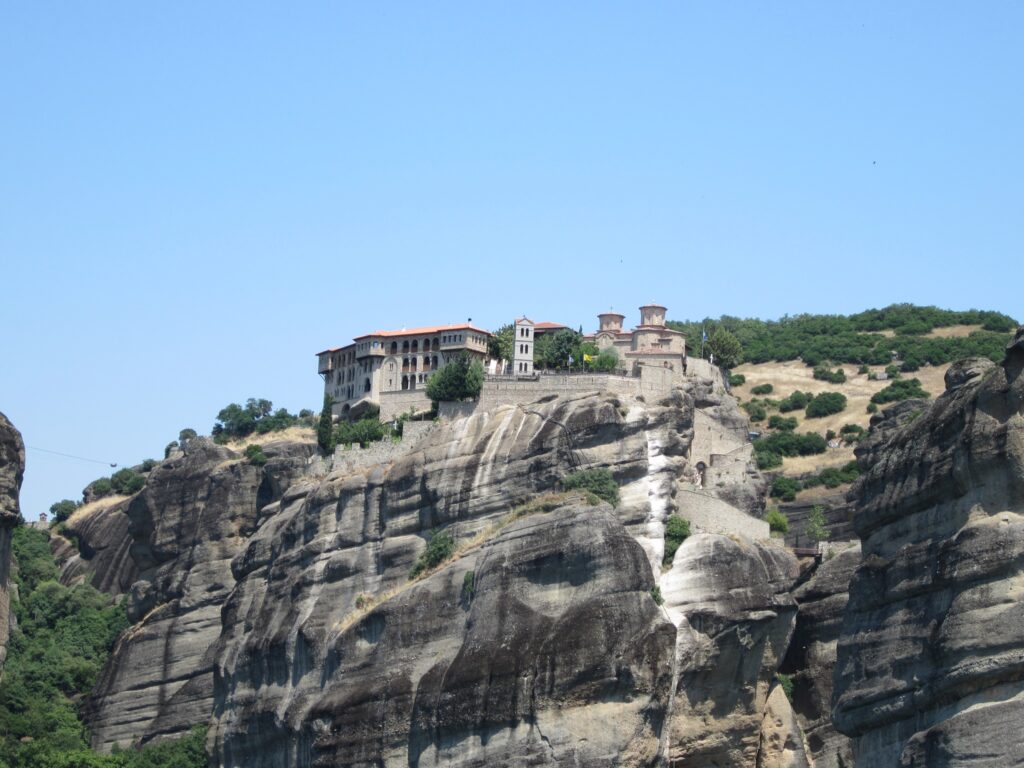
Then there is Varlaam, on top of a rocky spire at an altitude of 373 meters, founded around 1350 by the hermit Varlaam and rebuilt in the sixteenth century. Here you can admire the original net with which the monks were hoisted up to the rock. Looking at it, one wonders not only how the ropes did not break, but above all how the hearts of the unfortunate ones who climbed it could withstand the emotion. Here I am told that, when someone asked how often the ropes were changed, the answer was always the same: “when they break”. In short, it was really a matter of faith!
The monastery of the Holy Trinity (“Agia Triada”), founded in 1458, is the most difficult to reach: you have to go down the rock, through a narrow passageway, and from there climb 150 steps. It is hot and it seems that you never get there. I come across some tourists who, on their way down, praise the wonders of the views from the top. And, in fact, they are right: from the top, the plain opens up in all directions and the silence invites you to collect yourself and literally contemplate the world from the heights, with all its colors, the shades of green, the sky, the rocks, but without noise: only the gentle breeze that blows up here, the singing of birds and the chanting of the monks.
St. Nicholas Anapafsas is the closest monastery to the village of Kastraki. In it are preserved in perfect condition the frescoes of Theophanes Strelizas, Cretan painter of the sixteenth century. The figures painted on them seem almost to welcome pilgrims and travelers tired by the journey.
Among the Meteoras there are also two monasteries of nuns.
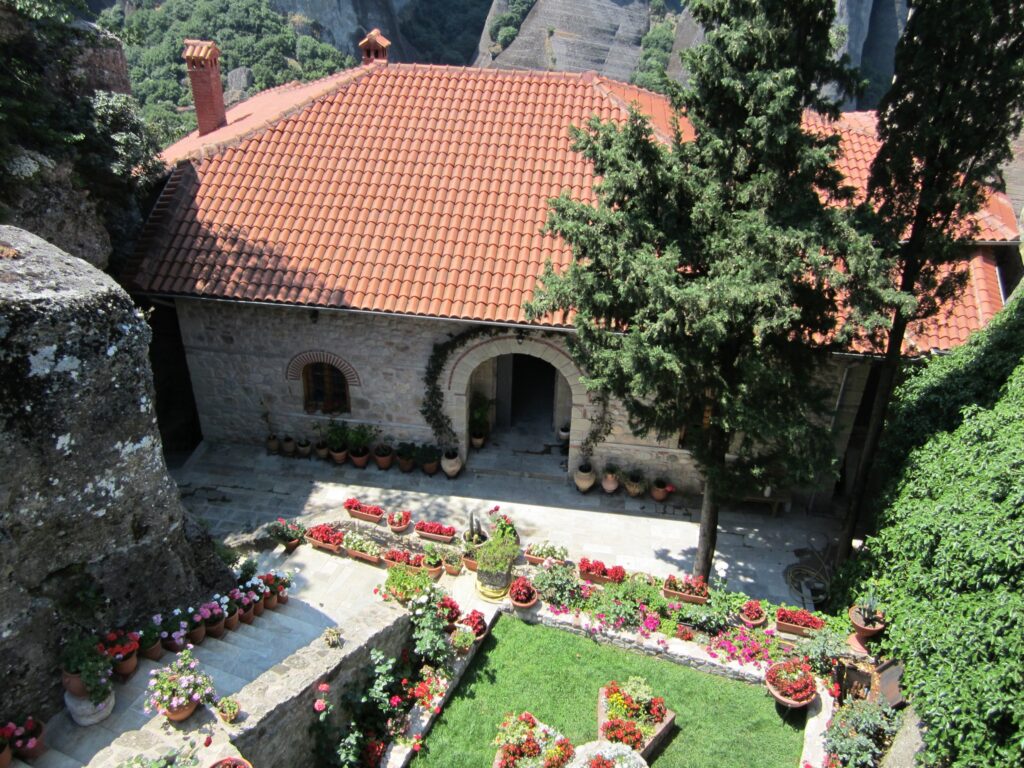
The first, Rousanou, founded in the 14th-15th centuries, has a name that sounds like a sigh. Maybe because I sighed with relief when I saw that it was reached by going down. Of course, if you go down, then you have to go up again, but it is worth it. In fact, you come to a cool, sheltered garden, with a fountain in the center and a shady cypress tree, protected by the rock and full of red flowers everywhere. And one notices immediately that there is a feminine hand embellishing the whole. The nuns, dressed in their black habits, pass by almost floating, in silence.
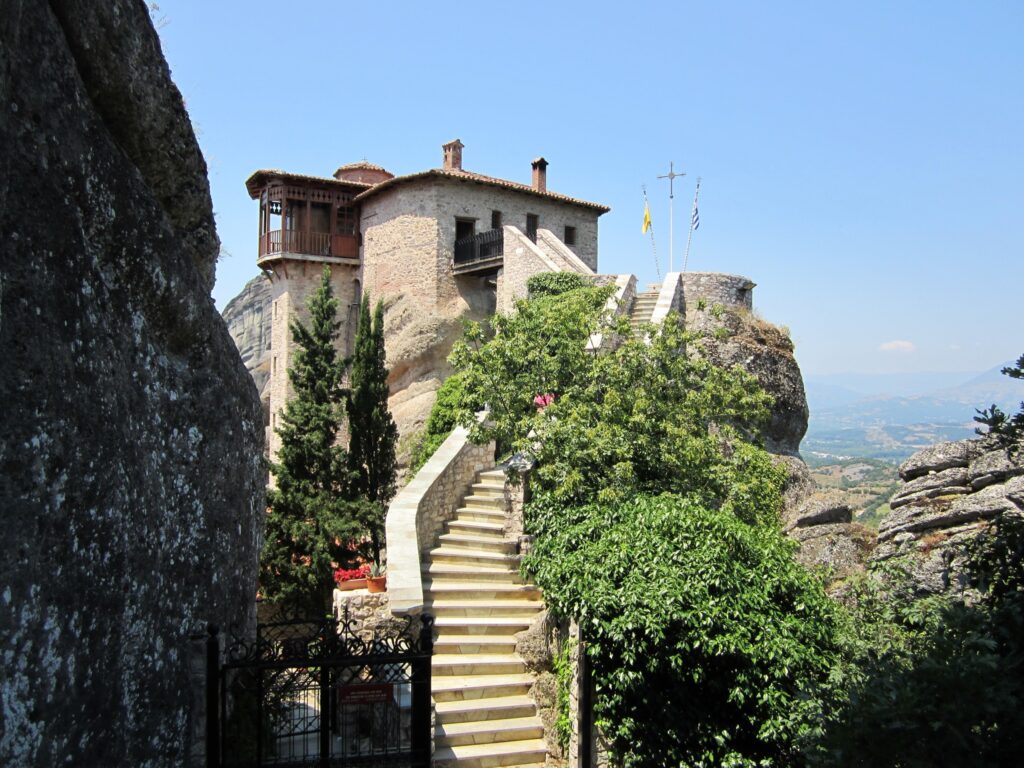
The second, Santo Stefano, is even easier to reach: a stone bridge connects it to the road where I parked. I read in the guidebook that the Byzantine emperor Andronicus III Palaeologus stopped here in 1333 and left precious gifts: priceless icons and liturgical ornaments. Also in Santo Stefano I have the same impression I had in Athos: each monastery has a character, a soul that makes it unique, different from the others. It may be because of the ease with which it can be reached, the number of monks or nuns who live there, the landscape, the dimensions. In Santo Stefano, the white, open staircase, with a wrought iron railing and cypress trees on either side, the Greek and ecclesiastical flags waving in the June wind give it a less austere air than the others. But perhaps it is because here I conclude my six efforts to reach each of them.
A world near and far
In 1988, the UNESCO inscribed the monasteries of Meteora on the World Heritage List, with the rare double recognition of both natural and cultural property. The official motivation speaks of an “extraordinary harmony between the human work and the natural landscape”. And, indeed, here one really feels in harmony with everything: the tenacity of the human being, his faith and obstinacy to build where it would not be possible join the tenacity, much more patient (60 million years), of nature, which has sculpted and modeled these rocks with the force of wind and earthquakes.
And speaking of harmony between nature and culture, also the second night I return to the small restaurant of the “moussaka”, to regain strength after having fed the spirit. A pleasant breeze caresses my face, the rocks are tinged with dark purple at sunset and the artificial lights begin to illuminate the monasteries up there, suspended in the spreading darkness. “And I see it's a good thing!”: some fresh bread on the table, the moussaka, the illuminated spires above my head and I feel in paradise and, as they say in Italy, “with all God's goodness!”.





 Español
  English
  Italiano