


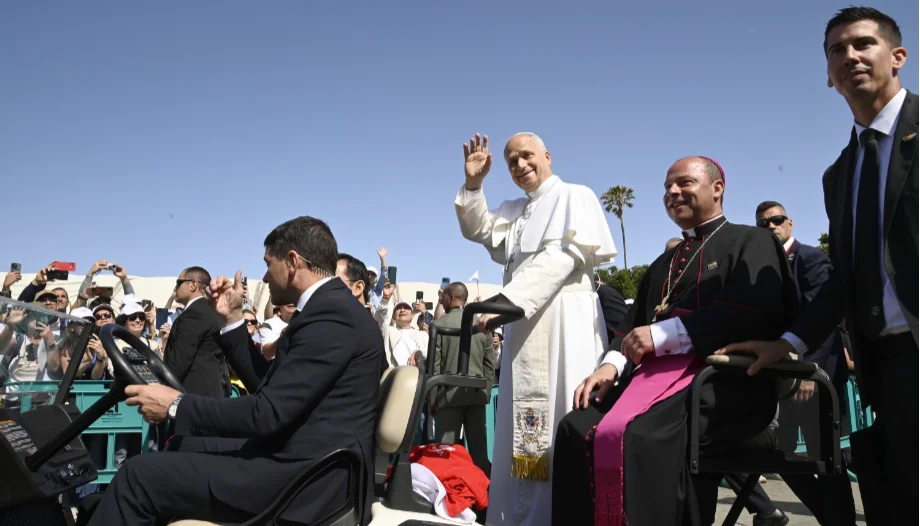
Pope Leo XIV met this afternoon in the emblematic Plaza del Santísimo Cristo in La Laguna with organizations dedicated to the integration of migrants, in a meeting that brought together volunteers, social workers, church representatives and migrants from different parts of the world.
The ceremony, held in the heart of this World Heritage City, included words of welcome from the bishop of the diocese, four testimonies and a pontifical address before the Pope bid farewell to the attendees.
Walking with those who walk
Monsignor Eloy Alberto Santiago Santiago, Bishop of San Cristobal de La Laguna, welcomed the Pope, stressing that the mission of the local Church goes beyond emergency reception. He highlighted the work of the diocesan Caritas, the Diocesan Delegation of Migration and various church organizations in the teaching of Spanish and occupational training, with the aim that migrants not only receive help, but also contribute to society. He also recalled that many of the faithful from Latin America, the Philippines and other regions are already an active part of the diocesan community, becoming, in his words, «new lifeblood for the communities that welcome them.
Testimonials. «What would our Lord do?»
Darwin Rivas, a Venezuelan priest who has been living on the island of El Hierro for seven years, described his experience accompanying the arrivals of African migrants to the coasts of La Restinga. Parish priest of four communities, he recounted how in 2021 he and his companions wondered what they could do in the face of the growing flow of arrivals, and how they set up a reception network together with neighbors, volunteers, the National Police and the mayor of the municipality. Frankly, he acknowledged moments of exhaustion and temptation to move away, «There were days and nights when I wanted to stay in the comfort of my home but thought, what would our Lord do?» That question, he said, was the compass that kept him on track.
Brotherhood beyond blood
Mbacke, a young Senegalese who has been living in the Fundación Canaria El Buen Samaritano for a year and a half, has spoken on behalf of this institution to thank those who did not look the other way. There he has learned Spanish, cooking, agriculture, masonry, carpentry, computers and sewing, among other disciplines. She expressed her relief at having found not only a roof over her head, but also people who told her «you are worth it, you can do it», and concluded her speech with a poem recited by the theater group in which she participates:
The story of a shipwreck
Khalid Allad, a 24-year-old Moroccan, gave the most harrowing account of the morning. He arrived in the Canary Islands in 2020 after two attempts by patera. In the first one, twenty people died. When he returned home, his father hugged him in tears: he had not slept because he had dreamed that the boat capsized. He forbade him to try again.
A year later, Khalid left again, this time without his knowledge, and after a second, equally painful journey, he arrived in Tenerife. Shortly after, when he was on the verge of homelessness, he found the Don Bosco Foundation, which became his second family: language, training in cooking, school monitoring, construction. A pre-employment contract allowed him to obtain a residence permit. Today he proudly works at the Salesian College. «Now every morning, when I leave my house, I go to work happy,» he said.
From migrant to Caritas volunteer
Thalia Johana Saldarriaga Diago, a 48-year-old Colombian who has lived in Tenerife for three years, told how she arrived with hope but soon found herself homeless with her brother. CEAR and Caritas gave her back, in her own words, «the dignity that life sometimes takes away from us». Thanks to the Don Bosco Foundation, he received professional training and became financially independent. But her story does not end there: today she is a Caritas volunteer, convinced that her experience can serve as a bridge for those who come to her in the same situation.
Pope: integrating is to avoid second shipwreck
Leo XIV delivered the longest and densest speech of the meeting, articulated around a central idea: integration is not an administrative task or a unilateral gesture of charity, but a reciprocal path that transforms those who participate in it.
The Pope began by evoking the image of La Laguna as a «city without walls,» a historical fact that he turned into a symbol: the most difficult barriers to break down, he said, are not always made of stone. «Sometimes they are in the look, in fear or indifference». From there, he developed a reflection on what it means to truly integrate.
Integrating: neither erasing the past nor creating parallel worlds
For the Pope, integration does not mean demanding that the newcomer abandon his or her history and memory. But neither does it mean tolerating that each community lives closed in on itself without any real encounter. «Integrating is a reciprocal path: those who arrive learn to inhabit a new land, and those who receive learn to expand their own home without diluting their identity or closing their hearts to encounter».
In this journey, he pointed out, those who arrive have an active and necessary part to play: learning the language, respecting the laws, knowing the customs and offering their own gifts with gratitude. And the host has duties towards the newcomer, but must also know how to receive. «Dignity recognized as a right flourishes when it becomes a responsibility and a sincere desire to build together with others».
Evangelization of immigrants
The Pope encouraged immigrants to allow themselves to be evangelized by those who welcome them, «for surely they bring with them gifts that Providence has wanted to bring to you through those who integrate».
He also asked Catholics that integration should not be reduced to a social task. Parishes must offer, along with bread, shelter and work, the possibility of knowing Jesus Christ, always with respect and freedom. «A Church that welcomes is also a Church that proclaims, offering Christ without imposing him and, at the same time, receiving the Gospel from the hands of the poor».
The silent shipwreck
One of the most powerful images of the speech was that of the «silent shipwreck. Leo XIV recognized that no human conscience, much less Christian, can remain indifferent to the deaths at sea, to »those cemeteries of the sea«. But he pointed out that there is another shipwreck, less visible and perhaps more widespread: the one that occurs after arrival.
«To be left alone in a city, without language, without ties, without work, without confidence and exposed to those who take advantage of one's vulnerability»: that is also to be shipwrecked. And integration, he said, is precisely the antidote to that second sinking. «To integrate is to prevent that second shipwreck. It is to help those who have been wounded not to remain fixed forever in their pain, but to be able to get back on their feet, recognize their gifts and offer them to the community».
A clear word to the traffickers
The Pope reserved his harshest words for those who profit from the desperation of others. From the square of La Laguna, he directly challenged «those who organize routes of death, traffic in people, withhold documents, exploit workers, threaten women, deceive families and turn the suffering of others into a business»: «Stop. Be converted. He reminded them that the tears and blood of migrants »cry out to God« and that »money torn from the vulnerability of the poor will not bring peace, honor or future«. He called on them to break these chains and to repair the damage caused while there is still time, invoking divine mercy, which can reach even the most hardened, but »only enters through the narrow door of truth, justice and conversion«.
The Pope concluded by commending the work of all those present to the Holy Family of Nazareth, which also had to migrate to Egypt to protect the Child Jesus, and proposed it as «model and protection for every refugee family, every migrant and every person who is forced to leave their land out of fear, persecution or need».
After the speech, Leon XIV was dismissed with a Peruvian song sung by the local Peruvian community.





 Español
  English
  Italiano
  Français
  Deutsch
  Polski