


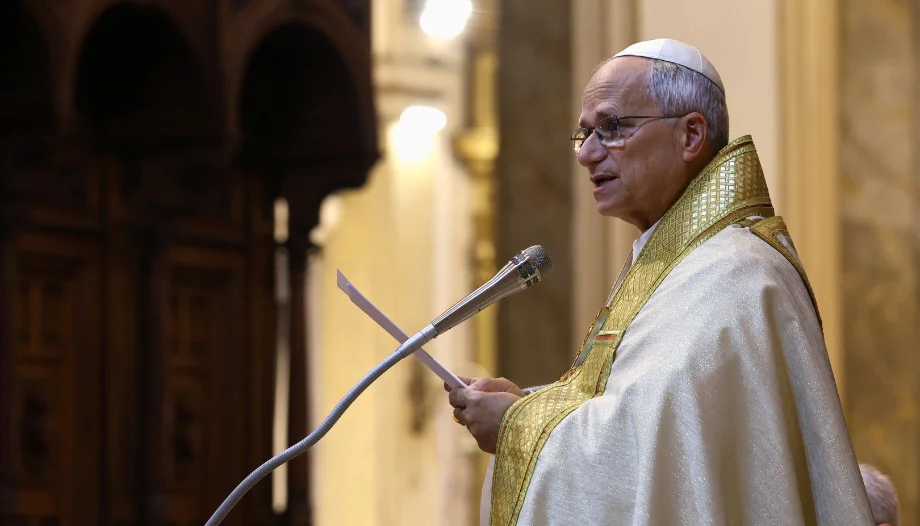
Pope Leo XIV met on November 10 with bishops, priests, deacons, religious men and women, seminarians, and pastoral agents at the Cathedral of Our Lady of the Assumption in Córdoba, Argentina. During the meeting, the Pontiff invited those present to renew their vocation, return to the roots of their calling, and remain available to serve God and his people.
Following the welcoming remarks of the Archbishop of Córdoba, Cardinal Ángel Sixto Rossi, and the testimonies of a consecrated virgin, a seminarian, a priest, and a nun, the Holy Father delivered a speech in which he referenced the Spiritual Exercises of St. Ignatius of Loyola, a tradition especially present in the history of Argentina.
Leo XIV recalled the work of Mama Antula, who traveled great distances to keep this spiritual practice accessible to all, and of Saint Cura Brochero, who made the Spiritual Exercises a central part of his ministry. He also mentioned Pope Francis, who shared the richness of Ignatian spirituality with the universal Church.
Back to the first yes
Drawing on this tradition, the Pope posed several questions to help those present reflect on their lives and ministries. The first was: «Why are we here?» Leo XIV recalled that, before any responsibility or task, there was a call from Christ that gave meaning to their commitment.
In this regard, he warned of a risk that can arise over the years: «working hard for God and spending less and less time with God.» Therefore, he invited everyone to return to the Eucharist, to listening to the Word, and to personal communion with the Lord, so that urgent matters, weariness, and routine do not extinguish the flame of their vocation.
The Pope also encouraged people to examine their consciences and acknowledge where they might have failed God. Among other things, he mentioned harshness toward others, resistance to being corrected, rivalries, and attachments that restrict freedom. «There is no age at which one can forgo conversion,» he affirmed, before recommending going to confession and maintaining humility.
A Church that leads to Christ
Another question Leo XIV posed to those present was whether they remained open to being sent by the Lord to places they had not considered. The Pope reminded them that a vocation demands a freedom that allows one to set aside personal preferences and accept even tasks one would not have chosen.
In this context, he addressed himself especially to the seminarians, whom he asked to «learn to see with the eyes of God and to allow themselves to be evangelized by his people.» He also highlighted the sensitivity of the Argentine Church to social needs and its closeness to those who suffer.
However, he cautioned that this attention must lead to something more: an encounter with Christ. To illustrate this, he recalled the words of Pope Francis: «The worst discrimination suffered by the poor is the lack of spiritual care.».
Hunger, injustice, disease, loneliness, unemployment, and the lack of decent housing all demand a response from Christian charity, Leo XIV pointed out. But, along with this, those who suffer need to receive «the greatest gift the Church possesses: Jesus Christ.».
«The Church is sent to bring everyone to Christ and his Gospel,» the Pope reminded the congregation, quoting a catechesis by Francis. Therefore, he emphasized that the mission of priests and consecrated persons consists in making possible the encounter with Jesus through the Word, the sacraments, and a closeness that helps people recognize his presence.
Faithfulness also involves the cross
The speech also addressed the moments of weariness and difficulty that accompany the priestly and consecrated life. Leo XIV recalled that following Christ means learning to remain with Him when the path leads through the cross, even when the fruits are not visible or the service seems to produce no change.
«There are stages in priestly and consecrated life where remaining in that position is already a very concrete form of commitment,» he affirmed. As an example, he presented Saint Héctor Valdivielso, the first Argentine saint, who died a martyr at the age of 24.
The Pope also alluded to the testimonies heard during the meeting and recalled his recent hospitalization. He mentioned Father Brochero, who continued serving his people despite his blindness and leprosy, and encouraged the use of technology to find new ways of evangelizing. «Neither age nor physical limitations can extinguish zeal: our strength may be exhausted, but never the power of God,» he noted.
«Dare to look at Argentina with the eyes of God!»
Leo XIV concluded his reflection by inviting those present to recognize what God is already doing in the Argentine Church and to ask themselves about the new paths He wishes to open. He also recalled the final stage of the Spiritual Exercises, contemplation to attain love, and the prayer of Saint Ignatius: «Take, Lord, and receive…»
«Can the Lord still dispose of me?» the Pope asked. He added that if the answer remains yes, there is still much to be done: «Let us not give up!».
The Pope recalled some examples of dedication from Argentine history, such as Mama Antula, Father Brochero and Blessed Ceferino, and encouraged dreaming of young people who ask themselves if Christ is calling them, parishes that are living communities of faith and religious families with the boldness of their founders.
«Dare to look at Argentina with the eyes of God!» he urged. He also called for a Church that continues «making a mess,» as Francis had asked young Argentinians to do in Rio de Janeiro in 2013, and that takes the Gospel to every corner of the country.
Finally, he invited them to return to their communities «with hope, with freedom, and with a desire to continue serving.» The meeting concluded with the Holy Father's blessing, the presentation of a gift, and a final song.
Following the meeting, Leo XIV traveled to the Ingeniero Aeronáutico Ambrosio Taravella International Airport in Córdoba, from where he departed at 4:55 p.m. local time, bound for Buenos Aires. The plane landed at Aeroparque Jorge Newbery International Airport, where he was received by local authorities before proceeding to the Apostolic Nunciature.




 Español
 English
 Italiano
 Français
 Deutsch
 Polski