


 Estefania LanderasThe Lord wants children to know Him".Covadonga, pilgrimage destinationTransmitting the faith to our children: sowing deep in the heart
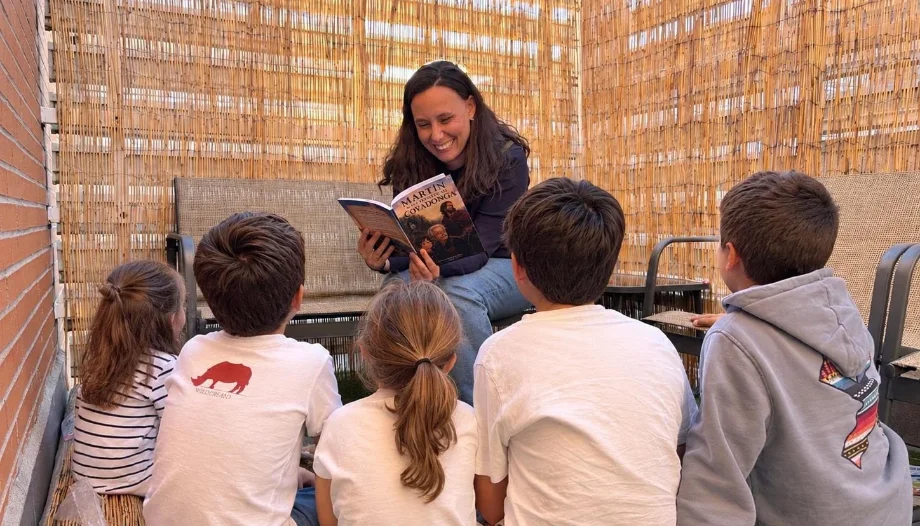
Its author makes her intentions clear from the start: “I’m not a writer, far from it, but a mother of four who will do anything to get them to read and discover that history can also be fascinating.” Verónica had the idea after a family trip to Covadonga, where her husband told the children the story of the battle. Pablo was captivated and, upon returning home, wanted to read more about it, but they couldn’t find anything suitable for a child his age. One night, after staying up late, she sat down at the computer and began to write.
A ten-year-old boy
Her initial idea wasn't to write a novel, but a short story for Pablo. “I wanted him to be able to identify with the protagonist and for the story to feel especially close to him, almost as if he were living that adventure himself,” she explains. That's why Martín is an only child, even though his author has four. Even so, he has something of each of her three older sons: “He's family-oriented and affectionate like Miguel, athletic and curious like Pablo, and fun-loving and mischievous like Jorge.” Thanks to that, creating the character was easy for her. “I didn't need to invent how a ten-year-old behaves; I see it every day at home,” she says.
Imaginary journeys
Grandfather Miguel is inspired by the author's father, who learned from his own grandfather to take imaginary journeys and now does so with his grandchildren: during the summers, before bedtime, they travel together to Egypt, Paris, London, or Antarctica. In the novel, these journeys become a time machine that takes Martín to the year 722.
“My father is a very affectionate person, although he doesn’t express it with words, but rather with actions,” his daughter says. He was the first to read the draft, but the most special moment came when she gave him the signed copy. Unintentionally, the story has become a tribute to her father and a legacy for her children: “When they grow up and he’s no longer here, they can open these pages, relive those moments, and remember everything they’ve experienced together. In a way, Grandpa Miguel will be eternal in the book.”.
Blood, spears, and faith
To research the story, Verónica consulted history books, open sources, and enlisted the help of her husband, a history buff and documentary enthusiast. She jokingly recounts that he would probably say the story lacks “blood and spears,” but she sees it differently: “Children need to be told the truth, but adapted to their age and their capacity to understand. It's not about hiding the harshness of wars from them, but about finding ways to introduce them to these events without dwelling on the violence.” The battle is the setting for the adventure, but the essence of the novel lies in the relationship between Martín and his grandfather.
In Don Pelayo, he wanted to reflect the values he tries to transmit at home: “A good leader is not the one who stands out above others, but the one who uses his qualities to help them and leaves no one behind.”.
Faith occupies a special place in the book: “I didn’t simply want to recount the Battle of Covadonga, but also to convey to children a small part of what faith means to our family.” The character of Don Pelayo, who seeks strength and protection from the Virgin, explains to Martín why he turns to her. “One writes from the depths of one’s heart, and for me, it was essential that our Mother have a place in this little story,” the author notes. The message she most wanted to leave with readers goes beyond Covadonga: “Having faith doesn’t mean asking God to make everything turn out the way we want, but rather trusting in Him even when things don’t go as we expected.”.
Further than expected
The publication came about spontaneously. Verónica discovered how easy it was to self-publish and thought it was a good opportunity for her children to have the story in book format. When she received the first copy, she shared it with her contacts, and was surprised by the reception. Today Martin and the Battle of Covadonga It is available for sale on Amazon.
Pablo did a school project on the book, and some parents have stopped Verónica at the school gates to ask for a sequel. Among the reactions she's received, she especially cherishes the one from an 87-year-old woman with dementia, whose daughter thought reading the book might be a good activity for her. Upon receiving the copy, the daughter sent her a video. “When you share something you've created with love, you never know how far it can reach or what it might mean to other people,” she adds.
Without a magic wand
She doesn't promise magic wands to parents who struggle to get their children to read. For her, the key starts at home: “I think example makes a big difference. If our children see us reading, it's easier to spark their curiosity.” In her family, when they don't have any plans, they go to the library or, on Friday afternoons, they go to story time with the little ones. “I think it's important for them to discover that books can also be a way to enjoy themselves, share family time, and have fun, and not just a school obligation,” she maintains.
Pablo has already asked for a sequel, and his mother doesn't rule it out, although she'll have to wait until summer, when the pace of daily life slows down and she finds time to sit down and write: “So, God willing, Martín and his grandfather will embark on a new adventure.”.



 Español
 English
 Italiano
 Français
 Deutsch
 Polski