



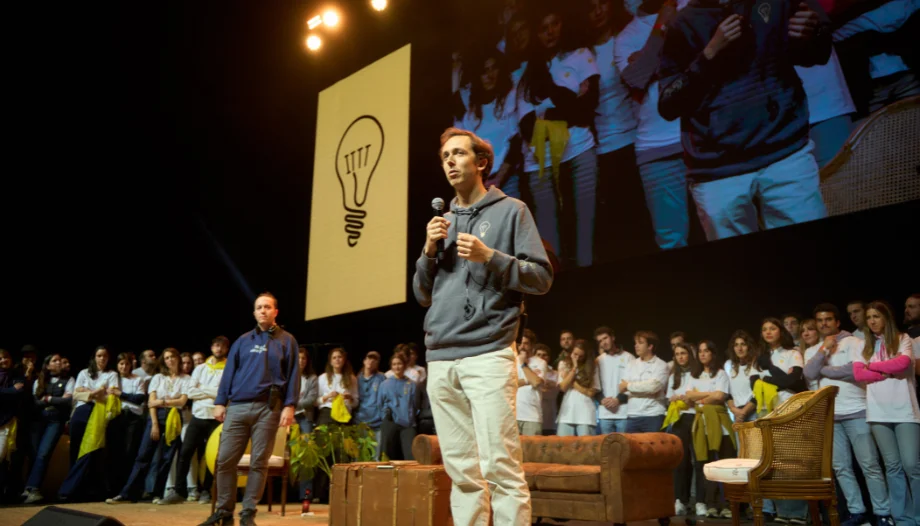
 “May 28”, the new revolutionary proposal from It'stimetothinkDoes the awakening of a generation begin in a bullring?
By Why don't they provide some context? Who are they, where do they come from, and where are they going?
– Javier Fernández: I'm 31 years old, married to Mercedes, and I've just become a father. I've always been very restless, and for the last five or six years I've dedicated a large part of my time to developing It's Time to Think, With the help of many friends and the fundamental support of my wife, who has been key from the beginning, I've achieved this. What characterizes me most is a sense of mission and a rather transcendent vision of life. Where am I going? In the years I have left—I don't know if it will be one or seventy—I would like to grow in family and friendship. And also to continue developing what we have nurtured these past years, so that it becomes a creative seed that encourages many more people to embark on transforming contemporary culture, society, and education, hopefully for a long time. We always say that we want to bring back the life of stonemasons; those cathedral builders who laid stones for something greater than themselves, knowing they would never see the final result. This is our cathedral. And, hopefully, we won't live long enough to see its fruits.
– Javier Roca: Although my name is Javi, I'm 30 years old, married to Teresa, and we have a one-year-old son, we're quite different. He's from Seville, I'm from Murcia. He has more hair and is taller. And he knows considerably more than I do about business and organizational management. Otherwise, I simply like beer, playing football, and reading. And I care about my country.
How and why did “It's Time to Think” come about?
– Javier Fernández: ITTT was born during lockdown. On March 13, 2020, the day we went into lockdown, a group of friends decided to create a space where people could take advantage of that moment to stop and think. We knew that life was moving very fast; lockdown was the perfect opportunity to search for the truth in all its dimensions.
We started in digital spaces, and two years later, in 2022, as soon as we could go out again, we were eager to move to in-person events. In October 2022, we began what we call ThinkGlaos: a guest speaker would come, no one knew the topic beforehand, they would speak for 18 minutes, and then a 45-minute dialogue would follow. But for us, almost as important as the talk itself is the after-party: two or three hours later where people get to know each other and build connections. That word—connections—defines our entire project and our whole vision of life.
How was the transition from virtual “thinktalks” to in-person “thinkglaos”? Were those moments challenging?
– Javier Fernández: It was a very natural step. A friend asked me a question that made me think: “Hey, you’re reaching a lot of people—there were live streams with more than 5,000 people connected at once—but how many friends have you made?” That changed everything. We decided to move from those large numbers to smaller gatherings. The first one was with just 40 people in Madrid. And through those friendships that were formed, the model began to expand on its own: people wanted to set it up in their own cities. In just one year, we were in 12 cities, and some people who were strangers to us at the time started it in Munich. Today, it’s in more than 50 cities and 10 countries, and more than 300 thinkglaos are organized each year.
How did they meet? What do they have in common with Ricardo Calleja and Pedro Herrero?
– Javier Fernández: We were introduced by Ricardo Calleja, a mutual friend. It was in 2022, just as I was thinking about moving It's Time to Think from a digital to an in-person format. I told Ricardo my idea, and he said that Javier Roca, who was about my age, would surely be able to help me. We had a blind date. And from that beer, what would later become thinkglaos began to germinate.
Ricardo and Pedro were the first two speakers at Thinkglaos, and the two people who helped Javi and me the most to finalize the concept. When we met them, one was an atheist and the other a practicing Catholic; very different views in many respects. And yet, they were great friends. That friendship between different people, combined with honest intellectual conversation, is the best reflection of what we want Thinkglaos to be: the union of intellectual engagement and personal connection.
What has the process of emergence and expansion been like in so many cities?
– Javier Fernández: It's a completely natural process, based on friendship. When we opened in Madrid in October, a friend wanted to set one up in Barcelona because she loved it. Within a few months, Seville, Jerez, Málaga, and Bilbao followed, where it was opened by a stranger who had attended a thinkglao. From then on, we haven't stopped receiving requests to open thinkglaos, usually from people who had attended others or followed them on social media. We have a model with ten principles that we believe generate such a strong community. From there, anyone can join as a volunteer and set up a thinkglao in their city. Our work as a foundation is to create a network of ambassadors and volunteers who live these principles and spread them, with the goal of building connections between diverse people around thought.
How did the idea for “The Awakening” come about, how was it developed, and what is the final result?
– Javier Fernández: The idea arose after many years of organizing thinkglaos, with over 500 meetings and more than 40,000 young people mobilized. We realized that a series of problems kept appearing: social fragmentation, job insecurity, and a lack of purpose. We wanted to organize a large event where all these issues could be addressed in depth, a kind of multi-hour macro-thinkglao. We came up with the idea of renting Vistalegre and trying to fill it. And that's exactly what happened.
How has the diverse civil society interpreted this major event? Is there a consensus? What are their key takeaways?
– Javier Fernández: Overall, the response was very positive. We wanted it to be a call to action. And here's a statistic: since Despertar (Awakening), more than 90 thinkglaos have been organized in just three months, and more new cultural initiatives have emerged. There had never been a cultural event with that level of attendance, and one organized entirely by volunteers. I think what stood out most was the atmosphere: festive, open, where anyone could take the microphone. There were some things we would have done differently, and that's partly why we haven't organized a second large-scale event immediately. We preferred to create a longer space for reflection.
How do they cope with being pigeonholed? What do they think of themselves? How do they define themselves?
– Javier Fernández: That's normal, to a certain extent. When you start a cultural movement that touches on all kinds of topics, there will always be those who want to pigeonhole you. The good thing is that we've been given very different and often contradictory labels. But if there's anything we're fighting against, it's ideologies and labels. Our goal is to promote the search for truth with honesty, without labels. In fact, we're humanists. That is, we try to go back to the pre-political, to what makes us human. And to foster dialogue between different people, the search for truth, and the building of connections. From there, everyone can apply whatever label they want.
What is “TheNomba”? How did it come about? What are its aims? How does it work?
– Javier Fernández: TheNomba is the natural continuation of the thinkglaos, built upon all the learning from these years. The idea was to create the school we never had: a school that helps you work on your cultural, spiritual, and professional dimensions, with the goal of helping you flourish as a person.
We do this through a 12-stage inner journey, structured in four phases. The first is crossing the threshold: learning to pause and reflect each day. The second is acquiring knowledge: philosophy, anthropology, history, political philosophy—nine disciplines we consider essential today more than ever for living with discernment. The third is creating: our theory is that the human soul expands and its creative capacity multiplies when it opens itself to transcendence and learns from these disciplines. And the fourth is acting: the idea is that everyone leaves TheNomba transforming their surroundings.
The next step is to create the Nomba Hub, which we're already working on: to ensure that this initiative sparks many more transformative projects like thinkglaos. As for how it works, each step is a 15-minute video lesson with a personalized reading plan, mentoring, and numerous events. Anyone can participate at their own pace, with nine months being the ideal timeframe for completion. There's also an internal social network to connect with other Nomba participants. Ultimately, it's for a countercultural individual who wants to live differently from what the world offers.
– Javier Roca: I would add that there's a diagnosis we've been making for years within the team, along with volunteers and ambassadors from other cities, and which, through listening to the people who come to the think tanks, has become clear: we've lost our common language. It's not a pretty metaphor. It's very concrete. Before, in a society, there were two or three newspapers, and people might read them all. Now there are a hundred thousand, and nobody reads all of them. Before, a family would watch the same movie on Saturday night. Now, everyone is watching their own screen. In the same house, father, mother, and children may not share a single cultural reference. The father speaks one language, the son another, and between them there's an awkward silence that neither knows how to break. Basically, we live without a narrative. We've multiplied the media and lost our sense of meaning. Each of us is locked in our own echo chamber, speaking only our own language, without a common ground from which to view the world with others. And that has a consequence that is very noticeable in the younger generation: a strange loneliness, not the loneliness of being without people around, but the loneliness of not having anyone to share what is important with.
TheNomba was born from this conviction: that before talking about leadership, purpose, or anything else big, we need to rebuild a foundation, a common language, shared references, a cultural minimum from which a generation can once again understand each other. And not so we all think the same, but so we can truly disagree, which is something we've almost forgotten how to do. I think the name is very telling: “the non-MBA.” The anti-master's degree. Because we don't want more executors—artificial intelligence already does that, and it will do it much better than we can. We want people with their own judgment, which is probably the only thing a machine won't be able to replicate.
What are your future plans?
– Javier Fernández: To make TheNomba the humanities school with the most students in the world. Today we have almost 1,000 in just four months. At the same time, we continue organizing thinkglaos in more and more places: these past few weeks we've taken the leap to smaller towns, starting in Osuna and Campo de Criptana, and today connections are being forged between inquisitive people in more than 40 cities across Spain. Intellectually, behind closed doors, for the next two years we're going to focus on deepening the meaning of connections in three dimensions: with yourself and your roots, with your close relationships—friends and family—and with civil society and culture. All of this will culminate in 2028 with a new major event in Vistalegre that we will call May 28, in reference to the pendulum swinging from May 1968 to May 1928.
How to foster cultural initiative and ethical innovation?
– Javier Fernández: I believe the answer to ethical innovation and cultural creation lies, to a large extent, in the humanities and in openness to transcendence. The first step is to help people cultivate themselves internally. To stop. To observe. To read, but also to experience silence. To write. To develop their creative capacity. There is a second step, which is learning to step outside of oneself, in a world primarily driven by the ego. A professor at TheNomba, Fabrice Hadjadj, once distinguished between purpose (which comes from within) and mission (which comes from outside). When you cultivate yourself and step outside of yourself, beyond your own navel, ethical innovation then comes naturally, almost as a natural consequence. But there is a third step that seems equally important to me: connecting with others. Great cultural transformations and ethical innovations rarely originate from a single individual; they usually emerge from communities of people who share the same concerns and the same vision.
– Javier Roca: I recently read an article by Xavier Marcet in La Vanguardia, “Caring and Demanding of Ourselves,” which I think is key. He says something that should be on the wall of every office: “If you don’t think, if you don’t concentrate, you’re superficial and AI wins. If you only mimic, AI wins. If you don’t understand that life is full of contradictions, exceptions, and divergent situations, AI wins. If you don’t understand contexts with a lot of empathy, AI wins.” And he summarizes the profile that will survive all this in a strange triangle: customer experience, empathy, and artificial intelligence. People who think for themselves. Who can withstand contradiction without breaking. Who can separate the wheat from the chaff. The curious thing is that this used to have a name: general knowledge. Reading. Knowing about history, philosophy, about things that seem useless until they become useful for everything. But we erased that from the map. Too slow. Not very profitable. Better an express master's degree in whatever the market demands. And now it turns out the market demands what we've been cutting. The paradox is brutal. Universities are cutting philosophy, economics, and physics while paying millions to tech companies for a chatbot. Students are using AI to write papers. Professors are using AI to grade them. And at the end of the cycle: degrees that carry less and less weight and minds that think less and less. The co-founder of Anthropic, the one who wrote Claude, studied Literature. And she says she doesn't regret it. It makes sense: when everyone knows how to use the tool, what makes the difference is having something to say with it.
And then there's what Javi already pointed out: space and silence are essential (as Natalia Ginzburg said). For something meaningful to be born within us, we need unproductive time, time that seems to be wasted. Today, we don't allow ourselves that. We live with the feeling that every minute without producing is a wasted minute. And then we wonder why no one has their own ideas. If you want ethical innovation, give it space. If you want leaders with soul, let people get a little bored.
What do they tell young people today?
– Javier Fernández: If I had to give a message, I would say that we have been incredibly fortunate to live in the times we do: a time full of opportunities to do good. With many people truly yearning for it. And with the tools to do so. Any restless young person has a capacity for transformation they can't even imagine. All it takes is to live in accordance with oneself and to seek out others with the same concerns.
– Javier Roca: A few months ago I read an article in X by a guy who goes by the name Anarcarural that really affected me. He described someone from my generation at two in the morning, looking at their phone, with an open bet that has ruined them with a Serbian second division team and a memecoin At -70%. Your head spinning: rent's going up, salary's not. Your boss saying we kids don't want to lift a finger. Some early retiree in X commenting that his job is to collect his pension and yours is your problem. And the question that kid asks himself, which is the question of an entire generation: but what else do I have to do? The best thing about the article is that it doesn't judge. It simply describes and explains that gambling, in that context, is rational. That when you already feel you're losing, you prefer a small chance of recovering to the certainty of staying down. I wouldn't tell young people to stop gambling. I'm not the one to do that. But what's clear is that if we keep trying, it's because there's something alive inside. A burning soul, as that kid says. But I highly doubt the way out is where they're selling it to us. It's not on the Telegram channel for 20 bucks a month. It's not in the shitcoin. It is not in the course of dropshipping. Those are shortcuts designed by people who understood before us that hope, in this system, is very expensive.
Perhaps rebellion today is about stopping. It's about reading. It's about making real friends. It's about daring to have convictions. It's about not buying into the script they're selling you, neither the one from the boss who calls you lazy, nor the one from the guru who promises you financial freedom. And, above all, something that seems to me the most important of all: you are not alone. The loneliness of a young person today isn't just economic. It's also linguistic. You're alone because at home no one reads what you read, watches what you watch, listens to what you listen to. There are many young people silently asking themselves the same questions, but each one locked behind their own screen. The problem, until now, was that there were very few places to meet.






 Español
 English
 Italiano
 Français
 Deutsch
 Polski