


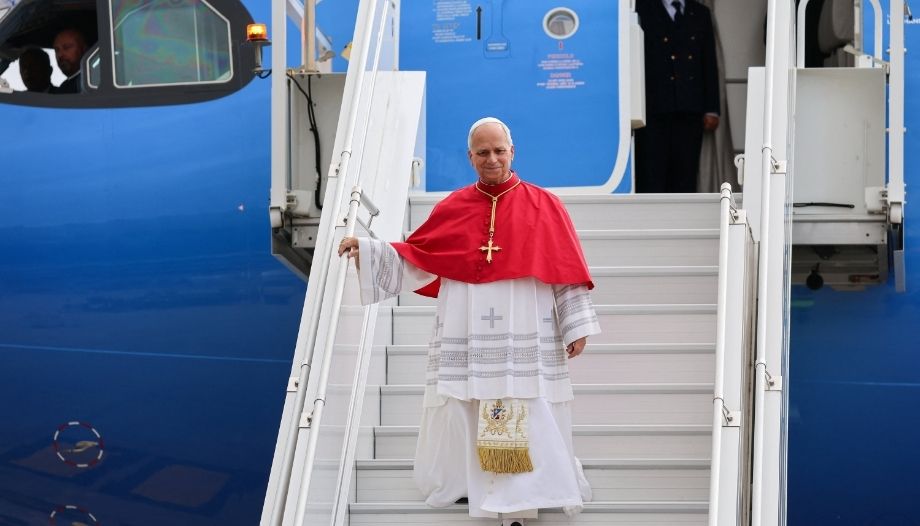
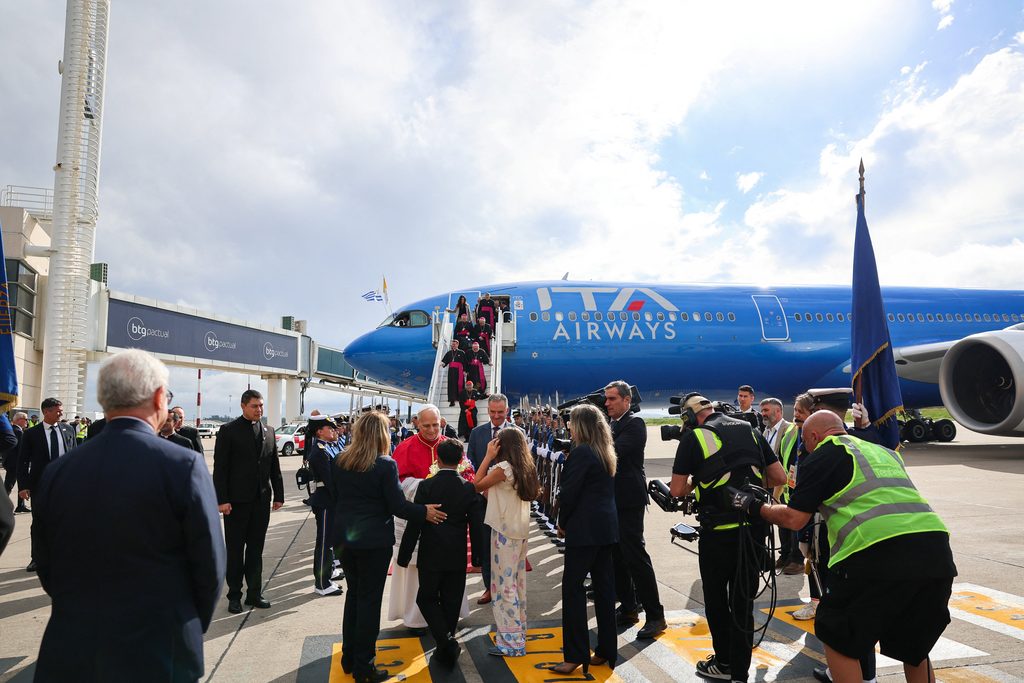
With German punctuality, Pope Leo XIV landed on Uruguayan soil at around 4:30 p.m. this Friday, November 6 (8:30 p.m. Roman and Spanish time), after more than 13 and a half hours of flight from Rome-Fiumicino.
There was anticipation to see the reaction of the Uruguayan people. And as has happened on other apostolic journeys, people took to the streets to greet the Pope. He was greeted with trumpets and chants, and shouts of ‘Pope Leo, we love you so much,’ particularly from young people.
At the welcoming ceremony in Independence Square, the Uruguayan national anthem was played with an orchestra and choir, before a large crowd. Addressing authorities and members of civil society, President Yamandú Orsi expressed his affinity with the Pope and the Church, particularly for their social work with the most vulnerable, their respect for human rights, and their efforts for peace. He especially thanked Leo XIV for addressing believers and non-believers alike. “This is your home, welcome to Uruguay,” he said.
Thanks from the Pope
“I have accepted with great joy the kind invitation extended to me to visit this Uruguayan land,” the Pope said in his first Speech in Uruguayan lands.”.
“I thank you, Mr. President, for the words you have just spoken and for the courtesies with which you have received me. My greetings also extend to those who represent here the institutions of the Republic and the nations accredited to the country.”.
Next, Pope Leo XIV delivered a lengthy speech in which he addressed issues related to the secular nature of the State, the family, the common good, economic organization and work, illness, and the links between the Holy See and Uruguay.
Healthcare for every person, a responsibility of all society
In his words, the Pontiff recalled that “I have recently experienced firsthand the limitations imposed by illness and have received care for which I am deeply grateful.
This experience makes me think about so many men and women who lack the means to obtain a timely diagnosis or receive the treatments they need.”.
“Ensuring that healthcare is accessible to everyone, regardless of their resources, is a responsibility that challenges all of society,” said the Successor of Peter.
“State neutrality does not require reducing religion to the private sphere.”
One of the topics to which the Pope paid the most attention is the freedom of religion, by emphasizing that “the neutrality of the State does not require reducing religion to the private sphere.”.
The Vicar of Christ wanted to point out that “the secular nature of the State is meant to guarantee a space in which believers and non-believers can live together freely and respectfully, because there are values that are universal. This neutrality does not require that the religious dimension be confined to the private sphere.”.
As the Second Vatican Council teaches, the Pope recalled, no one should be forced to act against his conscience or prevented from acting in accordance with it, whether privately or publicly, individually or in association with others, within due limits.
Respect for the law and patient search for agreements
In this context, the Holy Father said that “the coexistence of people from different backgrounds and traditions is also part of Uruguay’s history. This plurality is expressed today in the beliefs and convictions of its citizens.”
“In times when differences can easily become a cause for confrontation, persevering in respect for the law, in negotiation and in the patient search for agreements constitutes a service that Uruguay can continue to offer to its neighbors,” he added.
“Those who are not yet born already belong to the human family.”
Another subject to which Leo XIX devoted considerable attention was the family, immediately after referring to the demographic evolution of Uruguay.. One of the friezes on the monument to José Artigas depicts a woman carrying a baby in her arms. She holds it tightly while the march continues around them.
That gesture of protection leads us to think about life that is beginning, including that which is still growing in the mother's womb, the Pope emphasized.
“The unborn child already belongs to the human family and to the future of its people,“ Leo XIV emphasized. ”Its absolute dependence on the mother does not diminish its inherent dignity or the protection it deserves. Jesus himself chose to assume this condition by becoming incarnate,” Leo XIV stressed.
The family, the first environment of refuge
The family, he added, “remains the first environment in which each person is welcomed and learns to live with others.”.
Saint John Paul II, who also had the joy of visiting this land, expressed it with a phrase that retains all its force: ‘the future of humanity is forged in the family’ (Apostolic Exhortation Familiaris Consortio, 86), the Pope pointed out.
Elsewhere on the frieze, we see several children walking alongside adults. They are part of the village even before they can participate in its decisions or contribute their labor.
Human dignity
The Vicar of Christ also referred to several aspects that he has addressed in his latest encyclical, such as the dignity of the human person.
“A person’s worth cannot be measured by what he or she produces, by his or her work, or by his or her ability to fend for himself or herself. ‘The fundamental dignity of each person is not acquired, it does not have to be earned, nor does it need to be demonstrated’ (Encyclical Letter. Magnifica humanitas, 53)”, he noted.
Mental health
The Pope also addressed a drama of today's society, especially in countries like Uruguay, with a high per capita income.
Loneliness, anguish, and loss of hope can become so profound that a person stops finding reasons to continue living, he reflected.
“Faced with the painful reality of suicide, healthcare, family ties, and community support are inseparable. No one should ever feel like a stranger among their loved ones or think that their absence matters less than their presence.”.
Anyone who goes through any of these situations does not cease to be a full member of society nor lose any of the value of their life, he added.
Church Care
In these circumstances, their vulnerability makes it all the more urgent that they receive the assistance, resources, and support they need, Leo XIV emphasized, stating that “the care due to those who suffer involves the whole human family. For the Church, this duty finds a particular reason in the mandate of Jesus Christ to recognize and serve him in those most in need.”.
As Benedict XVI recalled, “the greatness of humanity is essentially determined by its relationship with suffering and with the one who suffers” (Spe salvi, 38).
Links between the Holy See and Uruguay
The Pope also referred to the Church in another context: that of the ”ties between the Holy See and Uruguay,” which date back to the early years of its independence.
With a history of faith and service that stretches back centuries, Leo XIV noted, “the Church wishes to continue offering to the Uruguayan people what she herself has received —Jesus Christ and the hope of his Gospel— and to collaborate from her own mission with all those who work for the common good and the dignity of each person.”.
May these days allow us to strengthen what unites us and renew the confidence with which we face difficulties and prepare for what is to come, the Pope concluded.
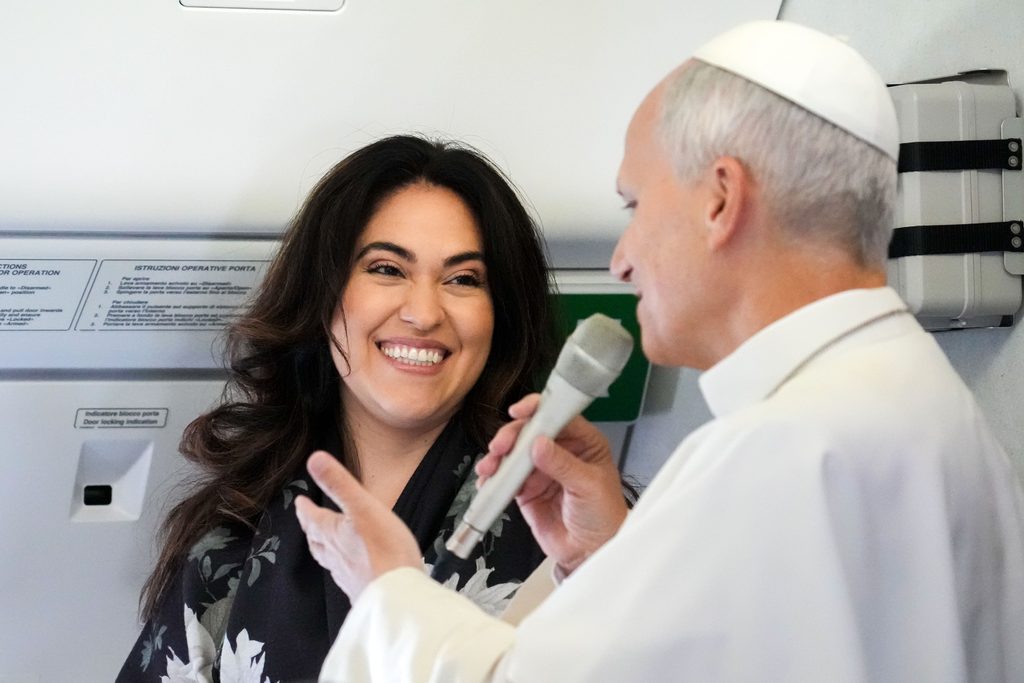
On the flight, shortly after leaving Rome, the Pope had written to the President of the Italian Republic: “As I prepare to embark on the Apostolic Journey to Uruguay, Argentina and Peru, I entrust the desires for peace and fraternity of these peoples to the intercession of the Virgin Mary and the saints who have proclaimed to them the Gospel of charity.”.




 Español
 English
 Italiano
 Français
 Deutsch
 Polski