


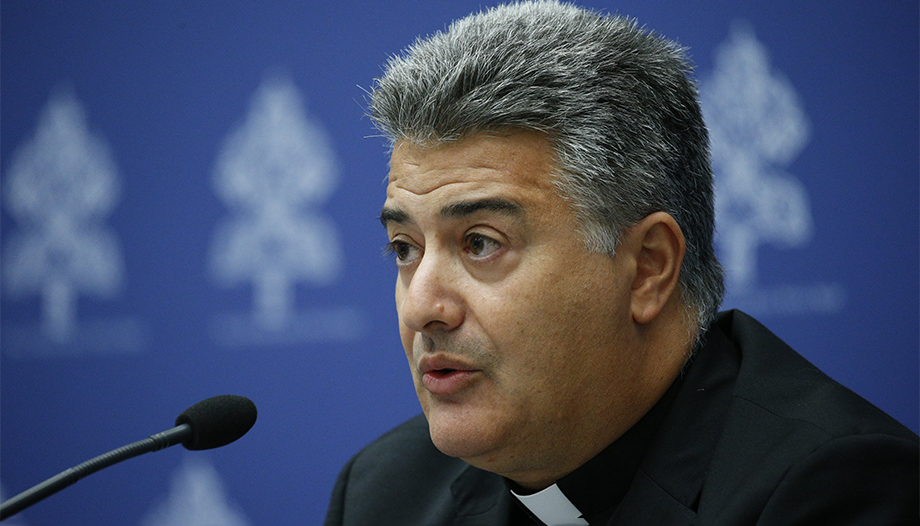
The transmission of faith has stagnated, especially among adults, while the prosperity and new possibilities offered by modernity have altered the questions posed to Christianity. This is one of the key interpretations offered by Monsignor Armando Matteo, theologian, professor at the Pontifical Urban University, and secretary of the Doctrinal Section of the Dicastery for the Doctrine of the Faith.
In this interview, he addresses the difficulties of Christian proclamation, the work of the Dicastery, and the document. Come to me, Dedicated to the transmission of the faith and published on October 22, the document bears his signature alongside that of Cardinal Víctor Manuel Fernández. The secretary also addresses the initial guidelines of Leo XIV's pontificate, digital technologies, and the Church's experience on different continents.
In his extensive theological and essayistic work, he has addressed many topics related to faith and the transformations of society. What cultural change poses the greatest challenge to Christianity today?
“This is a series of changes that have radically transformed, above all, the Western landscape. They have changed the very foundations of life for men and women born after the Second World War, thanks to new ideas, social transformations, and technological inventions. I'm using a somewhat strong image, but I think it's effective: we have gone from the ”valley of tears' spoken of in the Salve Regina to a context of abundance, to a broader life, full of possibilities and opportunities. Of course, problems still exist, but the overall trend is positive. In the West, we live longer, we lead less arduous lives thanks to technology, and we can alleviate suffering thanks to medical, pharmacological, and psychological research. We have less hunger and less ignorance, thanks to the availability of food and the spread of education. This is the great change that Christianity must confront today.".
You have often emphasized the responsibility of adults in transmitting the faith. What has been lost in the relationship between generations?
These changes have affected the adult generations most of all, who have found themselves in a scenario for which, I would say, our species was unprepared. For centuries we have struggled to survive, to cope with poverty, disease, and hunger. Christianity helped past generations to live well through the Gospel, the example of the saints, and prayer. When the situation changed radically, pastoral practice struggled to reinvent itself, to find new words with which to express the beauty of Christianity. Thus, in adults, the experience of faith faded, and families could no longer transmit what they were not living. The growing indifference of young people highlights precisely this breakdown in the mechanism of faith transmission.
Today, adults may struggle to understand why they should pray: prayer reminds them of that “valley of tears” world with which they no longer identify. And they find it difficult to imagine how the Gospel can help them in a world of freedom, opportunity, pleasure, and well-being. Therefore, the Church undoubtedly has a responsibility toward new generations, but, for its own good, it must find new ways to evangelize adults.
“The Church has a responsibility towards new generations but, for its own good, it must find new words to evangelize adults.”.
Monsignor Armando MatteoSecretary of the Doctrinal Section of the Dicastery for the Doctrine of the Faith
In this context, how can we make the Christian message understandable and meaningful again?
—The great resource, as Benedict XVI, Francis, and Leo XIV have repeatedly stated, is its appeal: this is the driving force behind Christianity throughout the centuries. We must rediscover the joy, the delight, and the happiness of being Christian. One can be Christian even in times of comfort and abundance, because the Christian message aims to humanize the person.
Today we face the challenge of freedom, possibilities, and opportunities. The Gospel can serve as a guide for fully embracing this new reality. It shows how its message can humanize even the most comfortable of circumstances.
You are the secretary of the Doctrinal Section of the Dicastery for the Doctrine of the Faith. What are the issues that occupy most of your work today?
—Besides our ordinary work, which consists of helping bishops, when they request it, to address issues within our competence in their dioceses, the topic we have reflected on most in recent months is precisely the transmission of the faith, the proclamation of the Gospel in this transformed context: to use an expression much loved by Pope Francis, in this “change of era.” We have worked extensively on the document Come to me, because it's a topic that has also emerged strongly in the visits ad limina and which is very important for recent Popes. We hope that the document can reopen the debate and illuminate pastoral practice.
What criteria guides the Dicastery when reconciling fidelity to received teaching with attention to the questions of our time?
The key is the conviction that encountering Jesus can help human beings, in any era, to live better, to achieve the goal we all share: to be happy, to experience beauty, serenity, and joy in our own lives. Jesus, the Gospel, prayer, the sacraments, and Sunday Mass are extraordinary resources for a better life. We must rediscover that we don't go to church or do the things typical of believers simply because we are believers, but because we are infinitely interested in human beings reaching their full potential. And it is Jesus who can make all of this a reality.
Throughout the centuries, the Church has proclaimed this in different ways, because the obstacles to human happiness and the available resources were different. Today, situations are radically different, but the conviction persists that the closer people draw to Jesus and his Gospel in a relationship of deep friendship with him, the more they can achieve their full human potential. This is also the fundamental proposal of Come to meTo invite pastors, priests, catechists, and evangelizers to awaken in their communities affection, sympathy, curiosity, and even a deep love for Jesus of Nazareth and his Gospel. It is necessary to return to the fundamental kerygma, which in the past may have been taken for granted, but no longer is.
Surveys indicate that, for many young people, Jesus is a stranger, but they also show a certain openness to the Christian message. And the words of Jesus can be decisive for adults as well, often besieged by an individualistic culture and a market that makes happiness seem like a matter of new purchases or new experiences. Christ, on the other hand, proposes sharing joy and looking out for the happiness of others, and from this also springs joy for oneself.
“We have fallen into a form of faith that is somewhat sad, almost depressed, lived as something very private.”.
Monsignor Armando MatteoSecretary of the Doctrinal Section of the Dicastery for the Doctrine of the Faith
Some doctrinal pronouncements provoke debate and division. How can we facilitate a better understanding of them among the faithful?
—The answer may seem trivial: invite the faithful to read the documents. We live in a society where blogs sometimes have a larger audience than the documents themselves; and what we find in blogs, newspapers, or magazines is often a summary of a summary. This creates a partial view, which can provoke reactions of bewilderment. I'm thinking, for example, of Fiducia supplicansWe have been provided with data that speaks of millions of interactions on the web, but I doubt that so many people have read the document in its entirety.
We must go to the source, and also accept that we live in a time of great change, with new challenges that sometimes require immediate interventions, and other times more nuanced ones. The Dicastery's documents are never improvised: they usually have a long genesis, a process of drafting and debate. To understand their meaning, it is important to read what they actually say, without limiting oneself to the reactions they elicit.
Pope Leo XIV has indicated certain priorities from the beginning. What emphasis is he placing on the Church's reflection on the relationship between faith and society?
—I find it characteristic of him to return to the fundamentals of what allows everyone to live a dignified life. First and foremost, there is the constant call for peace. As Saint John XXIII said, recalling his predecessor Pius XII, with peace everything is built and won; with war everything is destroyed and lost. Even though we are not directly at war, it seems we have a war economy.
A second element is rediscovering that humanity must accept its limitations, its fragility, and precisely because of this, its need for others. Closeness is a fundamental experience: it commits us to a civilization of love and to the recognition that others are indispensable to our lives. Peace and closeness are prerequisites for the realization of projects for the common good.
The reflection on Artificial Intelligence, addressed by the Dicastery together with the Dicastery for Culture and Education in the note Antiqua et nova, has found a new space in the encyclical Magnifica humanitas. What is the main anthropological question raised by these technologies?
—The illusion that each of us can manage on our own: that these tools can provide us with resources that will ultimately allow us to live a happy life without others. This seems to me the most delicate issue. The great theologian Karl Barth said that the truth of being human can be summed up in a single proposition: “with.” Human beings find their truth when they live this “with”: with God, with others, with nature, with technology.
When, on the other hand, one of these aspects is taken as absolute, we fall into a very serious illusion. The need for and desire of the other are constitutive: we are made for others and we are made by others. The Church will continue to reiterate this point, while also valuing these discoveries, which have surprising aspects, sometimes too surprising.
For many young people, Jesus is a stranger, but they also show some openness to the Christian message.”.
Monsignor Armando MatteoSecretary of the Doctrinal Section of the Dicastery for the Doctrine of the Faith
What can the European Church learn today from Christian communities in other parts of the world?
—I'll say it jokingly: you can learn the joy of being a Christian. Anyone who meets priests, bishops, and members of those communities senses a great joy, a pride, a gratitude for being Christian. They not only live this experience, but they also express it. You see it too in the pilgrims who come to Rome, wearing vestments that evoke Jesus, the Virgin Mary, or some saint. We, on the other hand, have fallen into a somewhat somber, almost depressed form of faith, lived as something very private. This doesn't help to awaken the appeal that allows faith to be passed from one generation to another and from person to person.
We should rediscover the joy of gathering together, of singing together, of recognizing one another and being together, without the constant pressure of the clock. After all, the first disciples, as the apostle John recounts, experienced joy: and it is that joy they wished to share and spread.
After so many years of study, teaching and service to the Church, what fuels your confidence in Christianity's ability to continue addressing contemporary man?
—The conviction that, upon recalling the words of Gaudium et spes, Those who encounter Jesus become more human: they experience an improvement in the quality of their lives and a vision of reality that opens horizons of authentic happiness. Our ancestors, even those closest to us in time, understood this very well, but it can also be true today. The word of Jesus affirms the primacy of love over possessions, of self-giving over accumulation, and of shared joy over that which is consumed in a solipsistic way. It is a word that not only has a future, but truly opens the future to individuals, communities, and humankind as a whole.





 Español
 English
 Italiano
 Français
 Deutsch
 Polski