The Vatican

Pope assures the poor that God loves them and asks governments to take action

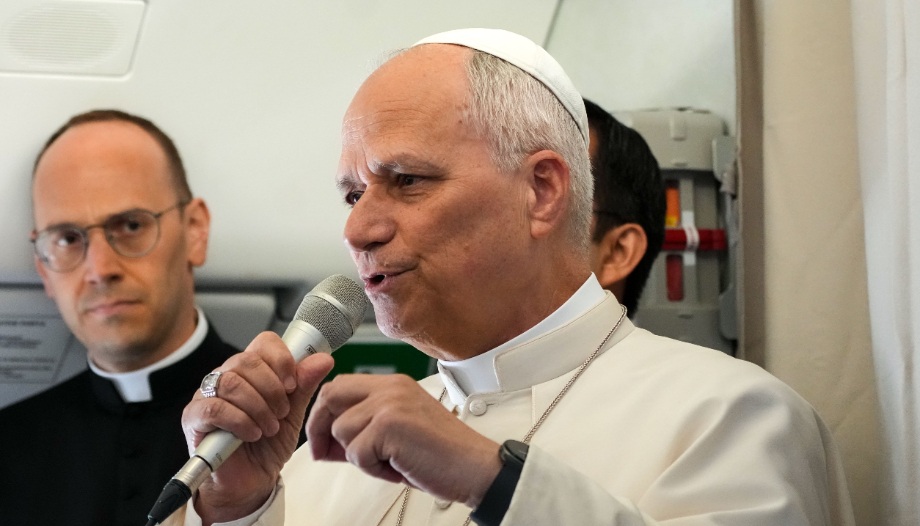
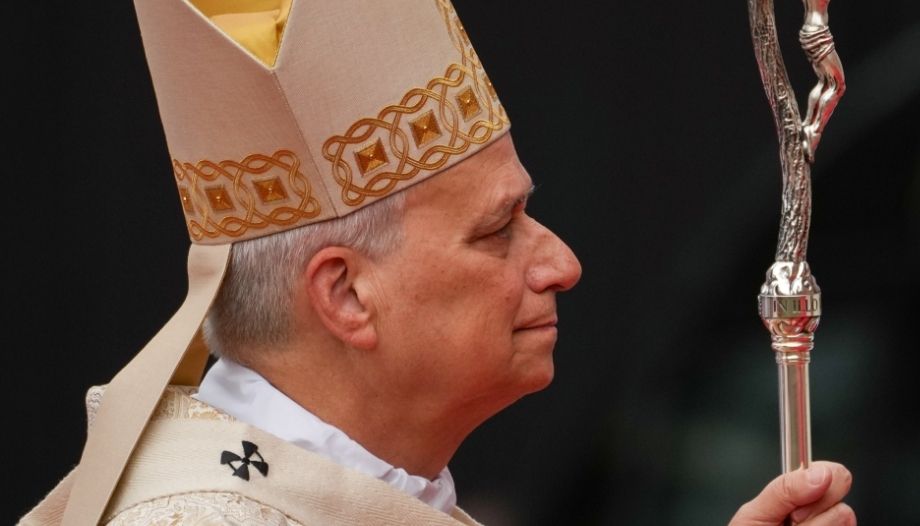
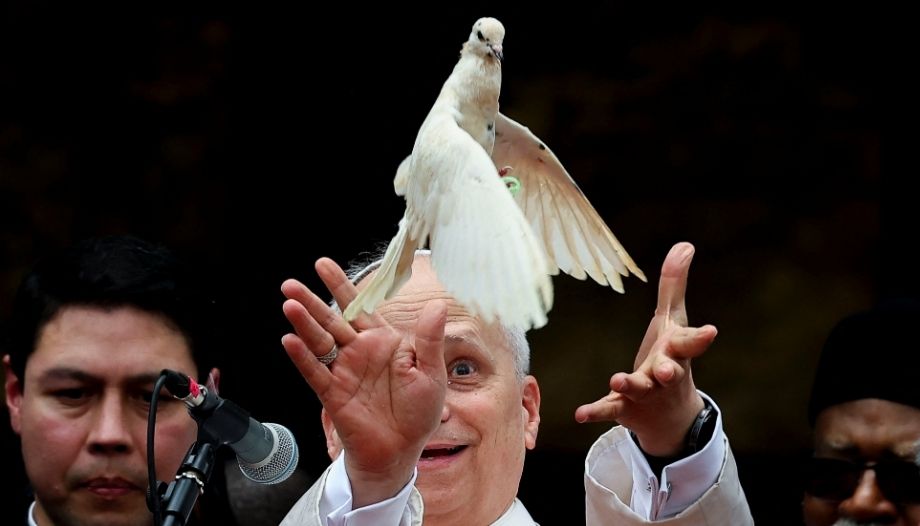
Before joining more than a thousand people for lunch, Pope Leo XIV celebrated the Jubilee Mass of the Poor and prayed that all Christians would share “the love of God, who welcomes, binds up wounds, forgives, consoles and heals.” The Pontiff called for “a culture of care to break down the wall of loneliness”.

CNS / Omnes-November 16, 2025-Reading time: 5 minutes

- Cindy Wooden, Vatican City, CNS

Before joining hundreds of people for lunch, Pope Leo XIV celebrated the Jubilee Mass of the Poor, and prayed that all Christians would share “the love of God, who welcomes, binds up wounds, forgives, consoles and heals.”.

“In the midst of persecution, suffering, struggles and oppression in our personal lives and in society, God does not abandon us,” Pope Leo assured thousands of migrants, refugees and homeless people.

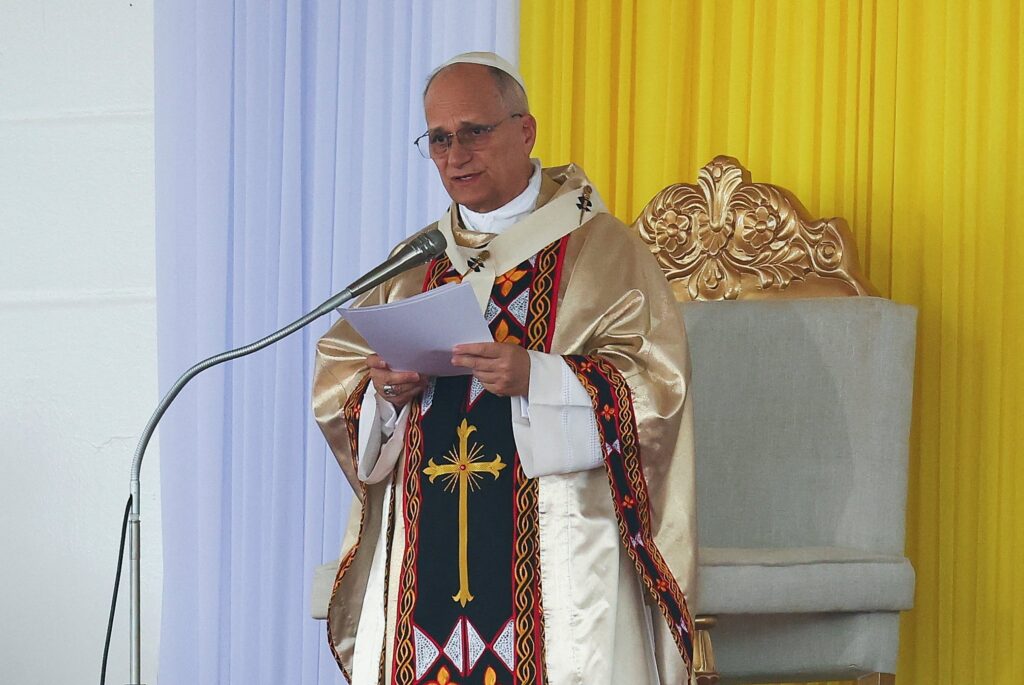
The Lord “reveals himself as the one who takes our side,” the Pope added in his homily on November 16, the day of the Church's celebration of the World Day of the Poor.

Volunteers from Vatican, diocesan and Rome-based Catholic charities joined the people they help for the Mass. The French charity Fratello organized an international pilgrimage, bringing hundreds of people to Rome.

Luncheon with more than 1,300 people, sponsored by the Vincentian Fathers

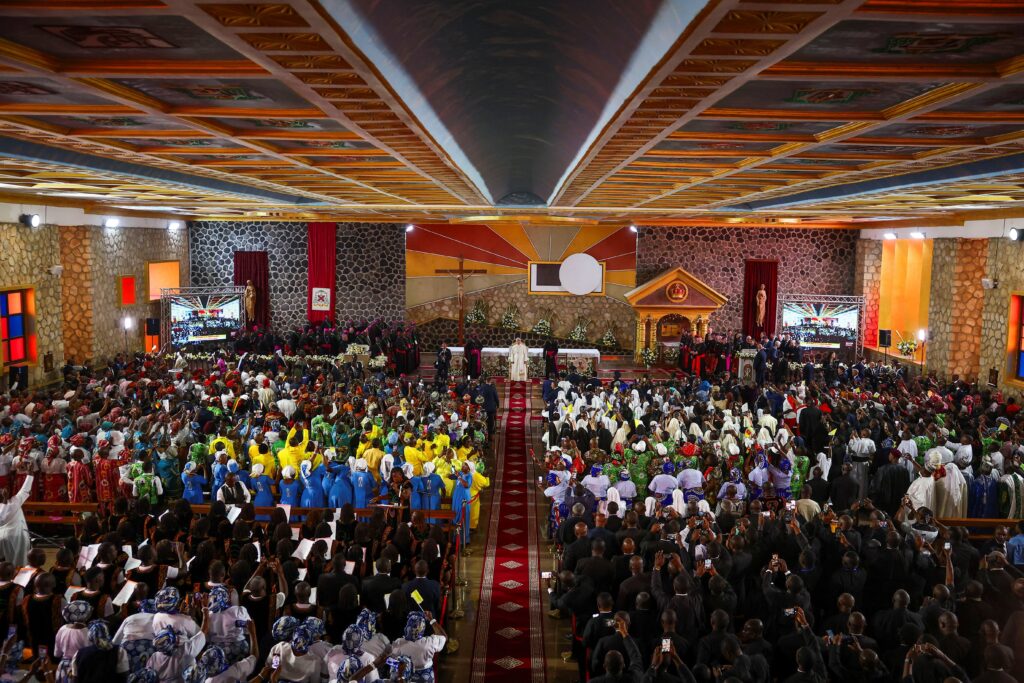
The Vatican reported that 6,000 people attended the Mass in the basilica, and another 20,000 followed the Mass on giant screens in St. Peter's Square. By the time Pope Leo XIV led the Angelus prayer, some 40,000 people were in the square.

Following the Angelus, and as part of the celebration of the 400th anniversary of their foundation, the Vincentian Fathers sponsored and served lunch to the Pope and his guests. Members of the Daughters of Charity and volunteers from Vincentian organizations helped serve the meal and distributed 1,500 backpacks with food and hygiene items.

Lunch consisted of a first course of vegetable lasagna, followed by chicken cutlets with vegetables and, to finish, baba, a small Neapolitan cake dipped in syrup. Rolls, fruit, water and soft drinks were also provided.

Pope Leo XIV spoke to the more than 1,300 guests at the luncheon served by the Vincentian Fathers, which was also attended by members of charitable organizations (CNS photo/Lola Gomez).

Homes for the world's poor

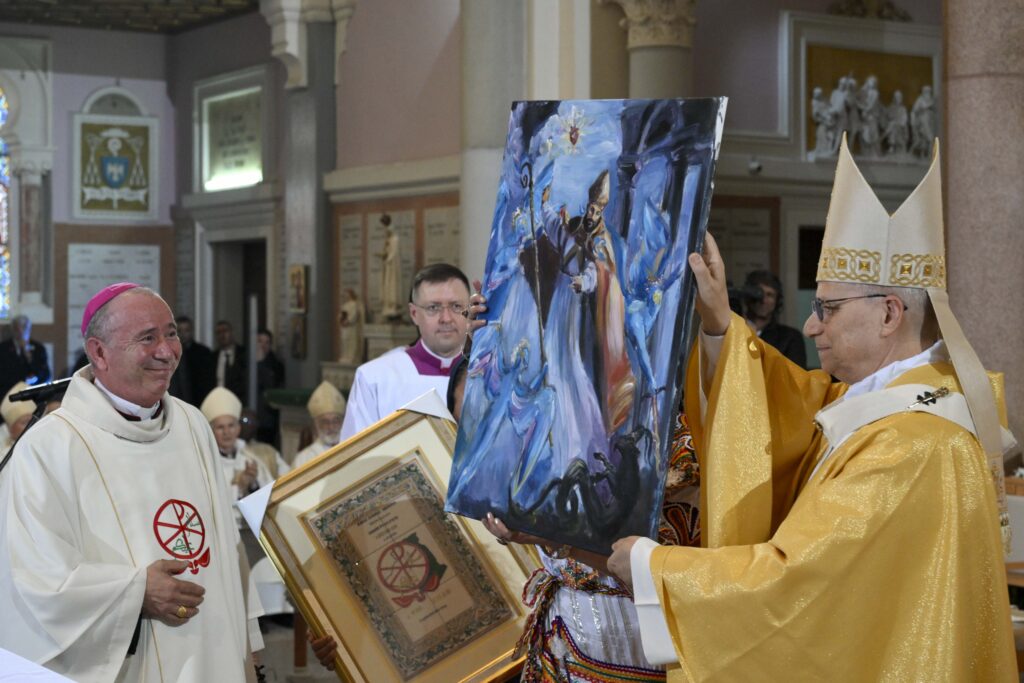
Before the Mass, Father Tomaž Mavric, Superior General of the Vincentians, symbolically handed Pope Leo the keys to the houses of the Vincentians« »Thirteen Houses Campaign." The name of the project, which has built homes for the poor around the world, is a tribute to St. Vincent de Paul and his decision in 1643 to use a donation from French King Louis XIII to build 13 small houses near the Vincentian headquarters in Paris to care for abandoned children.

‘Dilexi te’, ‘I have loved you’.”

In its homily During the Mass, Pope Leo XIV pointed out how the Bible is «woven with that golden thread that tells the story of God, who is always on the side of the little ones, the orphans, the strangers and the widows».

In the life, death and resurrection of Jesus, “the closeness of God reaches the highest expression of love,” he said. “For this reason, the presence and the word of Christ become joy and jubilation for the poorest, since he came to proclaim the good news to them and to announce the year of the Lord's grace.”.

While the Pope thanked Catholics who help the poor, he said he wanted the poor themselves to hear “the irrevocable words of the Lord Jesus: ‘Dilexi te,’ ‘I have loved you.’”.

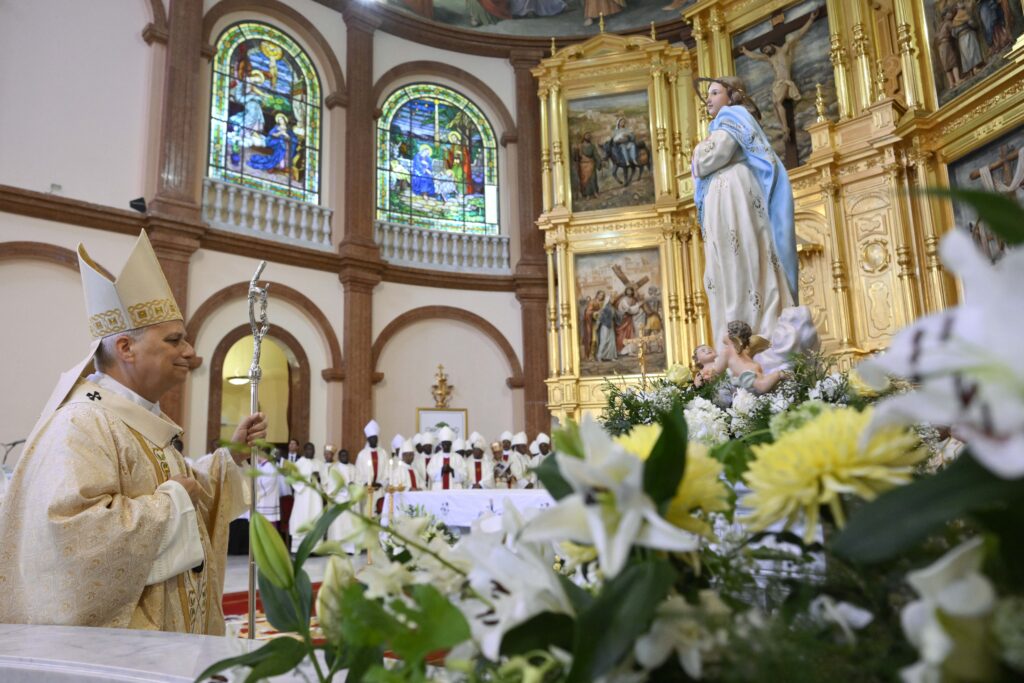
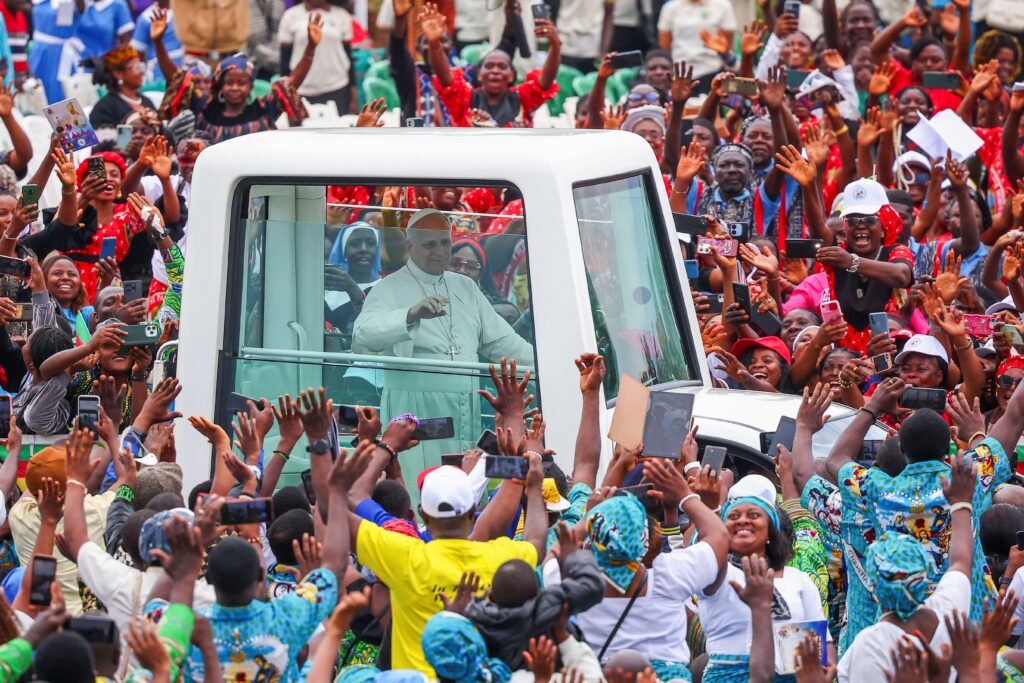
Pope Leo XIV celebrates the Jubilee Mass of the Poor in St. Peter's Basilica at the Vatican on November 16, 2025 (CNS Photo/Lola Gomez).

“A culture of care, to break the wall of loneliness”.”

“Yes, in the face of our littleness and poverty, God looks upon us as no one else and loves us with an everlasting love,” the Pope said. “And his Church, even today, perhaps especially in our time, still wounded by old and new forms of poverty, hopes to be ‘mother of the poor, a place of welcome and justice,’” he added, citing his exhortation on love for the poor.

While there are many forms of poverty - material, moral and spiritual - what cuts across them all and particularly affects young people is loneliness, he said.

“He invites us to look at poverty in an integral way, because while it is true that it is sometimes necessary to respond to urgent needs, we must also develop a culture of care, precisely in order to break down the walls of loneliness,” the Pope said . “Let us therefore be attentive to others, to each person, wherever we are, wherever we live.”.

Appeal to Heads of State and leaders: ‘There can be no peace without justice’.’

Poverty is a challenge not only for those who believe in God, he said, and appealed to «heads of state and leaders of nations to listen to the cry of the poorest of the poor". poor".

«There can be no peace without justice,» said Pope Leo XIV. And the poor remind us of this in many ways: through migration, through their cries, which are often stifled by the myth of welfare and progress that does not take everyone into account, and even forgets many individuals, leaving them to their fate.”.

Some 40,000 people gathered in St. Peter's Square at the Vatican to accompany Pope Leo XIV at the Angelus prayer on November 16, 2025 (CNS photo/Vatican Media).

Angelus: Christians, victims of discrimination and persecution

“Today, in various parts of the world, Christians are victims of discrimination and persecution,” Pope Leo XIV told some 40,000 people gathered in St. Peter's Square for the Angelus prayer.

“I am thinking in particular of Bangladesh, Nigeria, Mozambique, Sudan and other countries from which news of attacks against communities and places of worship frequently arrive,” the Pontiff added. 

“I accompany with my prayers the families of Kivu, in the Democratic Republic of Congo,” he also noted, where in recent days there has been a massacre of civilians, with at least twenty victims due to a terrorist attack. “Let us pray that all violence may cease and that believers may collaborate for the common good.” But, Pope Leo XIV concluded, “God is a merciful Father and desires peace among all his children!”.

Persecution with lies and manipulations, the martyrs

“The persecution of Christians, in fact, occurs not only with weapons and mistreatment, but also with words, that is, through lies and ideological manipulation,” added Leo XIV.

“Above all, when we are oppressed by these evils, physical and moral, we are called to bear witness to the truth that saves the world, to the justice that redeems people from oppression, to the hope that shows everyone the way to peace.”.

“Dear brothers and sisters, throughout the history of the Church, it is above all the martyrs who remind us that God's grace is capable of transfiguring even violence into a sign of redemption,” he concluded.

Prayer for peace in Ukraine

The Holy Father did not forget Ukraine. “I follow with sorrow the news of the attacks that continue to strike numerous cities in Ukraine, including Kiev. These attacks have caused victims and wounded, among them also children, and enormous damage to civil infrastructures, leaving families homeless as the cold advances. I assure my closeness to the population in this ordeal. We cannot become accustomed to war and destruction. Let us pray together for a just and stable peace in the suffering Ukraine”.

The authorCNS / Omnes

Read more

Coincidences do not exist, causalities do.

Both believers and atheists do not have conclusive arguments about the existence or not of a creator being. These beliefs, in both directions, are supported by evidence, not proof, of the existence or not of God, says the author, who quotes Heisenberg: our world is not the fruit of chance. There is something that harmonizes creation, say many scientists.  

November 16, 2025-Reading time: 3 minutes

The childhood beliefs that we have been taught, transmitted or inculcated about the existence of God by our parents, grandmothers, teachers, catechists,... are crumbling faster and faster in our society, as the Nothingness progresses destroying Fantasy in The Neverending Story. 

In other words, when you listen to Ignacio Varela, Pedro García Cuartango, Fernando Savater,... and many journalists, intellectuals, artists, they give the impression that these fantastic stories are always surpassed by the cruel and devastating reality in which we live. These thoughts of people of “letters” are of scientists and can be of the same style or more radical, perhaps with more reason. Although they do not have to be. 

For example, Werner Heisenberg, the famous physicist who established the Uncertainty Principle, said: “The first sip from the glass of natural science will make you an atheist, but at the bottom of the glass, God is waiting for you”. 

Thinking about it coldly, the great arguments to demonstrate the non-existence of God do not exist either, they are pure ideas, intuitions. And the great theories and explanations of the universe are incomplete and always not fully demonstrated. So, is denying or affirming the existence of God a mere belief? Is there conclusive evidence in any direction, or is it an opinionated but non-scientific dispute? Is it an act of faith in both cases? 

Clearly yes, since both Faith and Science, in this question, do not have a clear answer in any sense. Both the “religious stories” and the impossibility of empirically denying the existence of God, make us see that both believers and atheists do not have conclusive arguments about the existence or not of a creator being. Therefore, any disdain towards those who have a thought opposed to their own is striking, since to disagree does not mean to discriminate. 

Having convictions does not give the right to offend

We can conclude that having convictions does not give us the right to offend those who think differently from our thoughts in any case, and even less if the evidence does not support it. And perhaps the religious person is the one who “pays the price” in this matter, since many times he is offended gratuitously for being a believer and thinking that there is a creator being, computer or maintainer of the reality in which we live, when neither this nor the opposite has been demonstrated.

We can say that these beliefs, in both directions, are supported by evidence, not proof, of the existence or not of God. They are not pure belief. They are reasoned and credible.

Theistic scientists

Albert Einstein, Arturo Compton, Louis de Broglie, Kurt Gödel, George Lemaitre, David Berlinski, Wernher von Braun, Gregor Mendel, Francis Collins, Werner Heisenberg, Louis Pasteur, Jhon Barrow, Tulane Frank Tripler, Richard Smalley, Freeman Dyson, Ramón y Cajal, John Eccles,They are scientists who, at some point, have shown that the order of the universe may have an intentionality or a purpose, which makes it “placed” and “ordered”. Let us call it God, programmer of algorithms or great harmonizing intelligence, but in something like this conclusive after their investigations. That is, they are men of intellectual rigor who conclude that there is something that harmonizes creation.

Catholic scientists

If it already seems a contradiction to say “theistic scientist» to say «Catholic scientist” is something that sounds wrong, probably because in Spain saying Catholic is like saying “fundamentalist”, but it is not so in the Anglo-sphere, since Catholic means universal, that is to say open to reality, so they are compatible terms.

The books published in recent years by Catholic scientists on this subject are not conclusive. The famous book “God. Science. The evidence” written by Michel-Yves Bolloré y Olivier Bonnassies, a bestseller in France, or “New Scientific Evidences for the Existence of God” by José Carlos González-Hurtado, They provide very interesting ideas, but as we have already said, they are not really “scientific proofs” but rather “scientific evidence” in one direction. The thesis of these books is based on the idea of Heisenberg, The more one delves into the explanation of how our world works, the clearer it becomes that it is not the result of chance.  

IV Congress of the Spanish Society of Catholic Scientists

From October 2 to 4, the IV Congress of the Society of Catholic Scientists The event was organized by the Society of Catholic Scientists (Society of Catholic Scientists) Spain section, this year at the CEU San Pablo University. It was attended by a varied group of scientists from different disciplines, who enjoy the concern to deepen and better understand the world and to know how to better explain the relationship between Faith and Science. Enrique Solano, The president of the Society of Catholic Scientists of Spain (SCCE), wants to empower the Catholic scientist, so he says: “Our obsession is to show ourselves to society, so that the Catholic scientist is no longer invisible”. 

Professor Javier Sánchez-Cañizares, physicist and theologian, who attended the congress, among many other things, says that the contingency and convergence of the universe can be a sign of God's action, without being a scientific proof, but an intuition. Just as the diversification, spontaneity and potential growth of nature can be an explanation that there is a personal God, who is not only creator but also loves his creatures.

——————

The Author

Álvaro Gil Ruiz

Professor and regular contributor to Vozpópuli.

—————-

The authorÁlvaro Gil Ruiz

Professor and regular contributor to Vozpópuli.

Poor

Faith fosters solidarity and awareness of human dignity, inviting us to imitate the poverty of Christ in order to attain true freedom and to recognize in the poor a richness that reveals to us the truth of the Gospel.

November 16, 2025-Reading time: 4 minutes

«The most serious poverty,» says Leo XIV in his message for the World Day of the Poor, "is not knowing God". This is a bombshell in the midst of a society that considers God as its archenemy and also erroneously believes that poverty can be fought with money.

God has been considered by some as the opium of the people, a childish fantasy that distances human beings from the struggle for justice, that alienates them from rebelling against the powerful, when the opposite is true. Faith, if it is in Jesus Christ, the Son of God, enlightens men and women to make us aware of our own dignity and that of our brothers and sisters.

Believing in a common Father makes us brothers and sisters, makes us neighbors, predisposes us to the just distribution of wealth because we belong to the same family. There are Caritas, Manos Unidas and so many organizations born in the heart of the Catholic community leading, year after year, the fight against poverty. They do it with works known to all; but also with prophetic words, denouncing the unjust situation in which millions of our brothers and sisters live. And they do it, being consistent, from evangelical poverty, from simplicity, without the powerful means that other institutions have.

Meanwhile, ideologies and -economically doped by them- social agents engage in their own struggles with the poor as their banner. They all believe they have the solution to end poverty; some by raising taxes on the rich to distribute among the poor; others by promoting the generation of more wealth so that there is more to distribute to those who have less; but, in both cases, from the idolatry of money, as if money alone had the power to end poverty.

But this is not the case. Just take a look at the statistics of people who have gone bankrupt after winning a lottery prize. According to one study, up to 70 percent of them end up bankrupt within five years. The reason? There is a human poverty that is superior to any material poverty and that makes us not be able to dominate money, but that it dominates us. If, with little, no one is free from falling into the temptation of satisfying absurd, selfish, if not harmful desires, how much more so if a shower of money falls on us! The same thing is happening to our rich societies. There is more and more money, but we are more and more indebted and the poor are getting poorer and poorer. How is this possible? The love of money distances us from God and therefore from everything that makes us human: solidarity, belonging to a community, sobriety, self-control. We squander on absurd policies and do not invest in what really generates wealth: people.  

The very word «solidarity», wielded by many who start out in the world of politics or organizations that fight against poverty, loses steam as they move up the social ladder until, with honorable exceptions, the glitter of the money they have earned and their vanity prevent them from seeing the poverty from which they have only just emerged. Poor little people, they have nothing but money that drags them down and dominates them. 

A week before the celebration of the feast of Christ the King, a king who appears poor and humble, with a crown of thorns and a heart pierced with love for mankind, the World Day of the Poor invites us to reign with him over the human powers that be, those who manage money, because «you cannot serve two masters». And he encourages us to imitate him in his poverty, in his detachment from all human security, relying only on the Father whose Providence is more powerful than any bank or any fund. Next Generation.

It is the freedom felt by so many saints like St. Francis of Assisi or St. Roch, detaching themselves from their riches in order to live authentic freedom. From there, we can begin to see the poor not as a hindrance, not just as a problem to be solved, but as a richness because they are, Leo XIV reminds us, «the most beloved brothers and sisters, because each one of them, by their existence, and even by their words and the wisdom they possess, provokes us to touch with our hands the truth of the Gospel». 

«The Lord prophesied, »You will always have the poor among you". And he did not say it so that we would throw in the towel because it is a problem without a solution, but so that we would be aware that our freedom, our salvation, is always within reach. We do not have to go very far to find a poor person, as do those who prefer to ease their conscience without getting involved.

Sometimes they sleep in the arcades of the center of big cities, yes, but sometimes they have the face of an acquaintance who is unemployed and whose benefits have run out. Sometimes they are in mission countries, yes, but other times they take the form of a relative who demands care that is incompatible with our standard of living. Sometimes they are in jail, yes, but sometimes they live in our own home imprisoned by video game addiction because no one pays attention to them. Sometimes they are in the psychiatric hospital, yes, but others are friends or neighbors who need our affection, time and understanding because they suffer from mental problems and living together becomes difficult... 

«The Lord prophesied: »You will always have the poor among you". And the fact is that wherever there is a poor person, a needy person, a person who suffers, nearer or farther away from us, He will be waiting for us to help us to get out of ourselves, to help us, therefore, to get out of the most severe poverty that is to live without Him.

The authorAntonio Moreno

Journalist. Graduate in Communication Sciences and Bachelor in Religious Sciences. He works in the Diocesan Delegation of Media in Malaga. His numerous "threads" on Twitter about faith and daily life have a great popularity.

Resources

What happens after death?

Death is not the end, but the passage to eternal life with God through resurrection, judgment and purification of the soul.

Santiago Zapata Giraldo-November 16, 2025-Reading time: 11 minutes

One of the main themes is “What happens after death?” Many questions about something that is uncertain to human eyes, on the other hand to the eyes of faith it is seen as that “return to God” from where we have come out. 

Death as the end of the human being

Death, certainly, reveals to man an imminent “finiteness” from which he cannot escape, which is the cause of sin. This death also opens him to another reality, that of abandoning his soul totally to the will of God, the fact of “end” is not interpreted as a total loss, but as a birth to a new, eternal and true life.

The catechism is clear, an end but also a beginning “In the face of death, the enigma of the human condition reaches its summit” (GS 18). In a sense, bodily death is natural, but by faith we know that it is really the “wages of sin” (Rm 6, 23; cf. Gn 2, 17). And for those who die in the grace of Christ, it is a participation in the death of the Lord in order to be able to participate also in his Resurrection (cf. Rm 6, 3-9; Flp 3, 10-11. CEC 1006). 

But is this as far as it goes? Christian eschatology teaches that just as we have gone out from God, we will return to Him as the first principle of all creation. Now, what happens after we die? Let us start from a first idea: man knew sin, with sin came death, the finiteness of his life became present by itself. With Christ everything changes, everything comes back to life with the hope of the total resurrection in God. His death is not the cause of sin, it is the cause of life for those who want eternity. 

We understand first of all that man must die, but a death that brings life, if we understand that we die to live eternally with Christ in Heaven, awaiting the resurrection of the flesh, not as an eternal sleep, but that our soul will see God. Faith in Christ and the confession that through him all salvation came, guarantees to walk the way of life, and not to die eternally “I am the resurrection and the life; he who believes in me, though he die, yet shall he live” (Jn 11:25) Christ is the way to salvation, but to live eternally, what does it mean? Death has not reigned over life, it cannot destroy man, the soul subsists, but the body awaits the resurrection. 

 “The rational soul is the proper form of man” (S.T I, q, 76, c, 1, a 1) St. Thomas, positively affirms that the soul is the form of the body, this is understood as long as matter exists, if there is “informed” matter that does not possess form, when it adopts a form that in our case is the soul, then it can advance towards perfection.

The soul comes from God, this is something evident, finding that there is not in nature, nor in matter, a proper quality that comes from it that explains the senses and the intelligence that man possesses in comparison with other creatures. If the soul comes entirely from God and will return to Him, what is the body for? “For the soul to be perfected in the knowledge of the truth it needs to be united to the body” (S.T I, q 76, c, 1, a 2) the soul to know the truth of God needs a body, and the body needs someone to give it the form that is soul. 

To understand death as the end is an idea that would deny the action of Christ in the world; to live in the hope of the resurrection is to live according to what God wants, that eternal Easter in which we will see God “as He is” (cf. 1Jn 3:2). 

Christian hope in the resurrection

“We firmly believe, and so we hope, that just as Christ has truly risen from the dead, and lives forever, so the righteous after their death will live forever with the risen Christ and that He will raise them up on the last day (cf. Jn 6, 39-40)” (CEC 989). Resurrection does not only mean earthly life (with a new Heaven and a new Earth) but a total transformation of the human being into the glory of God, where the corruption of sin (death) has no place among men “only at the end of the world will men receive the efficacy of the full resurrection, namely, the overcoming of death as the punishment of sin, when Christ raises all the dead with his power” (Gerhard Müller “the future resurrection” Dogmatics, theory and practice of theology).

The resurrection of the bodies, in a glorious body, united to God, from whence we came, the consummation of creation occurs when the glorious appearing of the Lord takes place. Where God's love embraces everything and everyone, in one and the same love that conquers even death.

It does not mean a return to life in the same form in which we are now, this would lead to a reincarnation theory that would totally deny the mystery of redemption by the fact that our life would start again from zero, the fact of professing that we will return to a body that is not ours, and we will return to “start” brings with it many denials to faith, it is also affirming that there are millions of cycles of death, besides this; we would totally deny the complete action of man, where he would only put on a body.

The Catechism (1013) says: “Death is the end of man's earthly pilgrimage, of the time of grace and mercy that God offers him to carry out his earthly life according to the divine plan and to decide his last destiny. When the “only course of our earthly life” (LG 48), we will no longer return to other earthly lives. “It is appointed unto men once to die” (Hb 9, 27).

There is no «reincarnation” after death”. To affirm reincarnation is to deny the union of the soul and the body, because if we think that the soul would seek after using the body it is because it was not united to it, and this would lead us to see the body simply as a “prison” from which we escape when we die and start again with the same soul. Likewise, reincarnation would lead us to think that we would never see God, there would be no beatific vision and our hope would be null, since it is a continuous survival in different bodies. 

Faith in the resurrection of the dead is incompatible with reincarnation, because we are not like an anonymous being, but a person, a unity that is called by God to live with Him, the resurrection is a divine transformation. And if the resurrection comes from Christ it is because our soul and body are personal, naturally united, forming a united and unique being that is loved. Therefore, to affirm reincarnation would be to deny the action of God, as well as the redemption of each person through the mystery of the Cross.

The trial

“He will come to judge the living and the dead” these words that we repeat in the solemnities, have an undertone of hope. In John's Gospel we read: “He who believes in him will not be judged; he who does not believe is already judged, because he has not believed in the name of the only begotten of God” (3:18) Christ does not condemn: He is pure salvation. This being so, pure salvation is the person himself who is judged, as we read from the apostle John, “he is already judged”, the judgment is also born of free will.

To accept Christ, with all that it entails, is to reach salvation; to turn away from God brings with it separation from the Good and therefore condemnation. Joseph Ratzinger affirms that: “Judgment consists in the fall of the masks that imply death” (“Eschatology, Death and Eternal Life”).

The idea of judgment, in the Christian conception, introduces a radical change with respect to the notion of eternal damnation: it is God who becomes man, the one who can judge and who also does so is the same one who seeks man, so that he may know the truth, so that he may turn away from the paths of death and live eternally with Him in Heaven. Therefore, it is man in his decisions who becomes judge of himself, Christ does not deny walking in the paths of his truth. He, who became flesh and dwelt among us, manifested during his earthly life the divine plan of salvation, announcing the Kingdom. 

Jesus not only speaks of the Kingdom, but Jesus is the Kingdom of God “Likewise you, when you see these things happening, know that the kingdom of God is at hand” (Lk 21:31) The Kingdom has come, it is a person, it is Christ himself, through whom we gain access to the Father. It continues to act, not as a future, but as a “now” by the Holy Spirit: “Jesus is the kingdom not merely in his physical presence, but through the irradiation of the Holy Spirit” (Joseph Ratzinger “Eschatology, death and eternal life”). He acts in the world, he remains in the Eucharist as the permanent reality of what one day we hope to see in all its splendor, no longer as the appearance of bread. The liberation of man through Christ establishes the lordship of God in the world, and through this action of God in the world, Christ is the Kingdom of God. 

Hell, Heaven and Purgatory. 

We find in the realities where the soul can be found after death. Hell, of which is the total separation of the creature from God, which respects the freedom of his creature, therefore, there is also that they are condemned by their own free will. The “yes” of man to the love of God in order to reach salvation is certainly a mutual response. Christ descends to hell, but he does not treat men as those who cannot, not as infants, but he makes them responsible for their freedom, he leaves them the right of their damnation. 

The Christian's giving everything, the “betting” everything for his salvation, with his eyes on Heaven, taking it seriously for his own soul. Joseph Ratzinger mentions: “God suffers and dies, what is evil for Him is not unreal. For Him, who is love, hatred is pure nothingness. He overcomes evil not by the dialectic of universal reason, which can turn all negations into affirmations. He does not overcome evil in a speculative Good Friday, but in a totally real” (Eschatology, death and eternal life).

Evil exists, it wants God not to reign in the world, it is a real presence, which cannot be ignored or transformed by concepts. Hegel tries to resolve evil in ideas, where he develops that evil as necessary moments for the development of consciousness, becomes an idea. He does not affirm that evil disappears, in a historical sense. God overcomes evil, not as an idea, or dialectically, but in a concrete and real event, with the sacrifice of the lamb.

When evil is set in concrete, God responds with the descent of Jesus to deliver from the place of the dead. That is his response of love. The scope of liberation can only be seen through faith, but it accompanies Jesus, who immerses himself in his person, a spiritual experience that becomes existential: “there is no man who can look or, at most, can only look to the extent that he also enters into that darkness through a faith that suffers” (Joseph Ratzinger, Eschatology, Death and Eternal Life). It is to live the “dark night” as St. John of the Cross says, it is to live it in the light of Christ's redemption, of suffering for the salvation of souls, the throne of Christ is his cross, our salvation is the Cross of Christ. 

Purgatory

The Catechism of the Church explains to us a centrality of what can be defined as purgatory: “Those who die in the grace and friendship of God, but imperfectly purified, although they are sure of their eternal salvation, undergo after their death a purification, in order to obtain the holiness necessary to enter into the joy of Heaven” (CEC 1030) The imperfection of men extends to the last moment of their earthly life, where their soul passes to “purification” where it has to enter without blemish into the presence of God. Purified to make our body conform to that of Christ. 

Entering this reality makes us enter God's time, where there are no physical laws that can measure the passage through purgatory. It is not a field of torture in another world, it is a necessary process as we become capable of God, of Christ and join the choir of angels to praise the Lord, “gold is refined by fire” (1Pet 1,7) where we have to purify ourselves, go through the fire that makes us complete image of Christ, where it is really there where the liberation occurs, where all the sin that can tend is purified by grace. The Church calls purgatory to this final purification of the elect which is completely distinct from the punishment of the damned (CEC 1031).

We could say that we are in a “waiting room” where our soul is not completely lost, but wants to see God. Those of us who are still on pilgrimage on earth, this Church militant, helps the purgative Church by praying for those who have died, whom we entrust to God's mercy, this help, especially with the sacrifice of the Eucharist, helps the faithful to pray for the souls of those we want to see God, so that they too may intercede as the Church triumphant for us. 

Pope Benedict XVI affirms: “Christ himself, the Judge and Savior. The encounter with him is the decisive act of judgment. Before his gaze, all falsehood melts away. It is the encounter with him which, by burning us, transforms us and frees us to become truly ourselves. At that moment, all that has been built up during life can manifest itself as dry straw, empty boasting, and collapse” (Spe salvi n. 47) the fire of love is what purifies, knowing that we are configuring ourselves to Christ, that we tried it on Earth and that now we will only live with Him in Heaven is the sign of God's infinite love. Certainly painful, but it brings freedom, through which we can be ourselves, just as we are, where there will no longer be anything hidden that has not been revealed. 

El Cielo

To live in Heaven is «to be with Christ» (cf. Jn 14, 3; Flp 1, 23; 1 Ts 4,17). The elect live «in Him», indeed, they have there, or rather, they find there their true identity, their own name (cf. Ap 2, 17). The hope of Heaven, which we so often think of on Earth, we can imagine as a continuous seeing of God. Incorporated by Him, Jesus opens Heaven to us, when He descends to the sheol (place of the dead) where all the dead went, awaiting the deliverance of the messiah.

Christ descends to the abode of the dead, as the fulfillment of salvation, he descends so that the voice of the Father may reach everyone, so that all may live. Jesus opens Heaven, descends to death, and thus, knowing also death, is sent to announce salvation, since all: the living and the dead are inscribed in God's saving plan. The souls of the righteous before Christ were waiting in Abraham's bosom, and this reminds us of the parable of the rich glutton (cf. Lk 16:19-31): Lazarus, as a poor and just man who suffered in this world, waited in Abraham's bosom for the Messiah to arrive. 

Now, many conceptions of viewing writing bring back the idea of the sheol where the interpretation itself, in the light of its own reason explains that we will wait in a state of sleep, this after death, this especially comes from groups of the XIX century. If we bring back the idea of a “sleep” while waiting for the parousia of Christ, this would lead to the fact that the action of Christ is not redemptive, but only a message that does not bring action.

Through Christ, with Him and in Him we have been redeemed, Heaven has been opened to us. If we understand the descent to the place of the dead as loneliness without God, Christ penetrates with his love completely to give life. It gives life, total separation from Christ is hell, our soul does not go to sleep until Christ returns, but is judged. Therefore, to think again of an idea of “sheol” brings with it the non-belief that Christ opened Heaven. 

Heaven is open, we know that the Church is already triumphant, through the saints, anonymous and those recognized by the Church, the martyrs, with St. Mary, continually seeing and adoring God in his three persons. If Heaven exists, it is because Christ himself became man, died and rose again. Heaven is the participation in the body of Christ, the fulfillment of the vocation for which we were baptized. The unity between God and mankind. All united with others, the communion of saints united to Christ as head, this is Heaven, when the Lord returns and the whole body is united with his head, united in one, in unity, that day that is to come, that day there will be only joy and jubilation.

Santa Maria and Heaven

Holy Mary, the Mother of God, who is the great intercessor, in our life here on earth, but also when the time of our purification comes. She who was assumed into Heaven by the power of God, body and soul, her totality. “The central statement of the dogma of the Assumption says that since Mary had, in faith and in grace, such a unique connection with the redemptive work of Christ she also participates in his risen form as the first fully and absolutely redeemed creature” (Gerhard Müller, “Dogmatics, Theory and Practice of Theology”).

Mary enjoys in a singular way a more complete intercession thanks to her connection with the work of redemption, being the prototype and model of the redeemers of her son, since she is configured more fully with him. We turn to her as Lady of Mercy every day, in our daily prayers, in the Sacrifice of the altar, so that she may obtain for us the graces of one day being able to contemplate her son.

The authorSantiago Zapata Giraldo

Read more
Evangelization

St. Albert the Great, Bishop and Doctor of the Church

The liturgy of the Church celebrates on November 15 the Dominican St. Albert the Great, Bishop of Regensburg, Doctor of the Church, and teacher of St. Thomas Aquinas. St. Raphael of St. Joseph, in the Kalinowski century, born in Vilnius (Lithuania), who worked hard in the expansion of Carmel in Poland. And also to the protomartyr of Uganda, St. Joseph Mkasa Balikuddembé.

Francisco Otamendi-November 15, 2025-Reading time: 2 minutes

St. Albert was born in Germany around 1200. As a young man he went to study in Padua, Bologna and Venice. He studied theology in Cologne, but his critical and systematic philosophical spirit had to face difficult theological questions, according to the Vatican saints' calendar.

In Italy, Albert became a Dominican and received the habit from Blessed Jordan of Saxony, the immediate successor of St. Dominic. The latter sent him first to Cologne and then to Paris, where for some years he held the chair of theology. There he met St. Thomas Aquinas, whom he took with him when the Order sent him to Cologne to found a center for theological studies. Study and teaching, with the love of the Lord, were his passions.

Integration of Aristotelian philosophy and revealed truths

In Cologne, he earned the nickname “Magno”. He studied and taught the works of Aristotle, so that he made Aristotelianism accessible within Christian thought, showing that it was not incompatible with Theology. He thus laid the foundations so that others, especially St. Thomas and St. Paul, would be able to understand Aristotelianism. Thomas Aquinas, developed a deeper synthesis, with its metaphysics.

In 1256, St. Albert was sent to Rome, and then, unexpectedly, the Pope appointed him bishop of Regensburg. In 1274 he was invited by Gregory X to participate in the Second Council of Lyons, and on his way back he was given the news of the death of Thomas. It was a hard blow for St. Albert, who commented: “The light of the Church has gone out”. He was canonized in 1931 by Pius XI, who also proclaimed him a Doctor of the Church. 

St. John Paul II at his tomb in Cologne

The prayer of St. John Paul II, kneeling at his tomb in Cologne in 1980, is well known. here. The holy Polish Pope presented St. Albert the Great as a symbol of the reconciliation between science (or reason) and faith, a theme that would later be developed by his successor, Benedict XVI.

The authorFrancisco Otamendi

Read more
Integral ecology

Hogar de Maria's first home for vulnerable mothers and babies

This November 16, coinciding with the World Day of the Poor 2025, the Hogar de María association begins a new stage. Bishop Xabier Gómez blesses its first Cradle House in Molins de Rei (Barcelona), next to the parish of Sant Miquel Arcángel. A new home where mothers already live with their babies, in vulnerable situations.      

Francisco Otamendi-November 15, 2025-Reading time: 4 minutes

The inauguration will begin with the visit and blessing of the Casa Cuna by the Dominican bishop of Sant Feliu de Llobregat, Mons. Xabier Gómez, who will then preside the parish mass with baptisms, confirmations and first communions of several families accompanied by the association.

The Casa Cuna Llar Magdalena Bonamich is the result of the collaboration between the Sant Miquel Arcángel parish and the Hogar de María association. The former parish house, which had ceased its activity in 2024, comes back to life welcoming pregnant women or women with small babies in vulnerable situations.  

“All the mothers of the baptized turn these days to flowers, cakes... On Sunday the bishop will bless because Hogar de María begins a new stage with the inauguration of the first Casa Cuna,” explains its vice-president, Maite Oriol. 

“The parish priest has made it possible for us to stay, and there is capacity for several mothers to achieve autonomy in life, with their babies. The Casa Cuna is a two-story tower with a garden, a workshop and an orchard, where 5 or 6 mothers stay with their babies, accompanied by a coordinator who lives and sleeps there”. 

“It's very cheerful, very pretty, and it's been underway since before summer. Now I'm painting a colorful wall. It's a minute away from the parish,” he adds.

Mothers with their babies hosted by Hogar de María's project @HogardeMaría.

Lay support, hand in hand with the parishes

Hogar de María is an association born from the impulse of lay people who, convinced that every life is a gift from God, accompany and support pregnant women in vulnerable situations. Hand in hand with different parishes and under the protection of the Virgin Mary, it offers a home and a community where every mother and every baby are welcomed with faith, hope and love.

Since 2014, it has served more than 2,000 families thanks to the work of a network of volunteers - psychologists, social workers, counselors and educators - in more than 25 parish headquarters throughout Spain.

Its motto is clear: to defend and welcome the life and dignity of each woman and her child. In each of their homes and projects, they offer psychological support, social counseling and job orientation, as well as spaces for training and spiritual accompaniment. The new home in Molins de Rei integrates all this into a daily coexistence that strengthens the autonomy and hope of the mothers. 

Motherhood and evangelization

“Our project is based on two pillars, motherhood and evangelization,” explains Maite Oriol. “In fact, we have 26 sites, five in Madrid, one in San Sebastian, one in Poland, and the rest in Catalonia, in Barcelona and the surrounding area. At each site, groups of a maximum of 30 mothers are formed. The closeness and the bond that is generated among them, and with us, make up a real family”.

Parish priests, the most enthusiastic

“We are in the parishes, which are places that are not used in the morning, and so we are close to the pastor, it is very important that the pastor can be close to them,” says Maite.

“The parish priests are the most enthusiastic about the project, they create wonderful dynamics, with a lot of joy. It is the reality of the mothers who were thinking of having an abortion and have not had an abortion, and they are successful and happy lives even though they have nothing.”.

The parish creates dynamics of help, volunteering, gathering, presence, witnessing, faith, and numerous baptisms. 

2024: care for more than 500 mothers

The Casa Cuna is managed by an interdisciplinary team and supported by donations. In 2024, Hogar de María cared for more than 500 mothers and delivered about 380 babies. But beyond the numbers, it is an example of how the Church can give a concrete response to social and spiritual challenges.

The vice-president of Hogar de María, Maite Oriol, explains that the initiative is intended to serve as a replicable model for other parishes and dioceses that wish to become involved in the defense of life from the point of view of closeness and personal accompaniment. 

“We have to make a distinction between these cribs and what is normal, which is, once a week, on Tuesdays, the mothers go to the parishes, they are together, they tell each other their problems, etc., and then they go home. Each one has her room, her partner, her mother... They always have problems looking for lodging, but we cannot give it to all of them, we do not have room for so many mothers, more than three hundred”.

Living in the Casa Cuna, and the activity in the parish

But in the Casa Cuna, Oriol continues, “it's nice, these mothers learn to live as a family, and they sleep there. They take care of each other much more like a family, and they help each other, cook, etc. And then these mothers go to the Hogar de María activity in the parish, to which another 20 or 30 mothers also go, which is run by the same coordinator. And there is another group of mothers, called champions, between 15 and 21 years of age, who are treated a little separately, because they are very adolescent, very young, they encourage each other. 

The project is entrusted to the Virgin Mary, and its walls exude the same spirit of trust and dedication that characterizes all the work of the association. In the words of one of its volunteers, “Hogar de María not only welcomes a mother and her child: it welcomes God who comes with them”.

Baptisms and love: hope made home

At a time when so many women face motherhood in solitude, this Casa Cuna becomes a luminous sign of mercy and Christian hope, reminding us that every life deserves a dignified and loving beginning, they say.

In his recent message for the World Day of the Poor 2025, Pope Leo XIV reminds us that “the gravest poverty is not knowing God” and that the poor “are not a distraction for the Church, but the most beloved brothers and sisters”. Thus, this house is also a concrete response: in it hope takes root, faith is incarnated and life regains the ground to flourish.

The authorFrancisco Otamendi

Read more
Culture

The Beauty that lifts us up: Vermeer and the desire for God

Abel de Jesús explains that Beauty takes us out of the logic of calculation and productivity, revealing God's deep desire. Like Vermeer's "The Geographer", it is enough to look up. In that light filtering through the window is everything: desire, beauty, love.

Sonia Losada-November 15, 2025-Reading time: 3 minutes

In the second session of the Arteology, Abel de Jesús confided to his students that one day contemplating a work by Vermeer moved him to tears. It was a serene and profound emotion, one of those that are neither sought nor planned, but happen as a gift. The work he was contemplating was “The Geographer”. He discovered something more than a painting: the irruption of unavailable Beauty, that which does not belong to the market of taste nor to the catalog of the useful.

Vermeer's geographer is working in concentration, busily working on his map, when suddenly he looks up. And in that raised gaze there is a revelation. That's how we also live,“ says Abel de Jesús: ”in the computational, in the predictable, until a light takes us out of the calculation and reminds us that we are made for something else".

This “something else” has a name: desire. Not the whimsical desire to possess or to consume, but the deep longing that God has inscribed in each person to lead him or her to fulfillment. “What do you desire?” -Abel asks. Not “what do you like?” or “what entertains you?”, but “what do you really desire?”. For in that question, he insists, God impresses his call.

The logic of productivity

We live in the logic of arithmetic: productivity, convenience, human respect. But the Gospel - Abel reminds us - is not measured by balance sheets. Jesus did not have a productive life: thirty years of silence and three years of words. He did not found companies, nor did he leave good balance sheets, but his light continues to accompany history. He teaches us that fulfillment is not in performance, but in loving correspondence with the Logos, that principle of order, harmony and meaning that is God himself.

“The theology of the Logos,” he says, "reminds us that God does not impose what is not: he does not ask anything of you against your nature. Things are not good because God wants them, but God wants them because they are good and beautiful". This Logos is the raison d'être of the world and the heart of revelation: a God who does not act on a whim, but out of love, because his being is a loving overflow.

During the session, Abel traces the history of faith as a pedagogical display: from an eye for an eye to the forgiveness of enemies, from the temple of stone to the temple of the heart, from the distant God to the incarnate God, who becomes man so that man may recover his fullness. “The incarnation,” he says, "is not just another event, like the release of a record or a historical event. It is an eternal leap: the moment in which God enters history and history touches the eternal".

This mystery has a concrete face; the face of Jesus. In the portal of Bethlehem, the first to adore are shepherds and magi: the poor and the wise, the marginalized and the intelligent. “In them the whole world is embraced: what the world despises and what the world admires. All kneel before a Child who is God.”.

Beauty and cross

In his reading of Hans Urs von Balthasar's «The Glory», Abel recalls that Jesus not only descends into hell, but to the point where there is no faith or hope left, to redeem even that. “Death, emptiness, evil do not have the last word.” That is why Beauty and Light triumph over darkness, not because everything will turn out well, but because in the end a love that transcends us awaits us.

Abel wonders if Jesus was happy, or Mary, or Joseph. In the measure of the world, surely not. But in the measure of love, they were full. The happiness that is sold to us today,“ he warns, ”is a trap: more options, more stimuli, more distraction. But more is not always better. He recalls the village cinemas where only one movie a week was shown and we were all happy. Today there are many movie theaters in a city and thousands of options to watch on digital platforms, and we often go to bed trying to choose without deciding on one. “Seeking one's own pleasure never ends,” he says, "while giving oneself to others can fulfill us.

The cross, a scandal for some and foolishness for others, thus becomes the definitive response to the mystery of human suffering. It does not promise an easy life, but a fruitful life: denying oneself not to annul oneself, but to be filled with the Other. “God destroys our castles,” Abel concludes, "so that we may discover that happiness was not there. Even our religion can become a habit. However, grace is not forced by personal merit: it is simply accepted".

Like Vermeer's geographer, it is enough to look up. In that light filtering through the window is everything: desire, beauty, love. God's unavailable Beauty continues to call us, silently, to remind us that we were not made to produce, but to contemplate, to love and to let ourselves be transformed.

The authorSonia Losada

Journalist and poet.

Read more
Books

Luna Miguel: the deepest censorship comes from us

From St. Basil to Luna Miguel, the work "incensurable" offers a reflection on reading, human dignity and the limits of literary censorship.

José Carlos Martín de la Hoz-November 15, 2025-Reading time: 4 minutes

The work of Luna Miguel (1990), a successful writer and editor and one of the best writers in Spanish literature today, I found it very interesting and very timely, because the issue addressed, literary censorship, is not a matter of Franco's times but, as the author shows, censorship is inside us, from the factory.

The origins of the critical sense and internal censorship

In fact, St. Basil the Great (p. 330-379), one of the great fathers of the Church in the fourth century, when the Church had already obtained a charter and could therefore express itself with complete freedom, is the first to address the young people of his time and of all times to speak to them about critical sense at the time of reading the Greek and Latin classics that they will be able to read when they enter the schools of Rhetoric and Oratory to begin their formation.

The advice that has transcended all times and cultures is of great wisdom: it is necessary to read a lot in order to learn to know who God, man, the world and nature are and thus to be able to govern the world that God has given us as an inheritance (Dt 3:18) and, therefore, to live together with others will build the kingdom of God and, finally, to acquire the necessary wisdom of life with which to bring to our time the values and gifts we have received from the family and our teachers.

The second piece of advice, even more concrete, was to know how to draw from books all the greatness they contain in order to build in ourselves the greatness of the dignity of the human person, of every human person of every class and condition. Logically, as a believer, he added that the greatness of the person is based on being the image and likeness of God. At the same time, it is necessary to know how to elegantly set aside anything that attacks the dignity of the human person, or diminishes or diminishes it in any way.

Luna Miguel's experience with Lolita and censorship

Luna Miguel will tell us on this occasion in first person, the genesis and development of a lecture that she had to give to a university audience on a topic as broad as censorship and pleasure, within a cycle of literature and eroticism. 

He then explained that in order to be able to say something valuable so that those attending the conference could take away from the presentation any idea of interest, it occurred to him to give the personal example of what had happened to him and his environment when, after much effort, he had managed to get hold of the novel by the Russian Vladimir Nabokov, published in the United States in 1955, which narrated the adventures of the protagonist, an obsessive man, Humbert Humbert, in his adolescence he had managed to get hold of the novel by the Russian Vladimir Nabokov, published in the United States in 1955, which narrated the adventures of the protagonist, an obsessive man named Humbert Humbert, who had fallen madly in love with a 14-year-old girl named Lolita and ended up marrying Lolita's mother in order to get close to the girl and take advantage of her.

First of all, Luna Miguel reduces the climate of tension that he would have created in a few short pages, that is, he explains crudely that the novel is much more propaganda than reality, because after a few years neither the subject matter was so crude, nor the narration is so explicit, and finally the exposition is not so credible either. That is to say, that nowadays its reprint would not have any success.

Evidently, the most interesting part of this work is the bibliography that he has incorporated at the end of the book, since it shows that he has given a lot of thought to what he has written and, above all, he has expressed it with good humor, maddeningly and documented.

Logically, he will provide us with all the information he has been able to gather about the impact of the famous contemporary novel that, according to the New York Times at the time, became a worldwide “best seller” and was translated into all Western languages.

He will also tell us about the scandal that the hippie movement and world pacifism due to the Vietnam War caused in large sectors of European and American society, ten years after the end of the Second World War, when secularization was slowly advancing and almost ten years before the revolution of sixty-eight.

Reflections on freedom, literature and women.

As the author clearly explains, in a very personal way, the book now has much less shrapnel than many works that are being published everywhere, television series, etc., both in terms of the subject matter and the way it is written.

In any case, it is interesting that the advice received by the author when she was a teenager, whether from her parents, the librarian or her literature teacher, was to wait a while to read it in order to have the necessary training, more complete criteria and critical capacity to extract from the book what was necessary to better understand the dignity of the human person and to reject what would diminish it.

In the background of this interesting work, it is clear that there is still a lot of tension in everything that refers to the treatment of women in literature, the audiovisual world or art in general. Evidently, there is a lot of mistrust in this book: “Let's not be naive. We have not yet broken the glass text. It is enough to know a little of the history of our gender to realize that behind the advance of our rights and freedoms there is always a wave of iniquity that forces us to retreat” (p. 33).

Admittedly, the work will gain momentum and eventually turn the subject of Lolita into a knot of interesting comments: can one distinguish the work from the author? Can one read this work without drawing the obvious conclusion that psychological abuse is wrong? (p. 37). This work will get “complicated” at times, but it also provides thought-provoking arguments for both novel readers and authors. 

It is interesting that our author, in a moment of raving, writes some words that summarize a senseless complaint against common sense: “it didn't matter if they censored it, she had them in her head and therefore she would rewrite them if she felt like it; to put an end to literature, they would first have to put an end to her” (p. 72-73).

And, putting Simone de Beauvoir in line with the Marquis de Sade, she will affirm: “De Beauvoir saw in the various misunderstandings provoked by the pornographer's work a form of murder. To forget her literature or to reduce her life to a couple of anecdotes was, on the one hand, that which would destroy her thought, but also that which, ironically, would save her name from the fire” (p. 95). Moreover, she will affirm: “the history of literature is the history of our addictions, I thought then, right there, at the stroke of midnight, with the enormous sadness of being alone” (p. 117). Shortly afterwards, she will end this work with these significant words: “It will be up to you to decide whether you want to participate in this unthinkable delirium, or whether you have only come to understand it” (p. 211).

Incensurable

Author: Luna Miguel
Editorial: Lumen
Year: 2025
Pages: 225
Integral ecology

J. R. R. R. Tolkien's Lessons for Times of Crisis

Reading Tolkien we can find four main characteristics of the vocation and mission that every human being is called to develop in his life.

José Miguel Granados-November 14, 2025-Reading time: 4 minutes

John Ronald Reuel Tolkien (1892-1973), British, deeply Catholic author, professor of ancient language and literature, was able to construct a impressive mythological “sub-creation, The book is an authentic history of salvation, with a profound theological vision of the mystery of the meaning of the world. Re-reading his enchanting accounts of the “Middle Earth”, We can summarize in four main characteristics of the vocation and mission that every human being is called to develop in his or her life.

Trust

    «It is possible for the good, and even the saints, to be subjected to a perverse power too great for them to overcome alone. In this case, the cause (not the “hero”) triumphs through the exercise of compassion, mercy, and forgiveness of injury: and a situation thus arises in which everything is reversed and disaster is averted» (Letter 192).

    Tolkien coined the term “eucatastrophe” to explain the paradox of how a concrete disaster or failure can be decisive in achieving the definitive rescue of existence. Here we find an imitation of the paschal mystery: in the death and resurrection of Christ it is revealed how divine providence achieves the definitive victory of truth, justice and virtue.

    Although created freedom is real and has dire consequences when it is not used in accordance with the truth for the good of the people, the living God - called in the English author's fictional work Eru (the One and Only) e Illuvatar (Father of all) - ingeniously transforms destiny, in order to obtain even from objective evil the greater good of those who live in his love (cf. Rom 8:28). For this reason, the Christian lives by faith and hope-in the midst of his struggles and efforts. serene, abandoned in the loving hands of the almighty Father, who has shown himself close and full of tenderness towards his children, whom he cares for with constant vigilance.

    Compassion

      -What a pity Bilbo didn't kill that vile creature when he had the chance,« said Frodo.

      -Pity? -Gandalf replied. It was precisely pity that stayed his hand. Pity and mercy: not to strike needlessly. And he has been rewarded, Frodo. Be assured that he was so little hurt by evil, and that he escaped in the end, because he began to own the Ring in this way: with pity« (The Lord of the Rings: I. The Fellowship of the Ring).

      At Válinor, the country of the valares (angelic beings), Gandalf was a disciple of Nienna, the goddess of pity and compassion for the wretched, as well as of patience and courage to face difficulties. Tolkien's work - in contrast to the materialistic vision, closed to transcendence, to the mystery of love and to the horizon of eternity - conveys the firm conviction of the immense value of forgiveness, generosity, service, humility and cordiality.

      In reality, the small acts of kindness and respect can change course They are like the lever on which the heart of the God who guides everything with wisdom, power and gentleness counts. For what seems useless according to worldly parameters is, in reality, decisive in the Lord's plans. Thus, no effort - however small it may seem - to build relationships and communities based on the logic of gift and gratuitousness is wasted.

      Courage

      -I wish this had never happened,« said Frodo.

      -And so do I,« said Gandalf. »And so do all those who live in such times. But that is not for them to decide. All we have to decide is what we are going to do with the time we are given.« (The Lord of the Rings: I. The Fellowship of the Ring).

      When Frodo, the bearer of the ring of dark power, laments his tremendous situation, because of the destructive and unbearable weight that has fallen upon him, Gandalf explains to him that often in life we are not offered the option of choosing our condition, but how to face the reality that concerns us. The task received requires that each one of us, assuming the circumstances that are given to him, must be able to resist in the determination to fulfill the noble task assigned in this life.

      The small and humble are sometimes stronger and wiser than the mighty, paid for their haughtiness; and, above all, the “medium talents” - such as the hobbits- are often less prone to the influence of evil. In a corrupt society, it can happen that the tenacity in the good deed that marks the hidden life of generous characters, The world's most important, if despised in the eyes of the world, is decisive for the regeneration of mankind.

      Company

        - «But,» said Sam, as his eyes filled with tears, "I thought you were going to enjoy yourself in the Shire, too, years and years, after all you've done.

        - «I thought so, too, at one time. But I have suffered wounds too deep, Sam. I tried to save the Shire, and I have saved it; but not for myself. That's the way it is, Sam, when things are in danger: someone has to give them up, to lose them, so that others may keep them. But you are my heir: everything I have and could have had I leave to you. And besides you have Rosa, and Eleanor; and little Frodo and little Rosa will come, and Merry, and Goldilocks, and Pippin; and perhaps others I cannot see. Your hands and your head will be needed everywhere. You will be the mayor, naturally, for as long as you want to be, and the most famous gardener in history; and you will read the pages of the Red book, And you will perpetuate the memory of an age now gone, so that the people will always remember the great danger, and love still more dearly the well-loved country. And that will keep you as busy and happy as it is possible to be, so long as your part of history continues» (The Lord of the Rings: III. The Return of the King).

        Samwise Gangee, the simple gardener, promised not to abandon Mr. Frodo, and remained true to his word, even when he had to accompany him to the terrible region of Mordor. The strength of the union and the fidelity of the modest characters makes the miracle possible: indeed, alone we get lost, or tired, or lose the illusion; but together, thanks to reciprocal encouragement, it is possible to to reach the goal of a successful existence.

        In the end, the award of a land and a society that recovers peace and beauty demonstrates the rightness of the choice of just and noble actions, even if they did not seem profitable or useful. As in the parables of the kingdom of God, a minuscule ferment (cf. Mt 13:33; Lk 13:20-21), powerfully present in the midst of the mass, comes to fertilize the entire community.

        In short, these four attitudes: companionship, compassion, trust, courage... are some precious lessons we can take away from the fantasy world - rooted in the Christian message - imagined and narrated by Tolkien, “master and literary prophet” for the personal and social crises of our time.

        Read more
        Evangelization

        Saints Serapius Scott and Nicholas Tavelic, martyrs, and St. Joseph Pignatelli, martyrs

        On November 14, the liturgy celebrates the Mercedarian martyr Serapius Scott, Nicolas Tavelic and his Franciscan companions, martyrs in Jerusalem in the 14th century. And Joseph Pignatelli SJ, who worked for the restoration of the Society of Jesus in the 18th and early 19th centuries.  

        Francisco Otamendi-November 14, 2025-Reading time: 2 minutes

        Friar Serapius Scott was born around 1178 in the British Isles, a relative of the Scottish monarchy. Although the details of his childhood and youth are unknown, he was immediately placed at the side of King Richard the Lionheart in the third crusade, fighting for the faith and the liberation of the land of Jesus, writes the Order of Mercy on his website. He then favored the captives who were being freed in Palestine, and he also suffered imprisonment and jail.

        St. Serapio participated in the battles against Islam in Spain, at Las Navas de Tolosa in 1212. A few years later, he met St. Peter Nolasco in Daroca and entered the Mercedarian Order.

        Driven by charity towards the captives, he carried out several redemptions. One of those attributed to him was carried out with St. Raymond Nonnatus in 1229, rescuing more than 150 captives. In the 1240 redemption that he carried out with Friar Berenguer de Bañeres in Algiers, he remained as a hostage. Tradition presents St. Peter Nolasco asking for help for the redeemer. But the ransom did not arrive in time and he was crucified on the cross like St. Andrew.

        St. Nicholas Tavelic and companions, martyrs in Jerusalem

        Nicolas Tavelic, Deodatus of Rodez, Stephen of Cuneo and Peter of Narbonne, priests Franciscans, died martyrs in Jerusalem on November 14, 1391. They came from different Franciscan provinces, such as Croatia, Aquitaine, Genoa and Provence, and coincided in the Custody of Holy Land, entrusted by the Holy See to the Franciscan Order. 

        After consultation, prayer and study, they presented the Christian faith before the Cadi of Jerusalem, but were invited to convert to Islam. When they failed to do so, the friars were executed. They were canonized in 1970 by St. Paul VI.

        St. Joseph Pîgnatelli worked for restoration

        Joseph Pignatelli SJ, (Saragossa 1737 - Rome, 1811), is venerated “for having given guidance and support to the Jesuits during the very hard years when the Society of Jesus was suppressed”, narrates the Jesuit website. From a noble family, he was noted for his spiritual life and was ordained a priest the week before Christmas 1762. He spent the next four and a half years in Zaragoza teaching grammar to children, visiting the prison and attending to prisoners and death row inmates.

        During the expulsion of the Jesuits from Spain in 1767, he showed fortitude and charity, helping his exiled brothers. After the suppression of the Society by Pope Clement XIV, he worked tirelessly for its restoration, and was a symbol of fidelity and hope. He died in Rome in 1811, with a progressive weakening of his health, three years before the Society was reestablished by Pius VII. He was canonized by Pius XII in 1954.

        The authorFrancisco Otamendi

        Read more
        Culture

        The Bible in contemporary culture

        The Bible is a literary monument and has inspired culture, art, law and ethics for centuries. Its influence on the human condition is not only explained by historical chance, but also by its character of living and revealed word, capable of continuing to radiate meaning and hope in contemporary culture.

        Francisco Varo-November 14, 2025-Reading time: 4 minutes

        George Steiner, a renowned literary critic, speaking of the Hebrew Bible, said that “.“all other books, be they stories, imaginary narratives, legal codes, moral treatises, lyrical poems, dramatic dialogues, or theological-philosophical meditations, are like sparks, often distant of course, which an incessant breath raises from this central fire.".

        Indeed, for many centuries the Word of God witnessed to in Sacred Scripture has been a leaven of creativity in thought, art, law and economics. In the contemporary world, too, biblical motifs continue to show glimpses of their beneficial presence even in contexts that are far removed from Christian culture. 

        Window of Peace of the United Nations

        The headquarters of the United Nations General Assembly in New York is undoubtedly a highly cosmopolitan crossroads. In its corridors, offices and conference rooms, a wide variety of people mingle in deliberately religiously aseptic work and relaxation spaces.

        When you enter the building from the landscaped plaza at the north end, the large entrance hall offers a large welcoming space, filtered by a blue light that invites you to meditate. This illumination comes from a stained glass window, especially bright at dawn, representing the human yearning for peace.

        It is a stained glass window of remarkable dimensions, 4.6 meters wide by 3.7 meters high, designed by Marc Chagall, with his peculiar style, where fantasy, reality and symbolism are combined. In its splendor can be distinguished several symbols that, in the midst of tensions, manifest a longing for peace and love. 

        Symbology

        In the central part, a tree sprouts from the ground, dividing the composition into two sections. It could be the tree of the knowledge of good and evil, since it has at its side the cunning serpent that seduced Adam and Eve. 

        On the left is a paradisiacal vision where angels, humans and animals float in joy and peace in a luminous space. 

        In the upper central part, amidst a bouquet of red and violet flowers, an angelic creature tenderly brings her face close to a little girl. It is a kiss of peace that symbolizes love and harmony between Heaven and Earth. And there are even those who dare to discover in this sweet gesture a deeper meaning that would symbolize the mystical union with God, or the infusion of the Holy Spirit. Could this scene, placed in the center, even veiled allude to the Incarnation, which came to change the course of a history marked by sin from its beginnings?

        The right, darker area represents the fallen world. A large crowd of people, men and women, children and the elderly, above which buildings can be glimpsed in the center, shows people who, caught in the tensions of the contemporary world, long for peace. At the bottom, a large woman kneels in grief, and in the middle of the crowd, a couple tenderly holds and protects their newborn child. 

        The footprint of the Bible

        Above these figures, an angel, with golden wings of notable dimensions, delivers from Heaven two tablets, with a design analogous to those that classical iconography places in the hands of Moses when he descends from Sinai with the Ten Commandments. Next to him, a crucified man assumes all the drama of human suffering to bring peace to the world.

        In this ensemble, two biblical symbols take center stage: the Tablets of the Law, which immediately bring to mind the Jewish culture, and the Crucified One, the Christian image par excellence. In addition, both figures share the same upper right area of the stained glass, establishing a dialogue between them on which much depends the configuration of a culture of peace. Only with respect for the natural law, synthesized in the Decalogue, and with the redeeming efficacy of the paschal mystery of Jesus Christ, will it be possible to return to the happy brightness of Paradise.

        It is enough to contemplate and admire this work of contemporary art to see that the sparks of light coming from that great home, the Bible, have reached this non-religious crossroads of today's world. 

        How is it possible that the book of a people of shepherds and farmers, inhabitants of a small region, arid in a large part of its territory, and a passing zone between the great empires of antiquity, which was forged in the midst of bloody persecutions, deportations and occupations, has ended up by first capitalizing on the culture of the Roman Empire, and then extending its influence throughout the world? Why did its idea of a personal God, creator and provident, just and merciful, spread throughout the earth and took root everywhere in all kinds of native cultures? Why has the Bible had such a great influence for more than two millennia? 

        There are those who maintain that its success is the consequence of an unusual sequence of fortuitous events. From the emergence of a Roman empire, which fused a heterogeneous set of elements of power in the republic of Rome with the idiosyncrasies of many conquered peoples to form a single political, economic and cultural community, which achieved a potential and dimensions hitherto unknown, to the casual accession of Constantine to the imperial throne that drove from above the expansion of Christianity, ...

        But that alone does not explain why Judeo-Christian values have had such an irresistible force over two millennia, and even less why they continue to maintain their full force for the majority of the world's population.

        The Bible as a cultural engine

        A deeper answer must be sought in the indelible mark that the text of the Bible has left on the human condition: in ethics, law, literature, music or art, and all the cultural manifestations that shape our identity.

        But even that is not enough. Despite the remarkable impact of that great classic that is the Bible in such diverse and influential fields, it could be said provocatively, as T. S. Eliot did, that those who speak of the Bible as a literary monument often admire it only as a “a monument erected on the tomb of Christianity”. This also merits reflection.

        The enormous potential as an engine of culture and progress that this classic of world literature has demonstrated over time, is it independent of its religious value, has nothing to do with the decisive role of the Hebrew Bible in shaping Judaism, nor with the testimony of a divine revelation that the Christian reader recognizes in a reading in dialogue of the First and New Testaments?

        The foundational character of contemporary culture that corresponds to the Bible does not derive only from its literary power, but springs above all from the fact that it is a true word, which comes from God and has been given to humanity.


        Content provided by the faculty of the Master's Degree in Christianity and Contemporary Culture of the University of Navarra.

        The authorFrancisco Varo

        Professor of Sacred Scripture, University of Navarra, Spain

        Culture

        “Camino”, a “living book”, celebrates its 100th Spanish edition

        The Way, the best known work of the founder of Opus Dei, is the fourth most translated book in Spanish in history, according to the Cervantes Institute.

        Maria José Atienza-November 13, 2025-Reading time: 2 minutes

        The Way is one of the best-known works on spirituality today. The book of spiritual “points”, written by St. Josemaría Escrivá saw the light in 1939, in Valencia, although several years earlier, in 1934, the founder of Opus Dei had published the germ of this work under the title of Spiritual Considerations, in Cuenca. 

        Since then, The Way has been translated into 142 languages and has sold more than five million copies. The famous prayer application, Hallow, The book was chosen as a guide book for Lent 2025, and among many of the anecdotes that this book has featured, during the era of persecution of the faith by the communist government in Bulgaria, a clandestine edition of The Way, helped in his spiritual life the faithful Catholics and those of other Christian denominations.

        The Way

        Title: Camino
        AuthorJosemaría Escrivá: Josemaría Escrivá de Balaguer
        Pages: 506
        EditorialRialp : Rialp
        Year: 2025

        Edition 100 of The Way in Spanish

        The National Library of Spain hosted the presentation of the 100th edition of this book in Spanish. book, edited by Rialp and coordinated by Fidel Sebastián Mediavilla, a specialist in Golden Age literature. This edition adds, to the original text, explanatory notes and an introduction that places the reader in its historical and spiritual context. 

        A “mysteriously alive” book”

        The director of Ediciones Rialp, Santiago Herraiz, pointed out that “Camino is still alive, mysteriously alive. A book that is almost 100 years old, that supports the weight of the years, is not easy. We have made a small edition of Camino, like a leather diary, with 5,000 copies and they are almost sold out.

        Presentation of the 100th edition of “Camino”.”

        For her part, the poet Marcela Duque, pointed out that, in The Way, St. Josemaría “achieves a unity between the form of expression and what is expressed, and this is also what Opus Dei does, as the saint himself pointed out: ‘making hendecasyllables out of daily prose.

        The editor of the centenary edition in Spanish, Fidel Sebastián, emphasized that “a critical edition seeks the author's will, and is illuminated with whatever is necessary”.

        Sebastián also affirmed that, “when I reread Camino, I discovered the mystic. To know more about this we will have to wait until the Intimate Notes are published. I think St. Josemaría was a great mystic, as we see, for example, in the point 555”The author's prayer experience is the fruit of his own experience.

        Finally, Fernanda Lopes, coordinator of the Committee for the Centennial of the Opus Dei, He wanted to emphasize the “thousands of paths of intimacy with Christ that this book has produced. There are a hundred editions, but thousands of paths.

        Drawing a parallel, Lopes stressed that “the centenary of Opus Dei is presented as a path, performative, transforming for each person of Opus Dei”.


        United States

        Immigration and free religious practice, top priorities for US bishops

        The U.S. bishops have elected Archbishop Paul S. Coakley of Oklahoma City as president of the U.S. Conference of Catholic Bishops (USCCB) and Bishop Daniel E. Flores of Brownsville, Texas, as vice president. Immigration and the defense of free religious practice will mark the agenda of the fall assembly beginning on the 10th.    

        OSV / Omnes-November 13, 2025-Reading time: 7 minutes

        - Julie Asher, Baltimore (USA), OSV News 

        From the opening to the close of the Nov. 11 session, the topic of immigration figured prominently for much of the first day of the U.S. bishops' fall plenary assembly in Baltimore, and it has continued to mark the meeting. The day's agenda included elections for the new leadership of the United States Conference of Catholic Bishops (USCCB), and a report on the immigration situation in the United States under the Trump Administration.

        Also taking place are preliminary presentations on possible revisions to the bishops« »Ethical and Religious Directives for Catholic Medical and Health Care Organizations." And the presentation of a new English version of the Bible for the United States to be published in 2027. It was reported that a Spanish translation of the New Testament will be available by Ash Wednesday 2026.

        The bishops also approved a local diocesan initiative to present the cause of canonization of Jesuit Father Richard Thomas (1928-2006), who for more than 40 years directed various ministries to the poor in El Paso, Texas, and Ciudad Juarez, Mexico.

        New president and vice-president with Leo XIV as pope

        The bishops elected Archbishop Paul S. Coakley of Oklahoma City as president of the USCCB and Bishop Daniel E. Flores of Brownsville, Texas, as vice president of the U.S. bishops' conference.

        The 2025 elections have marked the first leadership change in the conference since Pope Leo XIV, the first U.S.-born pontiff, began his Petrine ministry in May.

        They will continue to support migrants

        The day began with a message from the bishops to Pope Leo XIV at the start of their Nov. 10-13 meeting. The U.S. bishops told the Pope that they “will continue to support migrants and defend the right of all to freely practice religion without intimidation.”.

        “As pastors in the United States, we face an increasingly pervasive worldview that often conflicts with the Gospel mandate to love our neighbor,” they wrote. “In cities across the United States, our migrant brothers and sisters, many of whom are Catholic, face a culture of fear, hesitant to leave their homes or even attend church for fear of being harassed or detained.”.

        “Holy Father, know that the bishops of the United States, united in our concern, we will continue to stand with migrants and defend the right of all to worship without intimidation,” the bishops wrote. “We support secure and orderly borders and law enforcement actions in response to dangerous criminal activity, but we cannot remain silent in these difficult times while the right to practice religion and the right to due process are undermined.”.

        There are several flashpoints across the country over tensions generated by the Trump Administration's hard-line immigration policy, with regular protests in front of several local Immigration and Customs Enforcement (ICE) offices.

        U.S. bishops attend a session of the fall general assembly of the U.S. Conference of Catholic Bishops, held Nov. 11, 2025, in Baltimore (OSV News/Bob Roller photo).

        Detainees are denied sacraments

        Among the concerns of Catholics about how this policy is being implemented in U.S. cities is the denial of sacraments to detainees, an issue that has been highlighted most notably at an immigration processing center west of Chicago. On November 1, All Saints' Day, a Catholic delegation - which this time included clergy, religious and lay people, as well as an auxiliary bishop of Chicago - was prevented, for the second time in three weeks, from bringing the Eucharist to Catholics detained there.

        The issue of the possibility of immigrants detained by ICE receiving the sacraments «is one of our primary concerns,» Bishop Kevin C. Rhoades of Fort Wayne-South Bend, Indiana, said Nov. 11 during a noontime press conference at the bishops' plenary. The bishop is chairman of the USCCB's Committee for Religious Liberty.

        According to him, the bishops have focused on “the right of the Church to provide charitable services to immigrants.”.

        «We didn't really foresee what we're facing now with detention centers, but as soon as we became aware of it, it became our top priority,» he said.

        «It's heartbreaking,» Bishop Rhoades added, “when you think of the suffering and especially those who have been detained, separated from their families...they need spiritual support in this, and they need the sacraments.”.

        “You are not alone” (You are not alone, you are not alone).

        In an afternoon presentation, Bishop Mark J. Seitz of El Paso, Texas, outgoing chairman of the bishops“ migration committee, said the Trump administration's ”unwavering commitment“ to mass deportation, as well as ”restricting legal immigration“ and deportations to ”third countries that are completely unknown to them,“ make it clear that ”this is just the beginning.".

        Bishop Seitz said the migration committee, its staff and mission partners are working on an initiative entitled “You are not alone.” It will focus “on four thematic areas of ministry, family and emergency support, accompaniment and pastoral care, communication and Church teaching and, fourthly, solidarity through prayer and public witness.”.

        A glimmer of hope with religious worker visas

        However, he offered a glimmer of hope regarding visas for religious workers, a process stalled since the spring of 2023. He stated that he felt
        “very optimistic” that efforts to resolve visa backlogs for religious workers, which were moving forward thanks to possible new legislation and dialogue with the current presidential administration.

        Close elections

        In a close race among ten potential candidates, Archbishop Coakley was elected president on the third round of balloting in a runoff with Bishop Flores. The U.S. bishops then elected Bishop Flores in the first round of the vice-presidential election.

        Their three-year terms begin at the conclusion of this plenary assembly in Baltimore. They succeed, respectively, Archbishop Timothy P. Broglio of the Archdiocese for the Military Services of the United States and Archbishop William E. Lori of Baltimore, who will complete their three-year terms at the conclusion of the fall assembly.

        Prior to the election, Archbishop Broglio, as outgoing USCCB president, delivered his final presidential address. He emphasized the need to “convince people to listen to each other” in the midst of polarization.

        «We must draw on our unity to illustrate that civil dialogue is not only possible, but is the most authentically humane way forward,» he said.

        Nuncio Pierre: teachings of the Vatican C.year II

        Cardinal Christophe Pierre, Apostolic Nuncio to the United States, then addressed the USCCB. His remarks at this year's plenary were his first as a representative of Pope Leo XIV.

        «Where have we come from and where are we going?» he asked, pointing to “a guiding light: the teachings and vision of the Second Vatican Council.” He emphasized that Vatican II “remains the key to understanding what kind of Church we are called to be today, and the reference point for discerning where we are headed.»

        Day 12: Pastoral message on immigration

        Immigration again took center stage yesterday at the fall plenary assembly of the U.S. bishops in Baltimore. The prelates approved a “special pastoral message on immigration,” expressing “our concern for immigrants,” with ideas reflected above.

        The statement has come at a time when a growing number of bishops have recognized that some of the Trump administration's immigration policies risk presenting the Church with practical challenges in administering pastoral support and charitable initiatives, as well as challenges to religious freedom.

        In other business, the bishops elected a new secretary for their conference: Bishop Kevin C. Rhoades of Fort Wayne-South Bend, Indiana.

        Bishop Kevin C. Rhoades of Fort Wayne-South Bend, Indiana, smiles after being elected secretary of the United States Conference of Catholic Bishops (USCCB) at the fall assembly. At left is Auxiliary Bishop Emeritus of Chicago Joseph N. Perry (OSV News/Bob Roller photo).

        Other issues

        The bishops also overwhelmingly approved an updated version of their guiding document on Catholic health care, with substantial revisions that include explicit prohibitions against so-called “gender-affirming” care. They also gave the green light to hold the 11th National Eucharistic Congress in the summer of 2029.

        Regarding the special statement on immigration, Archbishop Richard G. Henning of Boston told OSV News in an interview that the feeling that “we have to say something” and show solidarity with immigrants has been “coming up naturally among the bishops.”.

        “We are pastors,” he said. “We care about the people we serve, and what we hear from them is fear and suffering. So it's hard not to want to respond to that.”.

        In releasing the text of the statement late in the afternoon, a press release from the United States Conference of Catholic Bishops (USCCB) indicated that it was “the first time” in 12 years that the bishops“ conference had ”resorted to this particularly urgent way of expressing itself as a body of bishops. The last statement, issued in 2013, was in response to the federal government's contraceptive mandate.".

        ————-

        - Julie Asher is senior editor of OSV News. Kate Scanlon, Lauretta Brown and Gina Christian of OSV News contributed to this article.

        - This information and the Pastoral Statement on Immigration were originally published in OSV News and are available for your reference at here.

        ————-

        The authorOSV / Omnes

        Read more
        Evangelization

        Opus Dei prelate encourages relief for the suffering of the needy

        Fernando Ocáriz invites us to live charity, facing the poverty and suffering of the world with prayer, service and concrete help, remembering that love of neighbor is inseparable from love of God.

        Editorial Staff Omnes-November 13, 2025-Reading time: 2 minutes

        The prelate of Opus Dei, Bishop Fernando Ocáriz, in a new message released Thursday, urged the faithful to live Christian charity in a practical and committed way in the face of the many forms of poverty and suffering in today's world.

        “Every day, in various ways, we all receive news of the suffering of countless people, caused by the current wars, injustices, poverty and deprivation in many parts of the world” he introduced.

        Faced with this reality, Ocáriz invites us to meditate on the words of St. Josemaría Escrivá: «A man or a society that does not react to tribulations or injustices, and that does not make an effort to alleviate them, is not a man or a society that measures up to the love of the Heart of Christ... Otherwise, their Christianity will not be the Word and the Life of Jesus: it will be a disguise, a deception in the face of God and in the face of men (It is Christ who passes, n. 167)».

        The prelate stressed that, although “in the face of the magnitude of the world's problems, it is natural to feel one's own powerlessness to solve them,” Christians cannot remain indifferent. He recalls that “faith assures us that we can help a lot with prayer, which knows no boundaries” and encourages us to discover that “everyone -each one in his or her place- can do more than we think”.

        Poverty

        In his message, Ocáriz also cites Pope Leo XIV, who in Dilexi te recalls that “there are many forms of poverty: the poverty of those who have no means of material sustenance, the poverty of those who are socially marginalized... the poverty of those who have no rights, no space, no freedom”.

        The prelate added that the work of Opus Dei seeks to contribute to alleviating these needs, evoking the words of St. Josemaría: «Our mission is that there may be fewer and fewer ignorant and indigent people, and we will try to contribute to this everywhere.Letter 15, n. 193).

        He is grateful that “countless people, including many Opus Dei members, are carrying out assistance and formation activities in especially needy environments on the five continents,” and invites everyone to collaborate “with prayer, with work carried out in a spirit of service and with the material help that is possible for us.

        Finally, Ocáriz reminds us that charity is not only a social work, but an essential requirement of Christian love: «Charity, love for people, [is] inseparable from love for God». And he quotes St. Augustine to conclude: «Think that you, who do not yet see God, will deserve to contemplate him if you love your neighbor, for by loving your neighbor you purify your gaze so that your eyes may contemplate God» (Treatments. Ev. S. John, 17, 7-9).

        Evangelization

        Mother Eliswa Vakayil, beatified in Kerala (India)

        Pope Leo reported at yesterday's Audience that Mother Eliswa Vakayil, foundress of the first Third Order of Discalced Teresian Carmelite nuns, was beatified on Saturday in Kochi, in the Indian state of Kerala. On the other hand, the liturgy today celebrates Saints Leandro de Sevilla and Diego de Alcalá.

        Francisco Otamendi-November 13, 2025-Reading time: 2 minutes

        Mother Eliswa Vakayil's courageous commitment to the emancipation of the poorest girls is a source of inspiration for all those who work for the dignity of women in the Church and society. This is how Pope Leo XIV referred to the Indian nun yesterday at the end of the Audience, in which he also mentioned the bishop St. Josaphat, martyr for his untiring zeal for the unity of the Church“.

        “A model, a mirror in which every daughter, every mother, every woman - lay, consecrated and religious - can identify and recognize herself.” In this way described Malaysian Cardinal Sebastian Francis, Bishop of Penang, to Mother Eliswa Vakayil, founder of the first indigenous Third Order of Discalced Carmelites (TOCD) for women in India. 

        In fact, prior to the call to consecrated life, the Mother Eliswa she was a wife, mother of a daughter and widow. Nourished by frequent adoration before the Blessed Sacrament, between 1831 and 1913, Mother Vakayil opened the doors of consecrated life to Catholic women of the Latin and Syro-Malabar rite.

        Saints Leandro de Sevilla and Diego de Alcalá

        Saint Leander of Seville (Cartagena, 540 - Seville, 599), was the brother of Saints Fulgentius, Florentina and Isidore. In 578 he was named archbishop of Seville. He suffered persecution and exile for his efforts to convert the Arian Visigothic people to the Catholic faith. He presided over the Council III of Toledo (year 589), which achieved the conversion of the Visigothic king Recaredo and the Catholic unity of the nation. 

        St. Diego de Alcalá was born in San Nicolás del Puerto (Seville) around 1400, of a humble family. At a very young age he chose the hermit life in the mountains of Cordoba. At the age of 30 he entered the Franciscan Order as a lay brother. He was illiterate and dedicated himself to the humblest of trades, according to the Franciscan saints. He evangelized the Canary Islands, and after a transfer to Rome, he died in Alcalá in 1463.

        The authorFrancisco Otamendi

        Read more

        Invisible awards

        In a world obsessed with achievements and recognition, children live among diplomas, medals and rankings that seem to measure their worth. This reflection invites us to look beyond awards: to value effort, learn from failure and recognize that the unconditional love of the family is the true triumph that accompanies every life.

        November 13, 2025-Reading time: 2 minutes

        I confess that I love figures: surveys, rankings and those lists that tell us who “are the best”. I am attracted to concrete facts, those that seem to give us certainties and help me to decide calmly, without letting myself be carried away by subjectivity. But in life -that which does not fit in a spreadsheet- I am attracted to concrete facts. Excel-and especially when it comes to our children, we run a risk. And not a minor one.  

        In Chile, the end of the year is approaching, and with it the season of awards, diplomas and university entrance exams. Everything revolves around recognition: life is measured in scholarships, in marks of excellence, in medals that weigh more for pride than for the metal. Do the children who receive these awards deserve them? They probably do. And so do their parents, because behind every achievement there is silent effort and unconditional love.  

        But maybe it's worth looking at the other side: that of failure, of not being chosen, of the injustice that sometimes sneaks in between the applause. Did you give your 100 % and still not get chosen? Were you the best and someone else got the medal? Did you feel humiliated because they didn't trust you? 

        It hurts. Of course it hurts. But how much did you learn in that process? Did you think that the road may be worth more than the photo in Instagram? Sometimes, this blow to vanity is also a lesson in freedom: to learn to depend less on the opinion of others and to launch oneself into the void with one's heart exposed.  

        Perhaps it is a conversation for after-dinner conversation. Let our children know that the diploma may not be hanging on the wall, but that the love of their family will always be imprinted on their soul. Because, at the end of the day, that is the award that no one sees, but that in everyone's story shines brighter than any medal.

        The authorMane Cárcamo

        Read more
        Family

        Why the man who «invented» the contraceptive pill regretted his discovery

        Public opinion is unaware that the inventor of the contraceptive pill, Carl Djerassi, regretted his invention and opted for the natural recognition of fertility.

        Valle Rodriguez Castilla-November 13, 2025-Reading time: 3 minutes

        In 1950, the scientist Carl Djerassi managed to synthesize in Mexico a progesterone derivative with two revolutionary characteristics: it was a very potent anovulatory and it was resistant to digestion, which allowed it to be administered orally -a very functional route of administration for users.

        However, when Djerassi started working with this hormone, birth control was not his goal. Proof of this is that in his autobiography he confessed: «Not even in our wildest dream (...) did we imagine it»; as well as, quoting Bernard Shaw, he also wrote: «Science is always wrong: it never solves one problem without creating ten new ones».

        In this regard, towards the end of his life, in his last scientific article, published in the journal Science in 1990, left us with the challenge of teaching women to recognize their ovulation in an easy and accessible way (he spoke of the possibility of «bars» that would inform them of their hormonal status). Truly aware that, after the Sexual Revolution, the world had changed, Carl Djerassi insisted on putting aside his invention in favor of fertility recognition, which today is known as «Natural Fertility Recognition».

        With this sentiment, Carl Djerassi did not admit to being recognized as the inventor of the pill; he called himself «the mother of the pill»; and Gregory Pincus, «the father of the pill». In the 1950s, two other scientists, Gregory Pincus and John Rock, took advantage of Djerassi's invention and, with the economic support of activist Margaret Sanger and philanthropist Katherine McCormick, developed clinical trials -in a short time, with very high doses and without much information- among Puerto Rican women.

        Thus, in 1960, in the USA, the pharmaceutical company G.D. Searle & Company marketed Enovid®, the first legally available contraceptive pill in the world. This opened up a highly functional hormonal contraceptive route for women.

        Controversies about the side effects of the Pill

        In the 1970s, the commercialization of the pill progressed at the same time as the controversy over its side effects in some users. That is why, since then, formulations with new combinations and lower hormone doses began to be developed, while at the same time the temporariness of the treatment was advised.

        Today, the trail of side effects of the pill persists: decreased libido, headaches and migraines, nausea and vomiting, irregular bleeding, weight gain, fluid retention, mood swings...

        A review of Williams et al. in 2021 refers to some of these effects and, above all, other more adverse ones, such as, for example, the increased risk of:

        • HIV transmission;
        • cardiovascular diseases;
        • diabetic progression;
        • depression and other emotional disorders -much more accentuated among adolescents-;
        • cervical cancer, endometrial cancer; breast cancer - the latter also reported in a more recent study by the University of Oxford in Plos Medicine (2023); and all of them more accentuated in women with a family history of these cancers.

        Regarding some of these adverse effects, the study identified biased information to female users in the medical prescription.

        Despite these effects, the contraceptive pill turns 65 years old

        As we can intuit, even without considering the anthropological disorder that the pill has provoked - in the woman, in the man and in the couple - hormonal contraception, seen solely from the perspective of female biology, induces an artificial physiological state that, in certain cases, can derive into a pathological state.

        In spite of everything, the contraceptive pill is still going strong: on this anniversary it has reached 65 years of age. et al. published in 2021, 254 million women between 19 and 45 years of age worldwide -almost 14% of the total- use it. We see that the pill is advancing on its way, indifferent to what it leaves behind; and its consumption continues to be presented as part of a right... with a face, but without a cross.

        The authorValle Rodriguez Castilla

        Pharmacist. Expert in Sexual Affective Education.

        Books

        My days with Benedict XVI

        Alfred Xuereb, former secretary of Benedict XVI, shares in his book memories and anecdotes that reveal the humanity and closeness of the Pontiff.

        Maria José Atienza-November 13, 2025-Reading time: 2 minutes

        Alfred Xuereb has been, perhaps, the shadow of the shadow. This Maltese, currently Apostolic Nuncio to Morocco, served as second secretary to Pope Benedict XVI from 2007 to 2013, after the resignation of Joseph Ratzinger. In a book - diary, the bishop collects some of his main memories of his years at the side of the Bavarian Pope. 

        In this book, beautifully edited by Palabra and illustrated by hundreds of photographs, many of them little known and even unpublished, Xuereb reviews conversations with Benedict XVI or with his immediate superior, Msgr. Georg Ganswein. In his pages there are anecdotes full of humor, closeness and familiarity with the Holy Father during his time at the head of the Church. Xuereb recalls, for example, Pope Ratzinger's well-known love of music, his fondness for cats (even though he never had one) and amusing humorous touches about small details of daily life and work. 

        The story, written with the vividness of the most recent memories, also delves into the backroom of key moments in Ratzinger's life: the suffering of a Pope who decided to step aside when he became aware of his physical limitations and the months full of tension; also the Pope's suffering in the face of problems generated by a misinterpretation of his words or misunderstandings, such as the Regensburg episode. Along with these perhaps better known episodes, Xuereb also recounts small tests of fortitude to which the Pope reacted in a surprising way, as when a small fire burned a nativity scene belonging to the Ratzinger family and to which Benedict XVI was particularly fond of. The delicate dealings with his older brother, or the Pope's concern that both he and the first secretary could attend to their families and the details with the Mémores Domini who attended him are also a constant in a book that is a pleasure to read and contemplate as a family photo album. 

        A book accessible to all levels of reading and that will especially appeal to those who have followed the life and work of Pope Benedict XVI, thanks to which new details of his figure and his pontificate are extracted that underpin the idea of a papacy led by one of the most privileged heads of the XX -XXI century together with an unforgettable humility and closeness to God. 

        My days with Benedict XVI

        AuthorAlfred Xuereb
        Editorial: Word
        Number of pages: 376

        Read more
        Gospel

        The trials of each day. Thirty-third Sunday in Ordinary Time (C)

        Joseph Evans comments on the readings for Sunday 33rd Sunday in Ordinary Time (C) corresponding to November 16, 2025.

        Joseph Evans-November 13, 2025-Reading time: 2 minutes

        What the prophet Malachi describes in summary form in today's first reading, Our Lord expounds in greater detail in the Gospel. The prophet announces a “day” “in which all the proud and evildoers shall be as chaff; he shall consume them in the day that is coming, says the Lord of the universe, and shall leave them neither cup nor root.”.

        It is the total destruction of all evil and of all evildoers. On the contrary, Malachi says, “but you who fear my name, a sun of righteousness will shine on you, and you will find health in its shadow.”. For the wicked, the fire of destruction; for the righteous, that same divine fire which has power to destroy will act as a warming and healing sun.

        Jesus tells us more in the Gospel and deliberately connects two things: he prophesies the destruction of the Temple in Jerusalem (which actually happened in AD 70) and mixes this with references to the destruction of the world at the end of time. He explains that the righteous will be involved, at least in part, in this fire. It will be like a purgatory, a probationary fire, though still on earth. And so Christians will be persecuted. “They will deliver you up to torture and kill you, and for my sake all peoples will hate you.”.

        We too might be tempted to feel terror in the face of such turmoil. But our Lord tells us: “do not be alarmed, for all this must come to pass, but it is not yet the end.”. The destruction of Jerusalem was a historic event and the early Christians, heeding Christ's warning, escaped in time. The end of the world and all the turmoil that will accompany it is a future event. But every day we Christians must face trials and even persecution for our beliefs; we may suffer hatred for Christ's sake, especially if we stand up for true moral teaching.

        The prophets speak of the “day”It was also a frequent theme in the epistles of St. Paul (e.g., 2 Tim 1:12,18; 4:8). The prophets saw it as a day of judgment, of divine visitation, when God would punish the wicked and reward the righteous. It could be a specific historical event, but ultimately it would be the final day, the day of reckoning. But we live that day every day. Every day we are put to the test, and any day could be the last, when we stand before Christ: “Watch ye, for ye know neither the day nor the hour.” (Mt 25:13).

        Evangelization

        Fraternity frees from selfishness, divisions and arrogance, affirms Leo XIV

        Fraternity is not a beautiful impossible dream and is one of the great challenges for humanity. “It frees us from selfishness, from divisions, from arrogance," said Pope Leo XIV at today's General Audience.  

        Francisco Otamendi-November 12, 2025-Reading time: 3 minutes

        The Pope said it on several occasions during this morning's Audience in a sunny St. Peter's Square, for example to the French and English-speaking pilgrims, and today also in Croatian. “The fraternity that the dead and risen Christ gave us frees us from the negative logic of selfishness, divisions and arrogance. 

        In his catechesis, centered on the theme ‘Easter spirituality animates fraternity’, Leo XIV stressed that “fraternity is undoubtedly one of the great challenges for contemporary humanity”, but not “a beautiful impossible dream», or «a desire of an illusory few”. Fraternity is based on the commandment of Jesus, “who loved us and gave himself for us, so that we can love one another and give our lives for others».

        “Omnes fratres”, all brothers and sisters

        As was to be expected, Pope Leo mentioned in the Audience to St. Francis of Assisi, who addressed everyone as “brother”, “omnes fratres’, all brothers and sisters. Something that was taken up by Pope Francis, the Pontiff recalled, after 800 years, in the encyclical ‘Fratelli tutti’.

        Thus Leo XIV quoted him: “This demonstrates the need, today more urgent than ever, to reconsider the greeting with which St. Francis of Assisi addressed everyone, regardless of their geographical, cultural, religious or doctrinal origin: omnes fratres was the inclusive way with which he Francisco put all human beings on the same level, precisely because he recognized them in the common destiny of dignity, dialogue, acceptance and salvation”.

        Essential feature of Christianity

        This “tutti”, the Successor of Peter pointed out, expresses “an essential feature of Christianity, which from the beginning was the proclamation of the Good News destined to the salvation of all, never in an exclusive or private way». Furthermore, the Pope pointed out that fraternity is profoundly human, born of the ability to relate to one another. Without relationships we cannot survive, grow, learn. And he went so far as to describe enmity as “a poison”.

        “If we close in on ourselves, we run the risk of becoming ill with loneliness and even with a narcissism that cares only for others out of self-interest. The other is reduced, then, to someone to take from, without us ever being truly ready to give, to give ourselves,” he said.

        He went on to note that “we often think that the role of brother or sister refers to kinship, to the fact of being blood relatives, of belonging to the same family. In reality, we know well that disagreements, fractures and sometimes hatred can also devastate relationships between relatives, not only between strangers”.

        “Jesus loved us to the end.”

        Only in the light of the Resurrection of Jesus can we understand fraternity. As the Gospel says, “Jesus loved us to the end,” he stressed. “And the disciples become fully brothers, after so long a time of living together, not only when they experience the pain of Jesus” death, but, above all, when they recognize him as the Risen One, receive the gift of the Spirit and become witnesses.“ ‘The Risen One showed us the way to walk together with Him, to feel, to be ’fratelli tutti” (brothers all).".

        “Useless massacre of World War I: let us guard the peace”.”

        In his greeting to the Poles, the Pope recalled that “yesterday we commemorated the end of the useless massacre of World War I, after which for many peoples, including yours, the dawn of independence came. We thank God for the gift of peace. Of which, as Saint Augustine affirmed, there is absolutely nothing better. Let us guard it with our hearts rooted in the Gospel, in the spirit of brotherhood and love of country. 

        The authorFrancisco Otamendi

        Read more

        Surrender your burdens to God

        Prayer and trust in God can guide our decisions, alleviate anguish and open the way to reconciliation and peace in the family.

        November 12, 2025-Reading time: 4 minutes

        I love praying with the psalms for several reasons. First of all, I feel that I am drawing on words that Jesus Christ himself used - he prayed with the psalms! That makes me feel like I am praying alongside him and I already experience peace just because of it. Moreover, I am captivated by the fact that all kinds of emotions are reflected in them: joys and sorrows, celebrations and mourning, hope and bewilderment, anger and serenity, trust and repentance, praise and complaint. It is as if the best listener accompanied me and understood me in every section of my life. 

        The Word of God is wonderful, it is truly alive. 

        He meditated on Psalm 55, where the sacred writer expresses anguish and begs God for help. He can no longer bear it, one sorrow follows another and he would like to flee, soar like a dove, fly high and find rest. In the denouement there is a call to hand over the burden to God: “Commit all your troubles to the Lord and he will take care of you” (Ps. 55:22).

        I was wondering what these words mean: do they mean that when faced with a problem I should stop acting? Or that, with the certainty that I have a Father who loves me, I should do everything that is in my hands, putting in His hands what is not in mine.  

        A psalm that comes to life

        I had a clear answer when, after my prayer, I received a visit from a good friend who told me the following story: “I separated from my husband. It was a necessary step. A few years ago he lost his job and went to invest in what he considered a good business. It didn't work out and he tried again. Within a couple of years he had lost everything. I did my part and started working because we had to provide for our 4 children. 

        My husband's attitude disconcerted me more and more. He was angry with me, blaming me for everything and talking down to me. My husband offended me by insinuating that I was flirting with others. Our arguments were witnessed by our children. I worked myself to exhaustion and received no support from him. When I came home exhausted I found him sleeping, he had changed so much! He was cold, distant, rude, inconsiderate.

        The straw that broke the camel's back was an argument we had that was recorded by one of my sons. When I saw myself in that video, I didn't know myself. I saw myself as grotesque as I saw him. I realized that we were hurting each other and hurting our children deeply. 

        I sought help, I needed guidance. I was married forever, but not to live this way. I wanted to do God's will but I doubted if I could just put up with all this.  

        My pastor gave me bright lights for my discernment. I knew that I had to stop the abuse without destroying my husband, but trying to build the home that God wants for everyone. It was necessary for him to change his behavior and for me to change mine. I proposed to him with a healthy conscience and words of blessing: “Love, we need help. We can't go on like this. Let's go for a marriage where there is love, mutual help, respect and trust. I will do my best because I want to go all the way with you.

        His answer: “Do as you wish. I am the way I am, I am not going anywhere”.

        Heartbroken, in prayer and with the advice of my pastor, I decided that separation was necessary. He had to realize that his attitude was destroying those he loved the most. I put all my trust in God because I knew that this was a very risky thing to do. I asked him to help me, to save our home. I did what I had to do: set clear boundaries. I looked for a small place to move with my children. I announced my decision and he responded with arrogance. 

        I did not cease to pray for him. My faith sustained me. In the meantime, God was weaving a miracle for both of us.

        A month after my mother died, he came to the wake and behaved like the most gracious gentleman. He was very kind to me and my children. My family received him with so much affection that he was surprised. He asked me if they knew anything about our situation and I told him that for me it was a very intimate matter, I had not discussed it with them and I did not want it to stay that way. I wanted reconciliation and change for both of us. 

        A few days later he offered me marriage counseling. He said he was also interested in a better relationship, offered to do his part. We started a process even though we were still separated. Six months later his father died. Again we gathered as a family to show our support. We were all behaving like the united family we had dreamed of. 

        In therapy I understood that his attitude responded to the depression he was going through due to the loss of his job. He did not know how to handle his emotions and disguised them with anger. My response did not help him, but rather worsened his frustration. We both accepted that we had hurt each other, forgave each other and reconciliation came. 

        God is wonderful! It is true that He takes care of us when we choose to trust Him and not the world's criteria. I did the right thing and we received a blessing, a blessing much greater than expected! My husband received an inheritance that allowed us to pay off debts and get back the house we had lost.”. 

        To put our worries in God's hands is to act correctly, it is to seek God's will in every situation, it is to choose Him and not ourselves, it is to be certain that the good end will come because He loves us.

        After listening to her story, I was moved to recognize that she had brought this psalm to life.

        “Commit all your cares to the Lord and He will take care of you” (Ps. 55:22).

        The authorLupita Venegas

        Read more
        Evangelization

        Saint Josaphat, bishop and martyr, sought unity between Orthodox and Catholics.

        In the 17th century, St. Josaphat Kuncewyc, born in Volhynia, today Ukraine, and later bishop in Ruthenia, dedicated his life to seek the unity of the Greek Orthodox Church with the Catholic Church. The liturgy celebrates him on November 12.  

        Francisco Otamendi-November 12, 2025-Reading time: 2 minutes

        St. Josaphat Kuncewycz was born in 1580 in Volhynia, a region that today is part of Ukraine, into a family belonging to the Orthodox Church. From his youth he showed a deep religious inclination and a life of piety. Josaphat sought unity between Eastern and Western Christians in a context of tensions between the Orthodox and Catholic Churches,

        He entered as a Basilian monk in the monastery of the Holy Trinity in Vilnius (present-day Lithuania), where he adopted the name Josaphat. There he stood out for his austerity, apostolic zeal and capacity for theological study. In 1609 he was ordained a priest and soon became a promoter of the Union of Brest (1596). By this agreement, part of the Ruthenian Church accepted the authority of the Pope of Rome, preserving its Eastern rite.

        His evangelizing work led to his appointment as archbishop of Polotsk in 1617. He worked for the formation of the clergy, the teaching of Catholic doctrine and reconciliation among the divided faithful. His doctrinal firmness and exemplary life won him admirers as well as enemies, especially among those who opposed union with Rome.

        Martyr of the Christian communion

        Because of his openness to the plurality of expressions that respected the one faith, his detractors began to accuse him of being a “kidnapper and thief of souls” from the Orthodox Church, notes the vatican saints' calendar. In reality, Jehoshaphat had never left the Eastern liturgical expressions. For he kept the Old Slavonic language, and based his teaching essentially on two foundations: fidelity to the See of Peter and to the tradition of the Fathers.

        On November 12, 1623, while visiting Vitebsk, a hostile mob broke into his residence. St. Josaphat was beaten and killed for defending the unity of the Church, becoming a martyr of the Christian communion. His body was thrown into the Dvina River, although it was later recovered and venerated as a holy relic. Pope Pius IX canonized him in 1867, and proclaimed him patron saint of the unit between Catholics and Orthodox.

        The authorFrancisco Otamendi

        Read more
        Education

        María Lacalle: «testimony is the most direct vehicle for transmitting values».»

        In the face of educational mercantilism, the UFV is committed to an education that forms complete persons, with ethics, accompaniment and the testimony of the teacher as the keys to creating "new maps of hope".

        Teresa Aguado Peña-November 12, 2025-Reading time: 5 minutes

        In the Apostolic Letter “Designing New Maps of Hope”, Pope Leo XIV invites schools and universities to become authentic “laboratories of hope” where dignity is prioritized over efficiency or educational commercialism.

        He thus proposes an education that places the person at the center, promoting dialogue between faith and reason, and the collaboration of the entire educational community-teachers, families, students and civil society-in a choral task. It also stresses the responsibility of the educator, whose personal witness is as important as his or her teaching, and the need to form future professionals integrally with mind, heart and hands.

        In this context, we spoke with María Lacalle Noriega, Vice Rector for Faculty and Formative Model and Director of the Instituto Razón Abierta of the Francisco de Vitoria University, to learn how a Catholic university can respond today to the Pope's call and become a true space for human and social transformation.

        The Apostolic Letter “Designing new maps of hope” proposes that the Catholic school be a “laboratory of hope” in the face of educational mercantilism. How do you interpret this call of the Pope in the context of Catholic universities? 

        -In the current context, one of the main dangers facing the university lies in the tendency to conceive of its function as merely technical and focused solely on professional training. It is true that a large majority of students are not looking for anything else, and that many companies demand precisely this type of training. This dynamic has led some universities to adopt this reductionist approach, responding to the demands of the market and, admittedly, obtaining good economic results.  

        However, the mission of the university goes far beyond mere professional training to embrace the whole person, and seeks “that professionalism be imbued with ethics, and that ethics not be an abstract word, but an ordinary practice,” as Pope Leo says. When the university fulfills its true vocation and succeeds in forming and transforming its students, they not only become better persons, but also better professionals. In this way, the university makes a valuable contribution to the common good and actively contributes to the construction of a more just and better society, thus becoming an authentic “laboratory of hope”.

        The Pope emphasizes that “educators are called to a witness that is as valuable as their teaching.” How can a Catholic university involve its faculty more in the evangelizing task?

        -The current educational context is marked by the predominance of relativism in most of our students, so that the effectiveness of arguments and theoretical reasoning is very limited. Rational discourses alone rarely succeed in convincing, and even have great difficulty in capturing the interest of students. Faced with this reality, personal testimony is a much more direct and powerful vehicle for transmitting values and convictions.

        The teacher's authentic and coherent example has an impact that far exceeds the force of theoretical arguments. When the teacher not only explains and rationally defends a certain conception of life, but also lives in accordance with these principles and demonstrates it in his or her daily life, his or her influence is multiplied. In this way, the conviction he generates is twofold: on the one hand, through logical reasoning and, on the other, through the credibility and coherence of his own vital testimony.

        This combination of argumentation and witness is fundamental in the integral formation of students and in the evangelizing work of the Catholic university, since it facilitates the intellectual understanding of the proposed values and shows their viability and meaning in real life. In this way, the professor becomes a true point of reference, capable of inspiring and guiding the students both by word and example.

        How are the humanities promoted at UFV? 
        -At the Universidad Francisco de Vitoria, all undergraduate students participate in a transversal humanities training plan, regardless of the degree they are taking. And it is important to emphasize that humanities subjects occupy a central place in the university's educational model; they are not a complement, but the fundamental nucleus on which the students' integral education is articulated.

        The main objective of this pathway is to achieve a complete education that combines professional excellence with a solid integral education. The aim is for students to develop both their technical skills and their human dimension, to learn to think rigorously, to critically position themselves in the face of reality and to responsibly take charge of their own lives.

        The different subjects of the humanities track are designed to invite students to ask themselves questions about the person, truth, good and meaning, in short, about the deepest questions of the person and society. This reflection is carried out through an experiential pedagogy that links humanistic reflection with the degree they are studying and with their own lives. Teachers have an essential role in this process: their main task is to awaken students to these questions and then to offer them criteria that will enable them to seek and discover the answers for themselves, making them part of their own personal and professional growth.

        How does UFV accompany students personally?
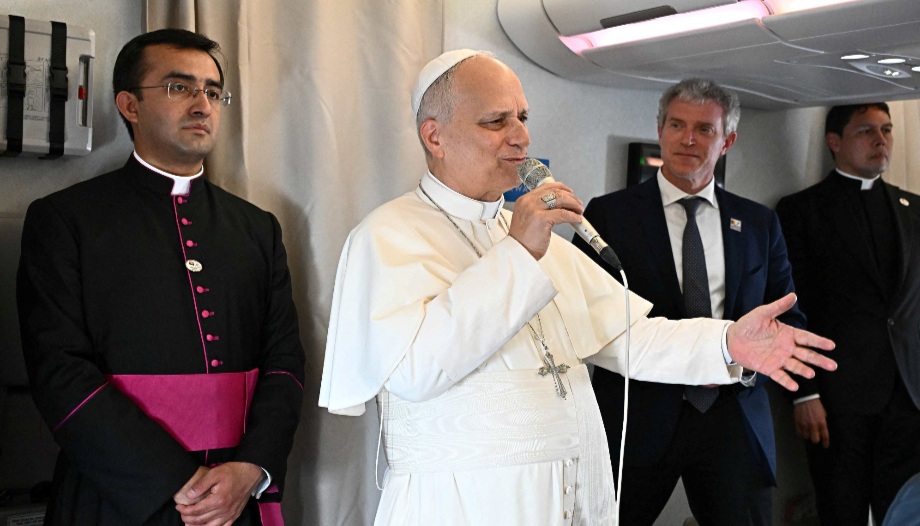
        -At the UFV we have a formative model that guides and sustains all our teaching work. And we have noted with joy that the Pope highlights and gives importance to some issues that for us are also essential, such as community, the search for truth, relationship, dialogue between reason and faith, education understood as a task of love and the role of the professor as an authentic teacher. All these elements are present in the formative model of the UFV, whose basis is a vision of the person as a being in relationship and whose central axis resides in the relationship between teacher and student. 

        Aware of the educational power of relationships, we live on campus a culture of accompaniment that is materialized, on the one hand, in personalized attention from the faculty and, on the other hand, in a mentoring itinerary that all students follow. A team of more than 300 mentors accompanies our students throughout their formative process, helping them to connect humanistic reflection with their own life experience through meaningful questions. In this way, we accompany their questions, listen to their concerns, walk with them in search of truth, and grow together. 

        In a time dominated by technology and artificial intelligence, how can the Catholic university form professionals who maintain that humanity in the face of digitalization?  

        -Education is the key that will allow us to take advantage of all the good things that technology and artificial intelligence bring us without losing humanity. And I dare say that, within university education, humanistic training is essential to give meaning and authenticity to everything in the digital and global environments in which we live. 

        We believe that it is necessary to address the issue in its entirety, avoiding the risk of formulating the question of technology in education in an excessively simple way, as if it were a merely instrumental question: what do we educate with? To consider that it is simply a matter of choosing this or that tool would lead us to a reductionism that is certainly risky. That is why we consider it necessary to go beyond the immediate usefulness of technological tools and approach the question with a broad view, including “theological and philosophical reflection”, as Pope Leo affirms, or from an “open reason” according to Benedict XVI's proposal that we have adopted at UFV. This implies assessing how technology and the way it is used can affect people, their relationships and their way of being in the world, their understanding of reality, as well as the common good and the future of humanity. In this way, we can arrive at prudent and sensible approaches that allow us to take advantage of all the good that technology has to offer and to avoid its risks.

        What are UFV's objectives for the coming years? 

        -Our main objective is to consolidate our training model, which is entitled Training to transform. We are convinced that university education can transform lives and entire societies. Our commitment is to form people who seek truth and goodness, leaders capable of facing the great challenges of the world with humanistic vision, innovation and responsibility. We want to be a place where science and faith dialogue, where academic excellence meets social commitment, and where each student, and also each professor, discovers the meaning of his or her existence and the need to commit to transforming society. We aspire to do our part to “design new maps of hope,” as Pope Leo XIV asks us to do.

        Photo Gallery

        Pope Leo XIV celebrates Mass at Saint John Lateran

        Thousands of people accompanied Pope Leo XIV at the Mass celebrated in the Basilica of St. John Lateran in Rome.

        Editorial Staff Omnes-November 11, 2025-Reading time: < 1 minute
        Evangelization

        St. Martin of Tours, Apostle of Gaul

        The liturgy celebrates on November 11 St. Martin of Tours, first a soldier, then a monk and bishop of the fourth century, called ‘the apostle of Gaul’. He is famous because, after sharing his cloak with a beggar, he had a dream in which he Jesus Christ appeared to him dressed in the piece of cloth he gave to the poor man.

        Francisco Otamendi-November 11, 2025-Reading time: < 1 minute

        Few people can have their history summed up in a single gesture as well as St. Martin. His took place around the year 335. As a soldier of the imperial guard, the young man made nightly rounds. And on one of these, during the winter, he came across a half-naked beggar on horseback near Amiens. Martin took pity on him, took off his cloak, cut it in two and gave half of it to the poor man. 

        The following night Jesus appeared to him in a dream dressed in that piece of the cloak, and said to the angels: “Behold Martin, the unbaptized Roman soldier: he has clothed me”. This dream made a great impression on the young soldier, who was baptized on the following Easter feast. saint's day Vatican.

        Born in Sabaria (now Hungary) when it was the Roman province of Pannonia, son of a pagan Roman officer, St. Martin, after receiving baptism and abandoned arms, founded a monastery in Ligugé (France). There he led a monastic life under the direction of St. Hilary. Later he was ordained a priest and was elected bishop of Tours. He evangelized the region of Gaul and founded several monasteries.

        Mercy 

        When he accepted the bishopric, the former soldier refused to live like a prince so that people in misery, prisoners and the sick could find a home under his mantle. He lived next to the city walls, in the monastery of Marmoutier, the oldest in France. Another important aspect was his defense of the mercy in the face of violence. He intervened with the emperor to stop the execution of heretics who had strayed from the doctrine. His funeral, in 397, was attended by a crowd that recognized him as a generous and supportive person.

        The authorFrancisco Otamendi

        Read more
        Integral ecology

        God and government

        The debate on assisted suicide in the United Kingdom presupposes the need to exclude Christian principles from the public sphere, under the false premise of a "neutral" state. The author argues that a faith-based vision of the state is superior because it promotes human dignity and the common good by limiting state power and promoting freedom.

        Philip Booth-November 11, 2025-Reading time: 7 minutes

        The idea that government should be based on Christian principles is under constant attack, most notably on several occasions during the debate over assisted suicide. Not only is the proposed law incompatible with Christian principles, but many proponents have suggested that Christians should not participate in the debate or that Christian principles should not determine our position on the issue.

        Do God and government mix?

        The atheist-humanist call to keep God out of the public sphere seems to resonate intuitively with many people today. Even some religious people seem to think that religion and politics should not mix. It is often argued that, if we had a broadly liberal state, we could have a pluralistic society in which people could practice their religion in private without it interfering with politics.

        But this argument fails, even at the logical level, not to mention the practical level. Consider, for example, the concept of a «broadly liberal and pluralistic state». Such beliefs presuppose a set of values that must have some origin. Why, for example, a broadly liberal and pluralistic state rather than a totalitarian state or total anarchy?

        In fact, we have a better answer to that question than humanistic atheists. This is because we believe in God-given free will. And we also believe in original sin. Therefore, we understand the dangers of totalitarianism and anarchy; and we understand why the state should serve individuals, families and civil society, not the other way around.

        Humanist atheists (and their ilk) argue that our politics and law should be based solely on reason and empirical evidence. They defend this view as neutral. But it is not. To hold that there is nothing in life beyond reason, evidence, and physical experiences is as great an act of faith as believing in the existence of God, which should influence our public life. In fact, 90% of the world's population, and most of the population of our country, believes that there is something beyond reason and empirical evidence. And it is a fact that our laws and institutions - including the monarchy - are based on Christian principles. The degree of explicitness with which this was manifested at the coronation of King Charles III was quite remarkable.

        Government without God

        And we can ask ourselves, «Where does a government without God lead?»

        In his address to Parliament in 2010, Pope Benedict XVI stated: «The central question, then, is this: where does the ethical foundation of political decisions lie? The Catholic tradition holds that objective norms governing right action are accessible to reason... According to this conception, the role of religion in political debate is not so much to provide such norms, as if they were unknown to non-believers... but rather to contribute to purifying and illuminating the application of reason to the discovery of objective moral principles.» In other words, faith and reason complement each other, and faith helps to purify reason.

        Indeed, as the Pope himself pointed out, when we try to perfect society solely through reason, we can end up in tyranny, as in the case of the terror of the French Revolution or the millions of deaths at the hands of communist regimes. These were the result of radical atheists who, in trying to build paradise on earth, ended up creating hell. We observe this, to a lesser extent, in the policies of contemporary humanist atheists. They explicitly demand, for example, that Catholic schools not be funded by taxpayers, as if Catholics do not pay taxes and a value-neutral school could somehow exist. In reality, this is a request by humanist atheists for the state to monopolize secular education, dictated by their values.

        A society built on properly ordered religious principles is not a cause for fear, even for those who are not religious. We believe in original sin and therefore reject the idea that we can coercively build the perfect society or allow anarchy to prevail. We believe in free will and therefore do not want to build a theocracy. But we also believe in the inherent human dignity of all people, so we reject the utilitarian idea that some people can be sacrificed for the common good. And we also reject the idea that a free society degenerates into a state in which the weak are abandoned to their fate.

        If I were not religious and were presented with realistic alternatives on how to organize a state, I would choose this religious conception. We should have no qualms in pointing out that our conception of the State is a great contribution to the world.

        What is the government's purpose?

        This brings us to the question of “what is the purpose of a government with Christian principles?”.

        In the Catholic tradition, the role of government is to promote human dignity and the common good. There is much debate among Christians about how best to use the structures of the state to promote human dignity in a general sense. However, it is worth mentioning, in the context of recent debates, that human dignity is not protected if the lives of the most dependent, the most vulnerable and the weakest (e.g., the unborn and persons with disabilities) and those approaching death are not adequately protected: human dignity applies to all.

        The common good is often thought of (because even Christians tend to absorb a secular narrative by osmosis) as a kind of euphemism for the «general welfare» (as opposed, for example, to my own individual interests). But we are not Benthamian utilitarians. The common good refers to both what is good and what is common.

        In the political sphere, the common good is related to that set of common conditions that can lead us, individually and collectively, to strive effectively for perfection or fulfillment. And social justice, that much-used - and rarely defined - expression, is the form of justice that promotes the common good.

        Again, there is the possibility of misunderstandings and different perspectives. But the first thing to say is that the idea of a society where everyone can achieve perfection does not sound much better than the French communist or revolutionary ideal, which ends in tyranny. It may sound like theocracy, but it is not. We believe in free will and original sin. Our belief in original sin tells us that the power of government must be limited. Our belief in free will tells us that we do not reach true perfection until we can choose what is good.

        Therefore, the role of government here is to develop institutions that foster freedom in the best sense of the word: the freedom to choose what is good. The first of these institutions, of course, is the family; another is the Church and all its charitable works. In fact, there must be a wide variety of free institutions that have their own common good and that, at the same time, contribute to the common good of all.

        A government that permits violent crime, political corruption or uncontrolled inflation, or that imposes cruel punishments without the possibility of reform or redemption, does not promote the common good or human dignity. This highlights the obvious responsibilities of government. Whether we should ban or regulate pornography, fatty foods or gambling, or regulate labor markets, and to what extent and under what circumstances, are matters for what we call «prudential judgment.».

        The role of public officials

        What role could civil servants or government administrators play in this scheme of thinking? I am a big fan of the television series «Yes, Minister.» Many civil servants see it as a training series to improve their job performance. But it's not. It is quite the opposite. In fact, «Yes, Minister» has academic roots. One of the authors attended seminars given by a Nobel laureate in economics on the discipline of public choice economics: these seminars were about how interest groups and public officials could put their own interests in a democracy before the interests of the people.

        It is not the role of public officials to set the policy agenda by imposing their views, but to help the government implement it. However, they may be tempted to pursue their own interests. And there is a danger, of course, that good officials and regulators will understand their role and fulfill it properly and with restraint, while those with an agenda contrary to Christian principles will overstep the mark and pursue their own interests, thus abusing their power.

        As Pope Francis wrote in Fratelli Tutti Others may continue to see politics or the economy as a stage for their own power struggles. For our part, let us encourage the good and put ourselves at their service.“.

        Public officials, of course, face complex problems. What should they do if their job is to implement clearly immoral legislation? Could they, from a Catholic perspective, improve secondary legislation by withholding information from the minister or lying to him? What if an official witnesses an act of dishonesty and his job is in jeopardy if he reports it?

        In the wake of the financial crisis, many Catholics in the business world reflected on the Catholic cardinal virtues; this way of thinking resonates with non-believers. They thought about how to integrate the virtues of courage, justice, prudence and temperance into their daily work. The same could be applied to the work of those who serve in government, perhaps through the analysis of practical cases.

        We have, of course, the example of St. Thomas More, who demonstrated all these virtues and, in the end, had to choose to disobey the king and lose his head. Again, to quote Pope Benedict XVI: «In particular, I recall the figure of St. Thomas More... whom believers and non-believers alike admire for the integrity with which he followed his conscience, even at the cost of displeasing the sovereign... because he chose to serve God above all else.».

        If we are to integrate God into government, Christians who work for government should integrate God into their daily work. Bishop Richard Moth, president of the Catholic Bishops« Conference of England and Wales, stated in his message on the occasion of the workers» jubilee: "I also ask Catholics to try to find a moment for prayer during the working day, even if it is only for a moment.".

        Stalin asked how many divisions the Pope had. If we truly believe that the world is governed by more than reason and empirical evidence, those who work in government should never forget to invoke our heavenly divisions in their daily work, including, of course, the intercession of St. Thomas More.


        The original of this article was published on the Catholic Social Thought website of St Mary's University.

        The authorPhilip Booth

        Professor of Catholic Social Thought and Public Policy at St. Mary's Twickenham University and Director of Policy and Research at the Catholic Bishops' Conference of England and Wales.

        Evangelization

        St. Leo the Great, Pope and Doctor of the Church

        On November 10, the Church celebrates “one of the greatest Pontiffs who have honored the Roman See. This is how Benedict XVI defined St. Leo the Great, Pope (5th century). He went down in history for having inspired the Ecumenical Council of Chalcedon, and for having stopped Attila, king of the Huns, who invaded Italian cities.  

        Francisco Otamendi-November 10, 2025-Reading time: 2 minutes

        He was born in Tuscia and was a deacon of the Church of Rome. In 440, Leo was sent by Empress Galla Placidia to pacify Gaul. A few months later, Pope Sixtus III dies, and Leo, his advisor, succeeds him. Pope Leo, the 45th in the history of the Church, began his Petrine ministry on September 29, 440. He was defender and promoter of the Primacy of Rome, and is Doctor of the Church.

        His pontificate lasted 21 years and broke several records, according to the Vatican saints“ calendar. First Bishop of Rome to bear the name of Leo. The first to be called ”Magno“, whose preaching -almost 100 sermons and 150 letters- have come down to us. One of the two Popes (the other is St. Gregory the Great) who received, by decision of Benedict XIV (1754), the title of ”Doctor of the Church". 

        According to historians, Leo the Great is also the first Pope to be buried, after his death on November 10, 461, inside the Vatican Basilica. His relics are preserved in St. Peter's, in the Chapel of the “Madonna of the Column,” the Vatican website adds.

        Detains Huns and Vandals

        In 452 AD, Attila's Huns conquered and sacked the cities of Aquileia, Padua and Milan. Near Mantua, on the Mincio River, Pope Leo the Great leads a delegation from Rome, meets Attila and dissuades him from continuing his invasion. Legend has it that Attila withdraws after having seen, behind Pope Leo, the Apostles Peter and Paul, armed with swords. 

        Three years later, in 455, the “Pope Magnus” stopped the Vandals of Africa at the gates of Rome. The city is sacked, but not burned. The Basilicas of St. Peter, St. Paul and St. John remained standing, where a large part of the population found refuge.

        Inspires the Council of Chalcedon

        St. Leo the Great has also gone down in history for promoting the Ecumenical Council of Chalcedon (today Kadiköy, in Turkey), which recognizes and affirms the union in Christ of the two natures - human and divine. “Thus the heresy of Eutychius, who denied the human essence of the Son of God, was rejected,” he wrote. Vatican News. When his document was read to the 350 Council Fathers, there was acclamation: “Peter has spoken through the mouth of Leo, Leo has taught according to piety and truth”.

        The authorFrancisco Otamendi

        The World

        Being Catholic in the United Arab Emirates

        In Dubai, more than 200,000 communions are distributed every month, and in Abu Dhabi thousands of faithful fill the church of St. Joseph every week: in the heart of the Muslim world, the Catholic faith not only resists, but flourishes with unexpected strength.

        Teresa Aguado Peña-November 10, 2025-Reading time: 5 minutes

        The Middle East, the cradle of the three great monotheistic religions, is today deeply marked by the Muslim presence, which dominates cultural, social and political life in countries such as the United Arab Emirates, Qatar and Saudi Arabia. In this context, the Christian presence may seem fragile: most Catholics are expatriates, far from their homeland, with limited public expressions of faith.

        However, against all odds, churches such as St. Joseph's Cathedral in Abu Dhabi or St. Mary's in Dubai have become beacons of faith and community life. Masses in multiple languages, prayer groups, catechesis and solidarity activities turn these churches into authentic mosaics of cultures united by the same faith.

        The presence of the Catholic Church in the Arabian Peninsula is organized in a unique way due to the cultural diversity and Muslim majority of the region. The United Arab Emirates, Oman and Yemen are part of the Apostolic Vicariate of South Arabia, while Kuwait, Bahrain, Qatar and Saudi Arabia belong to the Apostolic Vicariate of North Arabia. These circumscriptions, erected by the Holy See, make it possible to serve Catholic communities, composed almost entirely of migrants and expatriates, in countries where the Christian faith is a minority.

        The Vicariate of South Arabia, based in Abu Dhabi, is entrusted to the Capuchins of the Province of Florence and has as its pastor Monsignor Paolo Martinelli, OFM Cap, appointed by Pope Francis in 2022. For his part, the Holy See's diplomatic presence in the region falls to the Apostolic Nuncio to the Arabian Peninsula, Msgr. Christophe Zakhia El-Kassis, whose headquarters is also in Abu Dhabi. His role is to serve as a link between the local Church and the Vatican and to accompany the communities in respecting religious freedom.

        As Bishop Martinelli pointed out to the Vatican media on October 6,“Ours is a Church of migrants. All our faithful come from different countries and cultures, and that makes our vicariate truly universal. Being migrants here makes us missionaries in everyday life: we show our faith in the family, at work and in social relationships, without the need to proselytize.”.

        Although Islam is the official religion of the UAE, the government allows freedom of worship for non-Muslim religions, and there are temples and churches (Catholic, Protestant, Orthodox, etc.) and a synagogue. In fact, the government has legalized and recognized non-Islamic worship centers and has actively promoted religious coexistence (establishing a Ministry of Tolerance and promoting the Abu Dhabi Declaration on Human Fraternity). In this context, Dubai and Abu Dhabi have become centers where Catholics can practice their faith openly.

        Faith in Abu Dhabi

        In Abu Dhabi there are about 9 Catholic churches and it is estimated that Catholics represent between 8 % and 9 % of the population in the United Arab Emirates, although the figures vary due to the changing nature of the expatriate population. Of particular note there is St. Joseph's parish, which has become a true spiritual home for expatriate Catholics living in the heart of a Muslim country. With close to 80,000 parishioners, this multicultural community celebrates Mass in up to fourteen languages, reflecting the diversity of its members, who come mainly from India, the Philippines, Sri Lanka and Spanish-speaking countries. 

        Alexander Rodriguez, a lay aviator who helps in the parish coordinating the catechesis of the Hispanic community, recalls how, since his arrival in 2022, he found at St. Joseph's a place of welcome and spiritual growth, where faith is lived intensely through catechesis, volunteering, doctrinal formation and charitable activities.

        "The parish is intensely active, the evolution is constant. Every year there are new activities, new communities that are integrated. The last one that I have seen grow a lot is the one in Sri Lanka.”Alexander explains. His own commitment led him to coordinate the Spanish-speaking community, which brings together some 300 people among parishioners, catechists and families. “At the beginning there were only a few of us, but little by little we have been adding altar servers, helpers and more volunteers.”he says enthusiastically. Alexander highlights the charisma of the parish priest, Father Chito, and of Bishop Paolo Martinelli, who, he says, “is a great example of the charisma of the parish priest.“have been able to create a welcoming and friendly atmosphere.".

        Living the faith in a Muslim country, he says, has been an experience of freedom and respect. “In 2023, the house of the Abrahamic family in the United Arab Emirates opened its doors to an intra-religious gathering where Catholics, Muslims and Jews held their first ceremonies in the multi-faith center desired by Pope Francis and the Grand Imam of al-Azhar, Ahmed el-Tayeb as a symbol of fraternity between religions. It is a very civilized country, which protects freedom of worship”.”

        However, traditions are adapted to the local context. While private practice of other religions is permitted, proselytizing (preaching or trying to convert Muslims) is generally prohibited. In addition, non-Muslim religious practice is generally permitted primarily within the precincts of designated churches or temples. However, public celebration of large events such as an open-air Mass officiated by Pope Francis in 2019 has been permitted. Alexander comments that public processions, so common in Latin America or Spain, are held inside chapels: “Here the faith is lived in a more interior, more private way, but that doesn't make it any less intense. I have never felt that I am limited because I am Catholic.”he says. 

        Religiosity in Abu Dhabi, as in the rest of the United Arab Emirates, is lived with intensity, but also with prudence. Although freedom of worship is recognized, the legal system is based on Islamic law (Sharia), which can impact certain aspects such as marriage, inheritance and the penal code. However, reforms have been introduced in recent years to modernize the laws, especially for non-Muslim residents. In addition, there is vigilance to ensure that religion is “not instrumentalized” or used to justify violence, extremism or hatred, condemning the use of God's name for such purposes. In this context, the faithful have learned to express their faith with simplicity, depth and respect for their surroundings.

        The only two parishes in Dubai

        In Dubai, a city that symbolizes luxury, modernity and multiculturalism, there are only two officially recognized Catholic parishes, both located in areas close to each other and surrounded by mosques, a reflection of the country's dominant religious reality. These are the church of St. Mary and the church of St. Francis of Assisi, authentic spiritual lungs for hundreds of thousands of Catholics living in the city.

        St. Mary's, built in 1967 thanks to a donation from the then ruler Sheikh Rashid bin Saeed Al Maktoum, is one of the largest and most active parishes in the world. It serves a community of more than 300,000 faithful from countries such as the Philippines, India, Lebanon, Sri Lanka, South Sudan, Nigeria and Colombia. The church has 15 permanent priests, as well as dozens of catechists and lay volunteers. Masses are celebrated in English, Tagalog, Tamil, Konkani, French, Spanish and other languages, at times beginning before dawn and extending into the night, especially on weekends (which in Dubai are Friday and Saturday).

        According to parish estimates, approximately 51,000 communions are distributed each week, bringing the monthly total to some 200,000. This number reflects not only the massive influx, but also the serious experience of faith among the faithful, who often have to organize themselves in advance to be able to attend. One parishioner, who has lived there for three years, recounts that in order to be punctually at Mass he must arrive 40 minutes in advance to be able to park, especially on Sunday afternoons. “The area gets crowded, there is traffic everywhere, and parking is hard to find. But we all assume it as part of our faith experience. It is noticeable that people come here with a hunger for God, with a real faith, without any posturing.".

        St. Francis of Assisi Church, located in the Jebel Ali area, was inaugurated in 2001 to serve the growing number of Catholics in the southern part of Dubai. Although smaller than St. Mary's, it also offers intense pastoral activity, with daily Masses in several languages, sacraments, youth groups, retreats and social volunteering. Its construction was made possible thanks to the cession of the land by the local government, in another significant gesture of religious openness.

        Books

        The 250 years of the United States

        The 250th anniversary of the independence of the United States invites us to rediscover the deep imprint of Spain and Salamanca's humanism in the origins of the American nation.

        José Carlos Martín de la Hoz-November 10, 2025-Reading time: 4 minutes

        July 4, 2026 will mark the 250th anniversary of the independence of the United States and will shed much light on the historical and cultural roots of that event, with many conferences, scientific meetings and papers to be published in these months.

        A good example is the recent work of historian and communication specialist Angel Luis Cervera Fantoni, focused on Spain's contribution to the independence of the United States.

        Let us remember that very recently Professor Nel deGrasse Tyson (New York 1958), one of the most influential science communicators in the United States, referred to Columbus' voyage and the discovery of America on October 12, 1492 as one of the most important events in history, because with his daring to follow the western route he managed to interconnect two worlds that had been divided: North and South America had been disconnected from the rest of the continents for many centuries.

        In fact, through the fundamental fact of the discovery, the American colonization began based on cultural exchange and in the religious and legal sense, since the following discoveries throughout the length and breadth of those territories were aimed at the evangelization of the natives and their culturization.

        It is enough to realize that more than 60 % of the inhabitants of New Spain (Mexico) at the time of independence were indigenous people who were baptized and many of them were literate and governed their lands and had their industries. That is to say, the culture and civilization that Spain implanted was not that of Europe, but was completely new: neither Spanish, nor indigenous, but a synthesis of both that was acquiring tonalities and accents according to the different places.

        In fact, when the United States gained its independence and, above all, after the Civil War, the process of overcoming racism and slavery began and the new United States began to act as in South America, creating a new culture and civilization in those vast territories.

        In fact, just as in the South Spanish was imposed but grammars and dictionaries were written to evangelize those lands and to preserve many local traditions, so too in the United States they stopped the English system of “the best Indian is the dead Indian” to adopt the Spanish system.

        Christian humanism and the School of Salamanca

        But Spain did something much greater than discovering America and that was to bring there the Christian humanism that was sprouting in Europe from the School of Salamanca and that turned Renaissance humanism into a new humanism that was spreading from Spain to the whole world.

        In fact, in 1526, we will now celebrate the five hundredth anniversary of the beginning of the teaching of Francisco de Vitoria in the Faculty of Theology of the University of Salamanca and with that teaching would also begin the friendship and contacts of Vitoria and his disciples with more professors and students of the University and, through academic mobility and books, Vitoria's ideas reached all the universities of the world and from there to all the Christian people.

        It is very interesting that the laws of the Spanish Indies influenced the United States and contributed to the creation of the rule of law with the American Constitution. That is, the law protected the individual.

        Precisely, the dignity of the human person was the key to understand the School of Salamanca and to understand its fundamental characteristics. If we were to summarize the contributions of the School of Salamanca, we would have its characteristics and we would see that the basis was the dignity of the person.

        Vitoria only based his theological, economic and juridical edifice on human anthropology. Therefore, that man has the dignity of a person as the image and likeness of God, even if he was not baptized, subject to rights and obligations, free and capable of owning his land and supporting his family meant that there were no slaves among the Indians: they were all subjects of the crown of Castile.

        The legacy of Salamanca's humanism in America and the United States

        Precisely, the approval of the fair price, the limitation of taxes, the establishment of precarious loans, the dominion of land and the free market that operated in America and between Europe and America.

        The suppression of slavery, admitting black slaves to baptism meant that they had to be treated with delicacy, they could not be put to death, they had the right to buy their freedom.

        It is very interesting the establishment of schools, universities, hospitals, hospices, hospital cities, and the whole network of works of mercy, spiritual and material, since the commandment of charity was never taken in the Church as a benefit of inventory.

        The ordinations of mestizos, cuarterones, indigenous people began to surpass that of the crilllos, thus the civilization of Peru, Central America, Ecuador or Colombia are especially striking.

        All this way of acting would lead to the American constitution and democracy in the North, which received from Europe huge masses of population that were incorporated into the faith, law and culture that have made the United States a great and highly developed nation.

        In the juridical world of Vitoria and de Soto, Spain had a title of presence in America: to bring faith, culture and law, but always respecting freedom and the conviction that it could not be imposed except by persuasion. It is important that the 250 years of American independence remember that the principles of the School of Salamanca enlightened Europe and America through Christian humanism. If today we wish to get out of the impasse in which we find ourselves, a good solution would be to recover the humanism of Salamanca and turn it into a new humanism.

        Spain in the independence of the United States

        AuthorAngel Luis Cervera Fantoni
        Editorial: Sekotia
        Pages: 456
        Year: 2025
        Read more
        Evangelization

        Matina and Gospel Freedom: «our challenge is to be an authentic Gospel choir».»

        Singer Matina shares how her encounter with God led her to transform her life and evangelize through Catholic gospel.

        Teresa Aguado Peña-November 10, 2025-Reading time: 4 minutes

        Matina, Maite Zuazola's stage name, is a singer, composer and musical director from Bilbao who has turned her talent into an instrument of evangelization. Trained since she was a child in classical music and with an extensive career in genres such as jazz, soul or musical theater, she found her true vocation in gospel music: to sing to God and transmit the joy of the Gospel through music.

        In 2012 he founded in Madrid the choir Gospel Freedom, a community of voices united by faith and passion for Christian music. Under his direction, the group has grown to become a reference point for Catholic gospel in Spain, performing in churches, festivals, charity events and television programs. Their mission is clear: «to sing to God in Spirit and Truth and, through our songs, to infect souls with the joy of salvation, so much so that their bodies desire to dance and express themselves”.

        In this interview, Matina shares her testimony of faith, her journey of conversion and the inspiration from which the project was born. Matina and Gospel Freedom, winner of the Religion in Freedom Christian Music Award this 2025.

        Maite, how would you describe the moment or process in which you felt Jesus calling you personally to give Him glory?

        -His call was a surprise, and the mission he was entrusting to me. Jesus took me back home, as I had asked him one day. He took me back to The Church and to work from there. My first call was to music when I was 7 years old.  

        My paternal grandmother was a school teacher, a music teacher, and a woman of deep faith. One day in her house in Portugalete (Vizcaya), when she was playing the piano, I felt a force that attracted me to that music and I stood next to her while she played. He asked me if I wanted to learn and I said yes. Later I understood that this force was the Holy Spirit.  

        My grandmother became my mentor. She taught me solfeggio and took me by the hand to church, and so on for 4 years that I lived with her. This was key. 

        But when I left his house, I left the church. I finished my piano career and discovered voice. I worked in the artistic world for years until one day I realized that it was not enough, there was an emptiness inside me that I could not fill. Then I thought I wanted to start a family. I left my life in Madrid and got married. 

        My desert began. At that time I cried out to God, because I felt that my marriage, in which I had put all my hopes, even abandoning my musical career to create a family, was not going well. There were hard trials that can only be overcome in a true union. For me, marriage is sacred. 

        In the tribulation I began to talk to God. Jesus attracted me. I remembered the gospel music my father listened to... I missed the music. I missed myself. After 10 years, providence brought me back to Madrid, and then I felt I was coming back... In my joy I went to the nearest church with my oldest son, who was 8 years old at the time. During Mass, I received the call. And I came back, back to faith and back to music! It was an incredible time, I was happy in spite of my personal situation. 

        Looking back I have seen the whole process. God patiently prepared me and waited for my return. The day would come when everything would come together for the mission, and it did.  

        How was the Gospel Choir Libertad born?

        -The Gospel choir was born out of conversion. A total inspiration. I proposed it to the parish and the door opened wide. 

        Christian music, and in particular gospel music, is perfectly in tune with the joy of being a Christian. I resumed my role as a composer, but now I had no choice but to focus on God's music. It was quite a discovery. Christian music was a necessity that expressed, and continues to express, what my heart carries.

        Gospel has African-American and Protestant roots. What moved you to translate that musical spirituality into the Catholic context? What does gospel preserve and what does it transform when sung from the Catholic faith? 

        -Gospel music is praise music with a lot of rhythm and quality. Its beautiful melodies, with a brilliant rhythm, are an invitation to live the faith in joy and in the hope of the free salvation offered to us by our Lord Jesus Christ. Praising God in spirit and truth has no denomination.

        Catholic praise offers even more than Protestant praise, since it can praise the Eucharist and the Mother of God. In my case I have compositions with these characteristics, such as The Greatest Gift, referring to the Eucharist, Five letters that praises Mary and the Holy gospel, which is a tribute to the Saint of the Mass. Other themes of our latest album are psalms made song as are I trust you based on Psalm 91 and Sing to the Lordr, which is the psalm from Isaiah 12. Our Father to the rhythm of gospel. 

        What does it mean to you to evangelize through music? How can gospel be a missionary language for today's society? 

        -Evangelizing through music is our mission to carry out the command of our Lord: “Go and proclaim the gospel...” . The Holy Spirit pours out his gifts and charisms for us to put them at our service. It could be said that gospel has a special charisma, for it is a powerful music that pierces. No one remains indifferent after a gospel concert expressed from the heart. This is key. Unfortunately there are many gospel choirs that do not live what they sing, so they do not transmit it either. There are no results if there is no intention. They are not choirs for evangelization. The challenge of Matina and Gospel Freedom is to be an authentic gospel choir. 

        How do you integrate prayer and personal spiritual life into your artistic work and choir directing? 

        -It is precisely the work of the choir that keeps me in constant prayer. Preparing the songs, taking out the different voices, the harmonies, adapting the lyrics to Spanish or composing new songs are my means to be in constant contact with the Lord. I truly feel it is a privilege to have this wonderful gift that is my direct and immediate connection. 

        How do you see the growth of Catholic gospel in Spain and the world? Do you think it can become a powerful evangelizing movement?

        -In Spain there are gospel choirs, of course, but not Catholic choirs dedicated to evangelization. Matina and Góspel Libertad are an exception. 

        I do believe that it could be a powerful evangelizing movement, as it already happens in other denominations. In Spain it could also do a great job as long as it is carried out with quality, true enthusiasm and real support. Unfortunately there is a great lack of the latter, which makes the work sometimes wearisome and a real struggle.

        Read more
        The World

        Pope: “Work with patience to keep the Church on solid foundations”.”

        In many ways, the Catholic Church is always a “work in progress,” where "God is constantly molding its members. These must deepen and work diligently, but patiently,” said Pope Leo XIV at Mass in the Basilica of St. John Lateran in Rome on Nov. 9, the feast of the dedication of the basilica in the fourth century.  

        CNS / Omnes-November 9, 2025-Reading time: 4 minutes

        - Cindy Wooden, Rome (CNS)

        The work under construction is “a beautiful image that speaks of activity, creativity and dedication, as well as hard work.” “And sometimes, of complex problems to be solved,” the Pope said at the Basilica of St. John Lateran in Rome this Nov. 9, the feast of the dedication of the basilica.

        The basilica is the cathedral of the Pope as bishop of Rome, and is known as “the mother of all churches”.

        Standing on the “cathedra” or episcopal chair, Pope Leo preached about the basilica as “a sign of the living church, built with chosen and precious stones on Christ Jesus, the cornerstone.”.

        God chooses “the dirty hands of men” (Benedict XVI)

        He also spoke about the feast day when he returned to the Vatican for the Angelus prayer at noon.

        “We are Christ's church, his body, his members called to spread his Gospel of mercy, consolation and peace throughout the world, through that spiritual worship which must shine forth above all else in our witness of life,” he told those gathered to pray with him in St. Peter's Square.

        “Too often, the weaknesses and errors of Christians, along with many clichés and prejudices, prevent us from understanding the richness of the mystery of the Church,” he said.

        However, the holiness of the Church “does not depend on our merits, but on “the gift of the Lord, never revoked”, who continues to choose “with paradoxical love, the dirty hands of men as the vessel of his presence”. This is how the Pope expressed himself, citing Pope Benedict XVI's 1968 book, ‘Introduction to Christianity’.

        Pope Leo XIV greets the crowd gathered in St. Peter's Square at the Vatican for the Angelus prayer on Nov. 9, 2025. (CNS Photo/Vatican Media)

        Excavating for solid foundations

        In its homily In the basilica, Pope Leo asked the faithful to reflect on the foundations of the church in which they found themselves.

        “If the builders had not dug deep enough to find a solid foundation on which to build the rest, the whole building would have collapsed long ago, or would be at risk of collapse at any time,” he said. 

        “Fortunately, however, those who came before us laid solid foundations for our cathedral, digging deep with great effort before erecting the walls that house us, and this gives us much more peace of mind.”.

        Catholics must also first deepen their inner self.

        As members and collaborators of the Church, he said, Catholics today also “must first go deep within and around themselves before they can build impressive structures. We must remove any unstable material that prevents us from reaching the solid rock of Christ.”.

        The Church and her members must constantly return to Christ and his Gospel, the Pope said. “Otherwise, we run the risk of overloading a building with heavy structures whose foundations are too weak to support it.”.

        Building Christ's church is a work that requires a lot of time, effort and patience, he said.

        United with Christ, we are “living stones” for the building of his Church 

        Part of that work, the Pope said, is to be humble enough to allow God to work in each member, the “living stones” that make up the Church.

        “When Jesus calls us to participate in God's great plan, he transforms us by masterfully molding us according to his plans of salvation,” said Pope Leo XIV. “This involves a difficult path, but we must not be discouraged. On the contrary, we must persevere with confidence in our efforts to grow together.”.

        Pope Leo XIV ended his homily by making a special request to the community that celebrates Mass there regularly, but also to all churches and parishes.

        On the care of the liturgy at Masses

        “The care of the liturgy, especially here in the See of Peter, must be such that it serves as an example for all the people of God,” he noted. “It must comply with established norms, be attentive to the different sensibilities of the participants and follow the principle of wise inculturation.»

        He asked that the Masses “remain faithful to the solemn sobriety typical of the Roman tradition, which can do so much good for the souls of those who actively participate in it”.

        Prayer for the Philippines and peace building

        After the Marian prayer of the Angelus, Leo XIV expressed his “closeness to the people of the Philippines affected by a violent typhoon; I pray for the deceased and their families, for the wounded and the displaced”.

        He also expressed his “deep appreciation for all those who, at all levels, are committed to building peace in the various war-torn regions”.

        In recent days, “we have prayed for the dead and, among them, unfortunately there are many who have died in the fighting and shelling, even though they are civilians, children, the elderly and the sick. If we really want to honor their memory, let there be a cease-fire and let all efforts be put into negotiations,” he concluded.

        The authorCNS / Omnes

        Read more
        Family

        Paula Vega: «We dream of a Church where the vocation to adoption is naturalized».»

        Paula Vega, digital missionary and founder of Call meyumi, shares with her husband Dani the journey of faith that has led them to embrace adoption as their “plan A”.

        Teresa Aguado Peña-November 9, 2025-Reading time: 4 minutes

        Paula Vega is a digital missionary from Malaga and a committed layperson in her diocese, known for her commitment to evangelization in the digital environment. Founder of the project Call meyumi, Paula seeks to share God's love from a close and creative point of view, using digital media as a mission tool. In addition to her work on this platform, she works as a Project Manager in Spain for the series The Chosen, is Community Manager of the Redemptorist Congregation of Spain and Content Creator at Católicos en Red. He studies theology, offers conferences on faith and communication, and has published several books that reflect his spiritual and pastoral experience.

        Married since 2023 to her husband Dani, Paula lives her marital vocation with joy and depth. Together, they have embarked on a path of openness to life that has led them to embrace adoption as their “plan A”. On World Adoption Day, they share their testimony with Omnes in the hope of inspiring other couples to discover this vocation.

        Paula, could you tell us how this call for adoption came about?

        -God planted that concern in our hearts even before we met. Already as a bride and groom, when we dreamed of our future family, adoption came up in conversations and we always ended up saying: “If it is our way, He will take us there”. In our human logic we thought first of biological children and then of adoption; but God's logic was different. When I was newly married, I was diagnosed with endometriosis and we were warned of possible difficulties in conceiving. We were offered different ways to try biological motherhood, but we chose to be more open to life. We asked ourselves what it really meant to be parents and decided to start adoption as our “plan A” as well.

        For many women it is a very difficult cross to accept that they naturally cannot have children. What is your experience.

        -In our case, we have never been declared infertile; that is why we remain open to life in all its forms: biological, adoption and also foster care (which we are already discerning). These are paths that we put in God's hands so that he may decide the times and forms.

        We feel that our current cross is not the impossibility of becoming parents, but rather the waiting period. If it were up to us, we would have our child here tomorrow, but God's timing is what it is. In the meantime, we face this period with patience and trust.

        How do you live and how is the adoption process you are going through?

        -We always say that adoption does not start with the first piece of paper, but with the first movement of the heart. Then come the formal steps: an informative talk, a training course (about 20 hours) and the offer. It is not “requesting” a child - because there is no right to be parents - but offering oneself as a family for a specific profile of a child, putting his or her needs at the center.

        Then comes suitability: psychological and social interviews, home visits, review of the support network... They are demanding and we think it's good that they are: the most valuable thing is protected, which is the child. Once this phase is over, then comes the waiting period, which varies according to the child's profile or the country where the adoption is being processed.

        In practical terms, the paperwork is intense: doctors, certificates, notary's office, child protection service, photos, printouts and copies. The hardest part is the bureaucracy and the uncertainty of deadlines. The most beautiful thing is knowing that each step brings us closer to our child. 

        We prepare to receive our child as we would a biological child, but perhaps with more awareness. We pray every day for our little one and for his or her biological family. We are training in attachment, trauma and educational methodologies - books, courses and podcasts - to arrive with a more trained heart and realistic expectations. We are also preparing the house with simplicity; a cozy room, clear routines and space to build attachments. In addition, we talk a lot with our family, friends and parish community to explain more about the adoption process, and the needs or characteristics our child will bring. We prepare with excitement and of course, with the normal fears that any parent would have wondering if we will know how to do it right. 

        How have you dealt with the doubts and the wait on this adoption journey?

        -The first thing was to welcome them with affection: they are normal and human. We name them, we talk about them among ourselves, we present them in prayer and, little by little, they find their place. We understood that in all parenthood there will always be doubts and expectations; the key is not to let them lead. We tried to look at our path with God's logic and love: to put the child at the center, to remember why we started and to choose - again and again - to trust.

        We also give ourselves permission to live the wait in a different way; we do not both feel it in the same way and saying out loud what each one of us needs helps us a lot. We avoid comparing ourselves with the times of others, because we know that God already has that red thread tied and ready, and that requires constant trust and abandonment to his plans. We also try to remain active in our mission, focused on serving God from what we have been given, without becoming obsessed with waiting, because our marriage is already fruitful. 

        What would you say to other Christian couples who are concerned about adopting, but don't know where to start?

        -Let them begin, even with fear. Put into words the seed that God has placed in your heart, talk about it calmly among yourselves and get close to couples who are already on the road: listening to their lights and shadows is very pacifying. Go to the informative talk and also to the formation course offered by the Child Protection Service: it does not commit you to continue with the process, so you can live it as a discernment that opens your eyes and your heart. And ask yourselves the basic question: What does it mean to me to be a father or mother? Is it reduced to sharing genes or does it have to do with welcoming, caring for and loving a specific person? When that answer is settled, the “where to start” becomes simple.

        What hope do you want to convey with your story and what wish do you have for the future of your adoptive family within the Church and society?

        -In a Church that raises its voice loudly for the unborn, we would like to hear more and more the cry of those who have already been born and are waiting for a family. There are thousands of children in centers who need a stable and safe home. If we do not speak of the vocation to adoption and fostering, it does not seem to exist; that is why we dream of parishes and communities where this call is naturalized and put on the table, so that couples can know it and discern it. If our story encourages just one couple to open themselves to life in this way, it will have been worthwhile.

        Read more
        Books

         What is the moral perspective?

        In "Ethics is someone else's business"It is proposed that morality should not be divided into a private and a public sphere, as this is insufficient. To understand ethics, it is essential to adopt an intersubjective perspective, where morality is learned and cultivated by proposing and observing exemplary models of behavior.

        Rubén Herce-November 8, 2025-Reading time: 2 minutes

        Talking about morality usually leads many people to the private sphere, where everyone can have their own rules or standards of conduct. There, he is free to choose the ends that are worth pursuing and the appropriate means to guide his life according to his personal opinion; and from there, it is easy to distinguish this private sphere from the public, where there is also a morality but which has mainly to do with the system of rules by which we govern our coexistence. With rules that are not always written, but which we agree to respect. 

        One is easily divided, therefore, between a set of rules to follow or comply with in the public sphere - see codes of ethics in the various professions, civic laws or procedures guaranteeing fair or equitable treatment - and a personal way of behaving when “off duty”. Only in the latter can I really be myself, “take a break” from the rules and follow my own criteria of moral behavior. This is what we might call the subjective morality of the private sphere as opposed to the objective ethics of the public sphere.

        Ethics of the third person

        In a similar line of thought, there are authors who distinguish between third-person ethics, of a more “juridical” nature, where ethical behavior is discussed from normative and external criteria; and first-person ethics, which respond to the subjective vision that each person has of his or her own acts. In the third-person perspective, facts and events are judged and even some intentionality in behaviors can be objectively judged. If I have followed procedure, then I have acted well; if I do not comply with the laws, I am acting badly. In the first-person perspective, on the other hand, what counts are the intentions and the feelings of goodness or badness with which I have performed the action.

        However, there is no self-imposed ethics of facts. Facts, however objective they may seem, need to be interpreted; and this interpretation has to be made by subjects outside the individuals involved in the events. On the other hand, feelings and intentions, however subjective they may seem, are not merely internal but tend to be communicated. Happiness, sadness or anger do not belong to the merely private or subjective. 

        Ethics and morality, understood as the objective and subjective poles of our behavior, are not well understood without a third pole, the intersubjective, which is essential to understand the proper perspective of morality. A second-person perspective is needed, and this can be seen in the fact that we admire the behavior of certain people or even propose them as models of moral behavior.

        Morality is learned and exercised, above all, in the second person, seeing the behavior of other people and acting in a way that can be a reference for others. However, without leaving aside neither the teaching of ethical norms cultivated by the good deeds of those who preceded us, nor the inner fine-tuning that acts as a compass, to tell me that perhaps I have not behaved so well when I lacked rectitude of intention, even if my external behavior was impeccable. 

        Ethics is someone else's business

        AuthorRubén Herce
        Editorial: Eunsa
        Year: 2022
        Number of pages: 118
        The authorRubén Herce

        Professor of Anthropology and Ethics at the University of Navarra.

        Evangelization

        Maria San Gil and José Masip: «We want to proclaim our faith in all aspects of life».»

        The coordinators of the 27th Catholics and Public Life Congress, to be held in Madrid on November 14, 15 and 16, 2025, highlight the courage and sincerity of many young people in relation to the faith today.

        Maria José Atienza-November 8, 2025-Reading time: 3 minutes

        The Catholics and Public Life Congress is one of the key events for Catholic thought and action in society. This edition, the 27th, will bring together in Madrid, from November 14 to 16, thinkers such as Kevin Roberts, of the Foundation Heritage, scientists such as Enrique Solano, president of the Spanish Society of Catholic Scientists, influencers such as Pep Borrell or activist Loren Saleh, 

        In the final stages of the Jubilee Year of Hope, this has been the theme chosen as the focus of the conference in which, as its coordinators, Maria San Gil and Jose Masip, emphasize, “we want to spread and proclaim our faith in all aspects of our life. We want to show that we are a university, that we are Catholics and that we are in public life. 

        Soft-spoken Catholics?

        The congress, now in its 27th year, has touched on numerous themes in this more than quarter of a century, although reflection on Catholic identity in the various spheres of public life continues to be a hot topic. 

        In this sense, Masip emphasizes that “there are ideologies that have prevailed, especially in Europe, in the West, and that have influenced the ‘party’ politician to be afraid to identify with certain positions on very specific issues: the family, life..., but I believe that this gap is being overcome. Catholics must commit themselves in life, in society and, therefore, act and do so in accordance with their principles. Principles are proposed in public life, they are not imposed”.

        In addition, the congress coordinator points out, “apart from party politics, there is another politics, another public life that is not strictly speaking politics, such as journalism, life in associations, in movements that transmit and capillarize society much more”. 

        The motto of this edition, “You, hope.”, has different readings. The hope placed in action and personal responsibility, the hope of God, which is the end of the life of Christians... First you have to be Catholic, you have to be the hope that you must be, the rest, commit yourself to it and act accordingly.

        Young people are responding to God more than ever before

        The Catholics and Public Life Congress coincides, this year, with the publication of a trend that seems to be settling in Spain: the return to the religious sphere, to the spiritual life, especially among the youth. 

        Commenting on this situation, José Masip stresses that “worse times will come. That's for sure. I am not saying this in an ashen way, it is what the Gospel says. But fortunately, we are now at a time when young people are responding more sincerely to the word of God than in the past”. 

        A position shared by María San Gil: “I am Basque. There the secularization has turned what was once a land of vocations into a wasteland. As it happens in Catalonia, for example. I think they are very different realities depending on where you live and how you live it. We want to tend, of course, to what happens in cities like Madrid, where you enter a church and it is normal to find young people. What do we have to do? Sow. But the important thing in this sowing is not the quantity, but the quality,

        This year, as in the last edition, there will only be one congress without a “division“ of young people. A clear commitment by Masip to “include young people in everything. They are as responsible for this as the older ones. I always say that the divisions of young people in political parties are for ‘not to bother’, and that can not be. Of course, we have pointed out the need for more young people on the organizing committee. There are, but there could be more. 

        A congress with a Eucharistic presence

        One of the highlights of this conference will be the eucharistic adoration that will take place during the three days of the Congress. A possibility of prayer that highlights, in the words of Maria San Gil “that the Blessed Sacrament is the center. The theme of presence in public life is clear to us, because the speakers are public figures, very well known, but we wanted to give the importance of God present in the Eucharist”.

        Also, in this edition, the Masses will be central points of the program and there will be priests to hear confessions. Something that, as San Gil says, “was born almost naturally, because last year, it was announced in one of the conferences that there was a priest to confess and there was a flood of confessions”. 

        The success of the Congress? To continue to do so

        27 years after the first Catholics and Public Life Congress, The success of this event is, for its organizers, “the very fact of doing it one more year”. The political, social, cultural and religious circumstances in Spain, since November 1999, have changed a lot, “however, the Catholic Association of Propagandists and CEU continue to support this congress. This is very commendable,” said María San Gil.

        “We continue to walk, adds Masip, “when Pope Francis, declared the Year of Hope wrote that ‘the solution to weariness, paradoxically, is not to stop and rest, but rather to set out on the road and become pilgrims of hope’. This is what we seek and do with Catholics and Public Life. 

        Evangelization

        Quique Mira, what are young people looking for?

        Aute's founder, Quique Mira, seeks to bridge the gap between young people and the Church through the digital world and events like Kaleo, an immersive experience where every young person discovers that they are called and loved by God.

        Teresa Aguado Peña-November 7, 2025-Reading time: 5 minutes

        At the age of 19, Quique Mira's life took an unexpected turn. After devoting many years to the world of nightlife and away from the faith, he met Father Javier, a priest stationed in Barcelona, a priest whose gaze and closeness awakened in him an inner restlessness. “The way he cared for me surprised me a lot,” he recalls. That encounter led him, almost by chance, to a Holy Week course in Madrid, where he had a decisive conversion experience: “I remember being on the floor, crying before a crucifix, realizing that there was something real in that love».

        Since then, he began a process of searching for answers and spiritual accompaniment that transformed his life. Three years after that conversion, Quique decided to share his faith experience through social networks, which would later give rise to Aute, a project that seeks to be a bridge between young people and the Church, using digital media to proclaim the Gospel with authenticity and closeness.

        Today, together with a team of more than 50 people, he is also promoting Kaleo, Aute's first face-to-face event to be held this Saturday, November 8, where hundreds of young people will live an immersive experience to discover that they are called and loved by God.

        How did the idea of creating this project come up and what specific need did you see in today's youth that led you to promote it?

        -I started creating content five years ago out of a desire in my heart to announce to young people what had changed my life. I came from a very different environment and after my conversion, I spent three years hidden from public life, networks, etc., falling in love with the faith, falling in love with the Lord, falling in love with the Church.

        I began to understand that this had a lot to do with my life and I became more and more immersed in it. After three years I had it very clear in my heart that I had to create content to share my experience of Christ to others. My testimony grew a lot in social networks, I received a bombardment of messages from people saying «I did not know the Lord, I did not know the faith and when I saw your content I received an answer to a problem that was distressing me. I have understood that there is a God who loves me».

        Well, brutal. I was in the business world at the time, but I was running a marketing department in Barcelona, a company in Barcelona. And as my account started to grow a lot, there was a point when I was invited to the United States to give a leadership course and that's when, talking to the young people I was giving the course to, I ran into a brutal identity crisis.

        I met a young man subdued and bombarded by so many superficial inputs who told me uncle, I don't know who I am and I don't know what I'm doing here and I don't know what the meaning of my life is». I returned to Spain very touched. I told my wife, who was my girlfriend at the time, «Mery, something has to be done».

        I felt that I had to put more resources, more structure, more equipment to communicate the Gospel to the young people in a more professional and clearer way, which is what has changed my life. And that was the beginning Aute. Initially it was a tool to share the message of Christ to young people. Then we started to set up the application to connect the youth with the Church. 

        In what specific ways Aute brings the word of God closer to young people? 

        -We mainly do everything through digital media. Our official Instagram account is where we upload all the content, all the videos, which is a little bit the place where the viewer, where the audience, receives the Gospel.

        But then, the idea is that each person who has been touched by the Gospel, download footprint and there, according to your location, you find a place to live the faith. In the end, Aute does not offer a direct path in faith. We are an instrument, a team of 50 people, with this mission of announcing the Gospel and then each young person finds his place in the Church.

        What is the key to transmitting the message of Christ through the digital world? 

        -Be authentic. I think young people are crying out for authenticity. We are tired of lives that are lies, that tell the half-truth. So much idealism cancels out the truth. When a young person perceives authenticity in someone who shares both his good and bad days, and who speaks from the heart, he recognizes it immediately. What is true is beautiful, and it comes through, and it is attractive.

        I believe that the key to evangelizing in the digital world is to be authentic, to say «hey, I am a normal young person, with your same desires, concerns, with my job, with my dating relationship, but at the center of my life is something greater, which is Christ, which is the Lord».

        Kaleo's motto is “you have been called by name”, what does that phrase mean to you and how do you expect young people to live it? 

        -What the event intends, and a little bit the reason why we thought of it, is an immersive experience in which the young person will feel called by God.

        There is an experience where it is said «disconnect and forget about everything that binds you in the world and connect with the Lord». For me that is the fundamental thing. I could not be where I am in my day to day life and doing what I do if it were not because I have been called by the Lord.

        In my life I would have never imagined this. I had a job projection, a professional career, other aspirations in life, and since I met the Lord, since I was called there, all my activity, all my relationships, everything has changed. Everything has been transformed for the better, for the better.

        We want to transfer that experience in the format of a seven-hour event, with lectures, a time of worship, live music, so that the young people see that they are loved by God and that this has to do with their lives and not just with a few. 

        What fruits do you expect from Kaleo? What do you expect to happen after the event? 

        -May each one return home with a heart in love and ready to serve the Lord. We hope to receive a young man who is doing, who survives.

        Let them go out saying «today I work, tomorrow too, I have my girlfriend, better or worse, but life is exciting and I have a calling to serve with my gifts, to love. I have been created for this, I cannot be satisfied with what the world puts in front of me, with surviving». The whole event is planned with a common thread that proposes to the young man «you are called, you are loved and then you are sent».

        The last stage of the event is a presentation of the sending, to say «go back to your reality, go back to your family, go back to your relationship, go back to your work and that really what you have seen here, which is this love of God, you can take it to your home, to your reality».

        How do you know when to start talking about God? 

        -It is a process. I didn't start talking about God publicly until three years after my conversion. I needed first, in an interior way, to understand what was happening to me, to answer questions, to let myself be accompanied and assimilated.

        Then you start to understand your history. Then you look at your old environment and you say «I have to tell my friends with whom I used to go out on Thursdays, Fridays and Saturdays that there is a better life, that it's okay to go out partying but that life is not there, that we can't put life and hope there, which is how I lived until I was 19 years old».

        First there has to be a journey of knowing, falling in love and understanding what God's love means in your life and the power it has. And then you find yourself in the need to say «this has not been given to me to keep for myself, but to share it with those around me».

        Quique Mira with Aute's team
        Read more
        Evangelization

        Beauty as revelation of the mystery: St. John Paul II and Art

        St. John Paul II shows how the way of beauty allows art to reveal the sacred and the artist to assume the mission of interpreting the mystery of creation and divine truth.

        Alejandro Pardo-November 7, 2025-Reading time: 9 minutes

        It is no exaggeration to say that St. John Paul II's relationship with art was particularly close, to the point of being called “the artist Pope” (just as he was also called “the philosopher Pope”). This is largely due to his particular artistic sensibility, which he showed from a very young age and which he cultivated throughout his life, especially through poetry and drama.

        Indeed, from the beginning of his career in the cultivation of the arts and of knowledge, Pope Wojtyła has sought to walk the path of beauty (the via pulchritudinis) as a means by which to arrive at the truth and the good of man. This was confirmed by Cardinal Giovanni Ravasi, president for many years of the Pontifical Council for Culture, referring to the last poetic work of the Polish pontiff, Roman TriptychWhen the Pope wrote these verses, behind him, culturally, not only his personal philosophical and theological itinerary, but also a path of height that he had never abandoned was unfolding: that of art. From poetry to theater, passing through admiration for artistic genius, he had lived uninterruptedly the search for beauty...“

        It is often recurrent to turn to the Letter to the Artists (1999) as a primary source of St. John Paul II's thought on art. There is, however, a preceding text of singular importance. It is the spiritual exercises that the then Archbishop of Krakow addressed to a group of Polish artists in the Church of the Holy Cross in Krakow during Holy Week of 1962, published under the title of The Gospel and Art. Both texts are closely related and reveal the consolidation of a thought that has matured over time.

        To these are added the speeches that, once in the See of Peter, Pope Wojtyła addressed in meetings with artists and representatives of the world of culture on the occasion of his pastoral trips, and other occasional interventions, such as the VIII. Meeting of Rimini (1987), the Jubilee of Artists (2000) or the speeches to the members of the Pontifical Academies and the Pontifical Council for the Cultural Heritage of the Church, which he himself had created. His main teachings on art and the search for beauty can be drawn from all this magisterium.

        Art, transcendent opening to mystery

        Following the classical conception, St. John Paul II understands beauty as the radiance of truth and good, particularly of the Supreme Truth and the Ultimate Good, which are identified with God. It is, therefore, as he himself defined it in 1962, a “divine sparkle”, which crystallizes in “a particular knowledge (...) not abstract, purely intellectual, but special”. In this way, he concludes, “beauty is the key to mystery and a call to the transcendent”. This is what he would emphasize in a meeting with artists in Venice (1985): “Art is (...) knowledge translated into strokes, images and sounds, symbols that the mere intellectual conception cannot recognize as projections on the mystery of life, because they are beyond their own limits: openings, therefore, to the depth, to the height, to the ineffable existence, paths that keep man free towards the mystery and that translate the longing that other words cannot express”.

        In uniquely beautiful words, he expresses this same idea at the beginning of the Letter to the ArtistsNo one better than you, artists, genius builders of beauty, can intuit something of the pathos with which God, at the dawn of creation, contemplated the work of his hands. An echo of that sentiment has been reflected infinite times in the gaze with which you (...) have admired the work of your inspiration, discovering in it as it were the resonance of that mystery of creation with which God, the sole creator of all things, has wished in a certain way to associate you”. It is therefore a talent for capturing that divine halo we call beauty, to which the artist has access through a special sensitivity, in order to discover the true nature of things. Thus, artistic beauty “as a reflection of the Spirit of God” becomes “a cryptogram of mystery”.

        The artist's vocation as a mediator between beauty and the world

        If art, as a channel of expression and contemplation of beauty, allows a glimpse into the transcendent mystery, the artist -endowed with this singular sensitivity- becomes a privileged mediator or interpreter; or, following the simile of the cryptogram, a decryptor of such a mystery. Indeed, as Pope Wojtyła explains, “in ‘artistic creation’ man reveals himself more than ever ‘image of God,’” he participates in that “kind of divine flash which is the artistic vocation” through which “he can understand the work of the Creator and, together with it, receive in himself, in his creative fruitfulness, the imprint of gratuitous divine creativity.” It is thus understood that the artist lives “a peculiar relationship with beauty”, so that it can be concluded that “beauty is the vocation to which the Creator calls him with the gift of ‘artistic talent’”. In these ideas lies the high vocation and mission of the artist, called to be an interpreter of the ineffable mystery that surrounds God and his creative work.

        St. John Paul II considers this function of mediation exercised by the artist between the earthly world and the transcendent reality to be so sublime - especially if it is a Christian artist - that he compares it to a kind of priesthood: “Both the individual and the community have to interpret the world of art and life, to shed light on the situation of their time, to understand the height and depth of existence. They need art to address that which is beyond the purely useful realm and which, therefore, promotes man. (...) According to a profound thought of Beethoven, the artist is called in some way to a priestly service.” Specifically, the artist/priest becomes a “proclaimer” or “recognizer” of the pulchrum divine and, next to it, of the verum and the bonum of the Being by Essence. 

        Here we see the sequence election-vocation-mission, which this holy Pope applies to the case of the artist: God calls artists to a particular mission, which is to recognize and reflect the divine beauty present in the world - and, together with it, the truth and goodness of creation - and for this he gives them a singular talent. “This talent,” he explains, “is a special good, a natural distinction. It is a gift from the Creator. A difficult gift. A gift for which one must pay with one's whole life. A gift that engenders a great responsibility". This mission implies an existential commitment, because the artist feels the responsibility to make it bear fruit. Whoever perceives in himself this kind of divine sparkle that is the artistic vocation," he adds, "at the same time realizes that he has a great responsibility to make it bear fruit. the obligation not to squander this talent, but to develop it in order to put it at the service of others and of all humanity”.

        In Pope Wojtyła's opinion, this is not an easy path, because the artist faces two dangers that threaten the right deployment of this talent: on the one hand, the temptation to believe himself superior to God himself, to divinize his own works; on the other, to detach art from its true end, which is to reflect the truth and goodness of creation, that is, to detach artistic creation from the search for the truth about man himself and his happiness. From these considerations we can see the natural relationship between art and holiness - the need for the true artist to aspire to a life of spiritual fulfillment - to be able to create and manifest beauty, and to seek to contribute to the good of the world and of humanity. Beauty,“ concludes St. John Paul II, ”must be combined with goodness and holiness of life, so as to make the luminous face of God, good, admirable and just, shine forth in the world. In fact, his address on the occasion of the Jubilee of Artists in the year 2000 is “an invitation to practice the stupendous ‘art’ of sanctity".

        Art, a path of evangelization and salvation

        If art is a “revealer of transcendence” or a “cryptogram of mystery,” it carries within itself the capacity to lead to the existence of God. Already in the meditations he preached in 1962 to Polish artists in Krakow, the then Archbishop Wojtyła emphasized the efficacy of the via pulchritudinis to arrive at the knowledge of God. “Yes, indeed, the beauty of all creatures and of the works of nature and of the works of art is only a fragment, something limited, a symptom or a reflection, and there is nowhere its full, absolute version, then we must seek this absolute version of Beauty beyond creatures. Then we are on the path that leads us to the understanding that He exists. That Beauty, which is absolute and total, perfect from every point of view, is just Him”.

        In a way, those words of the then Archbishop of Krakow were premonitory of the message that St. Paul VI wanted to address to artists immediately after the conclusion of the Second Vatican Council: “This world in which we live needs beauty in order not to fall into despair. St. John Paul II will echo this conciliar message on various occasions. Thus, for example, taking his cue from the well-known phrase found in a work by Dostoevsky - ”Beauty will save the world!“-, he pointed out before a group of artists in Salzburg (1988): ”In this context, beauty must be interpreted as the reflection of Beauty, of the splendor of God. In the face of the overwhelming reality of the contemporary world, one should really expand this phrase and say, “Goodness, goodness, love will save the world!‘ We Christians express with this the love of God, which in Jesus Christ has manifested itself in its salvific fullness and calls us to emulation.’ He will also allude to this power of art in the Letter to the Artists, in which he expresses his hope for the emergence of “a renewed ‘epiphany’ of beauty for our time,” which will awaken “that arcane longing for God”.

        He would return to this “path of beauty” at the end of his pontificate in an address to the members of the Pontifical Academies six months before his death in November 2004, in which he would define the via pulchritudinis “The Pope said, ”as a privileged itinerary for the encounter between the Christian faith and the cultures of our time, and as a valuable instrument for the formation of the younger generations“. And he urged: ”If the witness of Christians is to influence today's society, it must be nourished by beauty so that it becomes an eloquent transparency of the beauty of God's love“. This is the only way to promote ”a new Christian humanism, capable of walking the path of authentic beauty and of pointing it out to everyone as a path of dialogue and peace among peoples". In fact, a couple of years later, the Pontifical Council for Culture would take up this invitation and prepare an extensive document, full of thought-provoking reflections, entitled The “Via Pulchritudinis”, a path of evangelization and dialogue.

        At this point, and within this salvific dimension of art, St. John Paul II distinguishes two aspects that constitute two sides of the same coin: the intimate connection that exists between beauty, truth and good; and, consequently, the efficacy of art as a vehicle of catechesis. Regarding the first aspect, in a meeting with artists, he affirmed: “As the ancients teach us, the beautiful, the true and the good are united by an indissoluble bond”. This ontological triad, which deeply permeates all created reality, challenges the talent of the artist, who, thanks to divine inspiration, is capable of capturing and interpreting these signals of transcendence emitted by the created universe in all its splendor. This is his mediating mission, as we have seen: a mediation that reveals the triple divine imprint present in the world and that attracts the human mind and heart through beauty. With beautiful words Pope Wojtyła himself expresses it in his Letter to the Artists, The “authentic inspiration has a certain vibration of that ‘breath’ with which the creative Spirit permeated from the beginning the work of creation”It consists of “a kind of inner illumination, which unites at the same time the tendency to the good and the beautiful, awakening in him the energies of the mind and the heart, and thus making him fit to conceive the idea and give it form in the work of art”.

        Herein lies the foundation of the catechetical efficacy of art, to which St. John Paul II has referred on various occasions. Specifically, he uses the expression “catechetical mediation,” which he takes from St. Gregory the Great, and which is based on this capacity that art possesses to reveal those glimpses of God's presence in the world. In fact,“ says this holy Pope in his Letter to the Artists- the Son of God, by becoming man, has introduced into the history of humanity all the evangelical richness of truth and goodnessand with it he has also stated a new dimension of beauty, of which the Gospel message is replete”. Hence, paraphrasing some artists and writers, he has referred to Sacred Scripture as a kind of “immense vocabulary” (P. Claudel) and “iconographic atlas” (M. Chagall) that has served as an inspiration to cultivators of the most diverse arts. In short, artists who recognize in themselves this talent will be able to offer “works of art that will open the eyes, ears and hearts of people in a new way, whether they are believers or seekers.

        “In the name of Beauty.”

        It can be concluded that Karol Wojtyła/John Paul II has contemplated, practiced and traveled the. via pulchritudinis since his youth, while reflecting on it as well. At the age of just nineteen, he headed one of the letters addressed to his rhapsodic drama teacher, Mieczysław Klotarczyk, in a most eloquent way: “I greet you with the Name of Beauty, which is the profile of God, the cause of Christ and the cause of Poland.” From that moment on, he would cultivate the arts of the word (poetry and theater) all his life, culminating in the publication, at the end of his pontificate, of his poetic legacy Roman Triptych.

        It is not surprising that the so-called “poet pope” developed a singular sensitivity towards the artistic and cultural world, and that he even developed his own ontology of art as an opening towards transcendence. Art thus becomes a “cryptogram of mystery”, a form of knowledge, a manifestation of the divine presence in the world. A mystery that the artist is called to unveil through his peculiar vocation. A mystery that is incarnated through the expression of beauty, converted into a path of salvific revelation (via pulchritudinis).

        From his place in the Father's House, this holy Pope continues to remind artists of all times: “May your art contribute to the consolidation of an authentic beauty which, almost like a flash of the Spirit of God, transfigures matter, opening souls to a sense of the eternal.

        The authorAlejandro Pardo

        Priest. Doctor in Audiovisual Communication and Moral Theology. Professor of the Core Curriculum Institute of the University of Navarra.

        The World

        Msgr. Cesare Pagazzi: “The Vatican Archives and Library are a ‘crossroads of bridges’”.”

        Archbishop Giovanni Cesare Pagazzi, head of the Vatican Archives and Library, explains that culture and faith, far from being relics of the past, are living sources of hope and encounter in a world marked by conflict and technological change.

        Giovanni Tridente-November 7, 2025-Reading time: 4 minutes

        In the heart of the Vatican, the Apostolic Library and the Apostolic Archives (known until 2019 as the Vatican Secret Archives) together form a single cultural breath: two lungs of the memory of the Church and of humanity. The mission of custodian of both institutions today falls to Archbishop Giovanni Cesare Pagazzi, incumbent of Belcastro, appointed by Pope Francis last March 2024 to the dual position of Archivist and Librarian of the Holy Roman Church.

        Born in 1965, Pagazzi is a theologian and academic with a long career, having taught Ecclesiology, Christology and Anthropology. In 2022 he was called to serve as secretary of the Dicastery for Culture and Education, before receiving episcopal ordination in November 2023.

        In his new assignment, the archbishop now finds himself at the head of two extraordinarily important realities that - as he himself tells in this interview for Omnes - are not only places of conservation, but “bridge crossings”where nations, even those far away or in conflict, are united by a passion for knowledge.

        How have these first months of service as Archivist and Librarian of the Holy Roman Church been for you?

        -These have been exciting months. I have found myself immersed in the great river of the history of the Church and of humanity, gathered between the banks of the Apostolic Archives and the Apostolic Library. I have the good fortune to work with two teams of the highest professional quality; I am learning a great deal from them.

        My predecessor, Monsignor Vincenzo Zani (Titular Archbishop of Volturno), had spoken to me about the great importance of the Archives and Library also from the diplomatic point of view, through the so-called cultural diplomacy. I had not imagined that it would be so important. I did not expect the Library and the Archive to be places where very diverse nations, united by their interest in culture, converge. Some of them, outside this space, are even enemies. The Archive and the Library are a crossroads of bridges.

        In a time of conflict, crisis and disorientation, can culture open paths of hope?

        --As I was saying, culture can open paths that are still unimaginable in other fields. It is no coincidence that, since ancient times, the Church has been one of the greatest cultural promoters in human history.

        Furthermore, Christians believe that the Father, the Son and the Spirit have not acted alone“.“yesterday”But also today, now, in this magnificent and dramatic world. If God is here, acting, why should we despair?

        On the other hand, the wisdom books say several times that whoever considers that yesterday was better than today is not a wise person.

        How can we train ourselves to recognize these signs also in our present?

        -He said: “train us”. We must train ourselves to recognize the signs of hope, even the smallest ones. A kind of physiotherapy is needed, a repeated exercise - not without effort - that restores to us a lost ability: the ability to see the grain in the midst of the weeds, the strength that allows us to admit that even from the enemy we can learn something. Perhaps that is why Christ asks us to love him.

        Returning to the Library, it is often perceived as a chest of the past, yet it is the custodian of a heritage that serves to illuminate the present and the future. However, it is the custodian of a heritage that serves to illuminate the present and the future. What then is its living function today?

        -Rather than representing a reduced image of the Library and the Archive, define them as “.“chest of the past”is a distorted understanding of the relationship between what we call past, present and future.

        Today is unimaginable without the supports and stimuli that come from yesterday. An everyday object, such as a spoon, is inconceivable without primitive metallurgy. A space mission could not be planned without the contribution, still operative, of ancient Egyptian, Indian, Chinese, Greek, Arabic and pre-Columbian mathematics.

        The past is contemporary with the present and accompanies it. There is a synchrony between all generations. A sort of “communion of saints”The works and good thoughts of those who preceded us are still active; therefore, we are indebted to them.

        Thus, the Library and the Archive are not mere places of custody of the past, but spaces where, in a more evident way, the synchrony of all generations vibrates. A synchrony that can be perceived even when today or tomorrow you use a simple spoon.

        Digitization projects and openness to scholars from all over the world make both institutions a laboratory of universal cultural dialogue. Is this also a sign of hope?

        -Of course. However, the Library and the Archive are like the heart. It works thanks to two opposite movements: diastole, which expands and opens, and systole, which collects and closes. Never one without the other.

        Excessive closure would make the Library and the Archive asphyxiating. An indiscriminate opening would transform them into a market where everyone takes what they want, without understanding that they are living organisms that cannot be mutilated. Otherwise, the document or book found would cease to be part of something living and would become an amputated limb.

        What help can the Church offer in a current scenario that oscillates between technological enthusiasm and global fears?

        -Above all, we should not be afraid. If the Lord has placed us precisely at this time, it means that he has full hope in our success.

        Just as past generations faced the cultural, social, economic and anthropological impact of technological innovations such as electric light, radio, television, automobiles, airplanes and the Internet, it is now up to us to assimilate the so-called artificial intelligence and the new possibilities of the digital environment.

        Claiming that artificial intelligence represents a greater challenge than those of the past does not take into account that we had no difficulty at all in “artificial intelligence".“digest them”and that is why we consider them easier.

        Are there possibilities for the Gospel not to remain confined to the private sphere, but to become a leaven in the culture?

        -The problem probably does not lie in a lesser capacity of Christianity to influence culture, but in the inability to realize how much culture is already indebted to Christianity. Therefore, it lives a kind of inferiority complex that inhibits it.

        You have worked extensively on the theology of the family. How does the family continue to be a “family" today?“school of hope"?

        -We have learned to look people in the eye, to smile, to walk, to talk, to trust people and things within the home of our origins. Elementary grammar and basic vocabulary, even of the most sophisticated cultural operation, we have learned in the family. What more can be added?

        If you had to choose an image or an episode that describes the function of Christian culture for our time, which one would you give us?

        -The seed that falls to the ground and dies.

        What wish or message would you like to address, from your role, to those who today are engaged in study, teaching or research, even outside the Church?

        -Courage is the beginning of everything, including all research. You don't know where it comes from, but it always inaugurates something new that demands fidelity.

        So: Courage!

        Integral ecology

        Natalia Peiro: «How are Christian values to be transmitted without leaving the comfort zone?»

        The 9th FOESSA Report shows an increasingly unequal and fragmented Spain, with a shrinking middle class and millions of people in exclusion. Natalia Peiro warns of the rise of individualism and calls for the recovery of the values of care, solidarity and encounter.

        Editorial Staff Omnes-November 6, 2025-Reading time: 3 minutes

        Spain is undergoing a process of social fragmentation in which the middle class is shrinking and millions of families are falling into the lower strata, leaving Spain with one of the highest rates of inequality in Europe. This is reflected in the IX FOESSA Report on Social Exclusion and Development in Spain, presented by Cáritas and prepared by a team of 140 researchers from 51 universities and study centers.

        According to the report, severe exclusion already affects 4.3 million people, 52 % more than in 2007. The main drivers of this fracture are housing and precarious employment: 45 % of those living in rented accommodation are at risk of poverty - the highest figure in the EU - and almost half of the working population suffers from some form of job insecurity.

        Other factors aggravate exclusion, such as insufficient education, poor health, social isolation or family background, which multiplies the chances of falling into poverty. Exclusion also hits female-headed households and children particularly hard, with one-third of the most severe cases.

        Despite the difficulties that severely excluded households face on a daily basis, three out of four of them activate inclusion strategies, i.e., they seek employment, get training, activate networks and adjust expenses, but they come up against structural barriers, encounter fragmented mechanisms, scarce resources and very little personalization. Activation in these households went from 68 % in 2021 to 77 % in 2024. With these data Raúl Flores insisted on dismantling the myth of the passivity of people in situations of poverty and exclusion: «this idea that they live on social benefits without seeking solutions or taking actions for their inclusion is false. This reality shows that it is not the people who are failing, but the system”.

        A fragmented community network

        The presentation of the report spoke of an increasingly individualized society: «The rise of individualism is also reflected in a gradual change of values: whereas decades ago equality was prioritized, now personal freedom is often given priority over social equality. And on top of this prevailing individualism rides the persistent myth of meritocracy, the idea of the ‘self-made man’, despite the fact that evidence shows that family origin, inheritance and social capital are decisive». 

        Raúl Flores pointed out that this individualism breaks the community network and isolates us: «when the awareness of risk does not generate collective action, but rather withdrawal, hope is shattered, leaving a deep emotional scar.

        In the face of this hopelessness, Natalia Peiro is committed to teaching about intergenerational relations, intercultural relations, the family «and that safety net that I believe has often been attacked but that we have not really found anything better. The report shows that the change in the structure of households favors a greater risk of social exclusion. We are committed to Christian values».

        Catholics against individualism

        “We believe that the future of society also depends on what we do every day. There is a strategy of moral destruction that prevents us from putting ourselves in the place of others. It is very easy to side with your own people, but not with those who think differently or those who have less,” he says.

        The secretary general warned of the creation of “fictitious enemies” between generations or groups, and warned of the risk of an “increasingly elitist and segregated” society: “there are many very elitist Catholics who contribute to this situation. every man for himself, because they can be saved. But those who cannot do so cannot be left alone. If we continue down this path, we will end up emptying public systems and moving towards models like those in Latin America, with unequal healthcare and education.”

        Peiro insisted that the Church and society must assume their share of responsibility, betting on a coexistence based on mixing, encounter and real solidarity: “It is difficult for us to relate to people in need in a real way, not only helping them but making them part of our lives. The future lies in mixing with people who are different, with life trajectories that displace us, but that enrich us. Encountering those who are having the worst time always gives you a much better perspective on life.”

        Despite the worrisome diagnosis, Peiro remains hopeful: “There are many people who continue to promote initiatives for coexistence and help. As long as there are committed people, there is hope. We can change our environment, and from there transform the system.”

        Evangelization

        From Abortion to Worship: Monica let God do it all

        After a youth marked by nightlife, lack of control and an abortion, Moni underwent a radical conversion that transformed her wound into a mission. Today, she prays in front of abortion clinics and accompanies other women in the healing process.

        Javier García Herrería-November 6, 2025-Reading time: 5 minutes

        Moni is a woman with a lively look. She speaks at full speed, as she is, with that mixture of strength and tenderness that only comes from having been through hell and back. “Human beings get used to everything,” she says. “I covered up many wounds in my life with going out, alcohol and fun, but since there is no wound that the Lord cannot heal, here I am now, full of peace thanks to Him,” she says with the experience of one who has seen it all.

        Children and youth

        Moni was born in Madrid, in a Catholic family “by custom, not practice”. She was baptized and studied at the Colegio San Ramón y San Antonio, of the Augustinian Sisters, “a Catholic school, where I received communion, but the faith did not take hold of me. I stopped going to Mass after my first communion,” she recalls. “I didn't feel anything. I didn't feel part of that world. She had a twin sister, inseparable in childhood, who always kept the faith, but Moni during adolescence distanced herself completely from the spiritual. 

        At 16, Moni met the man who would be her boyfriend for more than a decade. She spent a few years at night and out of control. “I used to take cars drunk. I didn't do drugs because I was afraid. I did a lot of damage to those around me. A lot. I hurt a lot of people,” she says sincerely.

        The strength that sustained her was, according to her, pure unconsciousness: “I was never afraid, never insecure. It was bam, bam. Until everything collapsed,” she says.

        The wound

        He was 22 years old when his life was completely broken. “It was one night after going to a house with four boys after being at a discotheque. I barely remember the details of that night, but the next day - trying to piece together the events - I was aware of what had happened and that I had been abused.”. 

        Weeks later, she discovered she was pregnant. “I went to the Dator clinic in Madrid. I had an abortion. And I went straight to work,” explains Moni.

        She went on with her life as if nothing had happened. She did not share it with anyone in her family, although soon after came fears she had never had before (of elevators, driving...) and anxiety attacks. I became insecure. My sister would say to me: ‘you look strange, afraid’. I would reply: ‘nothing is wrong with me’. But there was.”

        That miscarriage was a crack that remained hidden for years. “I thought I had fixed it. But the body keeps everything.”

        Hitting rock bottom

        After breaking up with her boyfriend, Moni fell into a void. “When he left me, I thought I was dying. But the Lord always took care of me, always, even though I was logically unaware and lived far away from Him. So I started playing paddle tennis, just to do something.” Paddle tennis was, without knowing it, her first step into the light. “That's where I met normal people,” he says with a chuckle. “People who made evening plans, who valued you. I realized that you could live without night.”

        It was also there that he met Jordi, a man who played in his same club. “I loved him. I thought, ‘He's great. But at the time it wasn't the Lord's plan. I didn't know it yet.’.

        After a few years of friendship, Jordi divorced, and they started a relationship until in 2015, Moni and Jordi moved in together. “The first year was phenomenal, but then it was fatal. I wanted to be happy at all, and I saw that I could not. What used to fulfill me, no longer made me happy.”.

        They had tough arguments. “I'd see him angry, and I'd think, ”I'm hurting again. I'm breaking everything. I've always thought that whatever I touch I break." During those years, Moni remained faithless, but the divine seed was beginning to germinate without her noticing.

        The day of his conversion

        The search for happiness led Moni to a Cursillo retreat and on January 16, 2020, “I was in front of the Tabernacle. I started crying non-stop. I only heard a voice inside: ‘calm down, calm down’. I didn't understand anything. But I knew that God was real, that He was there.”

        It was the beginning of his conversion. “From that day on, the Lord put order in my life. He teaches me that what I used to see as normal is no longer normal. I began to obey him. With love, because I knew he loved me.”.

        When she realized that her relationship with Jordi was inconsistent with her faith and could not continue the same, she took the most difficult step: “I told him that I wanted to live as brothers until he got the nullity of his first marriage”. 

        It was hard for Jordi, but he accepted it. “Fortunately, the Lord gave him a conversion as strong as mine, and we were able to live like this for four years, until 2024 when they recognized the nullity and we were able to get married. It was very hard and precious at the same time,” explains Moni, “It was as if the Lord was telling me: you see, when you obey, everything is in order. And I learned that there, in obedience”.

        Project Rachel 

        Although her life had turned around, one wound remained unhealed: the abortion. In March 2024, Moni began Project Rachel, a healing journey for women who have had abortions.

        “I went thinking I was already healed, but the Lord wanted something more. I went with fear, reluctantly. I was panicky about digging into past wounds that I thought I had overcome. But from the first session I felt a lot of peace.”.

        “Thanks to Project Rachel I have been able to have a relationship with my son. Before it was impossible, but now I have given him a name, she named him Maravillas. “One day I understood that my baby was wonderful, even if he came into the world the way he came. His life is a wonder. That's why he's called that.”.

        The last session culminated with a Mass offered by his son. “I wrote him a letter. It said, ‘I know your life is going to be wonderful in Heaven.’ And it is. Since then, I pray to him. I talk to him. I pray to him.”.

        Today: from injury to mission

        Today, Moni is one of the volunteers who pray in front of abortion clinics, including in front of the Dator clinic where she entered at the age of 22. “The first time I went there, I had a terrible time. It was raining, I was alone. A guy insulted me. I was scared. But I still go. Because I see them and I see myself.”.

        “What hurts me the most is the Lord. That we say no to his plan. That we take lives with such ease. It hurts me first and foremost the sin, not the people.” He speaks of the women who go in for abortions with the compassion of one who has been there. “I pray for them and for the boyfriends who accompany them. Poor, also deceived. If they only knew...”.

        And he concludes: “There is no greater evil than to take the life of your own child. But there is no wound that the Lord cannot heal”. Her story shows this clearly, especially now that she is six months pregnant. 

        Gospel

        Celebrating the Bishop of Rome. Dedication of the Lateran Basilica (C)

        Joseph Evans comments on the readings for the dedication of the Lateran Basilica (C) for November 9, 2025.

        Joseph Evans-November 6, 2025-Reading time: 2 minutes

        The union with the Pope is so important that this year the feast of the Dedication of the Lateran Basilica has priority over the normal Sunday. Because Our Lord told us “he who listens to you listens to me”.” (Lk 10:16), and Peter is, in the words of St. Catherine of Siena, the “sweet Christ on earth”, the representative of Our Lord. Let us remember that the Lateran Basilica, and not St. Peter's Basilica, is the Pope's cathedral. The latter is only the Pope's personal church, almost like his chapel, enormous as it is! Thus, the Lateran Basilica represents the seat of the Pope's authority as bishop of Rome. Every cathedral expresses the authority of the bishop and in every diocese we celebrate the anniversary of the dedication of that cathedral as an expression of our unity with the bishop. Today, throughout the Church, we celebrate the dedication of the Lateran Basilica as a sign of our union with the Pope who, although he is a universal pastor, is also the Bishop of Rome.

        The basilica is considered “Mother and Head of all the churches of Rome and the world”, which makes even more sense if we remember that it is dedicated to St. John the Baptist and has a huge baptistery, bigger than many cathedrals! Baptism was our birth into Christ and the Church, and John, of course, was the great baptizer who even baptized Christ, though only so that Our Lord would grant his grace to him and to us. Since the Baptism of Christ in the Jordan, by the power Our Lord gave to those waters, divine grace somehow “flows” into all baptismal waters in all places and throughout time. So today's feast speaks to us of our union with the Pope and the Church and how, through Baptism, the Church acts as a mother to give birth to us in Christ.

        But today's readings give us a warning. We must never abuse the sacred spaces that God gives us to meet with him. United with Christ, who is the true Temple of God, the true place where God meets with man, we ourselves must be living temples of God (1 Cor 3:16-17). God also uses material buildings so that we can have a physical place to come to as a community, but those buildings must always be houses of prayer and never be reduced to places of barter and trade. Jesus will not tolerate that, as today's Gospel shows. Perhaps we could also use this feast to reflect on whether we really respect our churches and see them not as mere community centers, but as places of prayer and worship to God.

        The Vatican

        Breath of Leo XIV: Easter is medicine, healing, and hope every day

        Believing in Easter on our daily journey means revolutionizing our lives, being transformed in order to transform the world with the power of Christian hope. The Easter proclamation is medicine and healing, the Pope said at the Audience, in which he encouraged “the common vocation to holiness. We are all called to be saints.  

        Francisco Otamendi-November 5, 2025-Reading time: 3 minutes

        With his reflection on ‘The Resurrection of Christ and the challenges of today's world,’ the Pope offered an injection of optimism and hope at this morning's Audience. Easter is “medicine, healing and gives hope to daily life (Mt 28:18-20)”. 

        His entire meditation revolved around this idea, which has a lot to do with the Pope's prayer intention for November: “For the prevention of suicide”, as you can see in the information from CNS here.

        The Easter of Jesus is an event that does not belong to a distant past, already sedimented in tradition, the Pontiff began by saying, but is actualized every day. “The Easter message is a sure anchor: love has conquered sin forever, and life triumphs over death,” he encouraged the English-speaking pilgrims. 

        Video with the prayer intention of Pope Leo XIV for the month of November 2025: «For the prevention of suicide».

        Paschal Mystery, every day in the celebration of the Eucharist

        Earlier, his words had been: “The Church teaches us to remember the Resurrection every year on Easter Sunday and every day in the Eucharistic celebration, during which the promise of the Risen Lord is fully realized: ‘Know that I am with you always, to the end of time’ (Mt 28:20).

        “For this reason, the Paschal Mystery constitutes the axis of the Christian's life around which all other events revolve,” he said. In his words to the German-speaking faithful and pilgrims, he exhorted them: “Just as Christ entrusted to the Apostles, the Church celebrates in every Holy Mass the true actualization of his death and resurrection. Here Christ's promise is continually fulfilled: ‘I will be with you always, to the close of the age’ (Mt 28:20)”.

        “The Pole Star”: from the Way of the Cross to the Via Lucis

        In him we have the certainty, the Pontiff stressed, of “always being able to find the pole star towards which to direct our lives of apparent chaos, marked by events that often seem confusing, unacceptable, incomprehensible: evil, in its many facets; suffering, death: events that affect each and every one of us”. 

        Meditating on the mystery of the Resurrection, we find an answer to our thirst for meaning. “In the face of our fragile humanity, the Easter proclamation becomes medicine and healing, nourishing hope in the face of the alarming challenges that life places before us every day on a personal and planetary level. From the perspective of Easter, the Way of the Cross is transfigured into the Via Lucis,” he added.

        Resurrection: not an idea, not a theory, but an event on which faith is based.

        The Pope wanted to point out that “Easter does not eliminate the cross, but overcomes it in the prodigious mourning that has changed human history. Our time too, marked by so many crosses, invokes the dawn of Easter hope”. 

        “The Resurrection of Christ is not an idea, a theory, but the Event that is the foundation of faith. He, the Risen One, always reminds us of it through the Holy Spirit, so that we can be his witnesses even where human history sees no light on the horizon”. 

        Easter hope does not disappoint, he pointed out shortly after. “To truly believe in Easter through the daily journey means to revolutionize our lives, to be transformed in order to transform the world with the gentle and courageous strength of Christian hope.”. 

        St. Benedicta of the Cross and St. Francis of Assisi

        In two moments of catechesis, Leo XIV has relied on some saints. 

        First of all, he cited a “great philosopher of the 20th century, St. Teresa Benedicta of the Cross - whose secular name was Edith Stein - who delved so deeply into the mystery of the human person, and who reminds us of this dynamism of the constant search for fullness”.

        He then recalled that from death ‘nullu homo vivente po skampare’ (no living man can escape), as St. Francis of Assisi sings (cf. Canticle of Brother Sun)”. But “everything changes thanks to that morning when the women who had gone to the tomb to anoint the body of the Lord found it empty”. 

        The Easter proclamation is “the most beautiful, joyful and moving news that has ever resounded in the course of history,” he said. “It is the “Gospel” par excellence, which testifies to the victory of love over sin and of life over death.”.

        “We are all called to be saints”

        Before giving the blessing, in Italian, the Pope urged the international community not to forget Myanmar, and recalled the recent feast of All Saints. He reflected on «the common vocation to holiness. We are all called to be saints. I invite you, therefore, to adhere ever more closely to Christ, following the criteria of authenticity that the Saints have given us as an example”.

        Made for the eternal

        Shortly before, he had reminded the French-speaking faithful of the message he is repeating these days, in line with the liturgy: “The month of November not only invites us to pray for our deceased, It also reminds us that we are made for the infinite and the eternal: that is, for the blessed life, the only reality that can fulfill the aspirations of our heart.

        The authorFrancisco Otamendi

        Read more

        The abandonment of «Los Domingos».»

        Every Christian has his Gethsemane; that moment when he can say, like Christ, “Thy will be done”: abandoning himself to a God who is Father.

        November 5, 2025-Reading time: 2 minutes

        One of the most striking scenes of Alauda Ruiz de Azúa's impressive film, “Los Domingos”,  is when the protagonist prays, in a church, the prayer of abandonment of Charles de Foucauld. I will say no more, because it is undoubtedly one of the turning points of a film that deserves to be seen more than once. 

        The scene is not neutral within the film. It requires positioning: either she is crazy, or here is God.

        The scene requires a response, and a life-changing response at that. That of the protagonist and, to a certain extent, that of the spectator.

        To say «There is God» is to accept that this God is not us, that there is an «other», a real Other whom we can truly love, and give him our life: the one of blood and sweat, the one of laughter and itchy feet.

        “Los Domingos” draws today's society as it is, with its lights and its noise, with its shadows and darkness, with the incomprehension it shows in the face of “silence”, the freely chosen concealment. 

        “Los Domingos” thus speaks of filial abandonment. An attitude that we have forgotten even within the Church itself. The film approaches the experience of faith, the relationship with God “like a husband, like a boyfriend”, that is to say, real. And it does so from the outside, but with a delicacy, dignity, respect -and perhaps, a bit of astonishment-, which gives it complete verisimilitude. 

        Every Christian has his Gethsemane; that moment in which you can fall asleep and hide the responsibility, draw the sword and attack it in an unconscious and hurtful way, or say, like Christ, “Thy will be done”: abandoning yourself to a God who is a father.

        Our society lacks parents and has too many “tips”. We have confused being adults with “having everything under control” or having everything done “as planned”.

        Total surrender to God, in a convent, in the lay life, in marriage, is today a revolutionary cry that changes the “Do it!” for “Do me! A cry so loud that it is not heard, but which shakes the cracked and wounded clay foundations of a society that longs to discover the Lord of ”Sundays“. 

        Oration of abandonment of Charles de Foucauld

        My Father,
        I abandon myself to You.

        Make of me what you will.

        Whatever you make of me I thank you,
        I am ready for anything,
        I accept everything.
        As long as Your will be done in me
        and in all your creatures,
        I wish for nothing more, my God.

        I place my life in Your hands.
        I give it to you, my God,
        with all the love in my heart,
        because I love you,
        and because for me to love you is to give myself to you,
        to give myself into Your hands without measure,
        with infinite confidence,
        for You are my Father.

        Amen.

        The authorMaria José Atienza

        Director of Omnes. Degree in Communication, with more than 15 years of experience in Church communication. She has collaborated in media such as COPE or RNE.

        Read more
        Evangelization

        The authority that makes you grow

        The number of the November Omnes magazine has a special dossier on articles on the abuse of power and conscience. We offer here one of those articles. 

        Diego Blázquez Bernaldo de Quirós-November 5, 2025-Reading time: 6 minutes

        When Sister Pilar took over the direction of an educational project on the outskirts of a large city, she inherited a file full of dust and silences. There were decisions signed without minutes, e-mails that “no record” and a custom that everyone called “obedience” but which, in reality, sounded like fear. The provincial superior gave her a single instruction: “Make the house smell like gospel again.”. He did not ask for heroism; he asked for method.

        That is the heart of this article: authority in the Church. It is not a pious entelechy or a mere organizational chart. It is an art and a discipline, with clear purposes and precise limits. And when it forgets its purpose - to edify people and safeguard a charism for the good of the many - it becomes a caricature.

        Authority, not dominance

        The Gospel is simple and severe: “It is not to be so among you.”. Christian authority is born of service and therefore submits to its own end. The law of the Church, so little given to slogans, formulates it with sober beauty: authority is exercised “in the name of the Church” and is intrinsically limited by the good of the people, the charism it serves and the rights of the faithful. This means that no superior can command what is impossible, unlawful or beyond his competence. It also means that obedience is not blind, because the conscience - well formed - never abdicates.

        What is remarkable is that when these ideas are taken seriously, the climate changes. Meetings cease to be rituals and become spaces for discernment. Fraternal correction ceases to be a nuisance and becomes an antidote to self-deception. Authority, then, is good news: someone is watching over everyone, so that each one flourishes and the work does not lose its direction.

        The border that protects freedom

        If there is a point where the course tends to be twisted, it is in the mixing of jurisdictions. Tradition has zealously guarded the distinction between what belongs to the internal sphere - confession, spiritual direction, intimate dialogue with God - and what belongs to the external sphere - actions, behaviors, government decisions. Respecting this boundary is not a juridical mania: it is the protective barrier of inner freedom.

        When a superior or a superior asks about “how prayer is going” to decide on an appointment; when a request is made “manifestation of conscience” to evaluate someone; when he becomes a habitual confessor of those he must send, correct or dismiss, he has opened a crack through which, sooner or later, manipulation enters. There is not always bad faith; many times there is confusion. But the damage is the same: the person ceases to distinguish the voice of God from the voice of government. And the basis of all Christian maturity is broken, without noise.

        The sound practice is well known and demanding: separate roles, focus on verifiable facts, document reasons and, when necessary, resort to external mediators. “Don't tell me how you discern.” -said a major superior to his managers; “tell me how you work, how you relate, what results you have achieved with your team. Your conscience is yours; my duty is to govern justly.”.

        How a house deteriorates... and how it rises again.

        Abuse rarely erupts with stridency. It usually comes disguised as efficiency. It all starts with an exception: “So as not to complicate things, I'll sign.”. Then, a custom: “Minutes are superfluous, we are family.”. Later, a language: “If you love God, you will do this.”. And finally, silence: no one asks, no one explains, everyone obeys. Authority becomes monologue. The government, opaque. Conscience, one more piece in the machinery.

        The good news is that reconstruction can also be done with small things. Sister Pilar began at the table: a Council that truly advised. Dossiers circulated in good time, uncomfortable questions asked with respect, vows where the norm required it and a written record of why one thing was decided and not the other. The next step was to restore dignity to each area: those who accompanied spiritually no longer gave their opinion on destinations; those who prepared the budget presented clear accounts; those who evaluated did so with published criteria. No one felt watched; many felt cared for.

        Suddenly something beautiful happened: the youngest sisters - the ones who are usually “voting with your feet” when they detect incoherence - began to speak out. And the laity, who in educational works know very well the taste of transparency, understood that this house was not afraid of being looked at. It was not a miracle; it was government.

        Three convictions that change the tone of the whole thing

        -First: the end does not justify the means. There is no growth of charisma if to achieve it, freedom is crushed or spiritual language is used as a lever of power. Say “for the good of the work” while a right is violated is not apostolic zeal; it is disorder.

        -Second: participation is not an ornament. Listening does not always oblige, but it almost always improves. The Church has foreseen councils, consents and consultations by millenary wisdom: no one governs himself. And accountability-acts, reports, budgets, proportionate audits-does not bureaucratize; it purifies.

        -Third: charity needs form. A “good spirit” is not enough to avoid abuse. Clear norms are needed, time limits on offices, management of conflicts of interest, protocols for dealing with minors or vulnerable adults, formation of superiors in leadership and in practical canon law. Charity, without form, becomes soft on the strong and hard on the weak.

        When there is already a wound

        What to do when the damage exists and is not hypothetical? The Christian answer has four stages that should not be confused. First, to listen with protection to the person affected, with support external to the government circuit, because trust is not decreed. Second, to stop the damage with prudent measures -cautionary, if necessary- that will save everyone. Third, to investigate the facts externally, without invading conscience or turning the process into an inquisition. Fourth, to do justice with reparation, which includes correcting, sanctioning if necessary, learning and changing structures so as not to repeat.

        Communication is part of this justice. A community that keeps silent about the essential and loses the rumor of the truth rots from within. It is not a matter of exhibitionism; it is a matter of not covering up, of calling things by their name, of humbly assuming that the Gospel is not defended with secrecy.

        A language that educates

        Words make worlds. Sometimes the pathology of power announces itself in the vocabulary. When “obedience” is confused with unlimited availability; when “discernment” means “guess what the superior wants”; when “trust” means “don't ask questions”, the deformation is already installed. 

        It would be good to recover exact words: to obey is to seek God's will together, with an awakened conscience; to discern is to confront reasons and signs, not naked wills; to trust is to be able to ask questions, even to disagree, without fear of reprisals.

        A church government that takes these distinctions seriously does not impoverish its spiritual life: it enriches it. Only those who are free can offer themselves. Only he who is listened to learns to listen. Only those who are accountable can look straight ahead.

        The elegance of simplicity

        At the end of a year, Sister Pilar gave a brief report to her provincial. It was not a catalog of victories. They were five humble observations: that the council was functioning, that the minutes told a coherent story, that the budget was understood, that the spiritual accompaniments were safe from the government and that appointments no longer depended on sympathies. “The house -wrote- it smells like gospel again”.”. Not because there were no problems - there were - but because the way to face them was evangelical.

        There are houses where, upon entering, one feels that authority is a burden; and houses where it is perceived as a good. The difference is not in the character of the superiors nor in the natural docility of the people. It is in the combination of a sober theology of power with a clear organizational culture: real participation, separation of powers, proportionate controls, written memory, honest language. It does not demand cover sanctity; it demands sustained will and simple habits.

        The Church has not improvised these intuitions. For centuries it has learned - sometimes with tears - that the charism flourishes when there are rules that protect freedom, and withers when authority is privatized. If we need an image not to forget it, let it be that of a well-laid table: documents in sight, time to talk, reasons to be pondered, decisions to be signed with peace, and a final gesture of gratitude for those who have contributed their part. Power, there, ceases to frighten. And obedience, there, becomes a beautiful word again.

        In the end, the prevention of abuses of power and conscience is neither a course nor a protocol-although both are helpful. It is a form of community life in which each person can say, without rhetoric, “here I grow”.”. And where those who govern can pray, without self-deception, “here I serve”. When this happens, the institution becomes credible, the charism becomes fruitful and the Gospel silently convinces.

        The authorDiego Blázquez Bernaldo de Quirós

        Consultant to religious congregations and director of Custodec.

        Read more
        The Vatican

        Vatican clarifies Mary's role in Salvation

        The Doctrinal Note "Mater Populi fidelis" clarifies the role of the Virgin Mary in salvation and discourages the use of certain titles that generate confusion.

        Editorial Staff Omnes-November 4, 2025-Reading time: 2 minutes

        The Dicastery for the Doctrine of the Faith has today published the Doctrinal Note Mater Populi fidelis (“Mother of the Faithful People”), a document that addresses in theological depth the meaning and limits of certain Marian titles, such as Corredentora y Mediator, The Virgin Mary's cooperation in the work of salvation is also well understood.

        The text, signed by Cardinal Victor Manuel Fernandez, Prefect of the Dicastery, responds to numerous consultations received over the past decades on Marian devotion. Its main purpose is to clarify the place of the Virgin in the mystery of Christ, the only Mediator and Redeemer, and to offer safe criteria in the face of inappropriate interpretations or expressions spread even on social networks.

        Mary, Mother and intercessor at the service of the only Redeemer

        The Note reaffirms Mary's spiritual motherhood and her unique role in salvation history, but stresses that her cooperation must always be understood as subordinate to Christ. It is always inopportune to use the title of “Mother of God. Corredentora to define Mary's cooperation,” the text indicates, recalling that such a term can obscure the unique mediation of Jesus Christ and «can generate confusion and an imbalance in the harmony of truths of the Christian faith».

        Likewise, the document points out that Mary is not a dispenser of divine grace, but an intercessor and model of faith. «Only God can give grace and He does so through the Humanity of Christ, since ‘the fullness of grace of Christ the man He has as the only begotten of the Father,'» reads one of the paragraphs.

        With a pastoral and ecumenical approach, the Doctrinal Note seeks to value popular Marian piety, especially that of the poor who “find the tenderness and love of God in the face of Mary,” while at the same time avoiding theological exaggerations that distort the Gospel message.

        The document includes an extensive biblical, patristic and magisterial development, and is in line with the Second Vatican Council, which proposes a Marian cult “oriented to the Christological center of the Christian faith, so that ‘while the Mother is honored, the Son is duly known, loved and glorified’. In short, Mary's motherhood is subordinated to the Father's choice, to the work of Christ and to the action of the Holy Spirit».

        “More than setting limits, Mater Populi fidelis seeks to accompany and sustain love for Mary and trust in her maternal intercession,” concludes Cardinal Fernandez.

        Read more
        The World

        Trump denounces violence against Christians in Nigeria

        Recently Academia Play, a well-known YouTube outreach channel, released a video explaining the context of what is happening in Nigeria and providing data on the number of Christians being massacred.

        Javier García Herrería-November 4, 2025-Reading time: 2 minutes

        U.S. President Donald Trump has threatened Nigeria with suspension of U.S. aid, and even military intervention, if the Nigerian government does not act quickly to stop attacks on Christian communities.

        Trump made the announcement on Oct. 31, stating that he would place Nigeria on a religious freedom watch list. In a post on his social network, Truth Social, Trump wrote: «Christianity faces an existential threat in Nigeria.».

        The president blamed radical groups directly and issued a stark warning: «Thousands of Christians are being killed. Radical Islamists are responsible for this slaughter,» he said.

        Trump urged action, noting, «When Christians, or any other similar group, are slaughtered as is happening in Nigeria...something must be done!» He also stated that the United States would not stand idle, stating, «America cannot stand by while such atrocities are committed in Nigeria and many other countries,» adding, «We are ready, willing and able to save our great Christian population around the world!».

        The rhetoric escalated when Trump directly threatened the Nigerian government. «If the Nigerian government continues to allow the murder of Christians, the United States will immediately suspend all aid and assistance to Nigeria, and may well enter that now disgraced country, ‘guns blazing,’ to completely annihilate the Islamic terrorists who are committing these horrific atrocities,» he said.

        The president warned about the nature of the possible military response: «If we attack, it will be swift, brutal and cruel, just as the terrorists attack our beloved Christians! WARNING: THE NIGERIAN GOVERNMENT MUST ACT FAST!» he concluded.

        Context of violence in Nigeria

        Nigeria, with a population of approximately 237 million, is almost exclusively divided between Muslims and Christians. Violence against Christians has intensified in recent years at the hands of Islamic extremist groups such as Boko Haram; however, Muslim communities have also been severely affected by this violence. Disputes between farmers and herders have also led to violence and displacement.

        In response to Trump's statements, Nigeria's President Bola Ahmed Tinubu used the X platform to defend his nation's stance: «Nigeria stands firmly as a democracy governed by constitutional guarantees of religious freedom.».

        Tinubu dismissed Trump's characterization, stating, «Since 2023, our administration has maintained an open and active dialogue with Christian and Muslim leaders, and continues to address security challenges affecting citizens of all religions and regions,» adding, «The characterization of Nigeria as a religiously intolerant country does not reflect our national reality, nor does it take into account the government's consistent and sincere efforts to safeguard freedom of religion and belief for all Nigerians.».

        An explanatory video

        Recently Academia Play, a well-known YouTube outreach channel, released a video explaining the context of what is happening in Nigeria and providing data on the number of Christians being massacred. 

        Evangelization

        St. Charles Borromeo, Cardinal Archbishop at the age of 27, promoter of Trento

        St. Charles Borromeo (1538-1584) was one of the leading figures of the Catholic Reformation and the Council of Trent, and played an important role in its implementation. Austere and pious, he promoted the formation of priests and founded seminaries. He died at the age of 46.

        Francisco Otamendi-November 4, 2025-Reading time: 2 minutes

        Born in the castle of Arona, near Lake Maggiore, into a noble family of Lombardy, Charles Borromeo showed great piety from a young age, and a penchant for the study of law and theology. After obtaining a doctorate in canon and civil law at the University of Pavia, his uncle, Pope Pius IV, made him a cardinal at the age of 22, entrusting him with important responsibilities in the curia and in the administration of the Church.

        As a cardinal, Borromeo played a decisive role in the conclusion and implementation of the Council of Trent (1545-1563). He promoted the formation of the clergy and the Christian education of the people. In 1564 he was appointed archbishop of Milan, a diocese that had not been personally visited by its prelates for nearly eighty years.

        In Milan, St. Charles undertook a profound pastoral renewal. He founded the seminary for the formation of priests, personally visited all the parishes of his diocese - even the most remote ones - and reformed customs. He promoted catechesis, sacred music, religious art and charity. During the plague of 1576, he stood out for his heroism. He remained in the city when many fled, and organized processions, prayers and aid for the sick and poor, even at the cost of his own health.

        “Souls are conquered on their knees.”

        His life was austere and prayerful, with pastoral dedication, according to his biographers. At the same time, according to the Vatican saints' calendar, after the schism provoked by the Lutheran Reformation, the Catholic Church was in a particularly critical period. And the young archbishop was not afraid to defend the Church against the interference of the powerful. 

        Borromeo encouraged priests, religious and deacons to experience the power of prayer and penance, transforming their lives on the path of holiness. “Souls,” he often repeated, “are conquered on their knees.” He died on November 3, 1584, at the age of 46, exhausted by work and fasting. He was canonized in 1610 by Pope Paul V. 

        The authorFrancisco Otamendi

        Evangelization

        “It is not the role of the hierarchy to understand how the economy works at a technical level”

        In this conversation, economists Philip Booth and André Azevedo discuss some topics on the social doctrine of the Church.

        Javier García Herrería-November 4, 2025-Reading time: 5 minutes

        With the title “Catholic social thought, market and public policies. Challenges of the 21st centurypolitical economists Philip Booth and André Azevedo Alves have authored the first work in a publishing initiative that aims to recover and update the richness of Catholic social thought in dialogue with the major issues of economics, politics and contemporary public life

        In this conversation, Booth and Azevedo reflect on some of the challenges facing Catholic social thought today in a world marked by economic uncertainty and significant cultural changes.

        Do the Church and the hierarchy understand how the economy works? 

        PHILIP: In a sense, it is not the role of the hierarchy to understand how the economy works at a technical level. The role of the hierarchy is to provide moral and theological guidance, including on economic and social issues. The documents of the hierarchy make judgements that are contingent. Judgements on economic and political issues can change over time for all sorts of reasons.

        And I think that if we were to succumb to the temptation to believe that the hierarchy should make judgements about technical aspects of economic life, it would be a form of clericalism. Just because someone is a cleric does not mean that they know everything, while there are other people who have knowledge and authority in those areas. Catholics in public life have to make prudent judgements informed by moral and theological considerations on economic and political issues.

        ANDRÉ: I think I would add that not only should people in the hierarchy not necessarily be expected to be experts in economics, but I also think the main concern should be that they do not overreach in their pronouncements on economics.

        So I think it is more important than having experts in the hierarchy to have people, especially in positions of power within the Church, who understand the role and limits of what Catholic Social Teaching (CST) is or should be, and who do not overreach in terms of wanting to have very strict positions on issues that may be, and often are, issues on which Catholics can disagree and still be good Catholics. For example, for prudential reasons, one can have different opinions on the application of economic theory to specific policy issues and it is okay to disagree.

        Could you give a concrete example?

        PHILIP: Gambling taxes are being discussed in the UK at the moment. The idea is to increase them to provide more money for poor families. The Church hierarchy could talk about the moral implications of gambling (the fact that it can be an occasion of sin or be addictive, etc.). But I would not expect them to have special expertise in this area, so they should not pronounce on exactly what taxes to impose.

        There are many variables at play. It is very likely that increasing taxes would have worse effects on poor families than on rich families: because poor families would spend proportionally more money on gambling; it would further worsen the position of poor addicts; it could create a black market, with devastating effects when things go wrong, etc. 

        There is nothing in the training of clergy that helps them understand whether increasing gambling taxes would help improve human welfare, even if they can understand the morality of gambling perfectly well.

        In a context of high public debt and fiscal tensions, how should solidarity between generations and between countries be interpreted in the light of the CST?

        PHILIP: This is a very serious problem throughout the Western world. It has been exacerbated by financial crises and COVID, as they have increased public debt. 

        For 30 or 40 years, populations have been declining, birth rates are low, and our social security systems have promised that we will all receive pensions and healthcare financed by future generations. This is also a form of debt. We have made promises to the older generation that will have to be financed by future generations of young people.

        For decades, many people have denounced the unsustainability of the system and, at the very least, we can now say that there is a significant transfer from the younger generation, which now has to bear higher tax burdens and retire later.

        It is an injustice. Francis has also spoken about distributive justice between generations; there is a section in Laudato Si that addresses this. Laudato Si that addresses it.

        Are there any countries or politicians who are good models of Catholic Social Teaching?

        (Laughter from interviewees...) ANDRÉ: That's an interesting and difficult question. I think I would divide the answer into two parts, one referring to political economy aspects and the other to bioethical issues. It is more in line with Catholic social doctrine if you manage public finances prudently; if you do not excessively increase a country's debt and compromise future generations with it; if you have efficient public services in reality. In short, a prudent, modest, rigorous government, etc.

        In this sense, I would say that Milei is more in line with Catholic social doctrine than previous governments in Argentina. Nor does the current Spanish government have satisfactory policies from this perspective, as it does not comply with the general principles of good governance and promote the common good more easily.

        And what about issues such as abortion or gender issues?

        ANDRÉ: On these issues, I think we are living in interesting times because over the last few decades, governments, both on the left and then on the right, have become very socially progressive. However, it now seems that some ‘untouchable’ positions are being challenged by politicians such as Orbán and Meloni. And this is regardless of whether they are doing so for instrumental reasons or out of a genuine commitment to reversing the progressive agenda. 

        There are many open questions, but I believe we are now at a moment of possible change. What happens will depend on all of us, but I believe there has been a change that seemed impossible just 5 or 10 years ago.

        PHILIP: I work for the Catholic Bishops' Conference of England and Wales, and life issues fall within the Department of Social Justice because they are considered the pinnacle of social justice issues: without the right to life, other rights are obviously not enforceable. And I know for all sorts of reasons that the debate on gender has definitely changed direction in many countries, something that has been made possible by a kind of alliance between Christians and scientists and feminists who know the difference between a boy and a girl!

        I think the same thing could happen one day with abortion. I don't know when, but it could happen one day that people realise that this is a life and not part of the mother's body. In the United Kingdom, this is not on the horizon, but it may happen. When it comes to how politicians behave, I am concerned by populists in countries such as the US. I believe that politicians should, in the best sense of the term “liberal”, debate in a liberal manner, assuming the best of their opponents, rather than trying to traduce their opponents and stop them in ways that are not appropriate. 

        What is the Church's approach to economic inequalities and the moral obligations of the rich?

        PHILIP: There are inequalities that arise from clearly unjust sources: corruption, bribery, etc. And no Pontiff has spoken out against that more strongly than Pope Francis did. I think that's very important. More difficult is the question of people who are immensely wealthy through legitimate and legal work, for example, developing businesses, being successful in sports or music. 

        In ‘Rerum Novarum,’ Pope Leo XIII made very clear the moral obligations of wealthy people, and I think we have to be careful not to think that our obligations to the poor end with just paying our taxes.

        We must also bear in mind that, although globalisation has enabled some people to become very rich — some unfairly, but I believe most fairly — inequality in the world as a whole has decreased dramatically, in a way that no one could have imagined in 1970. And in a way that has never happened before in the economic history of the world.

        Catholic social thought, market and public policy: Challenges of the 21st century.

        Author: Philip Booth and André Azevedo Alves
        Editorial: Eunsa
        Year: 2025
        Number of pages: 300

        Read more
        Culture

        Matera, the place where Mel Gibson filmed «The Passion of the Christ».»

        From millenary history and peasant life to cinematic glory: the city of Matera went from being the shame of Italy to a World Heritage Site and symbol of cultural renaissance.

        Gerardo Ferrara-November 4, 2025-Reading time: 5 minutes

        It is well known that Mel Gibson has begun shooting the sequel to his famous film «The Passion of the Christ» (2004), whose most striking scenes were filmed in Matera, Italy, a city famous for its Sassi and for its architecture and landscapes, which are deeply reminiscent of those of the Middle East. «Resurrection» should be released in 2027 and will also be shot in Italy, especially in Matera.

        Being a native of this small region of southern Italy, I can only rejoice: it is a little known region, but very rich in history.

        In my birthplace, Policoro (ancient Heraclea), in ancient Magna Graecia, Pyrrhus, king of Epirus, fought against Rome using war elephants. From there comes the famous expression “Pyrrhic victory”: the Greek king won, yes, but with such heavy losses that today the phrase is used to indicate a futile success.

        Also on the eastern coast of this region, in Metaponto, Pythagoras taught and founded his famous school. From Venosa, on the other hand, in the northwest, the Latin poet Horace originated. In the Middle Ages, Basilicata was chosen by Frederick II of Swabia to build some of his most famous castles.

        A region not very large, yet so prestigious in antiquity, then fell for centuries into national and international oblivion, until Carlo Levi, a Jewish Italian writer confined here by Mussolini, described its peasant reality in «Christ Stopped at Eboli». At that time, Matera, with its Sassi, was visited by Levi, a few years before Palmiro Togliatti, leader of the Italian Communist Party, and above all Alcide De Gasperi, president of the Council, denounced the conditions of extreme poverty and degradation in which the inhabitants of Matera lived, calling them a “national disgrace”.

        A millenary history

        Matera is located a few dozen kilometers from my hometown. Considered one of the oldest cities in the world still inhabited (the oldest in Europe), it is a place where human history is continuously intertwined with peasant culture and faith. Its famous Sassi, carved into the limestone rock and inhabited since prehistoric times, are today recognized as a unique architectural heritage in the world. Not for nothing did UNESCO proclaim them a World Heritage Site in 1993, and in 2019 Matera was designated European Capital of Culture.

        The cave settlements of Matera date back more than 9,000 years: first as natural cavities adapted by man as shelters, then converted over the centuries into real houses, stables and workshops.

        In the Middle Ages, the expansion of the city favored the development of an urban grid on several levels: the roofs of the lower houses became streets for the upper ones. Each nucleus had its cistern, its small square and its place of worship. For this reason, in the 1950s, Matera was defined by the famous architect Le Corbusier as an “organic city”: a spontaneous urban model that integrates man and nature and responds perfectly to the needs of the community.

        Between East and West

        Matera is also a crossroads of cultures. For centuries, southern Italy was under Byzantine rule (the name Basilicata derives from the Greek «basilikos», Byzantine imperial governor), also in the rite, and there is no lack of traces of monasteries and place names typically Greek, even in the devotion to the saints.

        This happened especially after the arrival, between the 6th and 11th centuries, of monks fleeing the Byzantine East because of the iconoclastic persecutions. All of southern Italy welcomed numerous communities of Basilians, followers of St. Basil the Great (4th century), bishop of Caesarea and father of Eastern monasticism. They brought the Greek rite, which in Matera left deep traces in the frescoes of various rock churches: the Christ Pantocrator, the «Theotokos», the saints blessing “Greek style”, with two fingers half extended and three bent, symbol of the Trinity; while in other churches the iconography and the blessing are “Latin style”. There are even exceptional cases, such as the cave church of Santa Lucia alle Malve, where figures of saints blessing according to both rites coexist: an anticipated ecumenism.

        In the city there are more than 150 cave churches distributed between the Sasso Caveoso (the oldest part of Matera, completely carved into the rock), the Sasso Barisano (the more recent and built-up part) and the Murgia plateau, with its typical limestone landscape of canyons and ravines.

        Among the churches not to be missed are Santa Maria de Idris, which dominates the city from above; San Pietro Barisano, the largest; and Santa Lucia alle Malve. These churches were not mere places of worship, but centers of community life and formation: their frescoes were authentic “visual catechisms”.

        Daily life in the Sassi

        Until the 1950s, the Sassi were inhabited by peasants, artisans and large families who shared small spaces with the animals. It is impressive to enter these caves (now inhabited again or open to tourism) that were kitchens, stables and workshops, with cleverly designed furniture: chests of drawers that turned into cradles, perfectly adapted utensils. It was a difficult life, no doubt, but rich in neighborly ties and a very strong social fabric.

        I still remember, in my childhood in the 80's in a small southern town, the women who spent their days knitting at the door of their houses, while we, the children, felt like children of all, playing freely under the watchful eye of any mother or grandmother in the neighborhood, who knew how to reprimand, but also offer a generous piece of bread with oil and tomato for a snack.

        We, however, had comfortable houses and did not live, like the former inhabitants of Matera, with the animals and without running water, electricity and basic services.

        As a result, Carlo Levi and the politicians of the time generated so much indignation that in 1952 a special law was passed to evacuate the Sassi and move the inhabitants to new, purpose-built popular neighborhoods. Thousands of families were displaced.

        For decades, Matera was remembered as “the shame of Italy”. And indeed, those who visited the city still in the 1990s can remember how the Sassi were dilapidated and dangerous. Nothing to do with the current context, in which they have become movie sets and people compete to stay there even for a few days, thanks to an immense work of restoration and enhancement that has transformed them into homes, diffuse hotels and museums.

        Matera in the cinema: from the Gospel to the Passion and resurrection of a city

        In recent decades, Matera has been chosen by various directors to set historical and religious films. The Italian Pier Paolo Pasolini, for example, shot there in 1964 «The Gospel according to Matthew», a realistic film in which he decided to use common people and peasant faces instead of professional actors. Mel Gibson acted similarly in his works. Even the movie «Nativity» was partially shot in this area.

        But the Sassi do not exist in isolation: they are part of the rough and majestic landscape of Basilicata, already described and shown in numerous films, novels and television series around the world. For those who, like me, have left their land in search of new opportunities, returning to Matera and Basilicata means, in addition to a journey into the past and feasts of local cuisine, reliving a history through its stones and understanding that even from them life and hope can be reborn, when all seems lost.

        What is not taken from you

        They can steal all the jewels and gold in the world. But the moment that enclosed each one of them, remains in our life.

        November 4, 2025-Reading time: 2 minutes

        Mine were far from being Napoleon's jewels stolen from the Louvre, but mine were stolen the day before and they were the ones that mattered to me. They were my souvenirs. I don't know if Napoleon's will ever be found, as they are difficult to sell. The gold that was stolen from me will be melted down, but the memories that each piece aroused will never be melted down. 

        We never go out on Fridays for dinner, the five of us, but that night was special. My oldest daughter was turning eighteen. She had said she wanted to celebrate with us, at an oriental restaurant, the same day as her birthday, and the next day with her friends. At about half past seven we left the house, and returned about two hours later. A cake and a bottle of spumante were waiting for us in the refrigerator. I had the glasses ready, it was toast day. When we arrived home, my husband noticed something strange when we entered our bedroom and said out loud: "What is this big mess? A second later, my son said in a surprised tone that the window was open, while I saw some drawers of a piece of furniture in the living room open. It was clear and my body froze all at once. 

        It had been such a short time since the intruders had been inside the house that we still «felt» their presence and felt fear. Feeling that someone has entered your house without your permission to steal leaves you with a tremendous bad feeling. My little daughter started crying and shaking. I told her that nothing was wrong and she answered me: «It's just that you're not afraid because you're older.»

        I was afraid to see what the thieves had taken. They emptied a box where the few valuable jewels I had «slept». That box contained, among the jewelry, an old bag in which there were some gold and coral earrings with a matching ring that my grandmother wore when she went to mass on Saturdays and that she had given me a few months before she died at the end of one summer. I think that was the only thing of value she had in her life and I accepted it knowing that she sensed her end. 

        Not even the thieves (skilled in distinguishing gold from scrap) suspected that there was a jewel in that old bag inside that box. As I remember, I never took my grandmother's gift out of that rare wrapping.  

        Life is a mystery in which we learn every day. I notice that everything is a process of detachment. Each piece of jewelry that the thieves took was a memory of a moment in my life. They could steal all my jewelry, but once again, I am convinced that objects are a materialization of a feeling. That night my grandmother did not allow thieves to take her gift. If it hadn't been in the old bag they would have taken them, but sometimes appearances can be deceiving. The gold and coral earrings were worn by her great-granddaughter at the dinner she had with her friends to celebrate her 18th birthday, the day after. 

        The authorMiriam Lafuente

        «Wounded» by abortion: an uncomfortable truth society ignores

        The documentary Wounded breaks the silence on the denied "post-abortion syndrome" through four moving testimonies, revealing the pain, the guilt and, above all, the possibility of healing through faith.

        November 3, 2025-Reading time: 2 minutes

        I admit that I did not feel like going to see it. Abortion is an uncomfortable subject, the reality of which is more bearable if it remains hidden. We prefer not to talk about it, not to look at it too much. It is not pleasant to think that last year 106,000 women went to a clinic with fear and uncertainty. It is true that not all of them consider it a traumatic experience. However, it does happen to many other women. And the hardest thing is that they are increasingly silenced and written off, because in our society we don't want to think that there is a “post-abortion syndrome”. 

        For this reason, «Wounded» is a documentary that shows an uncomfortable truth and that is precisely why it is worth watching and making it known.

        There is a lot of talk about abortion as a woman's right, but what may remain afterwards is never courageously addressed: the pain, the guilt, the silence, the “what would have been if...”. That inner echo that in many women does not disappear. «Wounded» gives voice to that echo, the so-called “post-abortion syndrome” that many try to deny.

        And it does so with exquisite tact. «Wounded» is not a weapon against anyone. It does not seek to point fingers, polarize or build trenches. It is pure visual and narrative delicacy. There are no accusations, there are looks. There are no speeches, there are faces. There is no propaganda, there is humanity.

        Her four testimonies - three women who had abortions and one man whose partner had an abortion - are moving. They are very well chosen to show a wide variety of situations. 

        The hard part is not in the images, but in the words. But, at the same time, there is something profoundly luminous in the whole story: the possibility of healing. The protagonists have found peace and reconciliation thanks to the Christian faith, which runs through the entire documentary like a thread of redemption and hope. 

        I left the theater in silence. Not with the weight of sadness, but with an uneasy serenity, like someone who has seen something true and doesn't quite know what to do with that information. I thought that maybe we need to talk more about these things. Or, at least, stop hiding them.

        That is why I sincerely recommend it. Worth seeing -especially if you have a friend, family member or acquaintance with whom you have disagreed about abortion, or perhaps whom you suspect carries an unresolved wound inside. Seeing it together can be a starting point for a good conversation.

        «Wounded» has many virtues, but it will remain, above all, as a point of light that showed many that post-abortion syndrome exists, and that it is possible to heal it.

        The authorJavier García Herrería

        Editor of Omnes. Previously, he has been a contributor to various media and a high school philosophy teacher for 18 years.

        Read more