


 Introduction to the History of Philosophy: Georg Wilhelm Friedrich HegelImmanuel Kant: Critique of Pure Reason
Four dates:
1847: He published his work in Paris and Brussels The misery of philosophy.
February 21, 1848: Publishes in London with Friedrich Engels the Communist Manifesto
September 28, 1864: International Workingmen's Association (First International).
September 14, 1867: He published the first volume of his work in Hamburg. Capital.
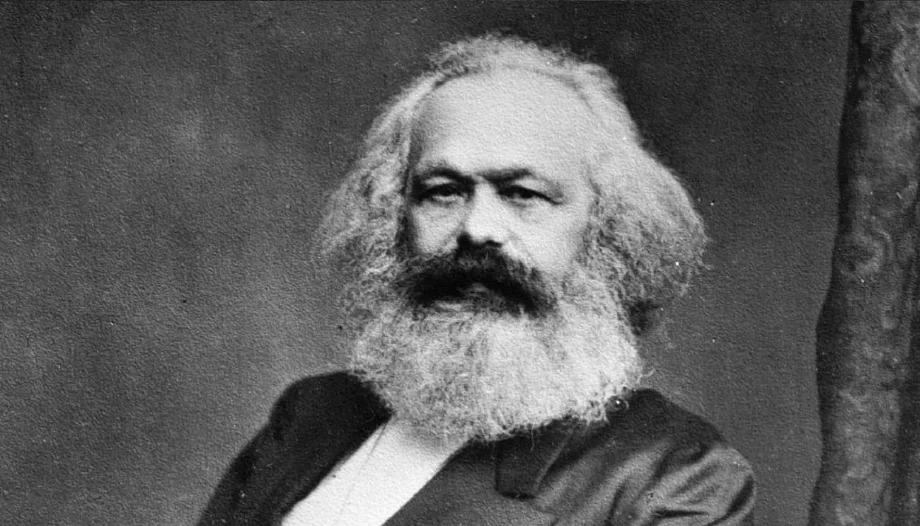
Born in Trier in 1818, the son of a Jewish lawyer who converted to Protestantism, he studied law and philosophy in Bonn and Berlin with the Young Hegelians. A journalist in Cologne, his newspaper was shut down by censorship, and he went into exile in Paris, where in 1844 he met Engels, his lifelong friend. There he broke with Proudhon and published in 1847 the The Poverty of Philosophy. Expelled after the revolutions of 1848, during which he published together with Friedrich Engels Communist Manifesto, He took refuge in London in 1849, living with his family while writing at the British Museum Capital. He died in London in 1883. His thesis of class struggle as the driving force of history had a profound impact on socialist thought.
Industrial revolution
The Industrial Revolution found Europe without legislation regulating the relationship between capital and the new class that mechanization had created: the proletariat. Workers labored in factories 365 days a year, with shifts of twelve or more hours a day. Children and even entire orphanages were employed—since machines now made child labor possible—and cruel punishments were used to subdue their natural energy (whips and even teeth filing). Only this profound injustice explains why such utopian social proposals as those of Fourier and Saint-Simon found so many followers, often in mutual conflict. These proposals gave way to the more credible... Philosophy of misery By Pierre-Joseph Proudhon, the leading revolutionary thinker of the era, this work, with its scientific and philosophical aims, delves into economic theory. In it, Proudhon proposed that the valuation of a product should no longer be based solely on its exchange value—determined by supply and demand—nor on its... utility value that those who opposed this were asking for, but the value constituted because of the time it took to produce it.
Against Proudhon
Against this work, the young Karl Marx wrote a merciless critique that, from the very title, is already critical of him. The misery of philosophy He turns it on its head. He begins by demonstrating that, in a free market, if one properly analyzes Proudhon's supposedly salvific formula—paying for the production time of the commodity—it consists of valuing the commodity by the labor it took to produce the sustenance and clothing that made possible the survival of those who produced that commodity, and only while they produced it—precisely the formula with which the economist David Ricardo had described the current state of exploitation of the worker.
Any concession in this chain that offered the worker anything more than their bare survival would raise the price of the goods above what a competitor without such a concession could offer. The employer might try, perhaps converted by the preaching of Mr. Proudhon—for Marx refers to him as a preacher—but then he wouldn't be able to sell the product: the company would have to close, and everyone would be plunged into poverty.
To this analysis Marx adds his undisputed discovery of the capital gainIf the worker is paid only for his subsistence, but in fact he works more hours a day than are necessary to subsist, he has been robbed of the payment for that excess of working hours that would have provided him with a normal life, beyond mere survival.
So who ends up with this surplus stolen from the worker? The obvious answer seems to be that it's the employer. But if that were the case, the problem could be solved, since it would only take the employer to heed Proudhon's warnings and relinquish that surplus. But Marx astutely observes that the problem is more structural than that, and that it's not so easily fixed, because the one who primarily keeps the surplus is the buyer, by paying less for the product than it's worth. Therefore, the price cannot be raised to pay the worker for this surplus, as this would make the product more expensive and less competitive in the market.
Since all the machinery that constitutes the capital of companies consists of products purchased from previous companies, Marx understands capital to be nothing more than stolen and accumulated surplus value. It is therefore labor, since the machines and other means of production that together form capital are nothing but the stolen fruits of workers' labor. Thus, in the interaction of capital and labor, he sees only labor, since in reality both past and immediate labor are involved.
And as for Proudhon's philosophy, that supposedly revolutionary proposal of his, which Marx has shown to be in reality the formula for worker enslavement described by David Ricardo, he now denounces it as profoundly reactionary, since Proudhon incorporates it into nothing less than Hegel's eternal derivation of the idea: When Proudhon sees exchange value as the thesis or affirmation, and utility value as its antithesis or negation, and proposes constituted value as the synthesis of both or negation of the negation, then Proudhon sees this dialectical step as a link in the eternal derivation of the idea. If it is eternal and its temporal unfolding is inexorable, then nothing can be done against it! Can there then be anything more reactionary than Hegel's philosophy and the proposal that Proudhon presents as its version in economic theory?
That philosophy of Hegel in which Proudhon has framed what is nothing but David's formula of worker slavery, presented itself as “the philosophy” and as definitive, but Marx is convinced that it is the elaboration of a concrete social class -the bourgeoisie- that has emerged from a very concrete mode of production -the concurrence of capital and labor- and therefore with a very concrete mode of distribution of products: their purchase and sale in the market.
In philosophical terms, Marx puts it this way: Hegel had said that everything is spirit in dialectical evolution. Well, it suffices to change the terminology to say equivalently that everything is matter—labor, production—in dialectical evolution. According to this “dialectical materialism,” the revolution consists in each model of society—thesis or affirmation—being opposed by another as its antithesis or negation, thus arriving at a synthesis—or negation of the negation—which will be a transcendence of the initial thesis. In present-day society, the mode of production is based on the interaction of capital and labor. Now, when this changes according to this process and the class it gave rise to—the bourgeoisie—disappears with it, then philosophy, which was nothing but a creation of this class, will also disappear, and we will then see what was eternal and immutable about it.
By criticizing Hegel's philosophy in this way as profoundly reactionary, Marx understands that he has criticized all of philosophy, since, assuming the same philosophy he criticizes—let us not forget that he was trained in the Young Hegelians—he understands Hegel's idealism as the ultimate culmination of philosophy and as that which encompasses it all. Philosophy is now superfluous; theory must be replaced by practice, truth by what I want to do—that is the revolutionary principle. Thesis XI on Feuerbach: “The philosophers have only interpreted the world in different ways. The point is to change it.”.
The change unfolded as follows: the bourgeoisie fought for their rights against the feudal lords, gradually developing class consciousness until their triumph in the French Revolution. Then, in the industrial era, the proletariat created by mechanization began to develop class consciousness in its struggle against the bourgeois class, both in temporary workers' coalitions—strikes—and in permanent ones—the trade unions.
In this struggle, the proletariat must win, for wealth inexorably tends to concentrate in the hands of fewer and fewer people, so that the proletariat will grow ever larger and the bourgeois class ever smaller, and thus its triumph will be due to numerical superiority. This will lead to the situation in which the proletariat seizes power, and with it the means of production, which has come to be called socialist society. This will be a transitional situation until it gives rise to a classless society in which goods will no longer be produced by the interaction of capitalists and workers and according to supply and demand in the market, since there will be neither capitalists nor a market. In this classless society, production will only occur based on the utility of the products, which will be determined by the needs of society, what has come to be called communist society.
We are on the path to that ideal. Liberal economists tell the workers: don't form coalitions, because when wages rise, paper prices immediately rise as well, so real prices remain the same, and in the end you only lose, because the bourgeois reaction is to invent a new machine. But Marx tells you: welcome the machine; its invention will not hinder a classless society, helping us to produce with less effort, in proportion to the needs of society, to the utility of the products, and not as now, according to the arbitrary laws of the market. Form coalitions, then, extend the struggle begun beyond borders, until the international proletariat achieves class consciousness in struggle without borders. And so in Communist Manifesto: “Workers of the world, unite!
Review
This critique will support my agreement with Hegel on one of his ideas about the history of philosophy: history always implements the logical derivations implicit in the idea. This has been borne out precisely in the philosophy we have just discussed, the culmination of an adventure whose precursor was the dissolution of concrete being into the idea. This was the real identification of existence and essence in Suárez's philosophy, based on the late medieval philosophy immediately following Thomas Aquinas. Thus began the dissolution of each being into the idea, of each person into humanity, of each individual into the collective.
The identification of essence and existence occurs in God, but only in Him, the Necessary Being, who exists by essence. Therefore, to apply this identification to all beings is to mistake them for the necessary being, the seed of pantheism. This is the implicit, unnoticed yet germinal pantheism in René Descartes' philosophical gesture of attempting to deduce the existence of the world, with his eyes closed, after having distrusted the data of the senses: as if the world necessarily existed.
Baruch Spinoza will warn about this in his Ethica more geometrico demonstrata where, after gathering in a few definitions and axioms the presuppositions that floated in the post-Cartesian rationalist atmosphere, he rigorously arrives in just a few pages at the conclusion that there is only one substance, what we have called pantheism. But history will take two centuries to implement this implication, arriving at the idealist pantheism of Georg Hegel. It sounds antagonistic to materialism: everything is an idea, everything is spirit in dialectical evolution. But, as Marx himself points out, this is equivalent to saying that everything is matter in dialectical evolution. Panlogism, then, and consequent materialism, is the inexorable endpoint of the Cartesian starting point. And it is here that Marx's philosophy is situated, with atheism being the idea that gives it coherence.
I'll explain with a familiar example. Adam and Eve live in a paradise where God is provident; the children live, trusting, with their father, who provides for them. But then comes the serpent's “You will be like God!” (Gen. 3:4), and you know the story that follows, ending with a door slamming shut in paradise. I use this expression, stretching the text a bit, because it is by slamming a door that the adolescent leaves his father's house, that first world, that paradise in which he lived trustingly. Now he realizes that he lives alone and that he must organize his life without relying on his father anymore, taking care of everything himself.
Thus, in Marxism, in the materialistic city organized without God, the State must take charge of everything that was previously entrusted to human nature, because the hand of God was seen in it. We have seen all spheres of human life politicized in Marxist countries: education, sports, art, science—everything was political, everything at the service of the State. Everything had to be regulated, controlled by the State, because the individual has dissolved into the collective, and there is no virtue except in the structure; nothing can be entrusted to human nature, nothing left to private virtue. “They dream of societies so just that nobody needs to be just” (T. S. Eliot, Choruses of The rock)
Thus, in the city organized without God, without trust in human nature. I take as an example the continent where Marx lived and where we live, Europe, so that the two models of 20th-century society in Western and Eastern Europe can be compared on equal footing (same cultural and wealth levels). The Russian Revolution presented itself as the seizure of power and the means of production by the proletariat, that is, as the establishment of the socialist model of society in that great country. Whether it was already communism or merely a step towards it depends on the interpretations of communism and the social reality experienced in Russia. But what is undeniable is that, whether it was already the Marxist paradise or a transition towards it, a wall was erected around that paradise: the Iron Curtain. But not because everyone wanted to enter it, as one might expect, but because everyone wanted to escape it! This continued until 1989.
So what had happened in paradise that made everyone want to leave? I once heard it from a farmer: “For the land to produce, you have to feel pain. And you only feel pain for what is yours.” I myself had the experience of living briefly in East Berlin, and that was an already unviable society that was only sustained by a rigid police regime that finally gave way.
And what had happened on this side of the curtain in the meantime? The answer can be found by comparing the two Germanies: the one that didn't call itself “democratic” was the one that did elect its governments and laws democratically. And while it's true, as Marx said, that capitalism leads to the concentration of wealth in the hands of a few, it's also true that in a democracy, violence isn't necessary for those few to lose their power, and with it their privileges, to the majority. The majority takes power at the ballot box and, in the legislative chamber, goes so far as to prohibit child labor, limit working hours and working days per year, establish a minimum wage, vacations, social security, severance pay, and so on. But these social laws don't put businesses at a disadvantage compared to their competitors—and this is the key point—because they also impose obligations on the competition.
Even in a society moderated by state intervention, the extraction of surplus value, discovered by Karl Marx, will persist. This occurs when the buyer pays less than the true value of the product, representing the hours of daily labor that could have funded their well-being. However, democratic society has evolved toward mechanisms for the return of this surplus value, a return by the state that Lassalle proposed very early on. The state currently does this by levying taxes not only on the sale of goods but also on property ownership and its transfer, and on other items. In this way, it can finance the well-being of citizens and provide them with public services that, perhaps due to a lack of profitability, are not covered by private enterprise (an ideal championed in Europe by Christian democracy).
And to this, yes, and without the need for violence, have contributed the coalitions of workers, both temporary—strikes—and permanent—unions—a legitimate right of the worker that the Church has recalled in its social encyclicals, whose principles have updated the values of Christianity for the present situation. These have been the best allies of human nature, whose attempts to supplant it have failed.
Complutense University of Madrid. SCS-Spain.





 Español
 English
 Italiano
 Français
 Deutsch
 Polski