




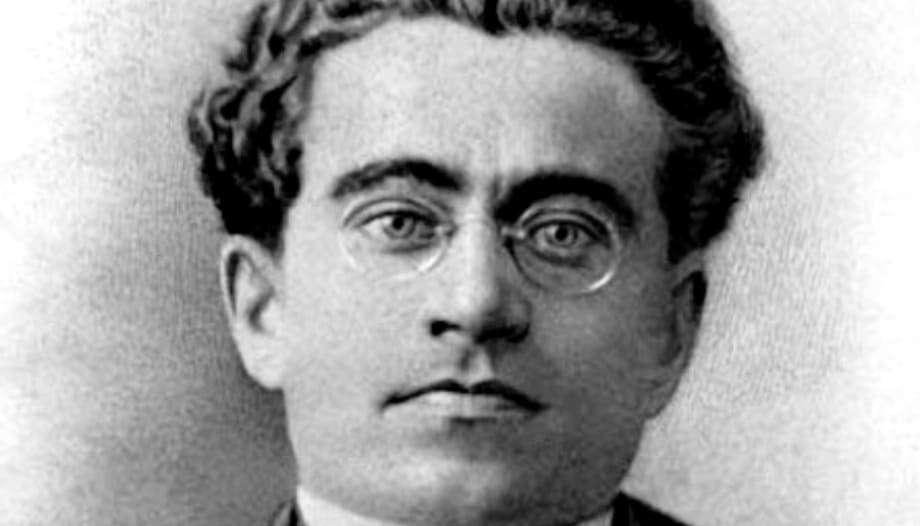
The Sardinian Antonio Gramsci (1891-1937) was one of the most influential Marxist thinkers of the 20th century, whose life was marked by political struggle and personal sacrifice. A founding member of the Italian Communist Party, he was imprisoned in 1926 by the fascist regime of Benito Mussolini, despite his parliamentary immunity. During his long and painful captivity, which seriously deteriorated his health to the point of death, he wrote his famous “Prison Notebooks”. This monumental work, written under censorship and in precarious conditions, transformed political theory by moving away from strict economic determinism to focus on the importance of the superstructure and social psychology.
His most famous intellectual contribution is the concept of cultural hegemony, with which he explained that the ruling classes do not only maintain power through force or coercion, but through consensus and the dissemination of their own values and worldview in civil society. Gramsci argued that, to achieve real social change, the working class had to build its own counter-hegemony through education and culture, led by what he called organic intellectuals. His thought revalued the role of institutions - such as the school, the Church and the media - as essential ideological battlegrounds for political emancipation.
The philosopher of praxis and the religious question
Gramsci was not a typical anti-clerical militant. Unlike the aggressive secularism of other co-religionists, his approach to the religious phenomenon was always one of almost reverential intellectual respect. In his famous “Cuadernos de la cárcel” (Prison Notebooks), he analyzed the Church not only in his own way, but also in the way of the Church itself. he analyzed the Church not only as a power structure, but as a force capable of giving moral cohesion and meaning to the popular masses.
For Gramsci, Catholicism was the «spiritual reserve» of Italy. His admiration for figures such as St. Augustine or St. Thomas Aquinas was not merely academic; he recognized in them an anthropological depth that the most crude materialism tended to ignore. This intellectual openness is what makes it possible today to read with different eyes the testimonies that suggest a closeness to the faith in his last days.
The Quisisana clinic controversy
As noted Diego Contreras in Aceprensa, The debate about his presumed conversion was rekindled after the declarations of Monsignor Luigi de Magistris. The archbishop rescued accounts of the Swiss nuns who attended Gramsci in the Roman clinic Quisisana during his agony in 1937. According to these testimonies, the communist leader would have kept a stamp of St. Therese of Lisieux -the «sister of the atheists»- on her bedside table and would have asked to kiss the image of the Christ Child during her last Christmas.
The documentation dusted off by the Jesuit Giuseppe Della Vedova in the 1970s reinforces this atmosphere of research. Sister Angelina Zürcher recalled an exhausted Gramsci who asked for prayers: «Mother, pray for me because I feel that I am at the end».». For his part, the clinic's chaplain, Monsignor Giuseppe Furrer, described his visits as meetings of high theological density where, after discussing the Fathers of the Church, Gramsci respectfully accepted the priestly blessing.
«It's not that I don't want to, it's that I can't.»
Perhaps the most enigmatic phrase collected by Furrer is Gramsci's response to the offer of the last sacraments: «It's not that I don't want to, it's that I can't.». These words reveal the inner drama of a man caught between the honesty of his public political commitment, the possible consequences of a change that could affect his relatives (especially his wife Julia and his two children, in the USSR) and the motions of a conscience that was looming over the abyss of death.
When on April 27, 1937 Gramsci breathed his last, Furrer entered the room to sprinkle the body with holy water, despite the reluctance of his sister-in-law Tatiana. There was no official act of conversion, no public abjuration of his Marxism. But, as with so many great souls, the boundary between doubt and faith turned out to be much more porous than ideologies allow us to admit.
The echo of a search
We will never know with certainty what happened in the intimacy of his spirit. What is clear is that Gramsci was a man who, even in the darkness of cell and illness, kept a window open to the transcendent. His figure reminds us that the dialogue between secular thought and Christianity need not be a battle of annihilation, but a mutual recognition of human complexity.
In a time of superficial radicalisms, the serenity with which Gramsci is said to have gazed at the tabernacle from the door of the chapel of Quisisana is an invitation to reflection. Perhaps, at the end of the road, the great theoretician of history was not looking for a dialectical synthesis, but simply for rest in the arms of that «sister of the atheists» who accompanied him in the silence of his room.






 Español
  English
  Italiano
  Français
  Deutsch
  Polski