



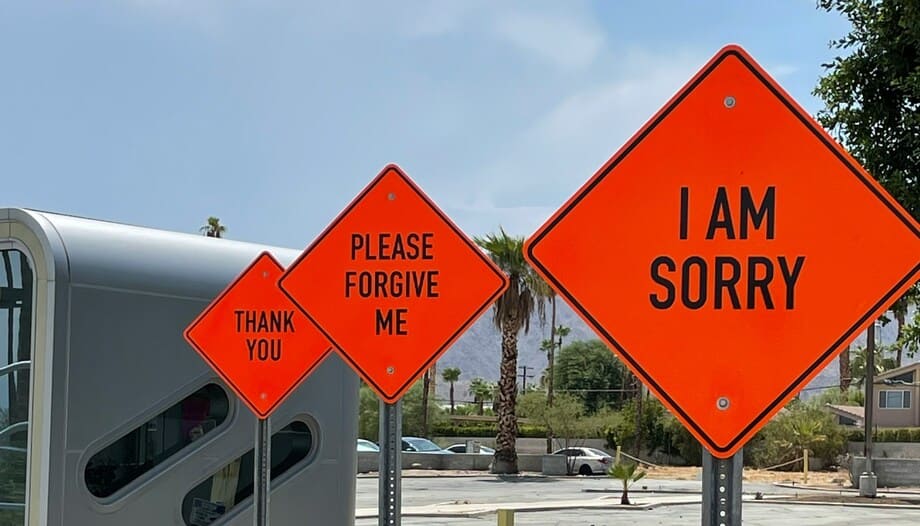
It’s been a long time since it happened. Years, perhaps. The people who were hurt went on with their lives as best they could; some succeeded, others not quite. And then, at some point—an interview, a campaign, a public rehabilitation effort in progress—the politician appears before the cameras with a contrite expression and a measured tone: “If anyone has been offended by my words or my decisions, I apologize.” That conditional is not innocent. “If anyone has felt”: that is to say, perhaps no one should have felt that way; perhaps the problem lies not in what I did but in how you received it. The apology shifts the responsibility onto the offended party. You suffered; I did not cause the suffering. And the harm—specific, documented, with names and surnames—is left hanging in the air without anyone taking responsibility for it. That is not asking for forgiveness. It doesn’t even meet the minimum requirement for forgiveness: acknowledging that I harmed a specific person, not just someone who may have been overly sensitive.
Empty apologies
This scene says a lot about the moral climate we live in. We’ve never had such a keen sense for detecting injustices, exclusion, and disrespect… The language The potential for harm is everywhere. We’re very good at identifying what hurts us, and, amid this heightened sensitivity, it has become more difficult to talk about blame with even a modicum of clarity, since everyone feels hurt, but almost no one seems willing to admit that they’ve caused harm. Everything is offensive, but almost nothing is recognized as objectively offensive. That is why hollow apologies are so common: they do not stem from an awareness of having done wrong, but from the need to put out a reputational fire.
The problem is that, without that awareness, there can be no true forgiveness either. For forgiveness to exist, there must be something to forgive. It must be possible to say, without euphemisms, that there was an injustice, a betrayal, a cruelty, a humiliation, or a lie. Forgiveness does not begin by downplaying the wrongdoing, but by naming it. That is why those public statements full of conditionals and vagueness are so irritating. They ask us to turn the page without having read the previous one.
The Arrogance of the Guilty Party
Let’s pause for a moment to consider the other side of the situation—not the person who was offended, but the one offering an apology. There, too, there is a very contemporary confusion. The idea has become widespread that apologizing is, in some way, equivalent to putting the episode behind us. “I’ve already apologized—what more do you want? I’ve done my part; now it’s your turn to forgive me and restore my peace of mind.” But truly acknowledging the harm caused does not entitle one to be forgiven within a timeframe one deems reasonable. If I have caused harm, I can admit it and make amends as much as possible, but I cannot control the other person’s reaction. I cannot demand that the other person stop feeling hurt so that I can feel morally safe.
Something similar happens with institutions. They, too, can humbly acknowledge the harm they have caused; what they cannot do is turn that admission into a justification for demanding redress. And if public opinion does not immediately restore trust, they have no right to portray themselves as victims. Having asked for sorry It does not turn every subsequent criticism into an injustice. There is a fairly recognizable form of arrogance in the guilty party who, after acknowledging their mistake, begins to complain because the harm continues to have consequences. It bothers them that they are not believed right away, that trust takes time to be restored. They portray themselves as victims of excessive harshness, when in reality what bothers them is realizing that an apology does not automatically erase the effects of what they did. Sincere repentance is somewhat humiliating because it forces one to acknowledge one’s own guilt and to wait—to accept that the other person may not yet be able to forgive.
Christian Forgiveness: An Act of the Will
Christianity has never confused forgiveness with moral amnesia. To forgive is not to deny the seriousness of what happened, to renounce justice, or to immediately trust again someone who has betrayed that trust. C. S. Lewis observed that we all think forgiveness is a wonderful idea… until we have something to forgive. That is when we discover that the problem is not understanding what it means to forgive, but wanting to do so. What forgiveness does entail is the concrete decision to refuse to live trapped in resentment, feeding the desire for revenge.
We tend to think of forgiveness in sentimental terms, as if only someone who no longer feels anger or sorrow could say, “I forgive you.” But Christian forgiveness takes place first and foremost in the realm of the will. One can still be hurt and yet forgive. One can continue to remember what happened with sadness and yet choose not to repay evil with evil. It may take time, prudence, even distance, and yet at the same time, one may have already taken that inner step by which one ceases to wish harm upon the other person.
St. Josemaría He put it in his usual unsentimental way: “Make an effort, if necessary, to always forgive those who offend you, from the very first moment.” The phrase is valuable precisely because of that “if necessary.” It does not idealize the human heart nor does it assume that forgiveness springs forth spontaneously as soon as one has understood the theory. It assumes that there will be times when forgiveness must be wrested from pride and wounded memory. Perhaps one will have to forgive before one feels like doing so.
School of Inner Freedom
On another point, St. Josemaría summarized the Christian response to offense in a very simple sequence: pray, be silent, understand, forgive. It is neither a magic formula nor advice for the weak-willed. It is a small lesson in inner freedom. Pray, because when one is hurt, one cannot see clearly. Remain silent, because the first responses are usually the worst. Understand—not in the sense of justifying evil, but of resisting the temptation to caricature the other person. And forgive—which doesn’t mean saying that nothing happened, but deciding that the harm I’ve suffered will not govern my behavior.
Forgiveness as a grace and an undeserved gift
Even so, Christians know that simply resolving to forgive is not enough. There are wounds that do not heal just because one has made a reasonable decision. There are betrayals that seemed to have been overcome but resurface years later with undiminished force. In such cases, the modern idea that everything can be resolved through willpower begins to falter. One may sincerely want to forgive and discover, to one’s great embarrassment, that one cannot. Then one of the deepest realities of Christianity comes to light: forgiveness is not merely a moral duty; it is also a grace that must be asked for. It is not merely a commandment, but a gift. The Lord’s Prayer expresses this with such naturalness that it almost prevents us from realizing what it is saying: “Forgive us our trespasses, as we forgive those who trespass against us.”.
We ask for forgiveness and, at the same time, we ask to be able to forgive. It is a demanding plea because it commits us; but it is also an admission of our weakness: we cannot always do it on our own. There are times when the only honest thing one can say before God is: I want to forgive, but I can’t; give me what you ask of me. Must a Christian forgive? Yes; the Gospel leaves little room for doubt. But the command does not arise from the rights of the guilty party, but from the mercy received. A Christian forgives because he knows that he himself lives by unmerited forgiveness. That is why forgiveness is not at the mercy of feelings, nor does it depend on the pain or anger someday disappearing.
The Need for Forgiveness
This doesn’t apply only to private life. A society in which everyone is quick to take offense and no one is willing to acknowledge fault, humbly ask for forgiveness, or grant it, eventually becomes suffocating. Every mistake becomes a stigma; every ill-chosen word, a condemnation with no end in sight. We talk a lot about coexistence, respect, and inclusion. But a human community cannot be sustained by rules and protocols alone. It is also sustained by the ability to say “I was wrong” without making excuses, and to respond “I forgive you” without trivializing the wrongdoing, yet without remaining chained to it. Perhaps that is why forgiveness can never be reduced to a correct formula or a well-delivered apology. It requires the truth to call wrongdoing by its name, and the freedom to ensure that that wrongdoing does not forever define our relationship with the other person.






 Español
  English
  Italiano