




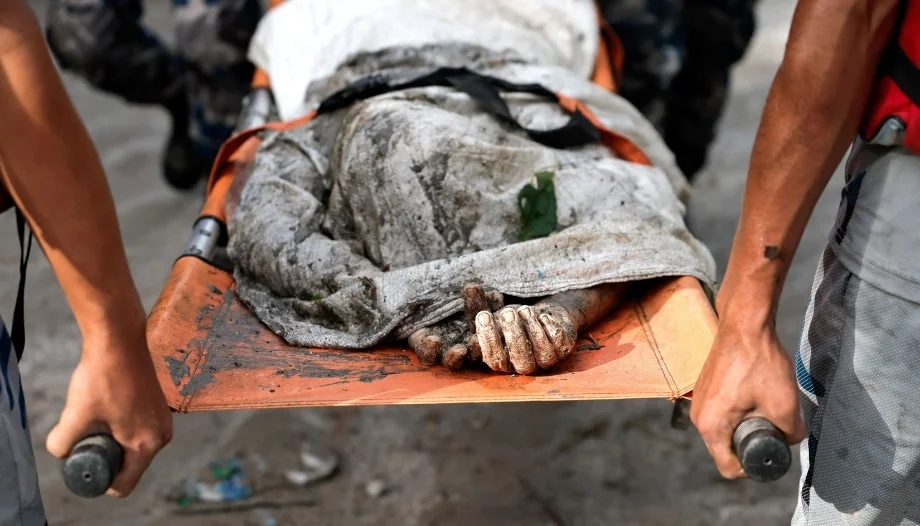
Hundreds of people running in panic are engulfed by a monstrous wave of water, ice, rocks, and mud that sweeps away entire villages in its path. The harrowing videos of the flash flood in Nepal or the earthquakes in Venezuela and Colombia lead us to ask: Where was God?
We can still blame ourselves for the flood if, as everything seems to indicate, it was caused by the sudden melting of a glacier attributable to climate change; but earthquakes have no other cause than the very structure of our planet. The same is true of volcanoes, epidemics, and so many other natural phenomena capable of destroying human lives.
In the face of events as dramatic as those we have experienced in recent months—with thousands of innocent victims—it is perfectly natural to doubt God, His existence, or at least His goodness and omnipotence. Some, whose convictions run deeper, do not distrust God but allow themselves to be carried away by logic without realizing that the organ in which logic operates—their brain—can make very natural errors due to its design. Trained over millennia to seek patterns and cause-and-effect relationships, the brain immediately activates its evolutionary mechanism to explain what it cannot grasp, reaching the erroneous conclusion that we must have done something wrong to merit this response from the Almighty. This is known as the illusion of causality. God is like a Father who, out of love, disciplines His children so they may walk the path of goodness. It makes sense, doesn’t it? But it is still an illusion that helps us reduce our anxiety over not understanding something that, in reality, is not easy to grasp. Jesus already had to explain this by giving the example of what happened to the victims of the tower of Siloam, which suddenly collapsed, killing 18 people who were no more sinful than anyone else. Just as human beings have the freedom to do evil—and God allows it—nature, too, has a certain autonomy in which God does not seem to intervene.
During his trip to Spain, the Pope helped us understand a little better this mystery of God’s apparent absence in times of trial. He reminded us that «when God seems absent, we must once again entrust to Him the burdens we carry in our hearts—even crying out to Him, even protesting like Job—confident that in some way He makes Himself present and is near even when He appears to be silent.» And, faced with the temptation to invent a false image of God that fits our human logic, he pointed out that «we must not spiritualize suffering, superficially attributing it to the “will of God” or to some mysterious plan of His, because this risks minimizing that suffering, silencing it, and hurting people.» He concluded by adding that «God does not want suffering; He bears it with us and invites us to trust in Him with perseverance.».
On this World Day for the Care of Creation, perhaps we should also recall the words of Pope Francis in *Laudato Si’*, in which he explains that «many things we consider evils, dangers, or sources of suffering are, in reality, part of the birth pangs that spur us on to collaborate with the Creator.».
The fact is that natural disasters can be a message from «our sister Mother Earth,» as St. Francis of Assisi referred to her in his famous Canticle of the Creatures. A reminder of our vulnerability—no matter how much scientific and technical progress we make—and that God’s work is not yet fully complete and remains imperfect. It is up to us to collaborate with God, to the best of our ability, to bring order to that disorder, transforming—as He did in the story of creation—chaos into cosmos. This means caring for the environment to prevent whatever can be prevented, taking preventive measures to minimize damage in the event of natural disasters, and, of course, coming to the aid of victims so they can return to normal life as quickly as possible. In this way, we will already be getting a foretaste of that new heaven and new earth at the end of time, where «He will wipe away every tear, and there will be no more death, nor mourning, nor crying, nor pain, for the former things have passed away.».
I’ll conclude with a thought from the Pope’s former preacher, Father Cantalamessa, who taught that, just as the earthquake following Jesus’ death on Golgotha was followed by an even greater earthquake—with its epicenter at the tomb—which gave way to his Resurrection; so, for every earthquake in our lives, every painful and incomprehensible event, every suffering, a much greater aftershock awaits, in which our now mortal and fragile nature will be revealed in all its glory. That is my hope!
Journalist. Graduate in Communication Sciences and Bachelor in Religious Sciences. He works in the Diocesan Delegation of Media in Malaga. His numerous "threads" on Twitter about faith and daily life have a great popularity.






 Español
  English
  Italiano
  Français
  Deutsch
  Polski