




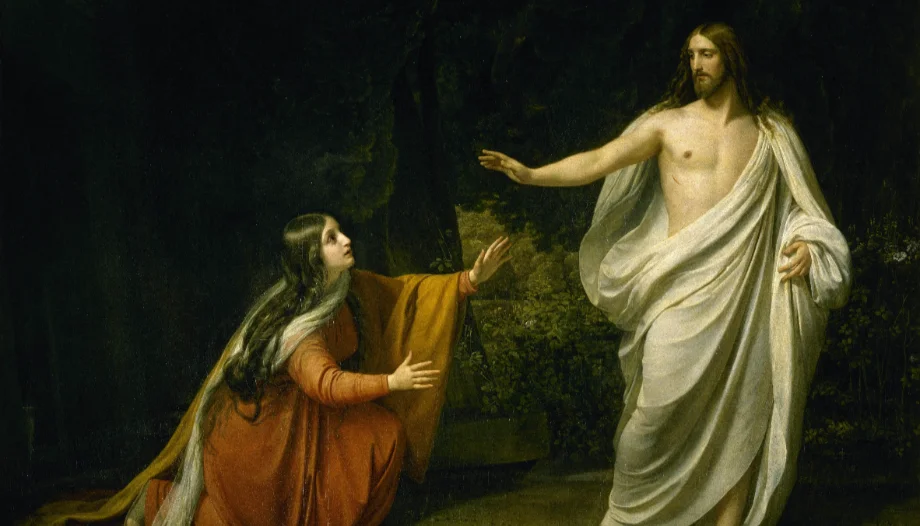
«Do not touch me». This is what the Risen Jesus said to Mary Magdalene when the apostle, after confusing him with the gardener, finally recognized him. But what do you mean, «Do not touch me»? Was such an unfriendly answer really necessary? The famous «Noli me tangere» of the Latin Vulgate (Jn 20:16) has been translated by the Bible of the Spanish Episcopal Conference in a kinder way that helps to better understand the true meaning of what Jesus meant. Concretely it translates it as «Do not hold me back».
What Jesus says to the woman of Magdala is not a moral prohibition or an advice not to be contaminated by the possible radiation arising from the process of resurrection, as some have deduced after studying the Shroud. Nor is it that the Risen One suddenly had an attack of haptophobia, which is the irrational fear of physical contact with other people, ChatGPT informs me.
What the «Master» (translation of the Aramaic «Rabunní» with which Mary addresses him when she realizes who he really is) was doing was acting as such and teaching her something very important. She was telling him that there is a before and an after the Resurrection, that the Jesus in a mortal body that she knew, the one who had driven seven demons out of her, whom she followed as a privileged disciple and whom she accompanied to the end on Calvary, no longer relates to us in the same way. His body has been glorified and now lives in another sphere.
Although Mary, the rest of the apostles, those of Emmaus and even «more than 500 brothers and sisters at the same time,» as St. Paul recounted, had the privilege of seeing and physically touching Jesus after his resurrection, this will not be the «normal» thing to do. Since that event, we men and women can continue to see him, feel him, hear him... but not in a physical way, but in faith.
Billions of Christians since then can categorically affirm that we have had an encounter with Jesus, through listening to the Word, the sacraments, prayer or any other kind of mystical experience, even if none of us has a selfie with him or can tell what he smells like.
Mary's situation is very logical. As a human being, she tries to cling to the mortal Jesus of flesh and blood, whom she knew and with whom she shared so much, especially after having seen Him die horribly; but the Risen One does not let her, because He wants to lead her to what is important: to the new way of relating to Him, to faith.
The Pope's upcoming visit to Spain has generated great expectation and, to a certain extent, everyone also wants to appropriate a bit of it, to grab it in their favor. Starting with the particular churches themselves, which fought at the beginning, when the project became known, to get at least a short visit to their territory; continuing with the politicians who, for or against, will take advantage of the visit to please their electorate; and ending with the millions of people who will try to get the best places to be as close as possible to him, to have him give us a look, let alone a handshake, a hug or a sentence, even if it is brief!
Everyone will talk about the Pope's trip. For a week, nothing else will be talked about. Every gesture, every word will be interpreted, his clothes, the car that will carry him or the place where he will sleep will be analyzed; and each one will interpret it according to his own preconceived cliché for happiness or displeasure. «In this he is moving away from Pope Francis» -one will say-; «in that he is moving closer to Pope Francis» -another will say-; a little step forward, Mary, a little step backward.
With honorable exceptions, the television sets, the radio talk shows and the opinion platforms will be filled with rare Christians, very rare, certainly far from the common parishioners, who will represent some ecclesiastical current of rebounded people very much to the taste of the editorial line of the media. Whatever it takes before giving a voice to Christians close to the Church, lest it seems that the media is proselytizing.
These will be days in which each one will pull on his own white cassock to get closer to him, to support his own ideas and to take hold of his figure, shaking the poor Pope. That is why I really liked the imperative motto of the trip: «Lift up your eyes», because like the «Noli me tangere» it invites us not to remain only in the superficial and to let God be God, and the Pope be Pope. If we do not open our hearts to what is new, if we do not allow ourselves to be surprised by what the Pope comes to tell us, the visit will have been in vain. Leo XIV will return to Rome and we will return to our usual routine, leaving no trace.
Let us raise our eyes, let us open our ears, leaving behind our preconceived ideas and let us allow ourselves to be immersed in the Good News that the Pope wants to give us!
Journalist. Graduate in Communication Sciences and Bachelor in Religious Sciences. He works in the Diocesan Delegation of Media in Malaga. His numerous "threads" on Twitter about faith and daily life have a great popularity.





 Español
  English
  Italiano
  Français
  Deutsch
  Polski