


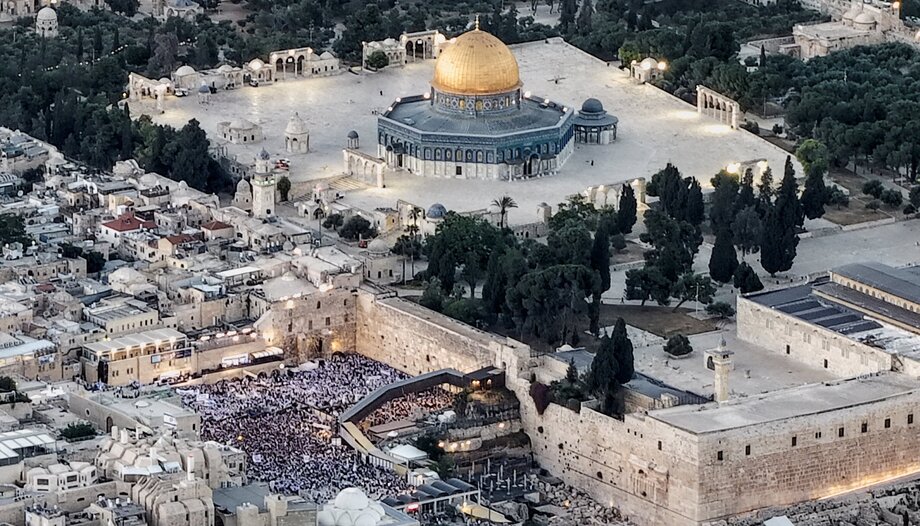
 Fray Manuelfrom Jerusalem: "It is moving to see Christians convinced that peace is possible".“We exist”: the voice of a Christian from the Holy Land
“Today we hear threats that the war will continue ‘until victory.’ We ask, what kind of victory - death, destruction, desolation? To those who promote war as the only way, we say: war is not the way. We reiterate our call for an end to bloodshed and destruction.” A group of religious leaders from different Christian Churches in the Holy Land have issued a letter demanding an end to the war affecting Israel, the United States, Lebanon, Iran and Palestine.
The letter was released on the occasion of the anniversary of the Palestinian Nakba (the end of the British Mandate in 1948) on May 15, and is signed by a prominent group of Christian leaders, including Patriarch Emeritus of Jerusalem Michel Sabbah, Greek Orthodox Archbishop, and Lutheran Bishop Emeritus, among others.
The text recalls that “if we truly seek an end to the war in the Middle East, we must focus on the central problem: the plight of the Palestinian people, who have been suffering since 1948. After October 2023, the catastrophe they face has intensified amid an ongoing war in Gaza, waged to erase Palestine and the Palestinians. And the war has spread to the West Bank, Lebanon and beyond.”.
“Our Holy Land yearns for equality, justice and peace. The peace we speak of is a peace that guarantees the freedom and dignity of every human being,” the Christian leaders stress.
Pastoral care of Patriarch Pizzaballa
The text coincides with some of the considerations expressed a few weeks ago, on April 25, by the current Catholic Patriarch of Jerusalem, Cardinal Pizzaballa, in a long and clear pastoral letter in which he also insisted on the need for peace: “We reject any complicity with the culture of violence. Wherever it comes from, violence is never an evangelical path”.
The Cardinal's lengthy letter, entitled “They returned to Jerusalem with great joy”The Cardinal, who has had an impact among Catholics in the Holy Land, is a review of the current state of the Catholic Church in the Holy Land. Without political analysis, the Cardinal is firm in condemning the war, which forces us to “rethink the forms and times of our ministry” and asks, beyond “necessary analyses and denunciations”, “what is the Lord asking of us at this moment”.
The text points out that October 7, 2023 and the subsequent war in Gaza have closed an epoch. According to the patriarch, for the Palestinians this period represents “the last and dramatic phase of a long history of humiliation and exodus», while for the Israelis it has meant “something unprecedented: a violence that has revived the horrors that occurred in Europe eighty years ago”.
The Patriarch denounces that the use of force has been consolidated as the main method of dispute resolution: «We are witnessing the resurgence of the use of force as an instrument considered decisive for the resolution of conflicts... War has become the object of an idolatrous cult».
Factors of the current crisis
Pope Cardinal Pizzaballa points out some of the main consequences of what he describes as the “chaos” that reigns today in the Holy Land:
- Pain, hatred and mistrust: The letter speaks of a “painful dehumanization of the other: when the other becomes only ‘the enemy’, everything becomes licit”. “Violence has not only destroyed cities and homes, people and hopes: it has marked consciences, it has poisoned public language.” It creates a distrust among all that makes reconciliation difficult.
- Fragmentation and fear: the Cardinal points out a worrying phenomenon: “the growing polarization. Not only between Israelis and Palestinians - which we know well - but within both social fabrics, where only people who think the same way, who speak the same language, are found”.
- Wear and tear of language: for the patriarch, terms such as “dialogue”, “justice” or “two States” have now lost their relevance in public discourse.
- Difficulty of interreligious dialogue: as a result of the conflict, “the Holy Places, which should be spaces of prayer, become identity battlefields. Sacred texts are invoked to justify violence, occupations and terrorism”. The Cardinal sentences: “I believe that this abuse of the name of God is the gravest sin of our time”.
However, he points out, “dialogue is our vocation and our destiny. It is one of the ways in which our faith is manifested and nourished.”.
Gaza, Palestine and Israel
The Latin patriarch reviews the state of different territories of the patriarchate: Gaza, “in a situation of extreme tribulation” and in Palestine, where “the situation is deteriorating day by day”; as well as in Israel, where “society has been traumatized since October 7, and this trauma has generated suspicion towards everything related to the Arab world, with the consequent growing mistrust between the two populations”.
A relevant aspect of the letter is the mention of the use of Artificial Intelligence in conflict. The cardinal raises the ethical implications of the automation of war: “What happens when the one who decides who lives and who dies is a machine? What responsibility is left to man?”
The document concludes with a call for coexistence. «There is no alternative. This Earth is the home of all», affirms the Cardinal, who maintains that the mission of the Church there must be to become a space of reconciliation.
“Redeeming the consequences of the conflict - the hatred, the fear, the ‘toxic memory’ - is the specific and sublime task of the Church of Jerusalem for the whole world,” he notes. He warns that “the Christians of the Holy Land are not an uncomfortable third party, nor a neutral buffer between Israelis and Palestinians, nor a group separated from their non-Christian brethren. Rather, they are salt, light and leaven within the societies to which they belong in their own right. They share the history, the language, the wounds and the aspirations of their peoples. They are not called to shut themselves up in a protected enclave, nor to flee, but to live their vocation to the full: to remain within society, sharing its destiny, to leaven it from within with a vision of man - and of society - rooted in the Gospel”.
Finally, the Cardinal appealed to the international community: “It has the duty and the right to take an interest in Jerusalem, because it belongs to everyone. The heart of the world is in Jerusalem and what happens there affects billions of believers”.
“The Church of Jerusalem, small and resilient, finds herself living here and now the style of the heavenly Jerusalem: to be a welcoming place, a paschal light that illuminates the darkness of rancor; to be a house of open doors, an instrument of healing in the world. This is its dream, its mission, its gift to humanity,” he concludes.






 Español
  English
  Italiano
  Français
  Deutsch
  Polski
  简体中文
简体中文