


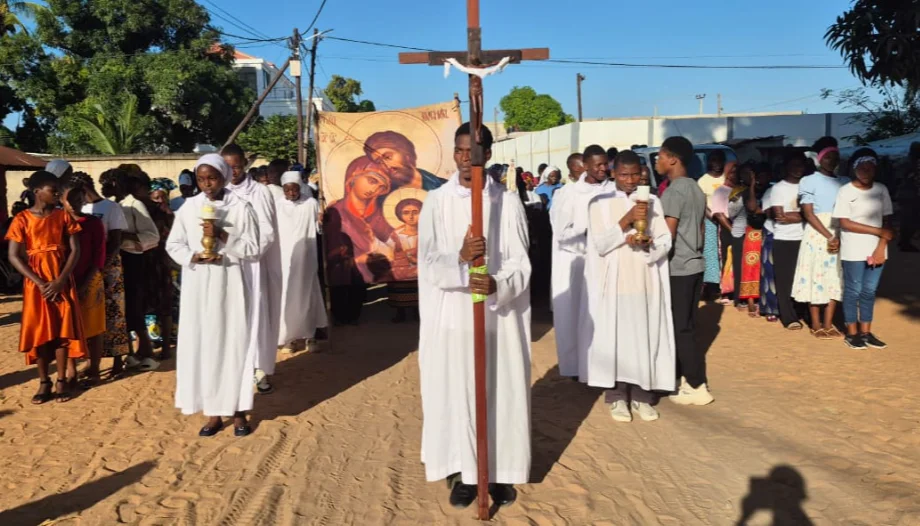
The Catholic Church in Mozambique operates in a context of extreme complexity, strongly marked by humanitarian instability and violence in the north of the country, especially in the Cabo Delgado region.
In these areas, the institution has become a key player in resistance and emergency aid, taking in thousands of families displaced by terrorism and coordinating the reconstruction of homes after devastating cyclones.
In the context of the diocese of Pemba and the province of Cabo Delgado, the mission of St. Aloysius Gonzaga suffered huge attacks, in which the places of worship, the residences of the missionaries and the convent of the nuns were set on fire, besides destroying the social and sanitary infrastructures associated with the Church that served the entire community of the area. This attack provoked a new wave of thousands of internally displaced people to the south and to the city of Pemba itself.
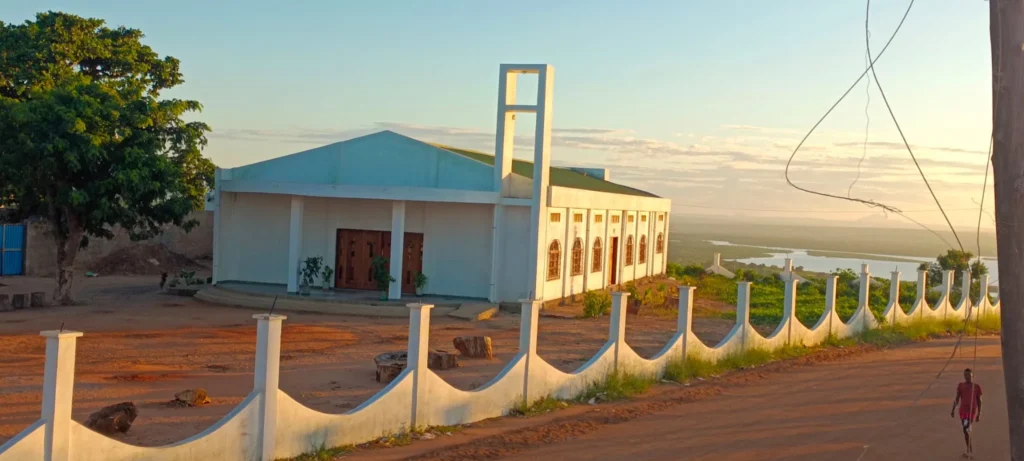
We spoke with Eduardo Roca, a Spanish priest from the Diocese of Zaragoza, who was sent as a missionary 14 years ago to the Diocese of Pemba. Ernesto Magengue, with whom he coincided while studying in Rome. He assumed the direction of a project of ethics, citizenship and development linked to the Catholic university of the diocese. He also attends to a very small community on the outskirts of Pemba, a Muslim majority, where he has built a large church.
What does your work in Pemba consist of?
-Like every missionary, I have multiple roles to play. As a priest and pastor, I preside over the sacraments and try to make the Word of God accessible to the community. However, in such a complex environment, one also becomes a reference point for the population; a guide who must transmit security and the certainty that the Lord does not abandon them. To say this is simple, but to experience it in a context of persecution, under the constant threat of Islamic extremism, is extremely difficult.
In addition to my pastoral duties, I work as a teacher and manage the educational institutions of the parish. We have a nursery school for children from two to five years old and a complex that includes primary and secondary education, which has more than two thousand students. It is a mission institution, although the majority of the students are Muslims. I also devote much of my time to interreligious dialogue and conflict mediation for peace building, which is one of my priority lines of action.
What work would you highlight of the Church in that region?
-Our work in Pemba and throughout the province of Cabo Delgado is a direct response to the suffering of the communities. This assistance has materialized in several areas. For example, following the passage of two cyclones that caused profound destruction due to the precariousness of local constructions, we focused on housing reconstruction. Through Caritas, In the last few years, we, the parish, my home archdiocese and several congregations, have been able to restore the roofs of many families who had lost everything.
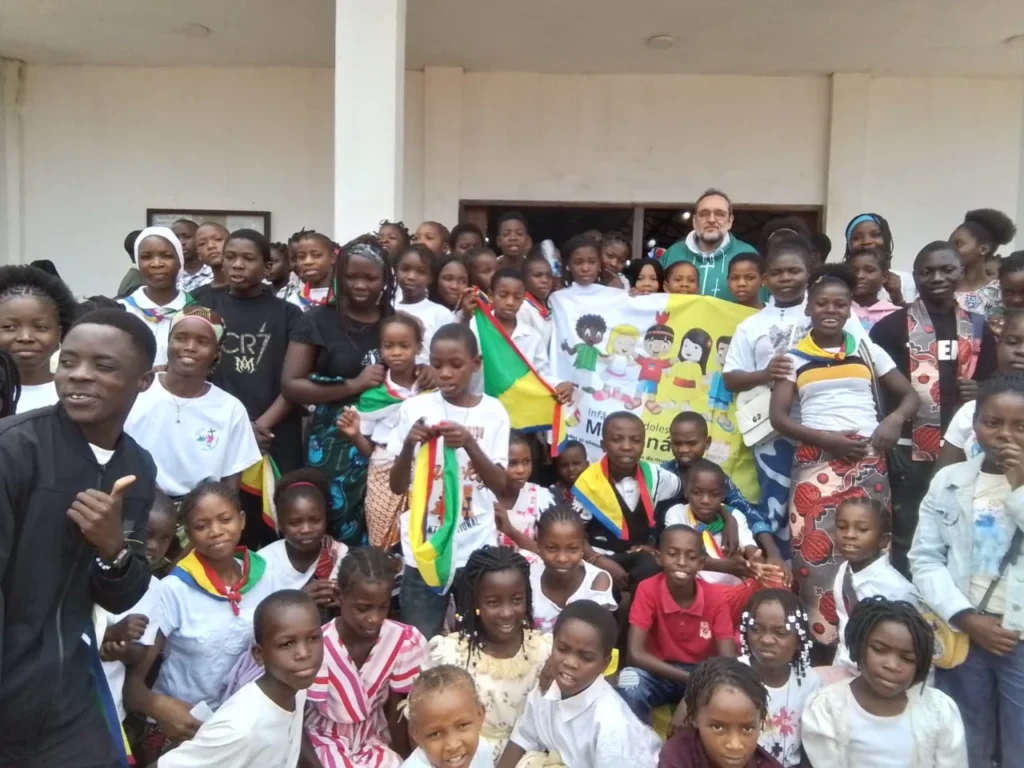
On the other hand, we manage the food emergency. As an area affected by the conflict, employment options are almost nonexistent. Most of the population is peasant and depends on agricultural cycles; when these fail due to inclement weather, shortages are critical. The children's center, for example, serves nearly two hundred children a day, ensuring that they return home with at least one plate of food.
Finally, the Church assumes the humanitarian reception. We have received thousands of families who have taken refuge here fleeing from the terrorist attacks in the north, which have intensified considerably; just a week ago there was an attack just fifty kilometers away that completely destroyed a mission. This reality demands of us a constant discernment and theological re-reading on how to manifest the presence of the Risen Jesus in the midst of pain.
What do you admire most about the faith of Mozambicans?
-He would synthesize his attitude in a concept of the Macua language: ulipe, which is translated as the capacity to resist, but which implies, fundamentally, the act of rising from the wound and destruction.
It is moving to observe a people who, in the midst of the cross and the most absolute misery, are capable of singing songs of praise. With the sound of the drums they seem to break the reality of the tomb and summon again the Resurrection. This spiritual strength is what impresses me most.
What have been the most difficult moments you have had to live through?
-The most complex period coincided with one of the first waves of terrorist attacks, when the insurgents reached the Metuge district, just across the bay from Pemba. We were unprotected and lacked security. The uncertainty of whether they would break into our area created tremendous anguish. At that moment, worrying about the fate of the children and families, the only viable option was prayer and abandonment to God's mercy. That experience was a major emotional break, a psychological impact from which I needed to reconstruct myself, due to the fear of a repetition of the atrocities that we already knew were happening in the north.
The other critical moment was linked to climatic factors. On the night of the second cyclone, with the uncertainty of not knowing what destruction we would find at dawn or whether our own structure would resist, we sheltered in the parish house numerous children and women whose homes had already been swept away by the wind and rain. These are extreme situations where faith and human endurance are put to the ultimate test.
Have you experienced violence at close quarters in your mission?
-Yes, violence has definitely marked our reality. Although our community of San Carlos Lwanga de Mahate was canonically erected as a parish only three years ago, I have been working in the area for almost fifteen years, dedicating the last few years to the reception of thousands of refugees.
The beginning of the exodus of these families was a strong shock to my conscience. The stories they told were devastating; they described summary executions of immediate family members witnessed by the children themselves. We had to immediately organize the reception of numerous orphaned children, a task that we began in collaboration with the Benedictine missionaries residing in the mission.
Despite the trauma and pain with which these people arrive, they show an amazing capacity for recovery and resilience, far superior to what we Europeans are used to. Today, our mission has expanded to support this internal migration flow; of the seven communities we serve, four are made up exclusively of families displaced by the conflict in the north. It is an environment of loss and vulnerability where we learn the true meaning of priesthood.
How do you assess the evolution and future of the Church in Mozambique?
-The Church remains committed to providing assistance through housing initiatives and soup kitchens managed by Caritas and the parish. However, beyond material assistance, the current situation has generated a remarkable spiritual strengthening. Historically, these communities have been largely neglected due to a shortage of clergy, depending almost exclusively on the valuable work of local catechists and animators with limited training. Therefore, deepening sacramental and ecclesial life requires a constant effort in catechesis and liturgical formation.
This work brings us great joys and well-founded reasons for hope. Last year, nearly 300 baptisms of young people and adults were celebrated. These facts show that the Church continues to be built up by God, regardless of external attempts to destroy it.
Finally, I consider it fundamental to consolidate interreligious dialogue as a diocesan pastoral priority. After my previous experience in Angola, where Islam was not a close reality, here I find myself immersed in Muslim communities, some of them with fundamentalist tendencies.
This has meant for me a process of inner conversion and of approaching the mystery of the different religions, always from the perspective of the Second Vatican Council and the magisterium of the last pontiffs. In the end, it is a matter of discovering the deepest values of the human condition in the most unlikely environments. As a brother priest, now deceased, used to say: «The most beautiful flowers grow, sometimes, in the most unexpected places». That capacity for wonder at human goodness and the need to stand firm in the face of difficulties sums up our current experience here.






 Español
  English
  Italiano
  Français
  Deutsch
  Polski
  简体中文
简体中文