


 Alpha, the course that has already led millions to faith
Hozana is a non-profit organization, founded by Catholic laypeople, that seeks to unite people in prayer and bring them closer to Jesus through the internet. To this end, it develops free platforms that allow users to share prayer intentions, access meditations, and pray in community.
Among its initiatives is the application Rosario, which promotes this prayer through the international campaign «Rekindle the Flame,» especially during the month of October. The initiative invites people to pray, delve deeper into the mysteries of the Rosary, and share it with others.
Romain Delenda, founder of Rosario, It explains what technology can contribute to spiritual life and why the Rosary remains a way to approach Christ with Mary.
The campaign proposes three actions: pray, invite, and educate. Why have they chosen these three dimensions in particular, and how do they complement each other?
–Because these three dimensions correspond, in essence, to three essential movements to truly revive devotion to the Rosary: to live it, to understand it, and to transmit it.
The first step is to pray, because the Rosary is discovered above all through practice. It's not simply about knowing a devotion, but about entering into it: taking up the rosary, praying each decade, contemplating a mystery of the Gospel, and learning, little by little, to see Christ with Mary. Practice is the starting point.
The second is to become more knowledgeable, because prayer can become impoverished if it becomes purely mechanical. A deeper understanding of the Rosary, learning to meditate on its mysteries, and discovering its place in the Church's tradition helps one to pray it with greater depth and to persevere over time.
And the third is to invite, because an authentic spiritual experience naturally tends to be shared. If a prayer helps us draw closer to Christ, the desire arises to share it with others. The Living Rosary facilitates precisely this step, offering a very simple and accessible way to begin praying in community.
Therefore, these are not three separate actions. We pray to live the Rosary, we study to deepen our understanding of it, and we invite others to share it. And, at the same time, our mission brings us back to prayer, because we know that the fruit of an invitation depends not only on our words, but also on the grace of God.
They speak of “rekindling the flame of the Rosary.” Has the Rosary fallen into disuse, and is it a practice that needs to be revived?
–I would be cautious about the idea that «people don't pray the Rosary anymore.» There are still many people who pray it every day: in families, parishes, religious communities, and prayer groups all over the world.
But it is also true that, for many Christians, the Rosary has ceased to be part of daily life, or is perceived as a distant, repetitive practice belonging to another generation.
That's why we talk about reviving, rather than reinventing.
The flame is already there. The Rosary is part of a very deep tradition of the Church and has endured through the centuries precisely because it is an extraordinarily simple and, at the same time, very profound prayer.
But “rekindling the flame” doesn’t just mean returning to prayer when we’ve lost the habit. It also means going deeper when prayer is already a part of our lives. Prayer is a loving relationship with God, and in love we can always grow, deepen our faith, and let the flame burn even brighter.
Therefore, there are, in a sense, two flames we want to nurture: the flame of the Rosary in the Church and the flame of our own prayer life. For some, October will be an opportunity to discover or rediscover it; for others, to pray it with greater fidelity, attention, or depth. Because God's love is infinite, there is always room to grow in prayer.
Why is praying the Rosary so important?
–Because, when one looks at the history of the Church, one discovers an extraordinarily constant insistence on the Rosary.
First, Mary herself invites us to pray the Rosary in several apparitions recognized by the Church. In Fatima, for example, the request to pray the Rosary appears repeatedly in the testimonies of the 1917 apparitions. In Lourdes, Bernadette also appears deeply connected to this prayer. Naturally, private apparitions are not the foundation of our faith—Christ and the Gospel are always at the center—but the Church recognizes that they can help us to live certain dimensions of the Christian life more deeply.
And this invitation continues to resonate today. Just a few days ago, during his apostolic journey to France, Pope Leo XIV expressly asked all the faithful and Christian communities in Lourdes to pray the Rosary during the month of October, with a particular intention for the end of wars and for peace among nations.
Added to this is the strong emphasis placed on the Rosary by popes throughout the centuries. Leo XIII dedicated numerous texts to the Rosary and decreed that the month of October be especially consecrated to this prayer. Saint John Paul II even proclaimed a Year of the Rosary and summarized its meaning with a phrase that I find essential: praying the Rosary is “to contemplate with Mary the face of Christ.” In other words, at its core we do not find a prayer that distances us from Jesus, but rather a path to enter more deeply into the mysteries of his life.
And then there's something that's very important to us: the testimony of the faithful themselves today. Even before creating Rosario, we conducted a survey among more than 4,000 people who regularly prayed the Rosary and asked them what this prayer gave them. In more than half of the responses, the idea of peace appeared spontaneously, with words like serenity, calm, or tranquility.
Since launching the app, we have continued to receive hundreds of similar testimonials. People share that the Rosary has helped them persevere in prayer, rediscover their faith, get through difficult times, or simply start their day with greater peace and confidence.
Clearly, we do not present the Rosary as a magic formula. Its importance is much deeper: it places us before the Gospel, teaches us to contemplate Christ with Mary, helps us to entrust our intentions to God, and introduces us to a simple prayer that can accompany us every day.
That's why this convergence impresses us: Mary recommends it, popes have constantly encouraged it—and Leo XIV just did so again in Lourdes—and entire generations of Christians continue to bear witness to its fruits. When so many voices, across such different eras and contexts, point in the same direction, we believe it's worth listening.
What is the difference between praying the Rosary individually and in community?
–Both dimensions are important and are not opposed.
The Rosary can be a profoundly intimate prayer. There are times when we need to be alone with God, to place a worry before Him, to contemplate a mystery, or simply to remain in silence.
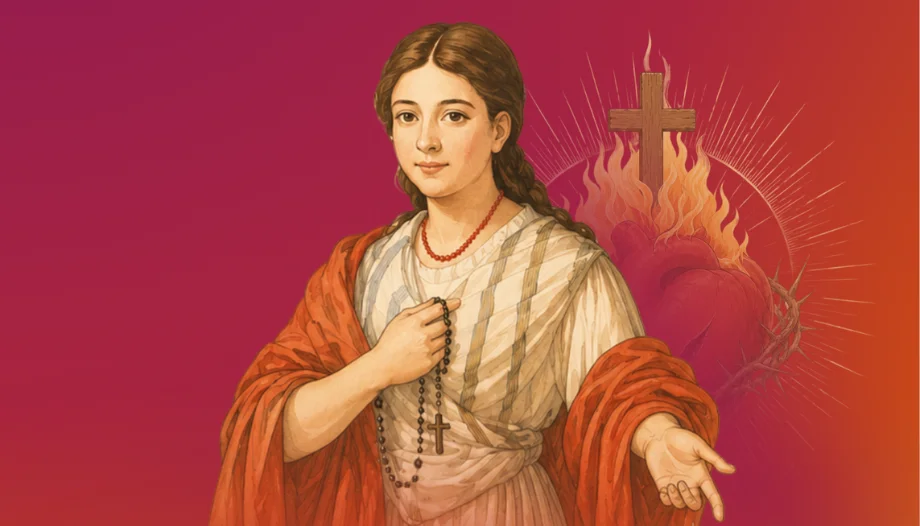
But praying it in community adds something very powerful: the awareness that we do not walk alone in faith. This is precisely at the heart of the Living Rosary, created in the 19th century by Blessed Pauline Jaricot. Her intuition was very simple: instead of asking each person to pray a complete Rosary, each member of the group would take on a part each day. Thus, a prayer that was very accessible to each individual became, thanks to the communion of the group, a much more expansive prayer.
Rosario takes up that intuition again today. In our groups, each person can commit to praying a decade daily and know that others are praying too. It seems like a small thing, but it changes the experience greatly: my prayer is no longer just “my” prayer; it becomes a link in a chain.
Furthermore, the community fosters perseverance. We hear this a great deal in the testimonies: knowing that others are praying, receiving a prayer intention, or simply seeing that others have completed their decade helps one remain faithful when alone one might have given up. The community does not replace the personal encounter with God; it sustains it.
We live in a world where many people are also approaching faith through the internet and apps. What can a digital platform contribute to a practice as traditional as the Rosary, and what are its limitations?
–For us, we must start with a fundamental distinction: an application does not make someone pray.
The app can remind you that it's time to pray, help you find a group, offer you the mysteries or an intention, but there comes a point when you have to stop looking at the screen, pick up your rosary, and place yourself before God. That is also its limit, and it's a limit we fully accept.
However, digital technology can eliminate many obstacles that previously made it difficult to begin or persevere. Pauline Jaricot had an extraordinarily modern insight in the 19th century: to create small networks of people who would support one another in prayer. At that time, she managed to spread the Living Rosary on a huge scale without having access to our modern means of communication.
We asked ourselves a very simple question: what could happen today with that same intuition using the internet?
An app allows someone to create a group in seconds, invite a friend who lives hundreds of miles away, find others to pray with, receive a prayer intention, and maintain a very simple daily commitment. But technology must always remain in its proper place: it is a bridge, not the destination.
Rosario is not intended to replace the parish, sacramental life, family, a religious community, or human encounter. If used properly, this digital tool should precisely help us enter more deeply into that real Christian life.
Can an app truly create a community, or is there a risk that the digital religious experience will remain individual and superficial? How do they address this challenge?
“The risk exists, and it would be naive to deny it. We can consume spiritual content in the same way we consume any other content: skipping from one video to another, reading an inspirational quote, and immediately moving on to something else. That can give the impression of a spiritual life without necessarily having a true relationship with God or a concrete commitment. That's why Rosario is designed precisely to try to make the opposite move: to move from the screen to commitment.”.
The focus of the app isn't on viewing content. It's on making a very concrete commitment: «Today I'm going to pray this decade.» And doing so knowing that we belong to a group. For me, that's one of the keys to the Living Rosary: community isn't just about being digitally connected. It exists because each person agrees to take responsibility for a small part of a shared prayer. That creates a different kind of bond.
Then, of course, we aim to extend those connections beyond the app. There are groups of friends, families, parishes, and communities that use Rosario precisely to support relationships that already exist in real life.
Our experience also shows us something interesting: sometimes the journey goes in reverse. A person begins praying behind a screen because perhaps they wouldn't yet dare to enter a church or a prayer group, and that small door ends up leading them toward a more concrete Christian life. I believe that's where the criterion for discernment lies.
A Christian digital tool makes sense when it doesn't enclose us within itself, but when it leads us further: towards prayer, towards others, towards the Church and, ultimately, towards Christ.





 Español
 English
 Italiano
 Français
 Deutsch
 Polski