


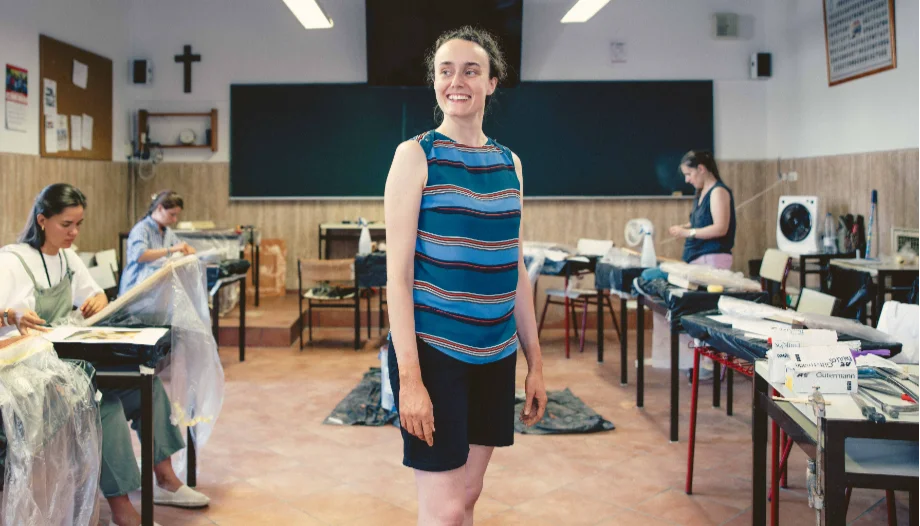
While religious art was one of the predominant forms of expression centuries ago, today it has become almost a niche. It raises questions about how to approach sacred themes from a modern perspective without falling into excesses that are either incomprehensible or, on the other hand, outdated. Matilde Olivera (Madrid, 1987) is a painter and sculptor who has created religious works, as well as a significant number of works without this connotation. She is an artist who knows what she is doing and who strives to imbue her art with deep meaning.
A few days ago, Matilde Olivera led one of the workshops at the Observatory of the Invisible, by Javier Viver. Matilde holds a Bachelor of Fine Arts degree from the Complutense University of Madrid and has studied philosophy and theology at the San Dámaso Ecclesiastical University; she completed her training at art academies in Florence.
His works can be seen at the Shrine of Fátima; at the Palacio Los Serrano in Ávila; at the Banco Santander Foundation in Madrid; as well as in parishes (especially his own, San Juan Crisóstomo in Madrid), schools, museums, and other institutions.
Commissioned works of sacred art constitute an important part of his work. And in his more personal work, he seeks not so much to reproduce exactly what he sees but rather to “capture the essence that shines through the forms, to find the true character of each motif,” in the words of Rodin. To this end, he draws on both figurative and abstract artistic languages and employs both painting and sculpture.
Centuries ago, the Church set the artistic style for its buildings. Hasn't that modernity been lost to some extent, with a shift toward styles that are either too classical or so avant-garde that their meaning is lost?
–Yes, I think it’s gone a bit to both extremes. It’s as if the Church had fallen behind in this regard, and now finds itself out of touch and unsure of what to do. Because, on the one hand, it has this complex of wanting to be trendy, wanting to embrace contemporary artists, and embracing what’s happening right now.
What’s going on? Much of the direction contemporary art has taken strays, in terms of philosophical principles, from the Gospel message. And in my view, they’re completely at odds. A banana stuck to the wall, for example, can never be a medium… Never, as far as I can tell. There are certain artistic languages and forms that clash—in concept and in essence—with the Gospel and with a Christian understanding of humanity. And also with the very nature of art itself.
And then…
–There are many who think that, in fact, that doesn't sit right with them when it comes to creating sacred art, so they stick to what they know and create remakes, hackneyed reinterpretations of past styles. It makes no sense to create 18th-century carvings or imitations of the 18th century in the middle of the 21st century. So, it’s as if modernity has gotten stuck. The only one who managed to break free from that stagnation—at least in architecture—was Gaudí, who is a truly paradigmatic example.
There are also some truly unique examples in the visual arts in general—in painting and sculpture. People who have managed to carry on the tradition while still being children of their time. That is my aspiration.
I don't know if I'll succeed or not, but that's the direction I've been sensing we need to take. There should be room to be a child of your time, to do things that aren't mere imitations of old styles, while at the same time maintaining a centuries-old symbolic and iconographic tradition that conveys meaning and is recognizable to everyone.
I don't know if it's essential—or even necessary—for an artist who creates sacred works to be a believer. What are your thoughts on this?
–I don't have a very fixed opinion.
We’ve seen people with tremendous faith and the best of intentions commit truly horrific acts that make you lose your faith. Faced with that, and a work of art that’s well-executed and artistically sound, created by a die-hard atheist, I’ll take the latter. It’s clear that being a believer helps, because you have to understand what you’re doing and put a little bit of your soul into it.
Is it absolutely necessary to be a believer? Maybe not, but you do have to put yourself in the shoes of someone who is a believer. It’s like being an actor. You can play a serial killer without actually being one. You immerse yourself in the role and take on something that, at first, is completely foreign to you. If an artist is capable of embracing a faith they don’t have or of coming to understand it, I think it’s indeed possible—and in fact, it’s more advisable for a good artist to do so.
An artist who has no ego, who is capable, in his atheism, of embracing the possibility of a faith that is foreign to him. I prefer him to the well-meaning parishioner who does something contrived and corny, kitsch.
Resources are almost always scarce, but might it not be fair to say that, at times, the contemporary Church has been a bit stingy when it comes to the arts?
–I think that’s a shift in mindset that’s very characteristic of our times. We don’t place as much value on things in the long term. In the past, a cathedral would take centuries to build, and the person who commissioned it wouldn’t live to see it completed—it didn’t matter to him. That doesn’t happen anymore. That’s a shift in mindset.
It’s also about money. Probably partly out of a sense of inferiority and partly because of what people might say. A parish priest anywhere thinks he’ll end up in all the newspapers because, instead of giving money to the poor or setting up a soup kitchen, he goes and spends I don’t know how much money on building an altarpiece. There’s also a real shortage of funds. There are parishes where the first priority is to fix the leaks. Certain things take priority.
You focus on religious art, but that's not all. What is your relationship with secular art like?
–It depends a lot on how open-minded people are. I don’t really draw much of a distinction between sacred and secular art. To me, they’re pretty much the same. The way I approach a piece doesn’t really differ in terms of execution, the process—anything at all. Even the way I turn it into a prayer is the same. Whether my work is what I offer, or whether my work is meant to give greater glory to God.
To me, a relief of leaves is no different from a relief of the Virgin Mary. Then there’s the difference in who’s looking at it, and what purpose the viewer sees in it. For me personally, there’s no difference.
A colleague once told me that I’d shot myself in the foot by drawing so much attention to myself, because I create sacred art and at the same time try to exhibit in galleries. They suggested that this would be a handicap, since many people wouldn’t want anything to do with me—because, let’s say, the spearhead of the avant-garde or the art movement is quite opposed to such an openly professed faith.
But I think it's the other way around.
In fact, saying that I create statues of the Virgin Mary and the saints has actually opened many doors for me professionally. I trust in God and in the commissions I receive, because He sends them to me.
You just said that you pray when you're creating a work of art—and not necessarily in a religious sense. Do you pray while you're working?
–Well, at that specific moment I might not be aware of it; I’m not thinking about the fact that I’m praying, but it’s a bit like what Saint Teresa said—that God is present even in the kitchen. In other words, whether you’re cooking a meal or mopping the floor—it doesn’t really matter what human activity you’re doing—what matters is the love and intention you put into it.
Then you go to Mass and offer up to God everything you’ve done that day. That’s part of your prayer life—in a way that isn’t exactly a conscious decision to say, “I’m meditating while I paint.” No, while I paint, I’m thinking about which color I need to use. I’m turning my work into prayer. That’s why it doesn’t matter to me whether it’s one thing or another.





 Español
  English
  Italiano