


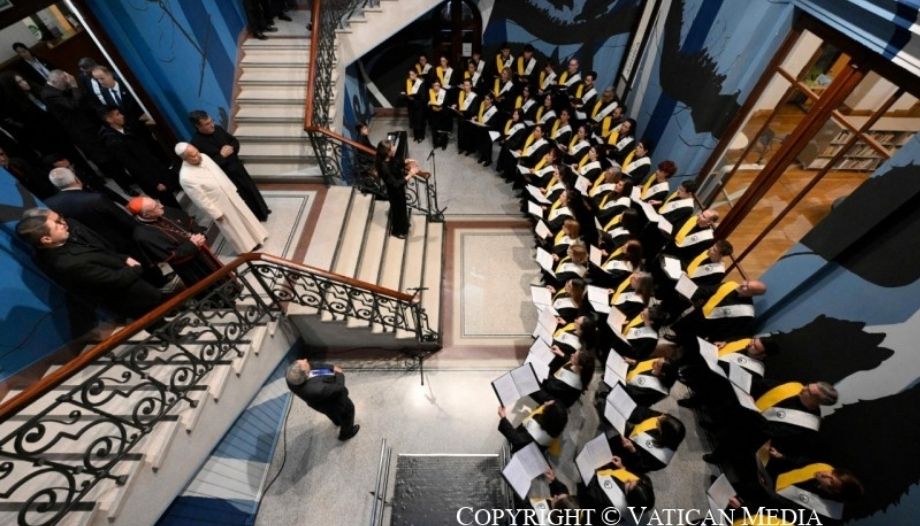
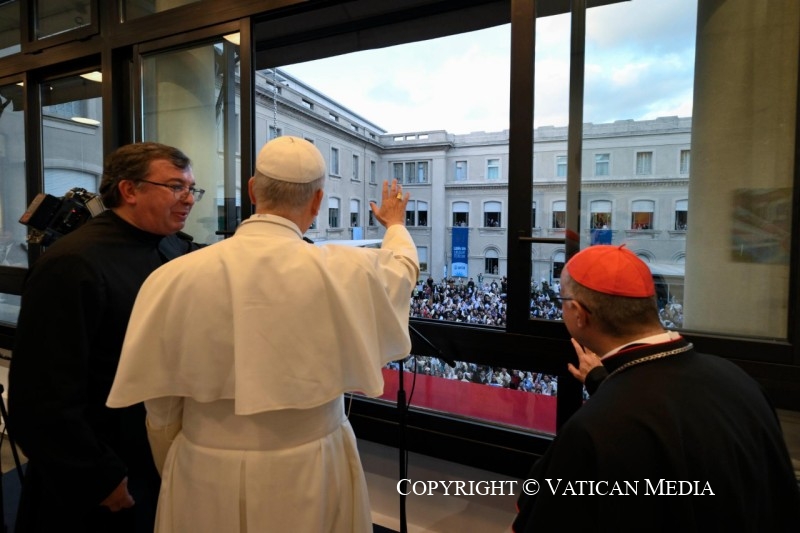
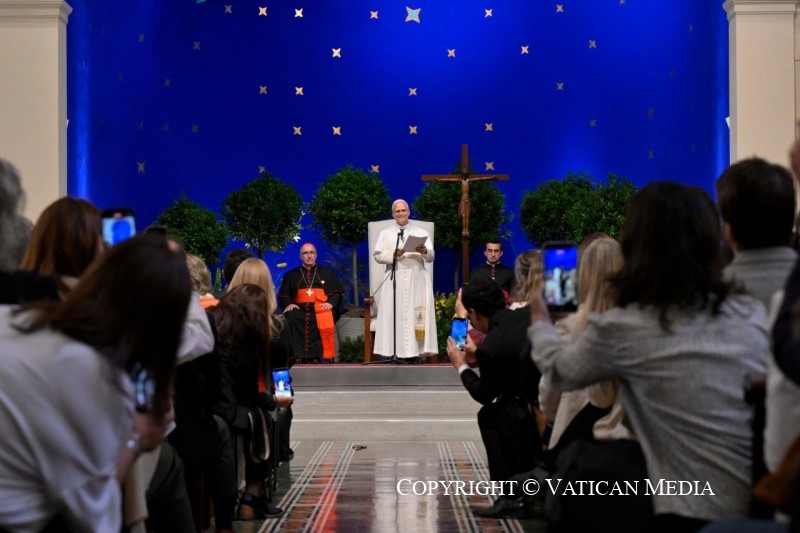
Shortly before the Prayer vigil With more than 70,000 young people, Pope Leo XIV held a meeting yesterday at the Catholic University of Montevideo, in which he proposed a journey through the five senses to reflect on the mission of educating and evangelizing.
The Pope recalled that Saint John Paul II had visited this university just over 38 years earlier, when it was in its infancy. He thanked the professors, students, and educational authorities for their work “in promoting the Gospel and the dignity of the human person.”.
For Leo XIV, the objective of the pastoral mission in the educational field It is so that students, teachers and those responsible for the centers can “hear, see, taste, touch, smell the Good News”, so that those who are part of the educational community strengthen “their inalienable dignity as a human person”.
This task, he added, is not limited to schools and universities, but also extends to the areas of extracurricular education, social and therapeutic reintegration, where the “attentive presence and life testimony of credible, competent adults who cooperate with each other” is especially important.
An education that integrates body and soul
The Pope deemed it necessary to “overcome dualistic views” of the human being and recalled the teaching of the Second Vatican Council: “The human being is a unity of body and soul.” Reducing the body to an object that can be disposed of arbitrarily, he warned, constitutes “a denial of the dignity of the person.”.
A “walk” through the five senses
Based on this premise, the Pope invited everyone to take a brief “walk” through the five senses to rediscover “the beauty of the Gospel and the magnificence of our humanity.”.
The view: contemplation, looking attentively
It began with the sight, evoking Psalm 8: “When I contemplate the heavens.” Contemplation, he explained, allows us to look at creation with attention and admiration, recognize the presence of God, and become aware of our personal and collective responsibility in caring for it.
This perspective also has an educational application. The Pope asked that contemplation occupy a privileged place in the formation of children and young people, because it contributes to regain attention They develop depth, silence, and discernment. Thus, he noted, “they grow in the familiarity of dialogue with conscience and with God.”.
Sight allows us to discover the world, but it also invites us to go beyond the obvious. To contemplate means to look with attention, admiration, and depth, recognizing God's presence in creation and our responsibility in caring for life.
Touch: hands, at the service of peace
The second sense was touch, represented by the hands and fingers. The psalmist speaks of God's “fingers,” which leave their mark on creation. Human hands, for their part, can work, produce fruit, greet, caress, and embrace. However, Leo XIV reminded us that they are also producing “the most terrible of human works: war.”.
Therefore, Catholic education is called to teach how to use our hands to foster peace. The Pope linked this task to the baptismal embrace received from God and to the embrace of the merciful Father who awaits each person. “Whoever feels embraced by the Father is, inevitably, a builder of peace,” he affirmed.
The key is putting “the person before the algorithm”
The third sense was taste. Taking the words of Saint Peter—“They have tasted that the Lord is good”—Leo XIV explained that wisdom is born from experiencing, reflecting, and discerning. It is not enough to gather information: “One cannot be considered wise who gathers information without discerning, without reflecting, without knowing the context.”.
At this point, he specifically addressed the challenges of new technologies and artificial intelligence. The Pope asked that school and university education contribute to the “wise use of technologies and AI, placing the person before the algorithm and harmonizing technical, emotional, social, spiritual, and ecological intelligence.”.
Therefore, education cannot be limited to teaching the use of technological tools, but must help to discern and guide their use. Leo XIV urged young people to learn to recognize “what is good, pleasing, and perfect,” according to the expression of Saint Paul in his Letter to the Romans.
The sense of smell: “the value of every human being”
The fourth sense, smell, led the Successor of Peter to the Gospel episode of the anointing in Bethany, when “the house was filled with the fragrance of the perfume.”.
Quoting Saint Augustine, he recalled that “a good reputation is a pleasing aroma.” Faced with a society in which rejection, contempt, and the discarding of people have become worrying realities, he called for the defense of the value of every human being.
“The world struggles to recognize the dignity of people”
Leo XIV warned of the paradox of a world that attributes intelligence to computer systems while struggling to recognize the dignity of human beings. He noted that many lives are judged according to criteria of efficiency and that those who cease to be considered productive risk being rejected and discarded.
To proclaim once again that “human life is respected in all its phases and states”
In light of this situation, he affirmed: “It is essential that we defend the fragrance of the human person, grounded in the fragrance of the Messiah.» And he emphasized: «We need to proclaim anew that human life is to be respected in all its phases and states. No one can be rejected.”.
The ear: listening to families and society
The Vicar of Christ's reflection concluded with the concept of hearing. Drawing on the Gospel of Matthew's phrase, “He who has ears to hear, let him hear,” Pope Leçon emphasized the importance of learning to listen and discern. He recalled that, for Saint Augustine, the authentic teacher «awakens the desire for truth, cultivates freedom to read the signs, and listens to the inner voice.».
Catholic education, he added, cannot remain confined within a closed system. It must listen to families, civil society, political and administrative authorities, as well as representatives of the productive sectors and working groups. He also valued the participation of children and young people in volunteering, missionary work, and community projects, experiences that allow them to recognize others «as a good, not as a threat.».
The Pope asked that wisdom, prudence and justice guide educational projects, taking into account rapid generational changes and the need to keep up to date “without abandoning sound tradition”.
“Walking, evangelizing and contemplating the whole person”
At the conclusion of his address, Leo XIV summarized his appeal to educators: “I ask you to continue walking, evangelizing, and contemplating the whole person: body and soul, heart and conscience, intellect and will.» It is not, he added, a matter of stopping, but of continuing to walk in Jesus Christ, “who became the Way, the Truth, and the Life.”.
Living with “enthusiasm every day”: “The voice that Uruguay needs”
In an impromptu greeting at the end of the meeting, the Pope expressed his hope that the enthusiasm experienced during the day would accompany the participants every day. He asked them to be “that voice that Uruguay needs to truly discover how important faith in God is, how precious human life is, and how valuable each of your lives is.” “May you continue to live with this enthusiasm, with this joy. Joy announces to you the great Gift,” the Pope concluded.





 Español
 English
 Italiano
 Français
 Deutsch
 Polski