


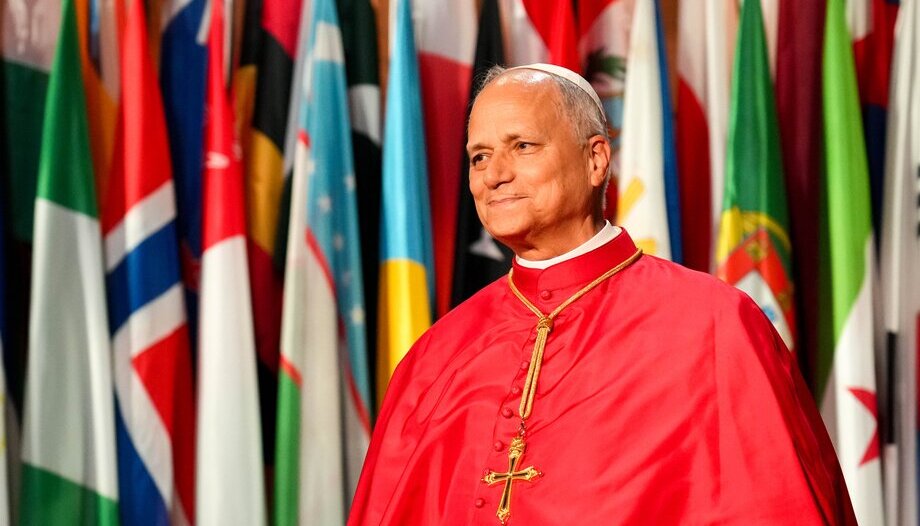
 Here's What Pope Leo XIV's Visit to France Will Look LikeLeón XIV in France. So that the world may have life
Pope Leo landed at Paris-Orly airport at ten o'clock in the morning, where he was received by President Emmanuel Macron and his wife, Brigitte.
Church bells across France rang for seven minutes as the papal plane landed. After a brief meeting with Macron at the airport, the Pope traveled to the Élysée Palace, the presidential residence, to meet with the French president.
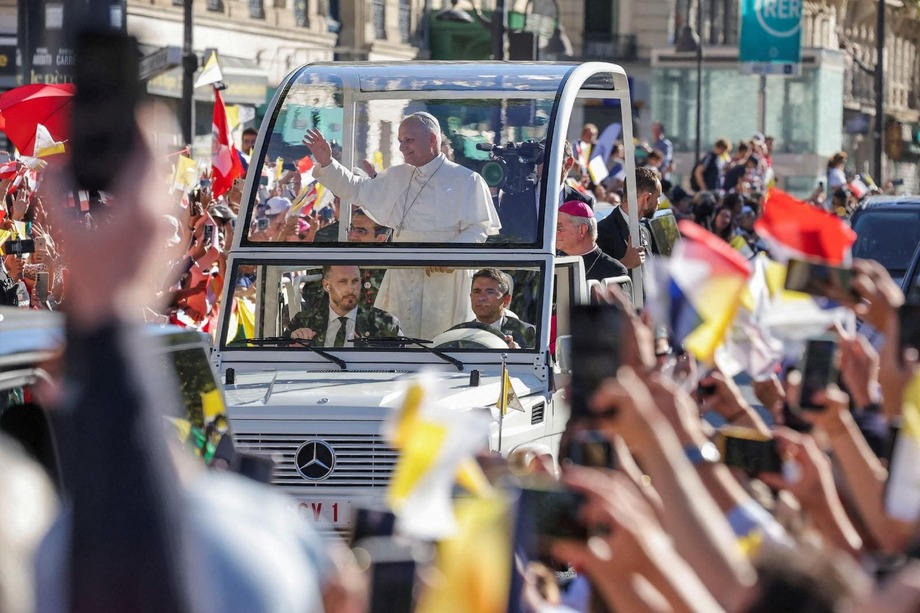
Throughout his journey, the pontiff was greeted by dozens of French people who gathered in the streets as he passed by.
Once at the Élysée Palace, Leo XIV held a private meeting with President Macron and then delivered a speech to the authorities, civil society, and the diplomatic corps. It was an address in fluent French, which did not go unnoticed by the French people.
In that first address, the Pope spoke of what would be the central theme of the entire visit: the dignity of human life. The motto for this trip is "That the world may have life," taken from chapter six of the Gospel of John.
«"A just secularism does not consist of excluding religion."»
Based on this principle, which guides the trip and the speeches, the Pope addressed topics such as the protection of human life, peace, the need for disarmament and secularism, among others, before the president and the authorities.
He called for "learning to welcome life unconditionally and to sustain fragility with tenderness," and reaffirmed, in the country of the Declaration of Human Rights, that "the protection of the right to life constitutes the essential foundation of any other human right.".
Leo XIV condemned genetic manipulation, organ buying and what he called "the offering of a programmed death," referring to the recent French law on assisted dying, which euphemistically refers to euthanasia, approved in July by the National Assembly.
Speaking about the relationship between Church and State, he specified that "a just secularism does not consist of excluding religion from the public sphere or from education.".
In this first speech, Leo XIV also urged an end to the arms race and warned that "the mistaken belief that the possession of nuclear weapons would be a guarantee of security is becoming increasingly widespread." He added that "peace is not a balance of power; it is built every day through dialogue and justice." For this reason, he called on France to remain "a tireless champion of peace and multilateralism.".
Leo XIV also spoke about artificial intelligence and warned, quoting the writer Georges Bernanos, about the risk of a "machine paradise" encroaching on daily life. In response, he said, "it is urgent to train minds in ethical discernment capable of distinguishing what is morally good.".
Leo XIV at UNESCO: "To be human means, first and foremost, to be a son"«
In the afternoon, the Pope arrived at UNESCO headquarters, toured the facilities, and met with its Director-General, Khaled El-Enany. He then watered an olive tree in Tolerance Square and subsequently delivered his second address to representatives of the member states. His speech centered on a key question: what does it mean to be human? He again emphasized the dignity of life: "To be human means, first and foremost, to be a child," he said, and reminded them that "we are all born naked and in need.".
When that truth is forgotten, he warned, life «is no longer understood as a gift, but as a product susceptible to exploitation.» He spoke of a dignity «that remains intact in the most vulnerable circumstances, even until death,» and called for the care of children in their mothers« wombs and in wars, of people with disabilities, of the elderly, of migrants and refugees: »They are the true proof of our claims about respect for human dignity.”.
At UNESCO, he also said that the most terrible of human endeavors is war, "because in it, science itself is placed at the service of an inhuman will to destroy and kill." He denounced a paradox: "While we attribute 'intelligence' to computer systems, we struggle to recognize the inalienable dignity of people," whose lives are ultimately judged by their efficiency.
«"Notre-Dame is much more than a monument"»
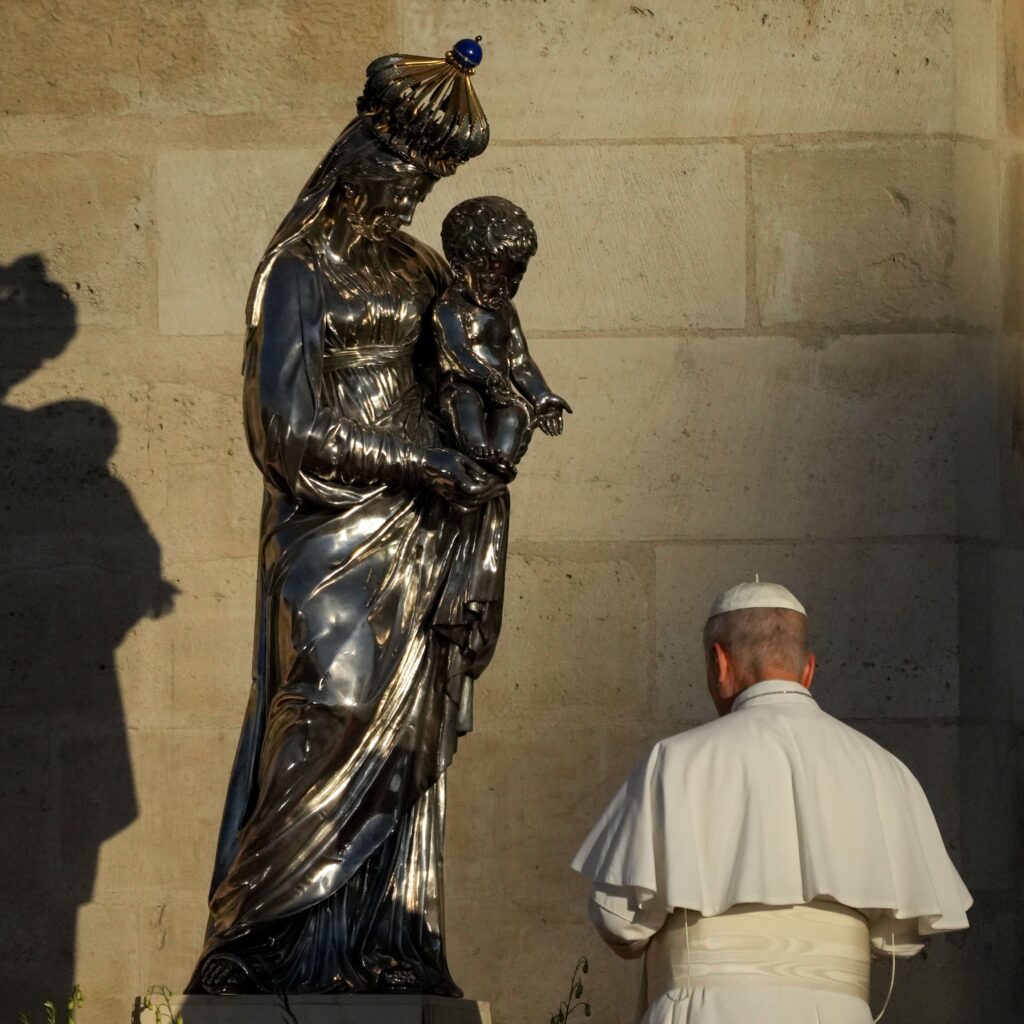
Later, the Pope went to the rebuilt Notre-Dame Cathedral to pray the Divine Office, Vespers, together with bishops, priests, deacons, consecrated persons, and seminarians from France. Before beginning the ceremony, he toured the restored cathedral and venerated the Crown of Thorns, which is kept in Notre-Dame. He appeared very impressed as he contemplated the restoration work.
In his homily at Vespers, the Pope presented the reborn cathedral as an image of what the renewal of the Church in France can be. He recalled the fire seven years ago: «In that dramatic hour we understood that Notre-Dame is much more than a monument.» He emphasized that, in the reconstruction, the Church understood its mission with creativity, and offered it as a model of a Church that goes forth, called to proclaim the Gospel.
He also recalled that the cathedral, like all churches, is not just stone, monument or museum, but exists for prayer: "it is not a stone shell meant to be admired: it lives from the sacred mystery that is celebrated in it.".
And, to emphasize that no mission can be sustained without an interior life, he quoted Venerable Madeleine Delbrêl: «Without prayer, we will not love God with love. Perhaps we will be his servants or his fighters, or even his disciples; but we will be neither loving children of our Father nor friends of Jesus Christ.» He concluded with a phrase that sums up the meaning of the visit to the cathedral: «This cathedral has been reborn so that you may be reborn with it in a new impulse toward holiness and daily mission.».
The vigil with 80,000 young people
The Pope's final event on his first day was a prayer vigil with 80,000 young people at the Stade de France in Saint-Denis. The gathering reflects a phenomenon that is currently taking place... Church in France: the growth of the catechumenate, that is, of young people and adults who, after a time of preparation, ask to receive the sacraments of Christian initiation —baptism, confirmation and the Eucharist—, together with the return of many baptized people who had drifted away and are returning to the practice of the faith.
According to data from the French Church, 2025 saw a record of nearly twenty thousand new members joining the Catholic Church, forty-five percent more than the previous year.
On Saturday the 26th, the Pope will go to the Catholic Institute of Paris to meet with the members of the Provincial Synodal Assembly.
The Pope will address the phenomenon of the growing number of adults requesting baptism in France, a topic that this Synodal Assembly will explore further. The bishops will present the Holy Father with the Instrumentum Laboris of the Assembly.





 Español
  English
  Italiano
  Français
  Deutsch
  Polski
  简体中文
简体中文