



 5 ways to foster devotion to the Sacred Heart of JesusWith an Open Heart. How can we teach that God cares for us and loves us?
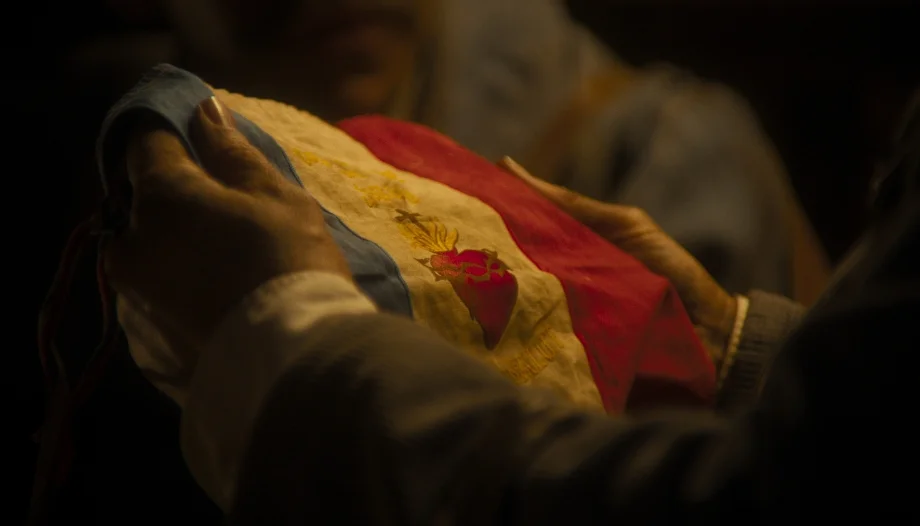
350 years ago, in Paray-le-Monial, Jesus revealed his heart to a nun of the Visitation, Saint Margaret Mary Alacoque. From those apparitions arose one of the most widespread devotions in the Catholic tradition. Sacred Heart, a documentary by the French production company Krea Film-Makers, takes that 17th-century episode as its starting point to explore whether this devotion still holds meaning today.
The project did not originate in a production office, but on a pilgrimage. In the summer of 2023, during a visit to Notre-Dame-du-Laus, Sabrina and Steven J. Gunnell encountered testimonies from people consecrated to the Heart of Jesus. “My heart was on fire there,” recalls Sabrina Gunnell.
Shortly afterward, they contacted the parish priest of Paray-le-Monial and discovered that the 350th-anniversary Jubilee of the apparitions was about to begin. For them, the coincidence carried its own significance: “We said to ourselves, ‘Okay… the Sacred Heart wants its movie,’” says Sabrina Gunnell.
Steven Gunnell sums up the underlying intention with a biblical reference: “We were thinking of the pilgrims on the road to Emmaus, who walk alongside a stranger and, after listening to him, say to one another, ‘Didn’t our hearts burn within us?’” That, he says, is the film’s aim: to allow every viewer to experience that same love, whether or not they initially share the faith of those speaking.
“Many people thought that talking about the 17th-century apparitions was something distant or outdated. But we wanted to show precisely that this message is still relevant today,” Sabrina recalls.
A Devotion That Lives On
Between 1673 and 1675, Jesus appeared three times to Margaret Mary, a nun of the Order of the Visitation in Paray-le-Monial, Burgundy. According to tradition, he showed her a heart burning with love for humanity, wounded by people’s indifference. From these apparitions arose one of the most widespread devotions in the Christian tradition.
The documentary organizes this message into three parts, which emerge throughout the film without appearing to follow a set structure: a love that is shown unconditionally; the pain of a love that is often not reciprocated; and an invitation to respond to that love, not just to contemplate it. The film devotes a good portion of its runtime to the third aspect: showing, through personal testimonies, what that response means in the life of a specific person.
The Same Heart, Centuries Later
The documentary alternates between two perspectives. One is historical, featuring actors who reenact Margarita María’s apparitions in the 17th century, the initial misunderstanding she faced from those around her, and the process by which that personal experience became a public devotion.
And another contemporary work, featuring some twenty testimonies from people with very different backgrounds—a priest, a nun, a missionary, and several young people—who speak about what that same wounded heart and that same love that does not impose itself mean today in their own lives.
Twenty voices, one heart
The transition between the 17th-century reenactments and the contemporary accounts is seamless: there are no jarring moments, nor does it feel as though you’re watching two different movies. The historical scenes—Margaret Mary, Jesus, the surroundings of Paray-le-Monial—are filmed with a dignity that is surprising for a documentary of this kind, without falling into the textbook-style reenactments that so often weigh down this type of production.
The testimonies work precisely because they are all different from one another. No two stories are the same, and that variety is what holds the documentary together. Not a single one is superfluous.
It’s true that, by touching on so many different aspects—historical, theological, and personal—the film leaves some doors ajar, without enough room to delve deeply into all of them. Even so, it never feels like it falls short: what it lacks in specific detail, it makes up for in intimacy, and it is that intimacy that stays with the viewer as they leave the theater.
Sacred Heart, produced by the French company Krea Film-Makers and distributed in Spain by Bosco Films—which is also responsible for Free (2023)—, hits theaters across Spain on September 11. Three hundred and fifty years after those apparitions in Burgundy, the question it raises remains the same: what does one do with a love that was never sought and yet never ceases to wait?.






 Español
  English
  Italiano
  Français
  Deutsch
  Polski