


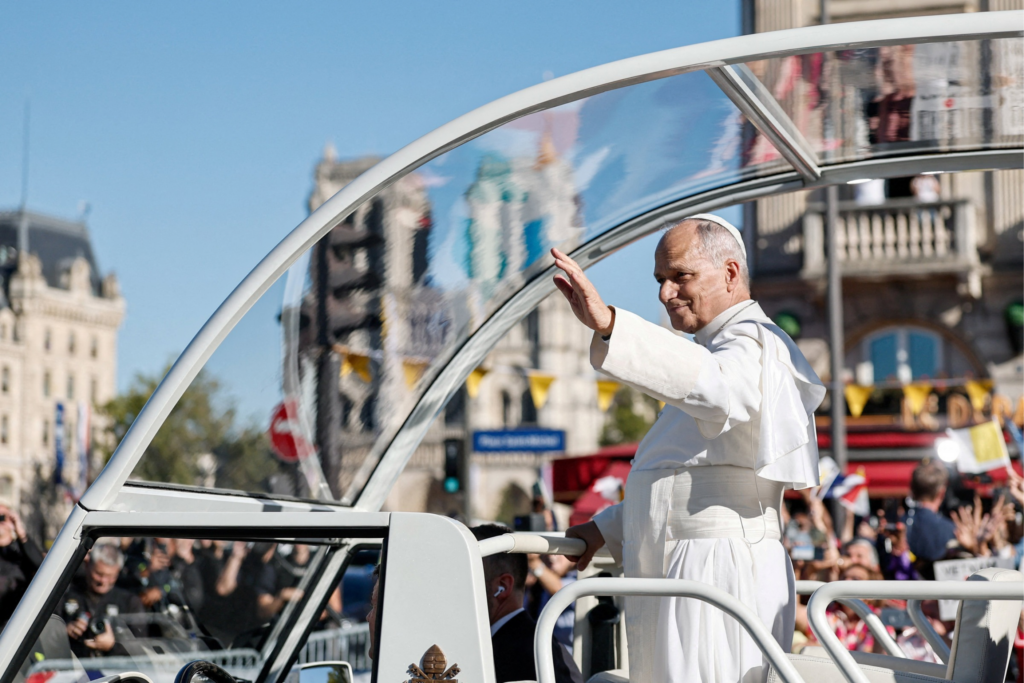
 Leo XIV bids farewell to France and Metz, a city of reconciliation and a beacon of hope for Europe and the worldFrom the Élysée Palace to Notre-Dame, Leo XIV opens his visit to Paris focusing on the dignity of human lifeThe Pope closes his second day in Paris celebrating life where there was once death.
Pope Leo XIV's trip to France, which took place between September 25 and 28 of this year, had a dimension that went far beyond the strictly protocol-driven. It was the first papal visit to France in eighteen years, and from the outset, it was clear that it would not be limited to a series of official events. The Pontiff combined the institutional dimension inherent in a state visit with intense pastoral activity and interventions on some of the issues that are currently generating the most debate in European societies: artificial intelligence, bioethics, the relationship between religion and state, and the future of the European project.
Leo XIV sought to place the dignity of the human person at the heart of his message, emphasizing the need for political, scientific, and technological progress to remain subordinate to that dignity. At the same time, his visit can be described as multifaceted, as he addressed diverse sectors of French society: political and diplomatic authorities, young people, the faithful gathered in Lourdes, and victims of abuse committed by members of the clergy.
The reception hosted by President Macron at the Élysée Palace provided an opportunity to raise, from the outset, firmly but gently, the relationship between French secular tradition and the presence of religion in the public sphere.
Leo XIV defended a conception of secularism that did not imply the disappearance of religious convictions from public life. The neutrality of the State, according to the Pope's view, should not be confused with the exclusion of the religious dimension from society. This is a particularly significant issue in France, where secularism constitutes one of the central elements of the Republic's political identity.
One of the most defining elements of the visit was the discussion of issues related to bioethics and technological development. In both fields, Leo XIV raised a common concern: that certain advances might ultimately displace the person from the center of decision-making.
The challenge of bioethics and the limits of technology
The issue was especially important in France, given the debate surrounding assisted dying. The Pope reiterated the Church's positive view on the defense of life and questioned the consideration of assisted dying as a solution to certain situations of suffering. For Leo XIV, human life is a gift that possesses its own inherent dignity and cannot be measured solely by criteria of utility or convenience.
The Pope also devoted considerable attention to artificial intelligence. For him, technological development does not mean creating a kind of limitless "paradise of machines." The problem lies not in technology itself, but in the possibility that human beings will end up delegating decisions that require discernment, responsibility, and moral judgment to automated systems.
This concern was present both in the UNESCO as in his meetings with young people. Leo XIV insisted that algorithms can become extremely useful tools, but they cannot replace the human capacity to decide on fundamental issues. Hence his call for regulations that ensure technology remains at the service of the individual and is not subordinated exclusively to economic interests or power dynamics.
In this sense, his speech was not so much a critique of technological progress as a call to establish its conditions and limits. The fundamental question posed by the Pope was, ultimately, who should retain responsibility for decisions that affect human life and dignity.
The pastoral response and the message to young people
The pastoral dimension of the trip was as important as its institutional one. In a deeply secularized society like France, the visit's ability to mobilize a large number of people is, in itself, one of the most significant aspects of its outcome.
One of the most symbolic moments was the celebration of Vespers at Notre-Dame Cathedral. The recovery and restoration of Notre-Dame has become a symbol of continuity, and Leo XIV used this context to speak of a Church called to remain open, no longer confined within its own structures.
The peak of the turnout occurred around the Place de la Concorde (800,000 attendees) and at the Stade de France (80,000 young people). The Pope's tone toward the young people was particularly direct. He encouraged them to "choose Jesus" in a context marked by anxiety, loneliness, and uncertainty.
The message was addressed to young people living in an environment characterized by the constant presence of screens, concerns about climate change, economic uncertainties, and international instability. Faced with these circumstances, Leo XIV sought to offer a religious perspective, but also a space for listening and dialogue.
The response at the Stade de France is one of the most significant findings of the visit. In a society where religious practice has declined considerably, the gathering of a large crowd of young people demonstrates that there is still a place for a Christian message that can be presented in a direct and understandable way.
Lourdes, responsibility for abuses and the future of Europe
The arrival in Lourdes introduced a different element. The Marian character of the sanctuary brought a particularly intense spiritual dimension, but Leo XIV's meeting with victims of sexual abuse committed by members of the clergy added a matter of great institutional and moral importance.
The gesture aligns with the transparency and reparation initiatives promoted by the Holy See. The meeting aimed to express that the Church cannot face its future without also assuming responsibility for the harm caused within its own structures.
The decision to cover the mosaics created by the priest and artist Marko Rupnik on the facade of the Basilica of Our Lady of the Rosary did not go unnoticed. As is well known, the artist had been expelled from the Society of Jesus for repeated abuse of nuns.
The abuses committed by some clergy and religious constitute one of the most shocking events in the life of the Church. Their firm yet sensitive handling during the papal visit highlighted the awareness surrounding this issue and the clear obligation of those responsible to answer to the victims.
The Pope's presence in Lourdes thus made it possible to unite two dimensions that sometimes appear separate: the spiritual dimension of the Church and its institutional responsibility. The meeting with the victims served as a reminder that any reflection on evangelization and on the future of the Church must necessarily include a response to those who have suffered within it.
The final leg of the journey, in Metz, provided an opportunity to introduce another central theme of Leo XIV's pontificate: the future of Europe. In this place, so closely linked to Robert Schuman, the driving force behind the European project, the Pope directly addressed the continent's Christian roots—a matter so dear to his predecessor, John Paul II—outlining the idea of a Europe based on peace, the pursuit of the common good, and cooperation.
The celebration of Holy Mass in the cathedral of Saint Stephen in Metz brought the visit to a close before the Pontiff's return to Rome on Monday the 28th. With it concluded a pilgrimage that had covered very different scenarios in a few days, from the political centers of Paris to the sanctuary of Lourdes and the city associated with the origins of the European project.
The main interest of Leo XIV's journey to France lies precisely in the combination of all these dimensions. It was neither merely an institutional visit nor exclusively a religious pilgrimage. The whole allows us to consider the Church's presence not so much as an alternative to political, scientific, or cultural institutions, but as a voice that seeks to influence them from a specific conception of the person and human dignity.
Leo XIV's message sought to connect the Christian proposal with very concrete problems of the new generations, avoiding presenting faith as an answer separate from the concerns of today's society.
At the same time, the visit to Lourdes served as a reminder that the Church must face its own responsibilities. The closeness shown to the victims and the reference to the abuses introduce an essential dimension to any serious assessment of the trip. Restoring institutional credibility cannot be separated from transparency and the protection of those in vulnerable situations.
In summary, the trip has allowed Leo XIV to present himself as a Pontiff willing to engage in the major debates of modernity without abandoning the core of his religious mission. The immediate results are significant. The visit has returned the Pope to the center of French public life after eighteen years, mobilized hundreds of thousands of people, and opened spaces for discussion on issues that directly affect the future of European societies. It remains to be seen to what extent the messages delivered during these four days will have concrete consequences, both in the political and ecclesial spheres.
What does seem clear is that the visit has not been reduced to a series of ceremonial events. Leo XIV has used his presence in France to raise a number of fundamental questions about the relationship between progress and dignity, between freedom and responsibility, between religion and the public sphere, and about the very future of Europe. The importance of the pilgrimage will depend, to a great extent, on the capacity of these questions to remain relevant once the Pope has returned to Rome.
Professor Emeritus at the Complutense University and Honorary President of the International Ibero-American Union of Jurisprudence.
Leo XIV bids farewell to France and Metz, a city of reconciliation and a beacon of hope for Europe and the worldFrom the Élysée Palace to Notre-Dame, Leo XIV opens his visit to Paris focusing on the dignity of human lifeThe Pope closes his second day in Paris celebrating life where there was once death.






 Español
  English
  Italiano
  Français
  Deutsch
  Polski
  简体中文
简体中文