


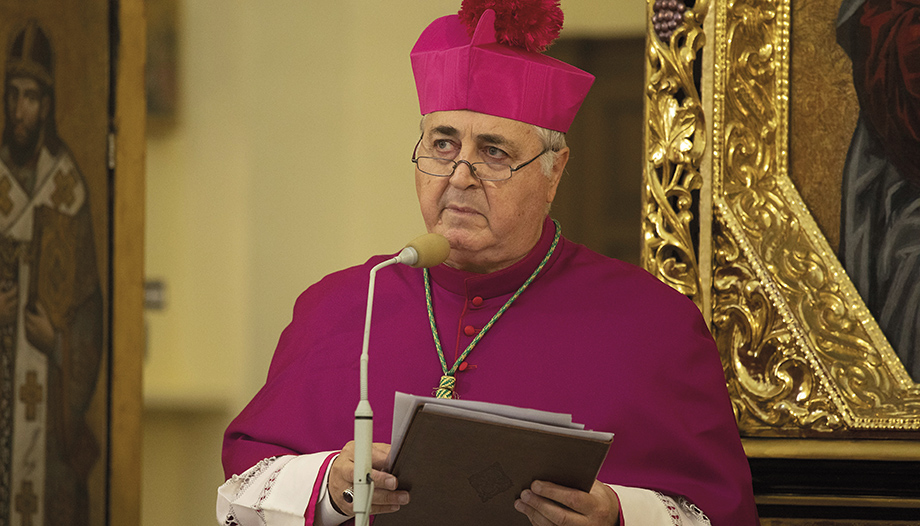
Three and a quarter centuries of history, but with an eye toward the future. The Pontifical Ecclesiastical Academy This year marks the 325th anniversary of its founding, at a time marked by the renewal initiated by Pope Francis and by the recent visit of Pope Leo XIV.
For Archbishop Salvatore Pennacchio, president of the institution and a diplomat of the Holy See for more than forty years, the jubilee is not merely a commemoration, but an opportunity to pass on to future generations a living legacy: that of a diplomacy that is both pastoral and prophetic.
He also recalls that the mission of the papal representatives is not to defend national interests, but to serve peace, justice, and human dignity in a world marked by conflicts, migration, and new cultural divides. From this perspective, the future nuncio must be, above all, a priest capable of listening, of being close to others, and of discerning—faithful to the task that Pope Leo XIV reminded the Academy of when he personally visited it recently: to be men of communion, builders of trust, and authentic messengers of Christ’s peace.
Your Excellency, the Pontifical Ecclesiastical Academy is celebrating its 325th anniversary. What does it mean today to preserve such a long-standing tradition without reducing it to a mere commemorative memory?
—The history of the “Alma Mater” of the papal diplomats continues to sustain the tireless work of so many who, yesterday as today, carry out with courage and dedication the mission of representing the Holy Father before nations and local Churches. The jubilee that our institution is celebrating this year is not, therefore, a mere celebration of memorable years past, but rather an opportunity to take up the torch of what has been, in order to pass it on to those who will come after us. It is a true traditio which is part of the broader context of that living Tradition which, as the Second Vatican Council teaches, expresses the life of the Church: walking the paths of time, always proclaiming the Gospel of salvation.
Pope Leo XIV recently visited the Academy, just as Pope Francis had done. What continuity do you see between these gestures of goodwill?
—By virtue of the unique service performed by the Ecclesiastical Academy, the Popes have always shown and reserved special care for it since its founding, in order to safeguard its mission. The structural and educational reforms that affected it—especially beginning with the pontificate of Pius IX and continuing through those of Pope Pius XII, thanks to whom it acquired its virtually unaltered structure—have enabled it to remain constantly up to date and to offer training better suited to the demands of the present. The focus of the institution, however, has always been on the individual—that is, on the generations of papal representatives who have been trained here. It is from this perspective that I interpret the gestures of the Popes toward this seminary. In more recent times, this applies in a special way to Pope Leo XIV, who visited the Academy while still a cardinal, and also to Pope Francis, of venerated memory, who established a An institute functioning as a faculty, as a center of advanced education in the diplomatic sciences. The continuity throughout various historical periods—as reflected in the recent reform—is therefore in keeping with the institution’s original mission, which it continues to faithfully uphold today: to serve the cause of Christ and the Church.
What concept of ecclesial diplomacy do you aim to convey to students from the earliest grades?
—The diplomatic service of the Holy See is a commitment that springs directly from the Gospel: it cannot exist unless it is rooted in this foundation and animated by divine strength. It is, above all, a responsibility that the papal representative matures spiritually through a sincere and daily relationship with the Lord. Pope Francis, in an address he gave to us a few years ago, clearly explained this dynamic, urging us to be shepherds endowed with inner strength, so that we may bear witness to the Lord Jesus before anyone else. Without a solid human and spiritual foundation, it is not possible to be shepherds, much less diplomats. The very heart of our mission is to continue to be shepherds in the image of the Good Shepherd, with the help we receive from the Eucharist, from prayer, and from listening to the Word of God. Formation at the Academy, which is therefore based on two fundamental pillars—the human and the spiritual—aims to ensure that the Good Shepherd remains the model for each of us, teaching us to accompany, sustain, and restore hope.
“Papal diplomacy operates in two spheres: the pastoral and the political-diplomatic.”.
Monsignor PennacchioPresident of the Pontifical Ecclesiastical Academy
How does the mission of an apostolic nuncio differ from that of a diplomatic representative of a state?
—Papal diplomacy operates in two spheres—the pastoral and the political-diplomatic—which have no equivalent in the diplomacy of nation-states. My fellow nuncios do not represent national interests or power dynamics: they are priests, an expression of the Petrine ministry, at the service of peace, justice, and human dignity. I like to recall the words of Fabio Chigi—the future Pope Alexander VII—who, during the negotiations at Münster in 1648, described the diplomat’s task with sober and profound words: “Do a lot, say little”. What the Holy See offers the international community is not merely a technical solution to conflicts, as is often the case, but also a vision of peace based on the dignity of every person, on justice, and on fraternity. Our diplomats serve as the voice of the poor, of migrants, and of the victims of war—in places where often no other diplomatic mission is called upon to be present.
In this regard, how does a future papal representative prepare to listen to ecclesial, cultural, and social realities that are very different from one another?
—Encountering such diverse environments—such as those the papal representative is called to engage with during his service—reveals the beauty of a rich and multifaceted reality. And this is evident every time the nuncio, during his mission, visits the various local churches, listens to the bishops, welcomes the priests, and reaffirms the message to the faithful, who always hope to feel the Pope’s presence close at hand. It is certainly a delicate task, one that requires human skill and spiritual sensitivity. Preparing for such a task demands, above all, a formation that is not merely academic, but deeply human, spiritual, and pastoral; that is why I said earlier that these are fundamental pillars for every priest, even more so than for a diplomat. Only in this way can one develop the depth and subtlety of vision necessary to read and interpret the complexity of history without losing sight of what is essential.
Pope Francis wanted the formation program to also include a year of missionary experience. How has this decision impacted life at the Academy?
—With this proposal, the Pope intended, first and foremost, to enrich the curriculum proposed by the “Alma Mater”, but above all to offer those who will collaborate with the papal representatives a missionary experience of evangelization. This choice is significant because it helps the future diplomat to remain connected to the concrete reality of ministerial life and to genuine encounters with people, especially those most afflicted and wounded by life. Pope Francis’s repeated call to reach out to the human and existential peripheries also applies to those young people preparing to serve the Pope in the Nunciatures and international organizations. There is no doubt that this experience has brought to the Academy a spirit of greater closeness, listening, and service, often in situations of poverty, fragility, and ecclesial minority.
Given the unstable international situation, what effective contribution can the Holy See’s diplomacy make?
—In this context, the mission of the Church, and therefore that of the papal representatives, is not limited to diplomatic mediation in the strict sense or to the pursuit of immediate agreements, but rather draws strength from a deeper effort aimed at overcoming mistrust and cultural, political, and religious barriers, thereby creating the conditions for authentic and lasting dialogue. What the Holy See can offer, in fact, to the international community is a perspective that is guided not by economic or geopolitical interests, but by the centrality of the human person, the defense of the dignity of all life, and the promotion of fraternity among peoples. And a privileged arena for this is precisely the multilateral sector, where these principles can be translated into concrete actions for peace, the protection of fundamental rights, and cooperation.
“What the Holy See can offer the international community is the centrality of the human person.”.
Monsignor PennacchioPresident of the Pontifical Ecclesiastical Academy
Is it possible to be prophetic despite having a job that requires discretion, prudence, and consistency?
—I am convinced that there is no diplomacy without vision. The role of papal representatives demands, today more than ever, a capacity that cannot be limited to formal dialectics, but rather requires a proactive effort aimed at envisioning and building a future that is more sustainable from both a human and spiritual perspective. Prophecy, as a gift of the Holy Spirit, is the believer’s insight that, with ingenuity and skill, knows how to keep a moral and spiritual perspective on history alive. It is not an ideological stance, nor is it achieved through sensationalist stances, but rather through the ability to constantly recall the centrality of human dignity, peace, justice, and the common good—even when this seems to go against the tide. This requires, on our part, the strength to speak in a respectful and prudent manner, but which, at the same time, clearly draws attention to decisive issues such as peace, the rejection of fundamentalism, the welcoming of migrants, the protection of every person’s dignity, the abolition of the death penalty, and responsibility toward the poorest.
You have served in a wide variety of countries and contexts. Which of those experiences do you find most useful today in guiding the formation of the young priests at the Academy?
—I have been traveling the world, without interruption, for forty-four years, first as a collaborator and then as an apostolic nuncio. In the various social and political contexts where I have been called to carry out my mission, I have always experienced the richness of very different international experiences. In Panama, my first assignment, I witnessed the Latin American Church’s commitment in the 1980s to addressing numerous social challenges. In Ethiopia, I witnessed the humanitarian commitment to helping hundreds of thousands of people affected by famine and water shortages. In Australia, I had the great opportunity to be part of the delegation accompanying Pope John Paul II on his pastoral visit. In Turkey, on the other hand, I had the opportunity to collaborate with the Ecumenical Patriarchate of Constantinople. I was in Egypt during the first Gulf War, in the context of the intervention against Saddam Hussein’s regime in Iraq. In Belgrade, I witnessed the early stages of the breakup of the countries of the former Yugoslavia. The list of countries is truly long: Ireland, Rwanda, Thailand, Delhi, Poland… It has been an indescribable experience, and today, from Rome, I look back with gratitude on a rich and fruitful journey.
What human and priestly qualities do you consider necessary for a future nuncio to meet the challenges of the coming years?
—I believe that the most essential quality is the ability to combine spiritual depth with genuine human closeness; in fact, it is from this perspective that formation at the Academy is being renewed. In this regard, I think it is helpful to recall the address that Pope Leo gave us at the recent meeting held at our institution. He reminded us that the most important reform consists in a constant exercise of conversion, aimed at cultivating closeness, attentive listening, witness, a fraternal approach, and dialogue—all lived with humility and gentleness. These are essential virtues for the papal diplomat, who will be called to serve in diverse cultural, ecclesial, and political contexts, where it will be fundamental to possess a manner capable of building trust, keeping channels of communication open, and fostering paths of reconciliation. The Pope has exhorted us to keep the Paschal gift alive within us, so that we may be true messengers of the Risen One, capable of bringing Christ’s peace to the world and becoming a bridge of dialogue between individuals, Churches, and peoples. This means living in the world without allowing ourselves to be absorbed by its logic of confrontation, but always maintaining a Gospel-inspired perspective on humanity and history.





 Español
  English
  Italiano
  Français
  Deutsch
  Polski