


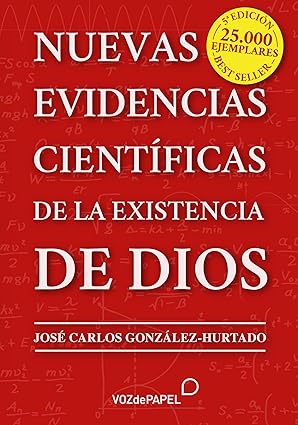
José Carlos González Hurtado's book ‘Evidencias científicas de la existencia de Dios’ (Scientific evidences of the existence of God), together with others recently published, is giving play in the media analysis.
One of the most recent debates has taken place in social networks in the video of ‘Addicted to Philosophy’ entitled ‘Theistic philosopher reacts to Schrödinger's cat. The book that proves God?’”. The final question mark is quite a symptom.
Here is a sample of the conclusions formulated by Rocío Vidal (Schrödinger's cat): “Does it follow inexorably, as is defended at the beginning of the book González Hurtado), that there is a creator God, conscious, omnipresent and essentially good? The conclusion is no. My conclusion from the first part is that God is still mainly in the realm of philosophy, not science”.
The philosopher shares thesis
It might seem that the philosopher self-described theist on Youtube, Enric G. Gel, “reacts” to the cat's thesis, but no. The author of ‘Is there philosophy in the fridge?’, shares with Rocío Vidal that “there is no inexorable way of reasoning towards the existence of God, a properly scientific demonstration that God exists”.
“We are in the realm of philosophy, and here, sorry for those who seek Cartesian certainty. But we don't have irrefutable proof, neither of this nor of anything, is that on any subject,” he adds.
It gives the impression that the philosopher Enric, in this 26’ 57” video, sets limits to theistic arguments, and at the step from “there is a cause of the universe” to “that cause is God”. “Any reason one can give in favor of that step will be philosophical, and in philosophy we are nowhere near the field of irrefutable proofs,” he says at the end.
Theism is broadly understood as the belief that affirms the existence of a supreme being, a creator of the universe.
Two premises; respect for people
Before collecting some of the arguments, it should be noted that Enric reveals in the video that he believes in God, and Rocío, Schrödinger's cat, does not.
The second issue is respect. “Let's avoid any insulting or offensive comments towards people, in particular Rocío. On my part, there is no enmity towards her, quite the contrary,” says Enric F. Gel.
Let's demonstrate that conviction that I try so hard to promote on this channel, he adds. “In philosophy, people who are equally intelligent, reasonable, honest and informed can disagree on almost every issue and nothing happens.”.
“We philosophers have been discussing this issue of the existence of God for centuries and centuries: it is neither closed nor will it be closed in the near future, so just because someone thinks differently from you does not mean that he does not know how to think.”.
A very positive point of Rocío's video, says Enric, is that “it correctly frames the discussion within the philosophical sphere, distancing itself from the scientism that demands that everything, without exception, must pass through the sieve of the scientific method.
Rocío corroborates this: “I have always been very critical of scientism, which really thinks that the scientific method is the only way to know reality. That's why I study philosophy.
“Theisms and atheisms there are many and of very different types.”
The analysis, of which only some aspects are presented, starts from “two minor points, very minor, of discrepancy. First, atheism as a lack of belief in God,” says Enric.
Rocío criticizes González Hurtado's thesis: “First, he continually mentions atheism as an ideology or as a faith. This is an initial consideration that must be made, since atheism is not a movement, it is not an ideology nor is it an activism. In fact, the consideration of atheistic faith is an oxymoron in itself, since atheism, if anything, would be a lack of belief. The lack of a belief cannot be a faith; it is the lack of faith.».
Enric shares the thesis: “Rocío is right in that talking about atheism as a unified movement is complex, and the same with theism. We can do so in order to understand each other, but without ceasing to be aware that there are many theisms and atheisms of very different types”.
Atheism: Lack of belief in God or denial of God's existence?
However, Enric points out that “the point I would question is to treat atheism as a lack of belief in God, as Rocío says.
It is true that in certain sectors there is a tendency to define atheism in that way, but I personally prefer to treat it simply as the denial of the existence of God. In general, although there are some exceptions, in philosophy atheism has tended to be treated in that way: as the position that denies the existence of God.
Second, defining atheism as the lack of belief in God I think easily leads to confusion by lumping two very different attitudes under the same umbrella.”.
Three possible answers to the question Does God exist: yes, no and I don't know
Both those who directly deny the existence of God and those who simply shrug their shoulders and say that they do not know if God exists, both lack belief in God. For the one who shrugs his shoulders, we already have a fairly widespread term, that of agnostic.
Therefore, it seems better and more useful to reserve “atheist” for the former, for the one who directly denies that God exists.
In fact, this seems to be the most natural usage as well, because, since there are three possible answers to the question “Does God exist?” (yes, no and I don't know), the triad theist, atheist and agnostic seems the most accurate. But this, as I said, is a very minor point and comes down to a discrepancy in how we use words. If someone prefers another definition of atheism, it's not a big deal.
The Kalam Cosmological Argument
The considered cosmological argument Kalam version is the subject of analysis in the video of ‘Addicted to Philosophy’.
Rocío: “We are going to base ourselves on the cosmological argument. Kalam, which is currently, I believe, the most widespread, whose premises are these: everything that begins to exist has a cause. The universe began to exist, therefore, the universe has a cause and that cause can only be God”.
Enric: “Here, forgive the digression, a very common criticism that Rocío does not make, is to ask, ‘Well, if everything has a cause, what caused God?’.
But notice that the objection falls into a straw man, because the argument at no point says that everything must have a cause. What it says is that everything that begins to exist has a cause. Since God, by hypothesis, does not begin to exist, this causal principle does not apply to him”.
Is the first cause God?
Rocio: "This logical argument is very interesting, but it is necessary to analyze both the premises and the conclusion. The premise that the universe began to exist, that is, that there is a creation, will be analyzed in the next section.
But even with this, we are still talking about the fact that there has to be a first cause and an uncaused cause”.
“Something or someone must have created the universe, since everything that begins to exist needs a cause and we have to stop somewhere, and that somewhere can only be an eternal, necessary and creative entity, ergo, God.
I have already said, this is a very interesting philosophical debate, isn't it? Since everything must need a cause, except God. But we really have to get to God as well”.
Atheist position on what might be the uncaused cause of the universe
“What is defended from the atheist position, so to speak, is that why not stop the universe? Why not let the universe be the uncaused cause?” asks Rocío.
“The logical leap that implies a creator God, eternal, personal and good, is a logical leap that cannot be demonstrated scientifically. It is unknowable, it is very interesting to debate, but it is not an irrefutable proof. We still have much to know about the laws of physics, including the laws of quantum physics.
Therefore, that uncaused cause of the universe could be a physical law, a quantum state, something we don't know, God... The hypotheses are all on the table and we can only place ourselves in the realm of doubt».
The passage from “There is a cause of the universe” to “That cause is God”.”
One might think that the theistic philosopher could put nuances to this argument. But Enric states, ”Again there is much here with which I 100% agree. “The move from “There is a cause of the universe” to “That cause is God,” is known in the literature as the ‘gap problem.’ And it is a hotly contested thing that is certainly not scientifically demonstrable.”.
“Any reason one can give in favor of such a step will be philosophical, and in philosophy we are far from being in the realm of irrefutable proofs. There is room, in my opinion, for naturalistic hypotheses of first cause, and whether they are convincing or not is for each one to judge from his own critical thinking.”.
Theistic position: that first cause also has personal attributes
What is common here on the theistic side is to combine the cosmological argument, which would be leading you only to an uncaused and necessary first cause, with other arguments such as the fine-tuning argument or the moral argument that would allow you to make reasonable the hypothesis that that first cause has also personal attributes such as intelligence or goodness.
Again, irrefutable evidence? None, but neither do they claim to be, at least at the academic level,” Enric adds.
González Hurtado: ‘The Big Bang was the moment of creation of the universe’.’
To better understand the considerations of the philosopher and the cat about the Big Bang, it will be useful to know what José Carlos González Hurtado says in his book ‘Evidencias científicas de la existencia de Dios’ (Scientific evidences of the existence of God). In short, the more we know about the Big Bang (Big Bang), the more one believes in God, he writes.
Indeed, González Hurtado states:
“The Big Bang was the moment of creation of the universe, which occurred, with all certainty, 13.7 billion years ago (...). “The universe also had a beginning - the Big Bang - and that puts atheist scientists and non-scientists in a bind.”.
“Because if there is a beginning, there will also be a Beginner. If there was creation, a Creator is also necessary,” continues the author of ‘Scientific Evidence’. “We have to think that not only all the matter in the universe was created at that moment, but also that time began at the Big Bang., that is to say that there was no “before” the Big Bang. That leads us to a timeless -omnipotent-, non-material and intelligent being as the creator of the Big Bang. That is what we call God.
Rocío: “we cannot assume it as scientific evidence”.”
«But there is another important problem that leads us to the second central argument, I think, of the book, right?” (González Hurtado's), says Rocio in Enric's video.
“And that is that the Big Bang is scientific evidence and the Big Bang proves that there has been a moment of creation.”.
The book (by GH) develops a lot of history with George Lemaître, who in the end was a Catholic priest and who was, therefore, the main developer of the Big Bang theory, which, according to the author's arguments, would demonstrate, then, as I say, that moment of creation.
This logical premise has not been totally demonstrated, but it is one of the hypotheses that are handled in science,” Rocío assures.
In fact, what the evidence shows for the Big Bang moment is that the universe went through a moment of high matter density, but not a creation per se. We know that there was a tremendous expansion after a primordial moment. We cannot know at the moment with the tools we have what was there before that great expansion. That places us in several hypotheses. One, that of absolute creation and there would enter then what the author defends of a moment of a creator”.
Enric: “The Big Bang does not necessarily lead to an absolute beginning in time”.”
“You are going to tell me that I agree with her all the time, but no, relax, we will soon reach a point of disagreement (...). But about this, I have always said that to me the Big Bang does not seem to me to necessarily lead to an absolute beginning in time,” says Enric.
“I think it is compatible with different models of an eternal universe. And here I want to be cautious because, well, I am aware that there is a lot of discussion about this subject and in the end I don't have the credentials either to be an authority about what follows or what doesn't follow from the Big Bang, but from what I have been able to read, hear, etcetera, it is the impression I get, that there is not such an obvious, automatic and necessary step from the Big Bang to the absolute beginning of time.”.
“It seems to me that it is a mistake to take the Big Bang as the absolute beginning of the universe». (...) “I think, of course, that the Big Bang is compatible with there being an absolute temporal beginning, but it doesn't seem to me that it necessarily has to be read that way.”.
Some authors
In his analysis, Enric cites some authors that may be useful to consult. For example, David Oderberg.
Anyway, he adds, “if you are interested in a cosmological argument other than the Kalam and that is also very cool, I recommend this book «How reason can lead to God», by Joshua Rasmusen, translated by himself.
In case it is useful for you to know, the IA recalls that the Church explicitly affirms that the human being can know the existence of God through natural reason, starting from created things. And also that, according to Benedict XVI, reason can be open to God, but it needs to be expanded (not reduced to the scientific method). A topic discussed in the video.





 Español
  English
  Italiano