


Humanity has always sought signs and symbols that would satisfy and calm its intellect and help it understand the meaning of its existence. The Bible shows that this search has been a constant companion throughout the history of salvation.
The people of Israel asked for signs so they could recognize God’s action. Moses performed wonders before Pharaoh; Elijah called down fire from heaven; Isaiah announced signs to confirm God’s promises; and when Jesus came, they were no longer seeking a sign in which to believe, but rather miracles that would confirm their own expectations. And He, once again, gave them what they asked for.
However, the Gospels recount occasions when the scribes and Pharisees asked Jesus for definitive proof of his authority. They had witnessed healings, exorcisms, the multiplication of loaves, and resurrections, but nothing was enough. They always demanded an even more spectacular sign. Jesus“ response is surprising: ”This wicked and adulterous generation seeks a sign, but no sign will be given to it except the sign of the prophet Jonah” (Matthew 12:39). Why Jonah, of all people? Why not the manna in the desert, the crossing of the Red Sea, or the fire on Mount Carmel?
The definitive sign will not be a spectacular miracle performed before a crowd, but an event that only those willing to believe can understand: the death and resurrection of the Son of God. Is it possible that, just as with that unbelieving generation, a sign has been given to every generation?
The Sign of Jonah: Much More Than Three Days in the Tomb
When Jesus mentions the prophet Jonah, many people immediately recall the story of the great fish. Jonah was thrown into the sea and swallowed by a huge fish, inside which he remained for three days and three nights. He was then miraculously returned to land to fulfill the mission he had rejected. Jesus draws a very clear parallel: “Just as Jonah was three days and three nights in the belly of the great fish, so will the Son of Man be three days and three nights in the heart of the earth” (Matthew 12:40).
For centuries, this comparison has been interpreted solely as a chronological reference. However, Jesus was likely saying much more than that. In the biblical worldview, the sea represents chaos, the power of death, and the forces of evil. Descending into its depths is symbolically equivalent to descending into Sheol, the realm of the dead. Jonah undergoes a true descent into death only to return alive. Christ will follow that same path, but in a definitive way. That is why the sign of Jonah does not consist solely of spending three days in a tomb. The true sign is emerging victorious from it.
It is significant that Jesus never offered a public demonstration of his resurrection to those who demanded proof. He did not appear in the Temple before the Sanhedrin, nor did he present himself before Pilate or Herod. He revealed himself only to those who were open to receiving him.
This divine pedagogy runs throughout Scripture. God rarely completely eliminates the space for faith. Even the greatest miracles leave room for acceptance or rejection. This was true of the plagues of Egypt, the crossing of the Red Sea, and the resurrection of Lazarus—and it was also true of the empty tomb. The very same events elicited completely different responses. Some believed after seeing the evidence, while others sought alternative explanations.
The Gospels depict this diversity of reactions with great realism. Mary Magdalene initially thought someone had stolen the body. The disciples had their doubts. Thomas insisted on touching the wounds. The priests spread the story that the disciples had stolen the body. There is no account describing the exact moment of the resurrection. What the first witnesses found was an empty tomb and two details: the folded linen cloths and the shroud rolled up separately.
If someone had stolen the body, they would hardly have stopped to remove the burial cloths. However, John pays special attention to this detail and writes a very brief sentence: “He saw and believed.” But what exactly did he see? Perhaps the arrangement of the folded shrouds hanging vertically was enough, or perhaps something imprinted on the shroud reminded him of a similar mark on Jesus’s garments as he came down from Mount Tabor. Or maybe he discovered something impossible to describe in words.
Whatever the answer may be, those cloths occupy an important place in the Gospel account. They are not merely a minor detail. They constitute the first material evidence of the empty tomb. If the Shroud of Turin were truly one of those cloths, it would take on extraordinary significance. It would be the only object to have been present at both the death and the resurrection of Jesus. And it is precisely here that the power of the sign of Jonah emerges once again.
The Shroud: An Image That Defies Categorization
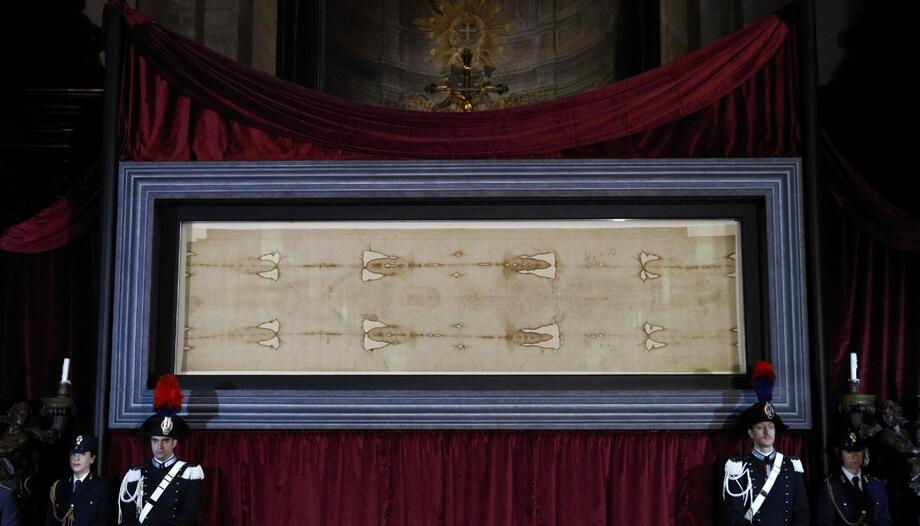
Two thousand years later, many Christians believe there is an object that truly appears to be a sign: the Shroud of Turin. For millions of believers, it constitutes a sort of «fifth Gospel,» as St. John Paul II once said. Regardless of the debates over its historical authenticity, the Shroud is an extraordinary phenomenon. It is a cloth bearing the front and back images of a man, with wounds consistent with the Gospel account of the Passion.
The image on the body—which has a different origin than the bloodstains—continues to baffle physicists, chemists, doctors, and historians because no one has yet been able to explain how it formed. But perhaps the most interesting question is not how that image appeared, but what it is showing.
Ever since it began to be studied using modern scientific methods, each discipline has contributed a piece of the puzzle. Doctors have analyzed the blood, the signs of the wounds, and the facial features; physicists, the origin of the image formation; chemists, the fibers of the linen; historians have examined its documented history; and a photographer, in the late 19th century, discovered that the photographic negative revealed a surprisingly well-defined body—which was later found to be three-dimensional, meaning that the negative was, in fact, a true photographic positive.
However, after decades of research, the Shroud continues to defy a definitive explanation. There are controversial issues, such as the 1988 radiocarbon dating, which was later questioned by various researchers due to contamination of the linen with cotton found in an area that had been repaired following a fire in the 16th century—the cotton that served as the sample for the C14 analysis.
Other questions remain unanswered, such as the precise mechanism by which the body image was formed. An interesting finding is that blood clots (pre- and postmortem) were present before the body image was formed (A. Adler and J. Heller, 1981); based on its facial features and other signs, this image indicates that it depicts a living body in an upright position (B. Hontanilla, 2020, 2022; G. Lavoie, 2023).
The Shroud of Turin is a silent testimony that allows us to contemplate suffering, death, and resurrection at a single glance, although it remains to be determined whether the image was formed naturally (it actually covered Jesus’s body) or artificially (someone else intended to depict him).
In any case, it can be understood as a visible representation of the sign of Jonah foretold by Christ. It does not seek to replace faith or to mathematically prove the resurrection; rather, it invites us to ask a question that remains as relevant today as it was twenty centuries ago: What if the tomb really was empty?
The important thing is to distinguish between verified data and interpretations: science describes the phenomenon; faith proposes a meaning. That is precisely what makes the painting so interesting. It does not force us to believe, but neither can it be easily reduced to a simple explanation.
The first thing that strikes one when looking at the image is that it does not convey suffering alone. If that had been its sole content, it would suffice to view it as the portrait of a man executed by the Roman Empire, and it would not constitute the complete testimony of any Gospel. But there is more to it. The depiction of the body seems to freeze time in a harrowing event. It does not represent the moment of death, but rather a moment immediately afterward, when the body is no longer present. It is as if the canvas had preserved the memory of an unrepeatable event, leaving an image of a living person in an upright position: the facial features are visible, the hair falls over the shoulders rather than onto the slab, and there is a gap between the back and buttocks and the shroud.
From a Christian perspective, this takes on profound symbolism. The Passion, the death, and the Resurrection are not three isolated events, but a single mystery present in a single object.
The question is whether it is a forgery (created by an artist) or authentic (whether it actually covered Christ’s body). Once again, there are no other options. In reality, an affirmative answer changes nothing. The Christian faith has never depended on a relic. For centuries, millions of people believed in the risen Christ without ever having heard of it. But it would also be hasty to claim that the Shroud is of no interest precisely because it raises questions that remain unanswered. Its power lies in the fact that it invites us to investigate and, at the same time, to contemplate.
The garden where it all began again
The Gospels place the first encounter between Mary Magdalene and the risen Jesus in a garden. This detail might seem minor, but it is not. Saint John tends to imbue every setting in his account with symbolism. In fact, the history of humanity began in a garden: Eden. There, sin severed the communion between God and humankind.
The story of the Resurrection also begins in a garden, where that communion begins to be restored. Mary Magdalene arrives before dawn, while it was still dark. She carries with her the weight of grief, disappointment, and the silence of the Sabbath. When she discovers the empty tomb, her first reaction is not faith, but bewilderment: “They have taken the Lord away, and we don’t know where they have put him.” It is a deeply human reaction. When suffering strikes us, we tend to look for natural explanations first, rather than accepting that God might be acting in an unexpected way.
After Peter and John returned home, Mary remained there, weeping. This detail is also important. John leaves with the privilege of believing out of conviction, while Mary is granted the privilege of believing because of evidence. And it is precisely then that the encounter takes place. Jesus is standing right in front of her, but Mary does not recognize him. She mistakes him for the gardener. It is significant that the Risen One appears precisely as a gardener.
In Genesis, God places humankind in the Garden of Eden to cultivate and care for it. After the Fall, that garden is lost. Now, the new Adam appears once again in a garden, ushering in a new creation. The Resurrection is not merely about one man coming back to life; it is the beginning of a new humanity.
The Canvas as a Silent Witness
While Mary runs to tell others that she has seen the Lord, the linens remain in the tomb. They do not speak. They do not preach. They do not perform miracles. They simply remain there. Later, they will be passed from hand to hand. This discretion is deeply consistent with God’s way of acting. He does not usually impose Himself through irresistible spectacles; He prefers to leave signs that can be freely accepted. The Shroud of Turin is a silent sign that constantly points to the Paschal event. It does not replace the Gospel, but it invites us to return to it. It does not create faith, but it can awaken or strengthen it.
If it had truly been in contact with the body of Christ, it would have been present at the most decisive moment in human history. And even if someone does not share this conviction, it remains an object that invites us to ask the great question of Easter: What really happened in that tomb? And perhaps that is precisely where the enduring power of the sign of Jonah lies.
Why is it so hard to believe?
If the Resurrection is the central event of Christianity, one might wonder why it remains so difficult to accept. This difficulty is not due solely to a lack of information. Human beings interpret reality through their prior beliefs, experiences, and expectations.
When an event profoundly challenges our understanding of the world, our spontaneous reaction is often to seek an explanation that is consistent with what we already believe. The human brain is evolutionarily programmed to prioritize negative stimuli. Fear and pain are warning signals that ensure survival; happiness and victory, on the other hand, are typically processed as states of rest that do not require the same biological attention.
For this reason, it is easier for the viewer to focus on the tragedy of the torture depicted on the canvas than to see what the image of the body implies: that death has been conquered. Human beings have an innate capacity for grief, but they are terrified by the possibility of the supernatural because it takes them out of their zone of control.
Modern science is based on the principle that the dead do not rise again. This is a fundamental premise for the stability of rational thought. Accepting that the Shroud could be the result of a resurrection would mean bringing down the entire materialist belief system.
For many, it is preferable to regard the canvas as a medieval hoax—even though the technique used to create it did not exist at the time and cannot be replicated today—than to accept a reality that defies the laws of thermodynamics and biology. The Resurrection is not merely an extraordinary phenomenon, but an event that transcends the usual boundaries of human experience. We are all familiar with death; no one can witness for themselves the definitive victory over it. That is why the Resurrection demands a shift in perspective rather than a mere accumulation of evidence.
Furthermore, this negative way of thinking creeps into the believer’s mind. It is the risk of reducing Christianity to Good Friday—what we might call the essentially “Lenten” Christian. Christians often focus primarily on Christ’s suffering. Images of the Passion occupy a central place in art, liturgy, and popular devotion. This is understandable. The Cross reveals the extent of God’s love.
However, Christianity does not end at Calvary. St. Paul expressed it with great clarity: «If Christ has not been raised, our faith is in vain» (1 Corinthians 15:14). The Resurrection is not a happy epilogue added at the end of the Gospel. It is the event that gives meaning to everything that came before. Without it, the Cross would be simply an unjust Roman execution of a good man. With it, the Cross becomes the sacramental act capable of definitively overcoming sin and death. However, our brains are not wired to see positive aspects in situations where negative and plausible elements are also present.
But perhaps the greatest obstacle to belief is not intellectual in nature or related to our ability to see. Whatever the era, human beings tend to resist anything that might transform their lives. The Resurrection is not meant to satisfy our curiosity; it is meant to transform our very existence.
There are people who decide simply not to believe, even in the face of evidence. That closed-mindedness—which is difficult to explain even from a scientific perspective—is a conscious decision to prevent anything related to God from affecting their lifestyle at all costs.
Learning to See and to Look
The Gospels insist time and again that seeing does not always mean understanding. Many witnessed Jesus’ miracles and remained indifferent. Others recognized the Messiah in seemingly insignificant gestures. The problem was not sight, but how one looked. This idea runs throughout the entire biblical text. The prophets denounced a people who had eyes but did not see, ears but did not hear. Jesus took up that same teaching when he explained the parables. It was not enough to hear the words; it was necessary to open one’s heart.
Something similar happens with the Shroud of Turin. Some people see it merely as an archaeological artifact that depicts only the Passion and death of Jesus. They are unable to discern the anatomical features of a living person; they are hindered by the scientific prejudice that the dead do not rise again. Without that ability to see, it is difficult to view it with fresh eyes, although the decisive factor remains the inner disposition of the observer.
In this regard, a reflection attributed to Pope Francis is particularly thought-provoking: “Only certain realities of life can be seen with eyes filled with tears.” The phrase is not intended to pit science against emotion, but rather to remind us that there are dimensions of existence that are only fully revealed when human beings accept their own vulnerability.
Jonah's Message for Our Time
Every era seeks its own signs. The contemporary world has technologies that would have seemed miraculous just a century ago. We can observe galaxies billions of light-years away, sequence the human genome, or communicate instantly with any place on the planet. And yet, the big questions remain unchanged. Perhaps that is why the figure of Christ continues to challenge even those who do not consider themselves believers. His Resurrection does not simply offer hope for the afterlife; it offers a new way of understanding life in the present.
If death has been conquered, then evil does not have the final say. If love has triumphed over hate, then forgiveness ceases to be naivety and becomes a transformative force. If Jesus lives, human history does not move toward absurdity, but toward fulfillment. The sign of Jonah remains relevant today because it continues to pose the same choice it did two thousand years ago: to view the empty tomb as an unsolvable enigma or as the beginning of a new creation.
The first disciples did not change the world because they found an empty tomb, but because they became convinced that Christ was alive. The canvas, if it is indeed authentic, would simply be a silent witness to that reality. However, it is not enough to know that certain events have occurred. Knowing them is very important, but that alone does not save us. Moreover, that knowledge could fill us with pride—sometimes with a great deal of pride.
We are living in a time when it is not enough simply to know—there are those who are mere consumers of religion—or to be content with merely refraining from doing evil. We are at a point where we are no longer asked to learn to do good (Isaiah 1:17), but to actually do it. And this call is so radical that James dares to say: “Whoever knows how to do good and does not do it is in sin” (James 4:17).
Five of the seven churches mentioned in Revelation are told to repent, and two others are told to remain faithful. We must turn our hearts to God. The Shroud of Turin is truly a sign that becomes a gift of understanding, and it can make us like Moses, who beheld God face to face. Not every generation has had that privilege. It may also leave us completely indifferent, but “unless we all repent, we will all perish as well” (Luke 13:3).
In a culture accustomed to demanding immediate answers, the Shroud of Turin invites us to take a different path: to observe, to ask questions, to investigate, and, finally, to decide. Just as it was with Peter and John on that Easter morning, each generation must enter the tomb anew and confront the same question: What does it mean that in a place where there should have been a corpse, there are only some pieces of linen? The answer cannot be imposed from the outside. Each person must find it through a dialogue between reason, history, faith, and humility.
For the believer, these canvases speak of an absence that is, paradoxically, the greatest of all presences, and perhaps that remains, even today, the most eloquent sign: a hope that, for twenty centuries, has continued to transform history. The “sign of Jonah” was not a miracle witnessed by a crowd, but an event that transformed history from the silence of a tomb. Viewed from this perspective, the Shroud can be understood as an echo of that dawn, a mirror in which the believer can contemplate, in a unique way, the drama of the Passion, the death, and the radiance of the Resurrection.
Full member of the Royal National Academy of Medicine of Spain.






 Español
  English
  Italiano